Why in News?
In April 2026, the Supreme Court of India delivered its first substantive interpretation of Section 294 of the Bharatiya Nyaya Sanhita, 2023 (BNS), the provision that punishes obscene acts, songs and utterances in public places. A two-judge bench quashed an FIR registered against the appellant for using allegedly vulgar words at a public gathering, holding that coarse, crude or distasteful language does not automatically amount to obscenity within the meaning of the statute.
The Court reaffirmed the “contemporary community standards” test laid down in Aveek Sarkar v State of West Bengal (2014) and categorically distanced itself from the Victorian-era Hicklin test borrowed in Ranjit D. Udeshi v State of Maharashtra (1965). The ruling is the first major appellate pronouncement on obscenity after the BNS, Bharatiya Nagarik Suraksha Sanhita (BNSS) and Bharatiya Sakshya Adhiniyam (BSA) came into force on 1 July 2024, replacing the IPC, CrPC and Evidence Act respectively.
Beyond the immediate facts, the judgment sets the interpretive tone for how police, magistrates and lower courts should read the BNS speech offences. With political speech, stand-up comedy, rap music, web series and influencer content routinely attracting §294 complaints, the decision carries implications for Article 19(1)(a) jurisprudence, platform regulation and the quality of the criminal process in India.
UPSC Relevance at a Glance
| Dimension | Detail |
|---|---|
| GS Paper | GS2 (Polity, Laws, Fundamental Rights) |
| Prelims | BNS 2023, IPC repeal, Article 19(1)(a) and 19(2), Aveek Sarkar case, Hicklin test, IT Rules 2021 |
| Mains | Free speech vs reasonable restrictions; criminal law reform; judicial tests for obscenity; platform regulation |
| Syllabus Tags | Fundamental Rights; Structure and functioning of the judiciary; Government policies; Criminal law reform |
Background and Context
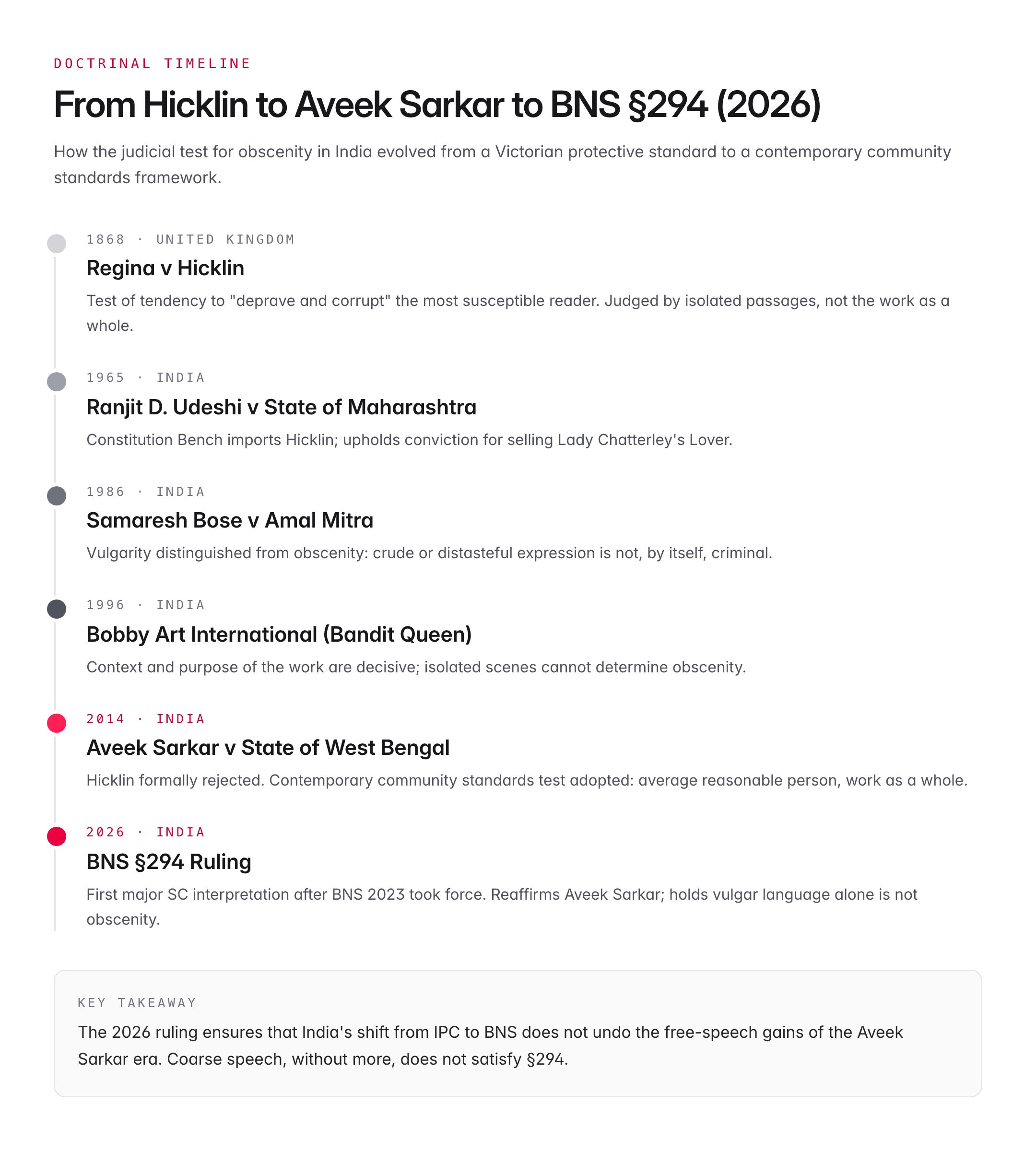
Obscenity law in India began as a colonial import. The IPC of 1860 criminalised obscene acts under Section 294 and sale of obscene material under Section 292. In Ranjit D. Udeshi v State of Maharashtra (1965), a five-judge Constitution Bench upheld the conviction of a bookseller for selling Lady Chatterley’s Lover and adopted the English Hicklin test from Regina v Hicklin (1868). The Hicklin standard asked whether matter was liable to “deprave and corrupt those whose minds are open to such immoral influences” — a deliberately protective and paternalistic yardstick anchored in Victorian morality.
The test sat uneasily with Article 19(1)(a). Over the following decades, the Court narrowed its reach. In Samaresh Bose v Amal Mitra (1986), the Bench distinguished between vulgarity and obscenity, observing that a vulgar passage may cause disgust but does not necessarily arouse sexual thoughts. In Bobby Art International v Om Pal Singh Hoon (1996), the Court cleared the film Bandit Queen, holding that the scenes had to be judged in the context of the message.
The decisive shift came in Aveek Sarkar v State of West Bengal (2014), where the Court expressly rejected Hicklin and endorsed the contemporary community standards test. The obscenity of a work, it held, must be assessed from the perspective of an average person applying contemporary community standards, with reference to the theme, context and purpose of the material as a whole, not isolated passages.
Parallel developments added layers. Section 67 and 67A of the Information Technology Act, 2000 criminalise publication of obscene and sexually explicit material in electronic form. The Cinematograph Act, 1952 governs film certification through the CBFC. The IT (Intermediary Guidelines and Digital Media Ethics Code) Rules, 2021 created a three-tier grievance framework for OTT platforms and a Code of Ethics for online curated content. The BNS 2023 retains §294 with minor modifications, preserving the pre-existing jurisprudence.
Key Features of the Judgment
Factual Matrix
The appellant, a public speaker, was booked under §294 BNS after using words some audience members found coarse. The High Court declined to quash the FIR. The Supreme Court, exercising Article 136 jurisdiction, heard the appeal and set aside the prosecution.
Statutory Text Interpreted
BNS §294 retains the substance of IPC §294, punishing any person who, to the annoyance of others, does any obscene act in a public place or sings, recites or utters any obscene song, ballad or words in or near a public place. The offence carries imprisonment up to three months, a fine up to one thousand rupees, or both, and is cognizable, bailable and non-compoundable. The essential ingredients the Court emphasised:
- The act or utterance must be obscene, not merely vulgar
- It must occur in or near a public place
- It must cause annoyance to others — a factual determination, not a presumption
The Court’s Reasoning
- Vulgarity is not obscenity. The Bench held that the threshold for §294 is higher than crude or distasteful expression. Relying on Samaresh Bose, it observed that disgust is not the same as depravity.
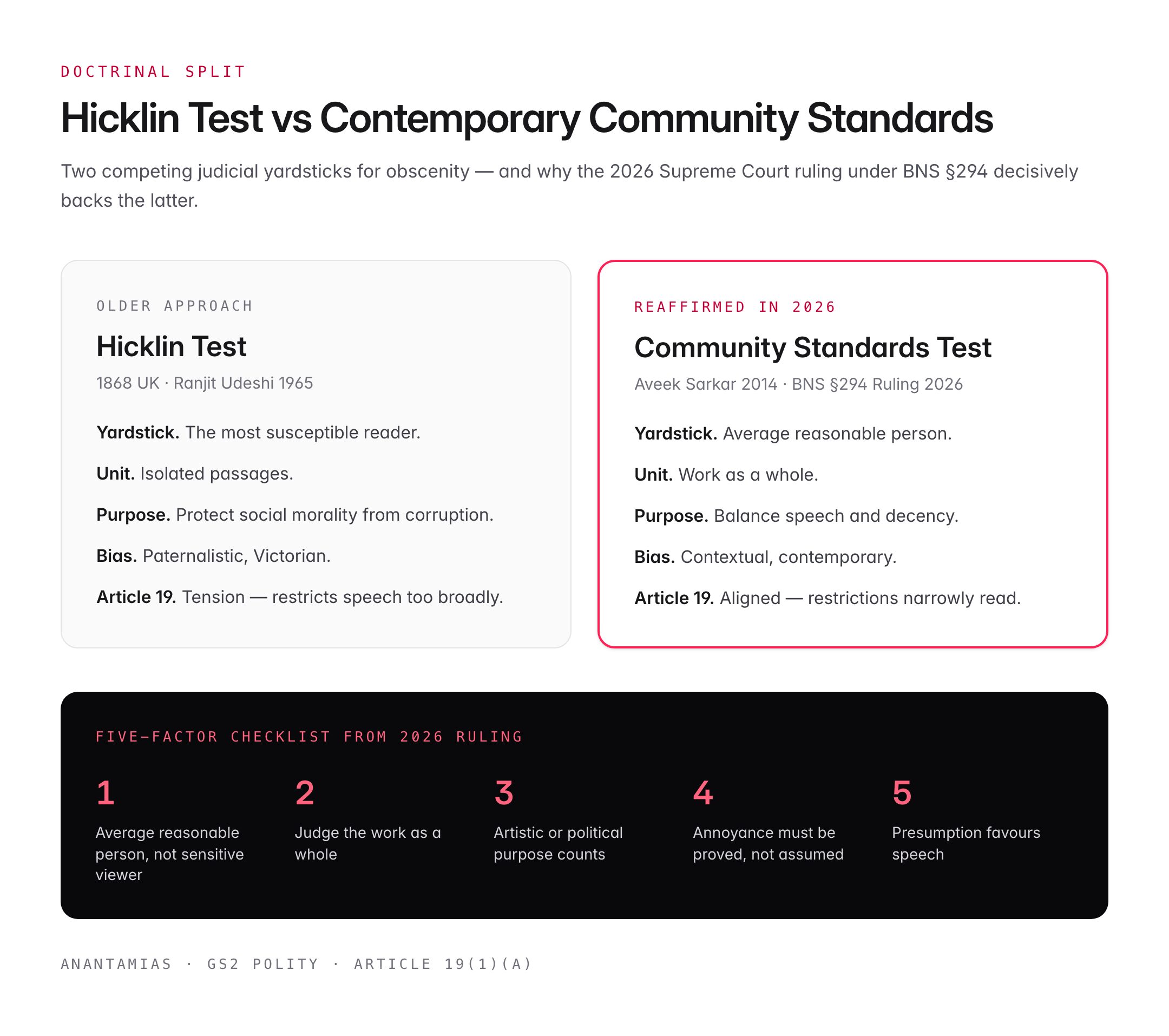
- Community standards, not Hicklin. The Court reaffirmed Aveek Sarkar and expressly stated that the Hicklin test, by isolating passages and measuring them against the most susceptible reader, is inconsistent with Article 19(1)(a).
- Context and audience matter. The utterance must be assessed in context — the nature of the gathering, the theme of the speech, the reasonable expectations of the audience and the purpose of the communication.
- Chilling effect. Registering FIRs for coarse speech, the Bench warned, risks a disproportionate chilling effect on political discourse, satire and artistic expression.
- Magistrate’s gatekeeping duty. Courts taking cognizance under §223 BNSS must apply mind to whether the allegation, taken at face value, discloses obscenity and annoyance, not merely offence to taste.
Guiding Principles Distilled
- The average reasonable person is the yardstick, not the most sensitive member of the audience
- The material must be judged as a whole, not by isolated phrases
- Artistic, political or educational purpose is a relevant mitigating context
- Annoyance must be established as a fact, not assumed from the language used
- The constitutional presumption favours speech; restrictions under Article 19(2) must be narrowly construed
Significance
- Clarifies post-BNS jurisprudence. The judgment is the first authoritative reading of §294 BNS and signals that the pre-existing obscenity doctrine carries over with its free-speech protections intact.
- Narrows police discretion. By requiring real annoyance and genuine obscenity, the Court raises the bar for registration of FIRs and restrains the frequent misuse of §294 against comedians, rappers, politicians and social media users.
- Aligns with Article 19(1)(a). The ruling embeds the Aveek Sarkar test more firmly in constitutional practice, treating freedom of expression as the default and restrictions as the exception.
- Protects creative expression. Stand-up comedy, satire, protest poetry and political rhetoric — forms that often push against the boundaries of taste — gain a stronger shield against criminalisation.
- Guides lower courts and magistrates. The insistence on application of judicial mind at the cognizance stage should reduce the “process as punishment” phenomenon where defendants suffer years of trial before acquittal.
- Signals continuity with comparative jurisprudence. The reasoning echoes the US Miller v California (1973) three-prong test and the European Court of Human Rights’ contextual approach to Article 10 ECHR restrictions.
Concerns and Challenges
The ruling resolves doctrine but not practice. Several frictions remain.
Enforcement culture has not caught up with Aveek Sarkar. Police stations routinely register §294 FIRs on bare allegations, and the bailable nature of the offence does not prevent harassment through investigation, travel, legal costs and reputational damage. The Supreme Court’s guidance has limited purchase unless internalised in police manuals, prosecutor training and magistrate sensitisation.
The “community standards” test is itself contested. Community standards in a plural society are not uniform. What passes as acceptable at a late-night comedy club may scandalise a neighbourhood audience. Courts will continue to face the challenge of defining the reference community — geographic, demographic, or notional.
Digital speech raises fresh questions. §294 applies to public places and physical utterance, but parallel prosecutions under §67 and §67A of the IT Act cover the same conduct online with far harsher penalties — up to five and seven years respectively for first and repeat offences. The contemporary community standards test has not been uniformly applied in the digital sphere, and platforms often over-remove content to avoid safe harbour disputes.
Women’s rights groups raise a distinct concern. Lewd public catcalling and sexualised harassment are often charged under §294 alongside §354 (now §74–75 BNS). A high threshold for obscenity may, in practice, weaken prosecutions against street harassment unless pleadings specifically invoke the annoyance-plus-targeting element.
Finally, political pressures can distort enforcement. In politically charged cases, §294 is used as a speech-suppression tool. The Court’s chilling-effect warning is welcome but will be tested only case by case.
Comparative and Historical Perspective
India’s obscenity doctrine has tracked global shifts away from Victorian standards toward contextual, purpose-aware tests. The journey from Hicklin (1868) to Miller (1973) to Aveek Sarkar (2014) marks a common-law convergence on free-speech-protective frameworks.
| Jurisdiction / Case | Test | Core Standard |
|---|---|---|
| UK — Regina v Hicklin (1868) | Hicklin test | Tendency to deprave and corrupt susceptible readers |
| India — Ranjit Udeshi (1965) | Hicklin adopted | Isolated passages, vulnerable reader |
| US — Miller v California (1973) | Miller three-prong | Prurient interest + patent offensiveness + lack of serious value, judged by community standards |
| India — Aveek Sarkar (2014) | Contemporary community standards | Average person, work as a whole, contemporary standards |
| India — §294 BNS Ruling (2026) | Aveek Sarkar reaffirmed | Vulgarity not obscenity; context, purpose, audience determinative |
Historically, the Perumal Murugan episode (Madras High Court, 2016) and the sustained harassment of writers such as Taslima Nasreen illustrate how even the broader Aveek Sarkar framework can be circumvented by private pressure and administrative silence. The 2026 judgment is a doctrinal reinforcement but the battleground has moved to police practice, platform moderation and state capacity.
Way Forward
- Ministry of Home Affairs should circulate an advisory to all state police headquarters translating the judgment into registration-of-FIR protocols for §294 BNS, with an obligation to record why the threshold is met.
- Bureau of Police Research and Development (BPR&D) should revise police training modules to embed the Aveek Sarkar–2026 ruling framework, with case studies on political speech, comedy and protest.
- National Judicial Academy and State Judicial Academies should design magistrate refresher courses on cognizance under §223 BNSS for speech offences, emphasising the gatekeeping duty.
- Parliament should consider a statutory amendment clarifying that “annoyance” in §294 requires a complaint by a directly affected person, not a third-party offence at hearsay.
- Law Commission of India should examine harmonising §294 BNS, §67/§67A IT Act and the IT Rules 2021 Code of Ethics, recommending graded penalties and clearer definitions for digital obscenity.
- Ministry of Information and Broadcasting should align the OTT grievance framework with the community standards test, avoiding prior restraint on creative content.
- Civil society and bar associations should invest in legal aid clinics for defendants facing §294 prosecutions, and build a public repository of §294 FIRs to surface patterns of misuse.
Conclusion
The 2026 ruling is a small judgment with a long shadow. By reaffirming Aveek Sarkar under the new BNS, the Supreme Court has ensured that the shift from IPC to BNS is not a silent doctrinal rollback on free speech. The ruling keeps India’s obscenity law tethered to contemporary community standards, contextual reading and constitutional values rather than to the sensibilities of a nineteenth-century English judge.
For UPSC aspirants, the decision is a clean case study in how Article 19(1)(a) is operationalised through ordinary criminal statutes, how judicial tests evolve across common-law jurisdictions, and how criminal law reform is as much about enforcement culture as about the statute book. The true measure of the ruling will be whether a police officer in a district headquarters thinks twice before registering an FIR the next time someone gives a fiery public speech.
Prelims Pointers
- BNS, BNSS and BSA came into force on 1 July 2024, replacing IPC 1860, CrPC 1973 and Indian Evidence Act 1872.
- BNS §294 punishes obscene acts, songs, ballads and words in or near a public place with up to three months imprisonment, fine up to ₹1000, or both.
- Ranjit D. Udeshi v State of Maharashtra (1965) adopted the Hicklin test from Regina v Hicklin (1868).
- Aveek Sarkar v State of West Bengal (2014) replaced Hicklin with the contemporary community standards test.
- Miller v California (1973) is the leading US obscenity test, applying a three-prong standard.
- Article 19(1)(a) guarantees freedom of speech and expression; Article 19(2) permits reasonable restrictions including on grounds of public order, decency and morality.
- §67 and §67A of the IT Act 2000 criminalise obscene and sexually explicit material in electronic form, with penalties up to five and seven years respectively.
- Cinematograph Act 1952 establishes the Central Board of Film Certification (CBFC).
- IT Rules 2021, Part III, lay down a Code of Ethics for OTT platforms and a three-tier grievance redressal mechanism.
- Samaresh Bose v Amal Mitra (1986) distinguished vulgarity from obscenity.
- Bobby Art International (1996) upheld certification of Bandit Queen, emphasising context and purpose.
- §223 BNSS corresponds to the cognizance-taking provision of the former CrPC §190.
Mains Practice Question
Q. “Vulgarity is not obscenity.” In light of the Supreme Court’s recent ruling on Section 294 of the Bharatiya Nyaya Sanhita, 2023, critically examine the evolution of the judicial test for obscenity in India and its implications for freedom of expression under Article 19(1)(a). (15 marks, 250 words)
Answer skeleton:
- Trace the doctrinal arc from Hicklin (1868) through Ranjit Udeshi (1965), Samaresh Bose (1986), Bobby Art (1996) to Aveek Sarkar (2014) and the 2026 BNS §294 ruling; highlight the shift from susceptible-reader to average-person and from isolated-passages to work-as-a-whole.
- Analyse the constitutional significance: alignment with Article 19(1)(a), narrow construction of Article 19(2) grounds (decency and morality), chilling-effect doctrine, and the gatekeeping role of magistrates under §223 BNSS.
- Flag the enforcement gap, digital spillover under §67/§67A IT Act, tension with women’s rights dimensions, and the way forward through police training, statutory clarification and harmonisation of obscenity provisions across BNS, IT Act and IT Rules 2021.
—
Related reading on anantamias.com:
- Right to Information to Right to Deny Information
- A Social Media Ban Will Not Save Our Children
- Pratap Bhanu Mehta on Constitutional Morality
- Secularism
- HC Justice Verma Resigns: Judicial Accountability Gap
- Will Purging Judicial Corruption from NCERT Solve the Real Problem?
Frequently Asked Questions
What is Section 294 of the Bharatiya Nyaya Sanhita, 2023?
BNS §294 punishes any person who performs an obscene act in a public place or sings, recites or utters any obscene song, ballad or words in or near a public place to the annoyance of others. The offence is cognizable, bailable, and non-compoundable, with punishment up to three months imprisonment, a fine up to one thousand rupees, or both. It replaces the identical IPC §294.
Why is the 2026 Supreme Court ruling on BNS §294 in the news?
In April 2026 the Supreme Court delivered its first major interpretation of §294 under the new BNS regime. The Court quashed an FIR and held that vulgar language alone does not amount to obscenity. It reaffirmed the contemporary community standards test from Aveek Sarkar (2014) and distanced itself from the Victorian-era Hicklin test adopted in Ranjit Udeshi (1965).
What is the difference between the Hicklin test and the contemporary community standards test?
The Hicklin test, from Regina v Hicklin (1868), judged obscenity by whether isolated passages could deprave the most susceptible reader. The contemporary community standards test, endorsed in Aveek Sarkar (2014), evaluates the work as a whole from the perspective of an average reasonable person applying current social standards, considering theme, context and purpose.
How does the judgment affect freedom of expression under Article 19(1)(a)?
The ruling narrows the scope of §294 prosecutions and raises the threshold for FIRs based on coarse speech. By warning against the chilling effect on political, satirical and artistic expression, it strengthens Article 19(1)(a) and ensures that Article 19(2) restrictions on decency and morality are read narrowly, preserving space for uncomfortable but constitutionally protected speech.
Does the ruling cover online or digital obscenity?
Directly, no. §294 BNS applies to obscene acts and utterances in or near public places. Digital obscenity is governed primarily by Sections 67 and 67A of the IT Act 2000 and the IT Rules 2021 Code of Ethics for OTT platforms. However, the community standards reasoning influences how courts interpret those provisions too.
What is the Miller test and how does it compare with India’s approach?
The Miller test, from Miller v California (1973), is the US standard for obscenity. It asks whether the work appeals to prurient interest by contemporary community standards, depicts sexual conduct in a patently offensive way, and lacks serious literary, artistic, political or scientific value. India’s Aveek Sarkar test is conceptually similar but places greater weight on context and purpose.
Why is the BNS 2023 significant in this context?
The BNS came into force on 1 July 2024 replacing the IPC of 1860 along with the BNSS and BSA replacing the CrPC and Evidence Act. Although §294 is retained with minor modifications, this judgment is the first authoritative Supreme Court reading under the new code, setting the interpretive baseline for lower courts, police and prosecutors.
How does this topic help UPSC aspirants?
The case links Fundamental Rights (Article 19), criminal law reform (BNS), judicial review, and comparative jurisprudence (Miller test) — a GS2 staple. It offers examples for Mains essays on free speech, ethics of public discourse, and law-enforcement reform, plus Prelims facts on BNS dates, landmark cases and constitutional provisions.
Tell Google you want more of this.
Add Anantam IAS as a preferred sourceOne tap, and this site shows up more often in your own Top Stories, AI Overviews and AI Mode. Remove it any time.