Supreme Court Judge Strength Bill Raises Sanctioned Capacity to 38
Why in News?
On 3 August 2026 , the Lok Sabha passed the Supreme Court (Number of Judges) Amendment Bill, 2026, which amends the 1956 Act and retains a ceiling of 37 judges other than the Chief Justice of India .
- The Bill was introduced in the Lok Sabha on 20 July 2026 and passed by that House on 3 August 2026.
- Clause 2 substitutes “thirty-seven” for “thirty-three” in Section 2 of the Supreme Court (Number of Judges) Act, 1956. Both figures exclude the Chief Justice of India.
- The change raises the statutory ceiling from 34 to 38 in total, an addition of four possible judgeships.
- The Bill is deemed to have come into force on 16 May 2026, the date on which the President promulgated the corresponding Ordinance under Article 123.
- Its repeal-and-savings clause repeals the 2026 Ordinance but preserves actions already taken under the Act as amended by that Ordinance.
- The Bill’s Statement of Objects and Reasons records 92,101 pending cases in the Supreme Court on 1 January 2026.
- In 2025, the Court received 75,410 fresh matters and disposed of 65,615, leaving a gap of 9,795 matters for that year despite operating near its then-sanctioned capacity.
- A larger bench can improve listing capacity and allow the Chief Justice of India to constitute Constitution Benches more regularly, but sanctioned posts are not the same as filled posts.
UPSC Relevance
Prelims Relevance
- Article 124(1) establishes the Supreme Court and allows Parliament by law to prescribe a larger number of judges besides the Chief Justice of India.
- The Supreme Court (Number of Judges) Act, 1956 fixes the maximum number of judges other than the Chief Justice of India.
- The 2026 Bill changes the statutory figure from 33 to 37 excluding the CJI; the corresponding total is 38 including the CJI.
- Article 123 empowers the President to promulgate an Ordinance except when both Houses of Parliament are in session, if immediate action is considered necessary.
- An Ordinance must be laid before both Houses and, unless replaced or otherwise ended, ceases after the constitutionally prescribed period following Parliament’s reassembly.
- The Bill’s commencement clause is retrospective to 16 May 2026, while its savings clause validates continuity of action under the Ordinance.
Mains Relevance
GS Paper 2
- Structure, organisation and functioning of the judiciary, especially Parliament’s role in fixing Supreme Court strength under Article 124(1).
- Separation of powers: the legislature authorises capacity, the executive participates in appointment and infrastructure, and the judiciary controls roster and adjudication.
GS Paper 2 Governance
- Institutional capacity should combine filled vacancies, registry reform, case-flow management, digital systems, government litigation reform and transparent performance data.
- Use the 2025 institution-disposal gap to show why increasing inputs must be paired with procedural reform and measurable outcomes.
Essay
- Justice delayed is justice denied: institutional capacity is a constitutional governance issue, not merely an administrative statistic.
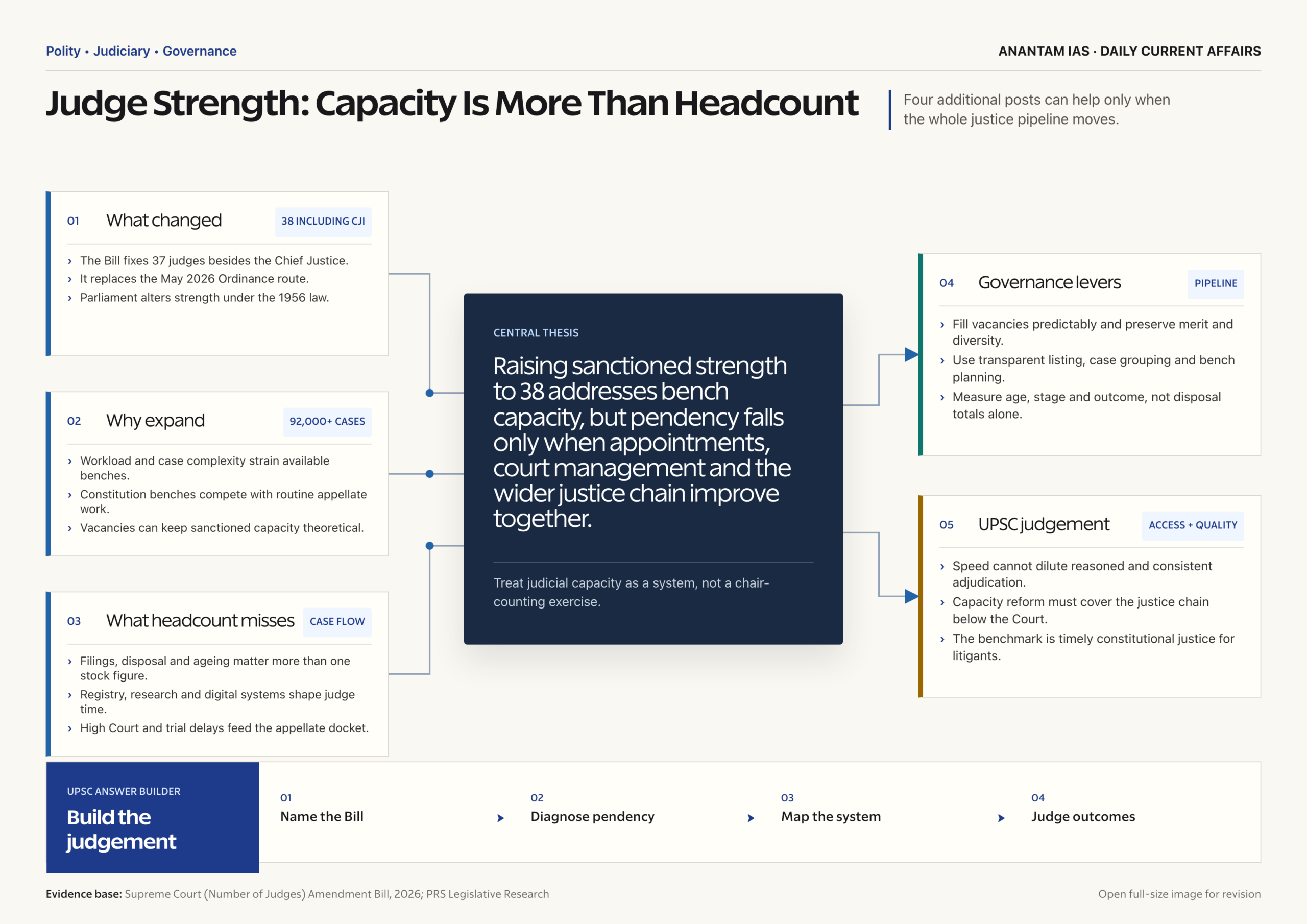
Background and Context
What the Bill changes and what it does not
The amendment is short in text but its arithmetic is often reported in two different ways.
- Section 2 of the 1956 Act counts only judges other than the Chief Justice of India. Replacing 33 with 37 raises the total authorised bench from 34 to 38 when the CJI is included.
- The Bill creates four additional posts, not five. A report saying “37 judges” may be referring to puisne judges only, while a report saying “38 judges” is counting the entire Court.
- The May 2026 Ordinance had already made the same substitution. The May Ordinance background note explains the immediate executive measure; the present Bill supplies the parliamentary replacement route.
- The Bill does not change judicial qualifications, tenure, retirement age, removal procedure or the appointments mechanism. It changes only the maximum statutory number under the 1956 Act.
- It also does not guarantee that all 38 positions will remain occupied. Each vacancy still requires a separate appointment, and retirements can reduce working strength even when the sanctioned ceiling stays unchanged.
Constitutional route: Parliament, Ordinance and appointment
Three distinct constitutional acts must not be collapsed into one: fixing capacity, temporarily legislating through an Ordinance and appointing individual judges.
- Article 124(1) permits Parliament to prescribe by law the number of Supreme Court judges in addition to the CJI. An ordinary amendment to the 1956 Act is sufficient; a constitutional amendment is not required merely.
- The President promulgated the Ordinance on 16 May 2026 under Article 123 because Parliament was not in session. The Gazette text substituted 37 for 33 and brought the change into force at once.
- The Bill is deemed effective from that same date, repeals the Ordinance and saves actions taken under it. This design prevents a legal break between the temporary ordinance regime and the eventual Act.
- Passing the Bill in the Lok Sabha is one stage, not final enactment. It must pass the Rajya Sabha and receive presidential assent before it becomes law in the ordinary legislative process.
- Article 124(2) concerns appointment to an authorised post. The judicial appointments explainer covers the collegium, executive processing and the distinction between institutional independence and administrative delay.
Why the government sought four more posts
The Bill’s own statement presents a capacity problem measured through pendency, filings, disposal and larger-bench requirements.
- The official baseline is 92,101 pending cases on 1 January 2026. This dated figure is preferable in an exam answer to an undated live-dashboard number, because NJDG totals change continuously.
- During 2025, 75,410 fresh matters were instituted and 65,615 were disposed of. The resulting 9,795-matter gap shows that a near-full bench did not stop the docket from growing that year.
- The Statement of Objects and Reasons specifically identifies older cases and matters requiring larger Benches as pressure points.
- Article 145(3) requires a bench of at least five judges for a substantial constitutional-interpretation question or an Article 143 presidential reference. Additional capacity can make it easier to run such benches while regular division benches continue.
- The financial memorandum estimates about ₹10.57 crore in recurring annual expenditure and ₹3.47 crore in non-recurring expenditure for four judges, staff, residences, vehicles, furnishing and security, around ₹14.04 crore in the initial stated package.
Why more judges may help but cannot be the whole reform
Judge strength is a necessary capacity input; disposal also depends on how cases enter, move through and leave the Court.
- More filled posts can create additional benches, distribute workload and protect time for Constitution Benches. That is the clearest direct benefit of the amendment.
- A seat on paper produces no hearing capacity until it is filled. Appointment timelines, retirement planning and administrative support must keep working strength close to sanctioned strength.
- The institution-disposal gap also reflects case-flow design: listing practices, repeated adjournments, incomplete filings, batch management, judgment writing time and registry processes influence output.
- Government is a major litigant. Better screening of appeals, acceptance of settled legal positions and accountable litigation officers can prevent avoidable cases from reaching the apex court.
- The judicial pendency analysis places Supreme Court capacity within the much larger court system. Reform at the apex cannot substitute for filling vacancies and improving processes in High Courts and district courts.
Way Forward
Fill and support the authorised posts
- Use advance vacancy calendars and timely collegium-executive processing so retirements do not reopen a persistent gap.
- Provide the four posts with adequate judicial clerks, research support, registry staff, courtrooms, secure digital infrastructure and administrative services.
- Publish age-wise and stage-wise pendency, identify cases awaiting only a narrow procedural step and list old matters through stable cause-list plans.
- Use grouping for cases governed by the same legal issue, stricter adjournment norms and early defect curing without compromising fair hearing.
Conclusion
- The Supreme Court (Number of Judges) Amendment Bill, 2026 gives Parliament’s backing to a four-post expansion first made through the May Ordinance.
- The expansion responds to real docket pressure and can support more benches, including Constitution Benches.
UPSC Practice Questions
Prelims MCQ 1
With reference to the constitutional and statutory framework governing the strength of the Supreme Court of India, consider the following statements:
- Article 124(1) permits Parliament by law to prescribe a larger number of Supreme Court judges besides the Chief Justice of India.
- The number specified in Section 2 of the Supreme Court (Number of Judges) Act, 1956 includes the Chief Justice of India.
- An increase in sanctioned strength automatically appoints judges to every newly authorised post.
How many of the above statements are correct?
(a) Only one (b) Only two (c) All three (d) None
Answer: (a) Only one
Explanation:
Statement 1 is correct. Section 2 fixes the number of judges excluding the CJI, so Statement 2 is incorrect. The statutory ceiling only authorises posts; each judge still requires appointment under Article 124(2), making Statement 3 incorrect.
Prelims MCQ 2
What is the most accurate description of the Supreme Court (Number of Judges) Amendment Bill, 2026 as passed by the Lok Sabha?
(a) It raises the Court from 37 total judges to 38 total judges for the first time (b) It replaces the May 2026 Ordinance, retains 37 judges excluding the CJI and saves actions taken under the Ordinance (c) It amends the Constitution to create a permanent seven-judge Constitution Bench (d) It directly appoints four named judges to the Supreme Court
Answer: (b) It replaces the May 2026 Ordinance, retains 37 judges excluding the CJI and saves actions taken under the Ordinance
Explanation:
The Bill substitutes 37 for 33 in the 1956 Act, with the statutory number excluding the CJI. It is deemed effective from 16 May 2026, repeals the Ordinance and contains a savings clause. It neither amends the Constitution nor appoints individual judges.
UPSC Mains Questions
- Increasing the sanctioned strength of the Supreme Court is necessary but insufficient to resolve judicial pendency. Discuss with reference to the Supreme Court (Number of Judges) Amendment Bill, 2026.
- Explain the distinct constitutional roles of Parliament, the President and the judiciary in expanding and filling the Supreme Court’s sanctioned strength. Why does this distinction matter for separation of powers?
Sources: PRS Legislative Research and Lok Sabha Bill text and The Hindu.
Frequently Asked Questions
Does the 2026 Bill set the Supreme Court’s strength at 37 or 38?
Both numbers describe different counts. The Bill fixes a maximum of 37 judges excluding the Chief Justice of India under Section 2 of the 1956 Act. Adding the CJI produces a total sanctioned strength of 38. The amendment creates four.
Did the August Bill add another judge after the May Ordinance?
No. The May 2026 Ordinance had already substituted 37 for 33 in the Act, excluding the CJI. The Bill replaces that temporary Ordinance through Parliament and preserves actions taken under it. It maintains the same four-post increase and does not.
Which constitutional provision lets Parliament change Supreme Court strength?
Article 124(1) establishes the Court and allows Parliament by law to prescribe a larger number of judges besides the CJI. Parliament exercises that power through the Supreme Court (Number of Judges) Act, 1956 and its amendments. A constitutional amendment is.
Why was an Ordinance used before the Bill?
Article 123 permits the President to promulgate an Ordinance except when both Houses are in session, if circumstances require immediate action. The 16 May 2026 Ordinance brought the four-seat increase into force at once. The later Bill follows the parliamentary.
Will four additional posts automatically reduce Supreme Court pendency?
They can create more benches and protect time for larger constitutional benches, but only after appointments and support systems are in place. Pendency also depends on filings, adjournments, registry processes, case grouping, government appeals and disposal rates. The Bill adds.