Add four seats to the Supreme Court and recommend five judges in a single month, and it looks like the appointments machinery is finally moving. In May 2026 it did exactly that. On 16 May the President raised the Court’s sanctioned strength from 34 to 38 by ordinance, and on 27 May the collegium led by Chief Justice Surya Kant recommended five names for the bench. But none of that touches the question the country has been arguing over for forty years. Who should pick India’s judges, and how openly should they do it? That question outlived the collegium’s birth in 1993 and survived the NJAC’s death in 2015. So a busy fortnight of appointments doesn’t settle it. It just reminds us the settlement was never reached.
That tension is the whole topic. A judge insulated from the government decides cases against the government, which is why independence matters. Yet a process where judges alone pick judges, behind closed doors, with no published reasons, invites the charge that one unelected club renews itself in private. Independence and accountability are both constitutional goods, not rivals. The hard part is delivering both at once, not choosing which one to surrender.
The Issue, Framed
The argument here isn’t whether judges should be independent. Everyone agrees they should. The argument is about the method of appointment, because the method is where independence and accountability collide.
Let’s fix the vocabulary first, because most of the noise around this topic comes from people using the words loosely. The collegium is the system, built by the Supreme Court itself, under which a group of the senior-most judges selects who joins the higher judiciary. For the Supreme Court that group is the Chief Justice of India plus the four next senior-most judges. The word “collegium” appears nowhere in the Constitution. The 214th Law Commission Report (2008) made exactly that point, noting the term grew out of judicial interpretation rather than any written provision.
The collegium recommends; the government processes the paperwork and notifies the appointment. The rulebook for that back-and-forth is the Memorandum of Procedure, the MoP, an agreed document setting out who proposes a name, who consults whom, and within what timelines. And here’s the catch that drives half the friction: a decade after it was meant to be rewritten, the MoP still isn’t finalised. So the two branches run the most consequential appointments in the Republic without a settled rulebook.
Two ideas anchor the whole debate, so pin them down now. Judicial independence means judges can decide without fear of the executive that appointed them, and the Supreme Court treats it as part of the basic structure, the set of constitutional fundamentals that even a constitutional amendment can’t erase. The other idea is the NJAC, the National Judicial Appointments Commission, a body Parliament created in 2014 to replace the collegium with a mixed panel of judges, the Law Minister, and lay members. The Court struck it down in 2015. Hold those two terms together, because the clash between them is the spine of this topic.
A judge who owes their seat to the government is a problem. A selection club that answers to no one outside itself is also a problem. The search for balance is the search for a method that avoids both.
What the Data Says
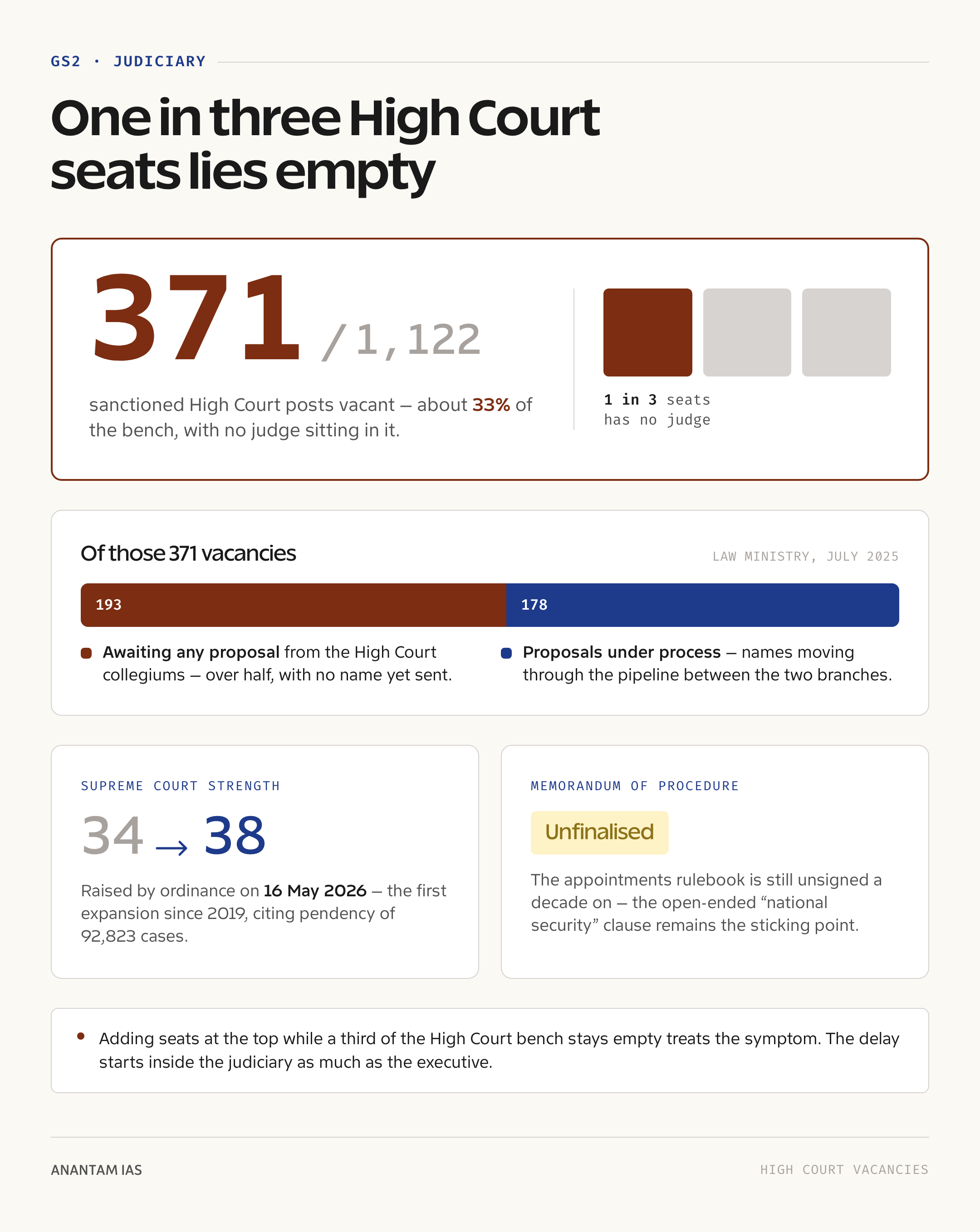
The numbers tell you the appointments system isn’t just contested in theory. It’s broken in practice, and the breakage is measurable. Start with the High Courts, where the strain is sharpest. As of the latest firm parliamentary reply in July 2025, 371 of 1,122 sanctioned High Court posts were vacant. That’s about a third of the bench, empty. Read it once and it’s a statistic. Read it twice and it’s roughly one in three seats with no judge sitting in it.
The texture under that headline is what matters. Of those 371 vacancies, the government’s own reply records 178 proposals under process and 193 still awaiting any recommendation from the High Court collegiums. So more than half the empty seats had no name even proposed. The Law Ministry added a pointed observation: High Courts “rarely observe” the rule asking them to recommend a successor six months before a vacancy opens. The delay, in other words, doesn’t sit only with the government. It starts inside the judiciary too.
This isn’t a one-year blip. A year earlier, on 1 April 2024, only 3 of 25 High Courts were functioning at full strength, with more than 60 lakh cases pending in the High Courts. So the pattern holds across years: a chronic third of the bench missing, and a backlog that grows in the gap.
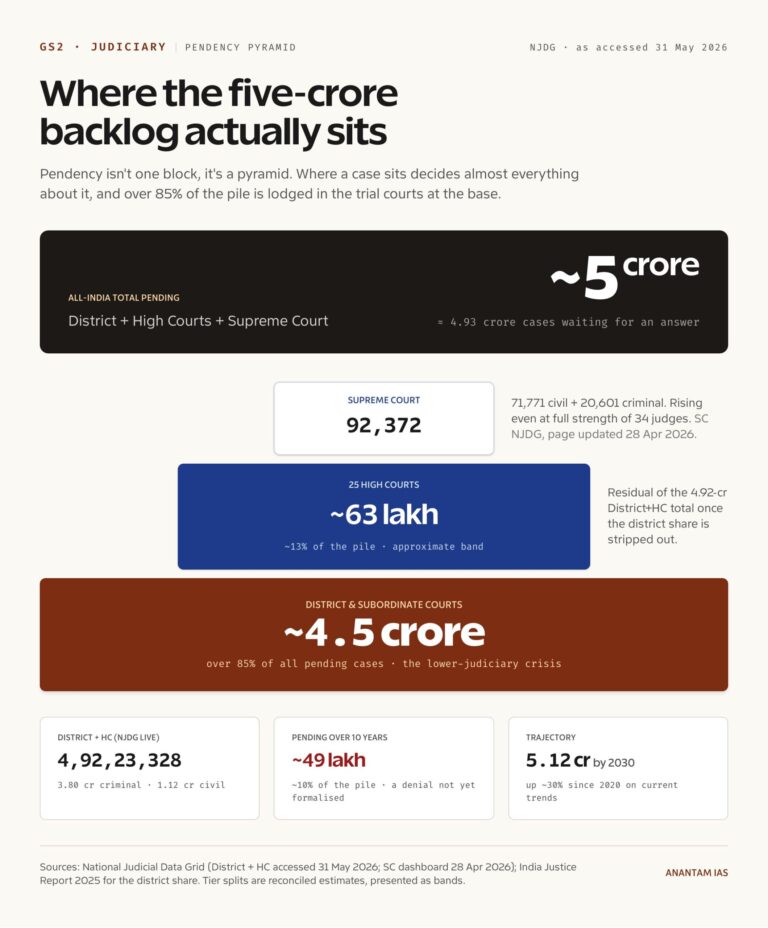
The Supreme Court’s own arithmetic is the immediate peg. Its sanctioned strength sat at 34 from 2019 until this May, when the Supreme Court (Number of Judges) Amendment Ordinance, 2026 raised it to 38 on 16 May 2026. The stated reason was pendency, 92,823 cases pending as on 30 April 2026, and the need to constitute Constitution Benches more often. Days later, on 27 May, Chief Justice Surya Kant’s collegium recommended five names: three serving High Court Chief Justices, one High Court judge, and Senior Advocate V. Mohana directly from the Bar.
So the month delivered motion. Four new seats, five new names. But notice what the data doesn’t show. It doesn’t show a finalised MoP, doesn’t show published selection criteria, and doesn’t show the 193 un-proposed High Court vacancies filling up. Adding capacity at the top while a third of the High Court bench stays empty is treating the symptom, not the disease.
The Case For
The case for the collegium is stronger than its critics admit, and an answer that skips it reads as one-sided. So let’s build it at full strength, starting with the history that produced it.
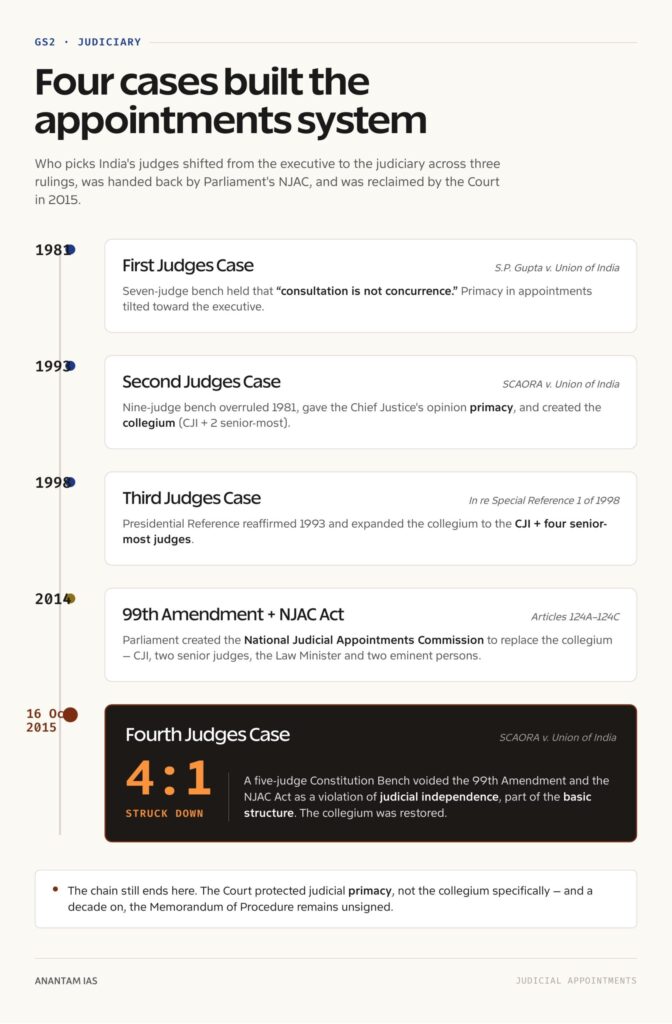
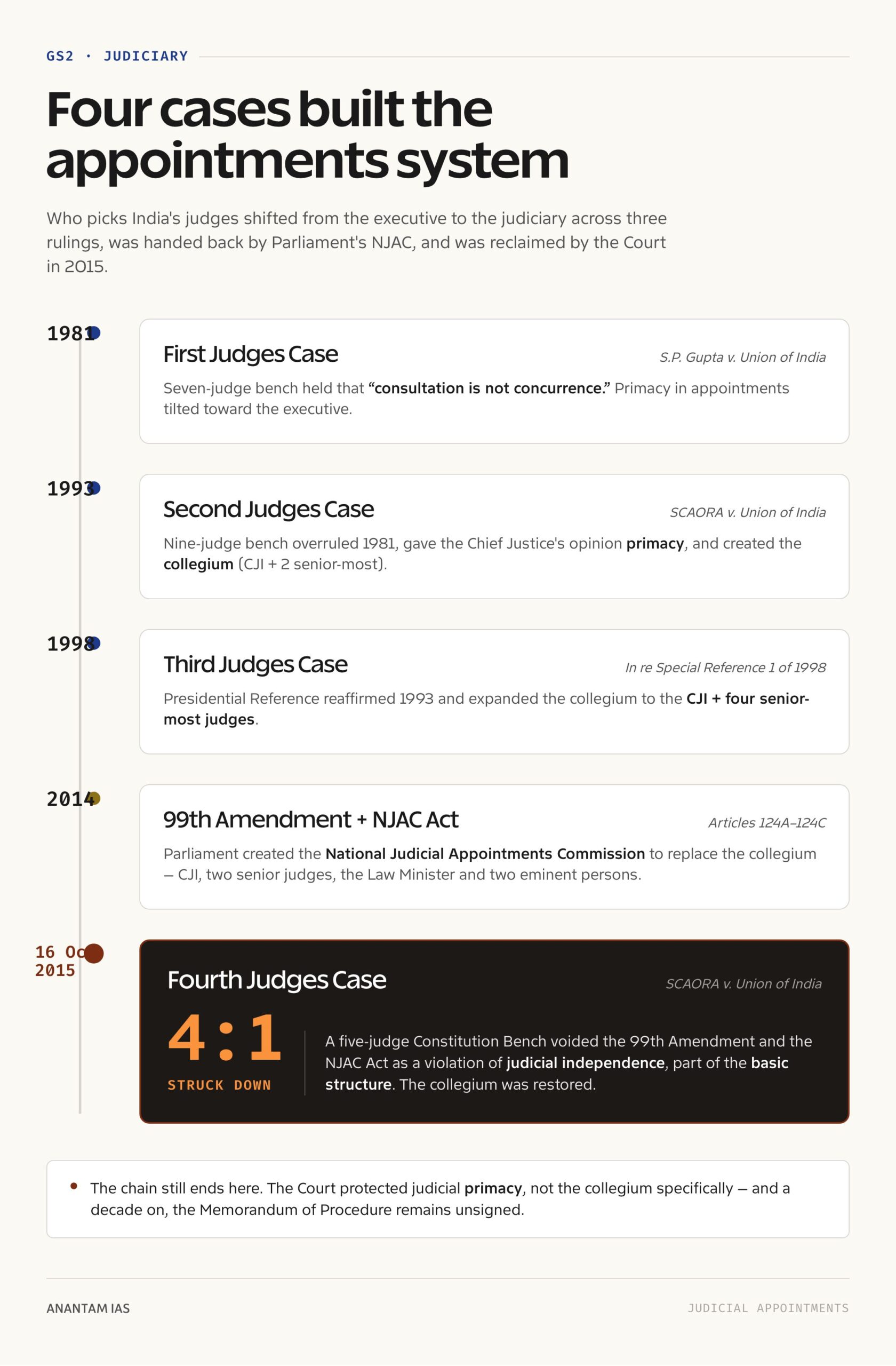
The collegium wasn’t dreamed up in the abstract. It came out of three cases. In the First Judges Case, S.P. Gupta v. Union of India (1981), a seven-judge bench held that the President wasn’t bound by the Chief Justice’s advice, that “consultation is not concurrence,” which tilted the power to appoint toward the executive. That tilt didn’t last. In the Second Judges Case, Supreme Court Advocates-on-Record Association v. Union of India (1993), a nine-judge bench overruled 1981, held that the Chief Justice’s opinion must have primacy, and created the collegium to keep executive influence in check. The Third Judges Case, In re Special Reference 1 of 1998, then expanded the collegium to the Chief Justice plus the four senior-most judges. So the system is a deliberate correction, not an accident.
Independence is the core of it, and the Court has called that independence part of the basic structure. The logic is simple. If the government chooses the judges who will rule on the government’s own cases, the temptation to reward the pliant and punish the bold is built into the design. Keeping the final say with the judiciary is meant to break that link between who appoints and who decides.
The government is the biggest litigant in the country, and that single fact does a lot of work here. When the State is party to the largest share of cases, handing the executive a controlling voice in appointments risks a bench selected for cooperation rather than independence. That’s precisely the danger the Court flagged when it struck down the NJAC, and it’s why supporters of the collegium treat executive primacy as the disease, not the cure.
There’s a structural backstop, too. When the collegium reiterates a name the government has returned, that reiteration binds the government, which is the system’s guard against a political “pocket veto” that quietly kills a name by sitting on it. Collegium resolutions have publicly pushed back when the government tried to delay or split up recommended names. So the collegium isn’t only a selection club. It’s also a check on the executive’s power to stall.
And the memory behind all this is real. Executive primacy in the S.P. Gupta era coincided with judges being superseded and punitively transferred. So when supporters defend the collegium, they’re defending a hard-won line, not a comfortable habit.
The Case Against
Here’s what the independence case walks past. A system can protect judges from the government and still fail the public, if it makes its choices in the dark and lets the bench run a third empty. On both counts, the collegium has real holes.
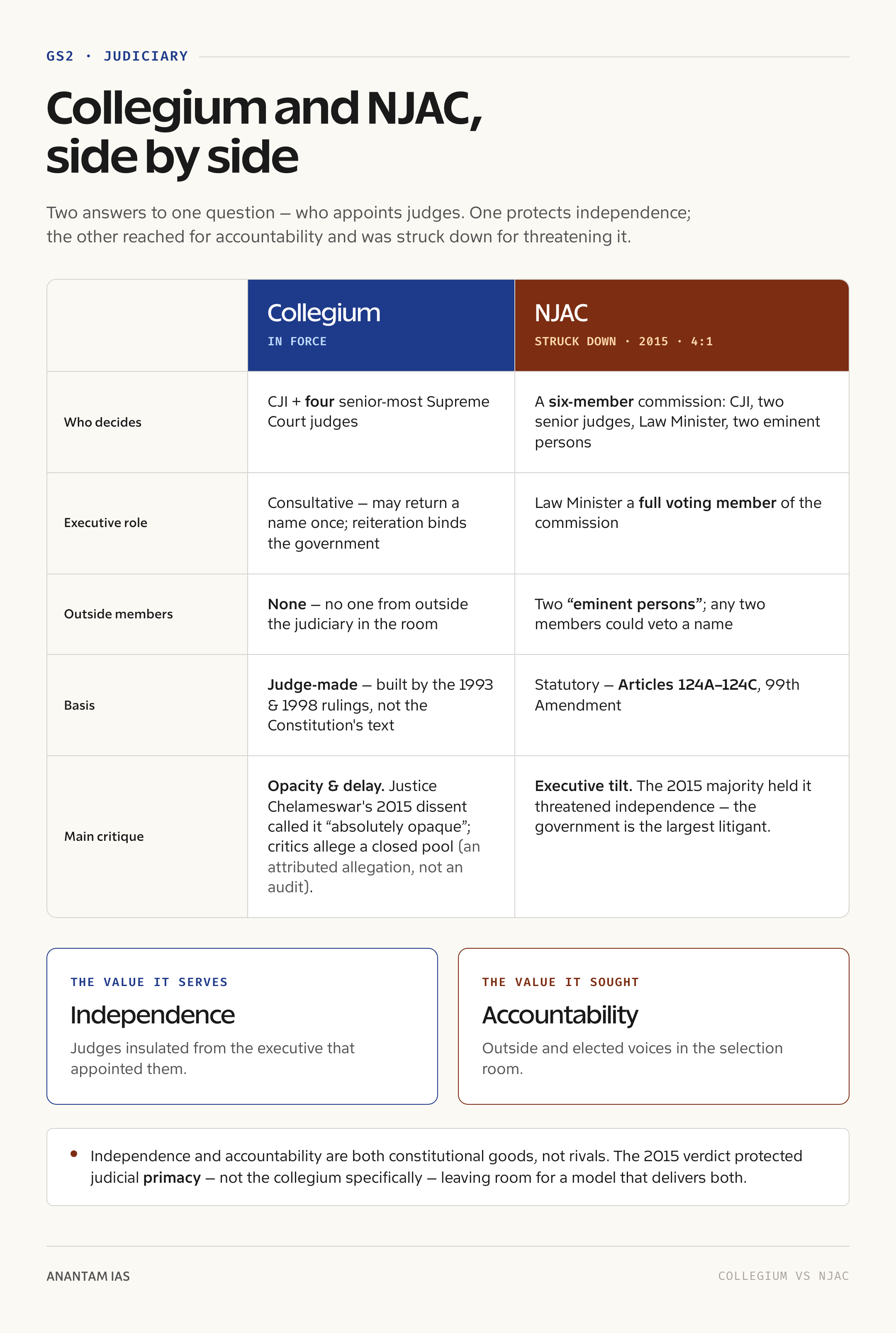
It’s opaque, and the sharpest version of that charge came from inside the Court. In the 2015 NJAC judgment, Justice J. Chelameswar, dissenting, called the collegium “absolutely opaque and inaccessible both to the public and history”. That’s not a critic outside the system talking. That’s a sitting judge of the Supreme Court. A 2017 reform tried to answer it: on 3 October 2017, Chief Justice Dipak Misra’s collegium resolved to publish its resolutions, with reasons, on the Court’s website. But the publication thinned out within two years, several files retitled as bare lists of names without reasons. So the transparency promise was made, then quietly walked back.
Then there’s the structural objection: judges appointing judges, with no one from outside the judiciary in the room. The 214th Law Commission Report (2008) criticised exactly this absence of any external check. You can defend judicial primacy and still concede that a selection process with zero outside participation is hard to square with accountability in a democracy.
The nepotism charge is the loudest and the one to handle most carefully. Critics allege the collegium favours a closed pool of legal families, the so-called “uncle judge” syndrome, and Justice Chelameswar himself reportedly described the system as a euphemism for nepotism. But treat the popular statistics with caution. The frequently quoted claim that “half of High Court judges are related to senior judiciary” traces to advocate M.J. Nedumpara’s submissions, not to any official audit. So it belongs in an answer as an attributed allegation about the system’s tendencies, not as an established fact.
The delays are the part that hurts ordinary litigants most directly, and they cut both ways. A third of the High Court bench sits vacant, only 3 of 25 High Courts ran at full strength in 2024, and 193 of the July 2025 vacancies had no name even proposed. Some of that is the government sitting on cleared names. Some of it is High Court collegiums not recommending in time. Either way, the citizen waiting years for a hearing pays for a process that can’t fill its own seats.
And it runs without fixed criteria. There’s no permanent appointments secretariat, no published, weighted standard for merit, seniority, or diversity. So even a good pick can look arbitrary, because the public never sees the reasoning.
It’s worth naming the other side of the delay, though. Critics of the government’s conduct point out that the unfinalised MoP and the selective clearing or returning of names, delays on Saurabh Kirpal’s recommendation pending since 2017, the returns of Somasekhar Sundaresan and R. John Sathyan, look like the executive using procedural levers to shape the bench despite losing in 2015. So opacity and delay aren’t only the judiciary’s failing. The executive contributes its share.
The Deeper Structural Read
Step back from the day’s headlines and the real fault line shows up. It isn’t “collegium versus NJAC.” It’s a question the Constitution sets but doesn’t fully answer: how do you make appointments independent of the executive and accountable to the public at the same time? The NJAC episode is the clearest test of that question we have.
Parliament’s answer in 2014 was the NJAC. The 99th Constitutional Amendment Act, 2014 and the NJAC Act, 2014 inserted Articles 124A, 124B and 124C and built a six-member commission to replace the collegium: the Chief Justice of India as chair, the two senior-most Supreme Court judges, the Union Law Minister, and two “eminent persons” chosen by a panel of the Chief Justice, the Prime Minister, and the Leader of Opposition. A veto by any two members could block a name. On paper, it answered the accountability charge by putting outsiders and the elected executive in the room.
The Court said no. In the Fourth Judges Case, Supreme Court Advocates-on-Record Association v. Union of India (16 October 2015), a five-judge Constitution Bench struck down both the amendment and the Act by 4:1, holding they violated judicial independence and therefore the basic structure. The majority, led by Justice J.S. Khehar, found the two-member veto “out-rightly obnoxious,” objected to the Law Minister’s presence given that the government is the largest litigant, and faulted the vague “eminent persons” criterion that let lay nominees override judicial primacy. Justice Chelameswar dissented, and his dissent is the one that named the collegium’s opacity out loud.
So 2015 drew a line. Any future model that strips the judiciary of primacy in its own appointments will fail a basic-structure challenge. That’s the constitutional boundary every reform has to respect. But, and this is the part students miss, the Court didn’t say the collegium is the only method that survives. It said judicial primacy must survive. Those aren’t the same thing. A reformed commission that keeps the judiciary in the controlling seat while adding transparency and outside input could, in principle, clear the 2015 bar.
The MoP is where the unanswered question now lives. After striking down the NJAC, the Court in December 2015 invited the government to finalise the MoP with the Chief Justice. A decade later it remains “pending finalisation”. The central sticking point is a proposed “national security” clause that would let the government reject a name on that ground; the collegium resisted the open-ended version, and the government has treated the rulebook as unsettled, which fuels the delay. So the appointments system today runs on a judge-made process the Court itself called opaque, governed by a rulebook neither branch will sign. That’s the structural read: not a clean win for either side, but an unfinished settlement that both branches use to their advantage.
And here’s the part that should bother a future administrator most. The vacancy crisis, a third of the High Court bench empty, isn’t caused by the design debate at all. It’s caused by both branches dragging their feet inside whatever design exists. So even a perfectly designed appointments body would still leave seats empty if the people running it don’t act on time. The method matters. But discipline matters as much.
What Should Be Done
So what does a workable settlement look like? Not a vague plea for “cooperation,” but concrete moves, each of which can sit inside the 2015 constitutional line. Treat these as the options under serious public debate, not as anyone’s final verdict. Six of them.
- Finalise the Memorandum of Procedure. The single most overdue fix. Settle the “national security” clause with a narrow, reasoned, judicially reviewable standard rather than an open-ended executive veto, so a name can’t be killed in secret on an unstated ground. A rulebook both branches actually sign would remove the biggest source of delay. The wider problem of judicial pendency starts with seats that stay empty because the rules for filling them were never agreed.
- Build a permanent appointments secretariat. A professional standing body to maintain candidate databases, track timelines, and run background checks would answer the “no institutional memory” critique. Right now each collegium starts almost from scratch. A secretariat gives the process continuity without touching who makes the final call.
- Publish selection criteria and reasoned resolutions. Spell out the weight given to merit, seniority, regional and social diversity, and put the reasons for each recommendation on the record, reviving the spirit of the 2017 reform that thinned out within two years. Transparency here costs the judiciary nothing it should want to keep and answers the opacity charge directly.
- Set binding timelines on both sides. Require High Court collegiums to recommend at least six months before a vacancy, and require the government to act within a fixed window, with mandatory written reasons for any delay. The July 2025 reply showed the rules already exist on paper and are “rarely observed”. Make the timelines enforceable, not aspirational.
- Use the new strength to clear the backlog. With sanctioned strength now at 38 and pendency at 92,823 cases as on 30 April 2026, the extra seats should go toward constituting Constitution Benches regularly rather than sitting symbolic. Capacity added is only useful if it’s capacity used. This connects directly to the broader fight over judicial pendency and reform.
- If a commission model is ever revived, keep judicial primacy intact. The 2015 verdict is the line in the sand. A de novo body could add outside input and transparency, but the moment it lets non-judicial members override the judiciary’s controlling voice, it fails the basic-structure test. Any serious reform has to design within that limit, not against it.
None of these forces a choice between independence and accountability. A process that keeps the final call with the judiciary, but does it on a fixed timeline, by published criteria, with reasons on the record, is both independent and answerable. That’s the settlement the NJAC episode pointed toward and never reached.
For Your Mains Answer
This is a high-value GS2 topic. It pulls together the structure of the judiciary, appointments to constitutional posts, separation of powers, and the basic-structure doctrine in a single frame, and the May 2026 developments give it a fresh, datable peg.
GS paper mapping: GS2: structure, organization and functioning of the executive and the judiciary; appointment to constitutional posts; separation of powers; comparison with constitutional schemes of other countries.
Likely question frames:
- “The strike-down of the NJAC settled who appoints judges but not how transparently.” Critically examine the collegium system in light of this tension.
- Judicial independence and accountability are both constitutional values. Discuss with reference to the Fourth Judges Case (2015) and the unfinalised Memorandum of Procedure.
- The collegium is a judge-made system the Court itself has called opaque. Evaluate the case for reform without violating the basic structure.
Quotable data and cases:
- S.P. Gupta (1981): “consultation is not concurrence”; executive primacy, later overruled.
- Second Judges Case (1993): Chief Justice’s opinion given primacy; collegium (CJI + 2) created.
- Third Judges Case (1998): collegium expanded to CJI + 4 senior-most judges.
- Fourth Judges Case (16 Oct 2015): 99th Amendment and NJAC Act struck down 4:1 as violating judicial independence and the basic structure.
- Justice Chelameswar, dissenting (2015): the collegium is “absolutely opaque and inaccessible both to the public and history.”
- 371 of 1,122 High Court posts vacant (~33%); 193 awaiting any proposal.
- Only 3 of 25 High Courts at full strength (2024).
- SC strength raised 34 → 38 by ordinance (16 May 2026); pendency 92,823 cases (30 Apr 2026).
Keywords to use: collegium, Memorandum of Procedure, judicial independence, basic structure, separation of powers, judicial primacy, executive overreach, NJAC, “eminent persons,” reiteration.
Syllabus linkages: judiciary, constitutional posts and appointments, separation of powers, basic-structure doctrine, accountability of unelected institutions, comparison with the UK Judicial Appointments Commission and the US Senate confirmation model.
Balanced conclusion line: The choice was never between an independent judiciary and an accountable one; it’s between a process that hides its reasoning and one that owns it, and India can have judicial primacy and transparency together the moment both branches stop using the gap between them as cover.
How to Build the Answer
Open with the tension, not a definition. The mark-scoring move is to show the examiner you’ve grasped that independence and accountability are both constitutional goods that the appointments method forces into conflict. A one-line definition of the collegium can follow in the second sentence, never the first.
Use the four cases as your backbone, but compress them. You don’t need paragraphs on each. One clean line per case, 1981 to 2015, shows command of the doctrine and frees up space for analysis. The examiner reads “S.P. Gupta to the Fourth Judges Case” and knows you’ve mapped the whole arc.
Steelman both sides before you take a stance. Give the independence case its strongest form, the government is the largest litigant, the basic structure protects it, then give the accountability case its strongest form, opacity, no external check, a third of the bench empty. An answer that argues only one side reads as advocacy, not analysis.
Group the way forward; don’t scatter it. Cluster the reforms: finalise the MoP, build a secretariat, publish criteria, set binding timelines, use the new strength, preserve judicial primacy in any new model. Use the topic’s own vocabulary so the answer sounds like constitutional analysis, not a news recap.
Common Mistakes to Avoid
- Don’t treat “collegium versus NJAC” as the whole debate. The deeper question is independence and accountability together. The model that wins keeps judicial primacy while adding transparency.
- Don’t assert the nepotism statistic as fact. The “half of HC judges related to senior judiciary” figure is an attributed allegation, not an audit. Frame it as a critique, not a finding.
- Don’t blame only the government for delay. The data shows High Court collegiums also fail to recommend in time. A balanced answer names both.
- Don’t propose a reform that violates the basic structure. Any commission that strips judicial primacy fails the 2015 test. Design within the line.
- Don’t end on a slogan. Close with a constitutional principle or an implementable fix, not a flourish.
A Compact Answer Spine
- Introduction: Open with the independence-accountability tension in one sentence; define the collegium and the MoP in the next.
- Evolution: One line each on the Three Judges Cases, then the NJAC and the Fourth Judges Case (2015).
- Arguments: The case for the collegium (independence, basic structure, government-as-litigant), then the case against (opacity, no external check, delay, vacancies). Keep both fair.
- Structural diagnosis: 2015 protects judicial primacy, not the collegium specifically; the unfinalised MoP is where the unanswered question lives.
- Way forward: Five or six grouped reforms, each with a clear actor and each within the basic-structure line.
- Conclusion: Adapt the balanced conclusion line to the exact question wording.
Diagram or Flowchart Idea
For a 15-marker, draw the appointments timeline as one clean horizontal chain: 1981 executive primacy → 1993 collegium created → 1998 expanded to CJI + 4 → 2014 NJAC → 2015 struck down → MoP still pending. The examiner reads the whole doctrinal arc in five seconds.
For a 10-marker, skip the timeline and use a two-column table instead: “Collegium (in force)” against “NJAC (struck down 2015),” comparing who decides, the executive’s role, lay members, and the main critique of each. It’s faster to evaluate under time pressure and shows you understand both models.
Ethics and Governance Angle
Add one line of public-administration ethics even in a GS2 answer. The values in conflict are independence and accountability, and the citizen who waits years for a hearing because a third of the bench is empty is the person who pays when neither value is served well. Name that litigant. Naming who bears the cost sharpens any governance answer.
Then convert the value into design. Don’t just say “make appointments transparent.” Say how: publish reasoned resolutions, set binding timelines with written reasons for delay, build a standing secretariat. That’s the move from a moral sentiment to administrative maturity, and it’s exactly what the examiner rewards on a reform question.
How to Use Data Without Sounding Mechanical
Use three figures, not ten. Lead with the scale (371 of 1,122 High Court seats vacant), add a contrast (only 3 of 25 High Courts at full strength in 2024), and close with the peg (strength raised 34 to 38 in May 2026). One structural number, one severity number, one current-event number is plenty.
Never leave a statistic standing alone. Follow it with “this means” or “the implication is.” The vacancy figure isn’t the point; what it does to pendency and to ordinary litigants is the point. In Mains, the number is raw material and the inference earns the mark.
Finish with one test: can a tired examiner follow this in a single pass? Short introduction, the case arc compressed, both sides marked cleanly, the way forward grouped. Clarity isn’t a lower standard than depth. For UPSC, clarity is how depth becomes visible.
FAQ
What is the collegium system in simple terms?
It’s the system, created by the Supreme Court through its own judgments, under which the senior-most judges decide who joins the higher judiciary. For the Supreme Court it’s the Chief Justice of India plus the four next senior-most judges; for a High Court it’s the Chief Justice and two senior-most judges of that court, routed through the Supreme Court collegium. The word “collegium” appears nowhere in the Constitution.
Why was the NJAC struck down in 2015?
In the Fourth Judges Case (October 2015), a five-judge bench struck down the 99th Amendment and the NJAC Act by 4:1, holding they violated judicial independence, which the Court treats as part of the basic structure. The majority objected to the Law Minister sitting on the commission given the government is the largest litigant, to the vague “eminent persons” category, and to a two-member veto that could override judicial primacy.
What is the Memorandum of Procedure and why does it matter?
The MoP is the agreed rulebook for judicial appointments, setting out who proposes a name, who is consulted, and the timelines. After the NJAC was struck down, the Court asked the government to finalise a revised MoP with the Chief Justice. A decade later it remains pending, largely over a proposed “national security” clause, and that gap is a major source of the delay and friction in appointments.
How bad is the judicial vacancy problem?
As of the July 2025 parliamentary reply, 371 of 1,122 High Court posts were vacant, about a third of the bench, and 193 of those had no name even proposed. Only 3 of 25 High Courts were at full strength in 2024. The Supreme Court’s sanctioned strength was raised from 34 to 38 by ordinance in May 2026 to help cut a pendency of over 92,000 cases, but the High Court shortfall is the deeper problem.
Tell Google you want more of this.
Add Anantam IAS as a preferred sourceOne tap, and this site shows up more often in your own Top Stories, AI Overviews and AI Mode. Remove it any time.