Access to Life-Saving Drugs: Supreme Court Flags Judicial Delay
Why in News?
The Supreme Court took suo motu cognizance of delays in cases concerning access to life-saving medicines after examining a long-pending Kerala High Court matter about the patented breast-cancer drug Ribociclib. Suo motu means that a court starts proceedings on its own motion rather than waiting for a conventional petition.
The Indian Express reported that the case, titled In Re: Access to Life Saving Medicines and Judicial Expediency in Article 21 Matters, was heard by a three-judge Bench led by the Chief Justice of India. The intervention treats time as part of an effective remedy when delay can permanently defeat a patient’s right to health.
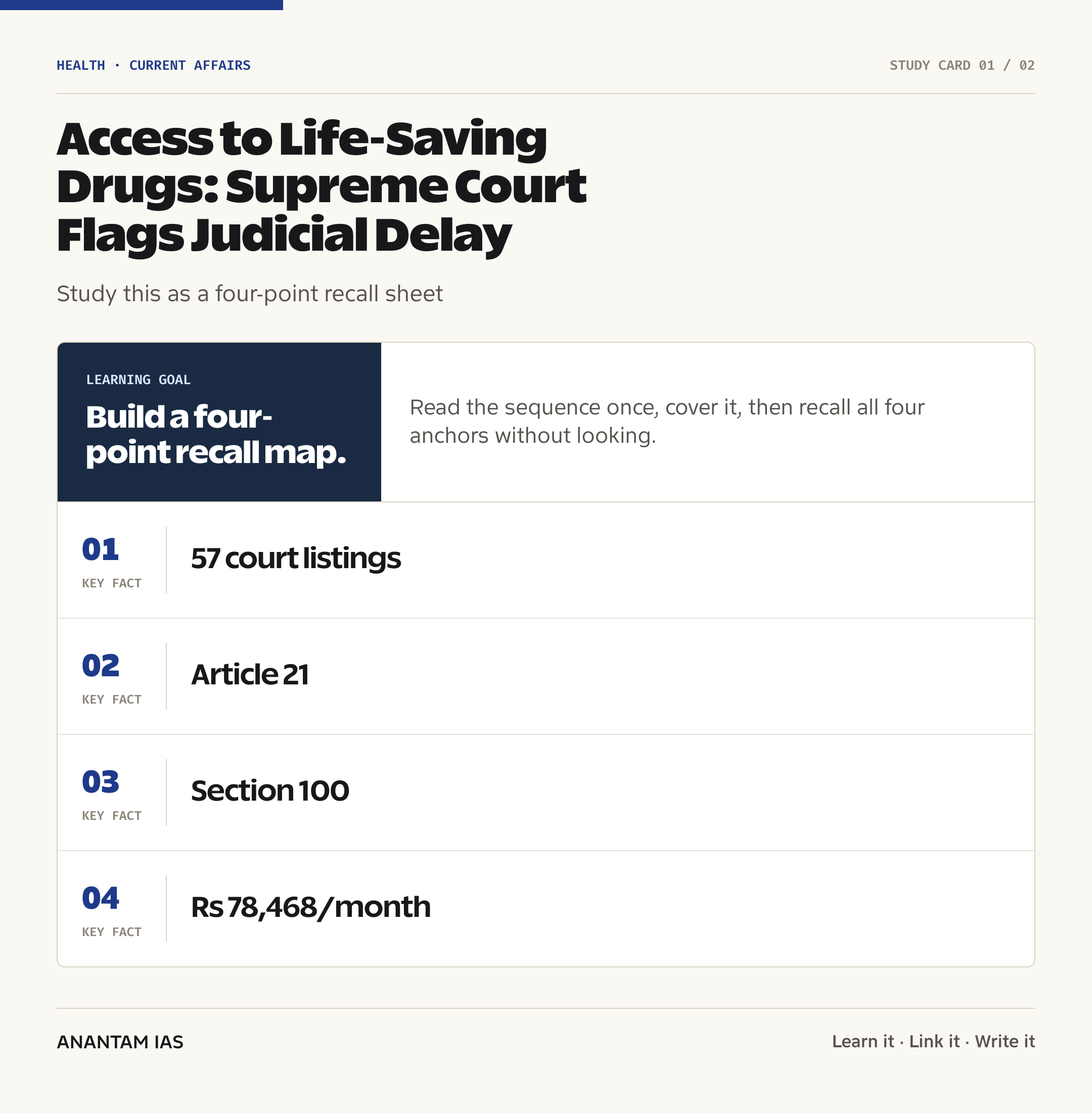
- The underlying Kerala proceedings concerning Ribociclib had reportedly been listed 57 times without a final conclusion.
- The original petitioner, a patient with breast cancer, died while the proceedings were pending; the High Court then converted the matter into a suo motu public interest litigation on expensive patented medicines.
- The Supreme Court said it would issue notice and asked the Kerala High Court to take up the pending proceedings at the earliest.
- The High Court separately sought expert views on whether the cheaper medicine Palbociclib could serve as an alternative to Ribociclib and Abemaciclib.
- A representation cited a monthly Ribociclib cost of about Rs 78,468 and sought government intervention under the Patents Act, 1970.
The development matters in the context of:
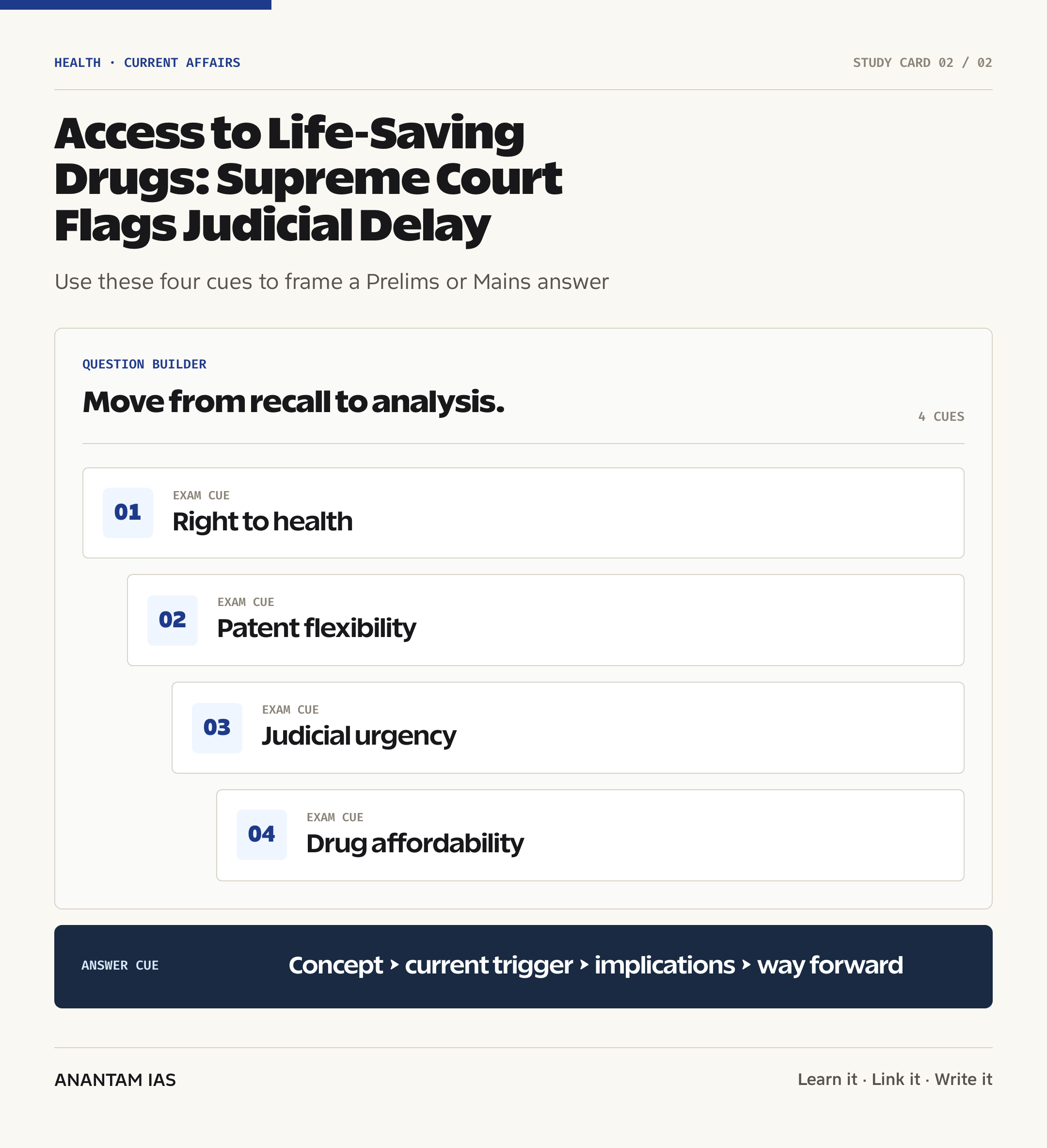
- This matters in the context of Article 21: a remedy delivered after the therapeutic window closes may be formally available but practically meaningless.
- It also tests how India balances patent protection, incentives for pharmaceutical innovation and the public interest in reasonably affordable medicines.
- The dispute highlights the need to connect courts, expert medical bodies, drug regulators and public-health purchasing systems without substituting judicial opinion for clinical evidence.
UPSC Relevance
Prelims Relevance
- Article 21 protects life and personal liberty; Supreme Court jurisprudence has read the right to health and timely medical care into its protection of life with dignity.
- Article 47, a Directive Principle, makes improvement of public health a primary duty of the State.
- Article 226 empowers High Courts to issue writs for fundamental rights and for other purposes; Article 32 guarantees access to the Supreme Court for enforcement of fundamental rights.
- Section 84 of the Patents Act permits an interested person, subject to statutory conditions, to seek a compulsory licence after three years from grant of a patent.
- Section 92 provides a special route for compulsory licences after a Central Government notification involving national emergency, extreme urgency or public non-commercial use.
- Section 100 allows the Central Government, or a person authorised by it, to use an invention for government purposes after a patent application is filed or a patent is granted.
- Section 47(4) permits government import of a patented medicine for its own use or distribution through specified public medical institutions.
- Ribociclib, Palbociclib and Abemaciclib are medicines used in defined clinical settings for hormone-receptor-positive, HER2-negative breast cancer; interchangeability requires expert assessment.
- The Drugs Controller General of India functions within the Central Drugs Standard Control Organisation and regulates matters such as approval of new drugs.
Mains Relevance
GS Paper 2
- Fundamental rights: relationship between Article 21, dignity, timely health care and an effective constitutional remedy.
- Judiciary: case management, prioritisation of time-sensitive matters and the human consequences of repeated listings without final adjudication.
- Social justice: unequal access to high-cost cancer therapy and the State’s obligations toward vulnerable patients.
- Governance: coordination among courts, health ministries, regulators, expert institutions and public procurement agencies.
GS Paper 3
- Intellectual property: public-health flexibilities under the Patents Act and the balance between innovation incentives and affordability.
- Science and technology: evidence-based assessment of therapeutic alternatives, generic entry and domestic pharmaceutical capacity.
Essay
- Justice delayed is justice denied acquires a literal public-health meaning when the subject is a time-sensitive treatment.
- A humane State must make innovation sustainable without allowing ability to pay to become the sole gatekeeper of survival.
Background and Context
From an individual petition to a systemic case
The litigation shows how one patient’s affordability claim grew into a wider inquiry about access to patented medicines.
- A patient approached the Kerala High Court in 2022 seeking help to obtain Ribociclib, an expensive prescribed treatment.
- After the petitioner’s death, the High Court kept the public issue alive by renaming the proceedings In Re Exorbitant Pricing of Life Saving Patented Medicines and appointing an amicus curiae.
- An amicus curiae, or friend of the court, assists with law and evidence but does not replace the parties or the judge.
- The later concern was not confined to one reimbursement request; it covered pricing, accessibility, government powers and potential therapeutic alternatives.
- On 15 July 2026, the High Court sought opinions from national and regional cancer institutions and the Drugs Controller General of India on alternative medicines.
- The Supreme Court’s new proceeding adds a second institutional question: how rapidly courts must act when delay itself can extinguish the value of a remedy.
Article 21 and the right to health
The Constitution does not use the phrase right to health in Part III, but courts have derived it from life, dignity and the State’s welfare obligations.
- Article 21 bars deprivation of life or personal liberty except according to procedure established by law; its judicial interpretation covers more than mere animal existence.
- In Paschim Banga Khet Mazdoor Samity v State of West Bengal (1996), the Supreme Court held that failure of a government hospital to provide timely treatment can violate Article 21.
- In State of Punjab v Mohinder Singh Chawla (1997), the Court recognised health as integral to the right to life and placed a constitutional obligation on government.
- Article 47 directs the State to improve nutrition, living standards and public health, while Articles 38 and 41 reinforce social welfare and public assistance.
- Directive Principles are not individually enforceable like Fundamental Rights, but they guide interpretation, legislation, budgeting and the design of health systems.
- The current case sharpens the idea of effective relief: a decision must arrive while treatment remains medically useful, not only after pleadings are complete.
Why repeated listing can defeat substantive justice
Listing a case means placing it on a cause list; it does not guarantee that the court will reach, hear and decide it that day.
- Time-sensitive health cases face a different risk from ordinary commercial delay because disease can progress during each adjournment or ineffective listing.
- A court may need expert reports and party responses, but procedural completeness cannot become an indefinite substitute for a reasoned interim or final order.
- Urgency can be managed through priority listing, fixed timelines, focused issues, early appointment of experts and carefully framed interim relief.
- An interim order can preserve access while the court examines liability, but it should identify the patient group, treatment period, funding route and review date. This prevents temporary relief from becoming an open-ended policy made without evidence.
- Judicial expedition does not mean a predetermined outcome; it means preserving fairness while preventing delay from deciding the dispute by default.
- The principle also protects the other side: clear schedules and limited adjournments reduce uncertainty for governments, hospitals and patent holders.
- A transparent urgency protocol would support judicial accountability without inviting executive control over judicial outcomes.
Patent protection and public-health flexibilities
A pharmaceutical patent grants a time-bound exclusive right, but Indian law builds public-interest limits into that exclusivity.
- Section 83 states general principles: patents should promote innovation, be worked in India and should not impede protection of public health and nutrition.
- Under Section 84, an applicant may seek a compulsory licence if statutory grounds are met, including unmet public requirements, lack of reasonable affordability or failure to work the invention in India.
- Section 92 allows the Central Government to notify a national emergency, extreme urgency or public non-commercial use, enabling an accelerated compulsory-licensing route.
- Section 100 is a distinct government-use power. India Code states that the Central Government or its authorised person may use an invention for government purposes, subject to the Act’s terms and adequate remuneration where applicable.
- Section 47(4) separately preserves government import and distribution options for medicines through qualifying public institutions.
- These mechanisms differ in trigger, decision-maker and procedure, so government use should not be casually treated as identical to an ordinary compulsory licence.
- For the wider statutory map, see compulsory licensing in India and Section 3(d)’s anti-evergreening safeguard.
Affordability is more than the sticker price
Access depends on the medicine’s price, clinical suitability, duration of therapy, household finances and availability through public programmes.
- The representation reported a Ribociclib cost of about Rs 78,468 per month; this is a case-specific reported figure, not a universal retail price for every dose or patient.
- Cancer treatment can add diagnostics, consultations, travel, supportive medicines and lost income, creating catastrophic health expenditure even when one component is subsidised.
- Price reduction alone does not establish access if a medicine is unavailable in public hospitals or excluded from insurance and procurement lists.
- Financial protection also depends on whether Ayushman Bharat PM-JAY, State insurance programmes or hospital assistance packages cover the diagnosis and treatment pathway. Coverage on paper must be tested against package rates, eligibility and actual hospital availability.
- Generic competition can lower prices after patent expiry or lawful licensing, but manufacturing quality, regulatory approval and reliable supply remain essential.
- Public procurement can negotiate volume-based prices and pool demand, while schemes such as Pradhan Mantri Bhartiya Janaushadhi Pariyojana improve access to many quality generic medicines.
- Patented oncology medicines may require additional tools such as negotiated pricing, risk-sharing, patient-assistance safeguards, insurance coverage or a statutory patent flexibility.
Clinical alternatives require evidence, not price comparison
The High Court’s request for expert opinions recognises that affordability and therapeutic equivalence are separate questions.
- Ribociclib, Palbociclib and Abemaciclib belong to the CDK4/6-inhibitor class, but class membership does not automatically make medicines interchangeable for every patient.
- Choice of therapy can depend on disease stage, biomarker profile, prior treatment, contraindications, adverse effects and the applicable clinical guideline.
- An expert comparison should examine efficacy, safety, dosing, monitoring, quality of life and total treatment cost, not only the purchase price.
- Courts can require a transparent assessment and test the legality of a decision, while qualified health authorities should make the core clinical evaluation.
- The Drugs Controller General of India can contribute regulatory evidence; specialist cancer institutes can assess clinical practice and patient-level consequences.
- This separation of roles reduces two risks: judges making medical choices without evidence, and administrators invoking an alternative without showing that it is genuinely suitable.
Innovation, equity and the patent bargain
The policy problem is not a simple choice between patents and patients; it is how to make the innovation system serve public welfare.
- Patents can reward research by granting limited exclusivity, but that exclusivity is a statutory instrument rather than an unlimited natural right.
- The public side of the bargain includes disclosure of the invention, eventual generic entry and safeguards against abuse or unaffordable access.
- Predictable use of statutory flexibilities is better than ad hoc pressure because it gives governments, manufacturers and patients clear legal expectations.
- Publicly funded research and procurement should include access conditions, transparent licensing and affordable-pricing commitments where legally feasible.
- India’s pharmaceutical capacity makes domestic manufacture relevant, but a licence still needs technology, regulatory compliance, raw materials and procurement demand.
- The durable objective is patient-centred access: the right medicine, for the right patient, at the right time, with fair payment for legitimate innovation.
Way Forward
Create a health-urgency listing protocol
- High Courts should identify cases involving imminent death, irreversible disability or a closing therapeutic window at the filing and listing stages.
- Use fixed hearing dates, written issue lists, limits on adjournments and reasoned priority orders while preserving notice and hearing rights.
- Allow a rapid request to modify priority when medical circumstances change, supported by a clinician’s concise certificate.
Build a standing medical and economic evidence channel
- Create neutral panels that can quickly provide courts with evidence on clinical need, alternatives, prices, patents, supply and public-programme coverage.
- Require experts to disclose conflicts of interest and distinguish established evidence from professional judgment.
- Publish non-confidential reports so that similarly placed patients and authorities can rely on a common evidence base.
Use the full access-to-medicines toolkit
- Start with pooled procurement, negotiated prices, insurance coverage and public-hospital supply where they can deliver timely access.
- If those tools fail, evaluate Sections 84, 92, 100 and 47 against their own legal thresholds instead of treating patent flexibilities as politically unusable.
- Record reasons, compensation principles, expected savings, supply plans and patient eligibility to make government action reviewable and credible.
Measure access by patient outcomes
- Track waiting time from prescription to therapy, abandonment due to cost, public-facility availability and out-of-pocket expenditure.
- Pair price interventions with pharmacovigilance, quality assurance and uninterrupted supply.
- Include patient groups in policy design while protecting personal health information and avoiding industry capture.
Conclusion
The Supreme Court’s intervention converts a tragic delay into a constitutional governance question. Article 21 is not served by a remedy that arrives after illness has made relief useless, but urgency must still operate through fair procedure and sound medical evidence.
India already has legal tools to balance pharmaceutical innovation with public health. The harder task is institutional: courts must decide time-sensitive cases promptly, governments must explain whether and how they will use patent flexibilities, and health systems must turn legal authority into actual treatment access.
For UPSC analysis, the central link is clear: timely justice, affordable medicines and evidence-based health governance are mutually reinforcing parts of the right to live with dignity.
UPSC Practice Questions
Prelims MCQ 1
With reference to the Patents Act, 1970, consider the following statements:
- Section 84 allows an application for a compulsory licence only after three years from the grant of a patent.
- Section 92 concerns national emergency, extreme urgency or public non-commercial use.
- Section 100 empowers only State Governments, and not the Central Government, to authorise use of a patented invention.
How many of the above statements are correct?
(a) Only one (b) Only two (c) All three (d) None
Answer: (b) Only two
Explanation:
Statements 1 and 2 are correct. Section 100 gives the relevant authorising power to the Central Government, which may permit a person to use an invention for government purposes.
Prelims MCQ 2
Which constitutional provision specifically directs the State to improve public health?
(a) Article 32 (b) Article 39A (c) Article 47 (d) Article 51A
Answer: (c) Article 47
Explanation:
Article 47 is a Directive Principle that makes improvement of nutrition, living standards and public health a primary duty of the State.
UPSC Mains Questions
- A constitutional remedy in a health emergency can lose all practical value through delay. Examine how Indian courts can secure judicial expedition in life-saving treatment cases without compromising procedural fairness, expert medical assessment or institutional boundaries.
- India’s Patents Act contains multiple public-health flexibilities, but legal authority alone does not guarantee affordable access to medicines. Distinguish compulsory licensing from government use and suggest an integrated policy for access to high-cost patented therapies.
Sources: India Code, Patents Act 1970 and The Indian Express.
Frequently Asked Questions
Why did the Supreme Court intervene?
The Supreme Court was concerned that the Kerala medicine-access case had reportedly been listed 57 times without a final conclusion. Because delay in a life-saving-treatment dispute can make later relief useless, the Court began a suo motu Article 21 proceeding and asked the Kerala High Court to decide its pending matter expeditiously.
What is Ribociclib?
Ribociclib is a CDK4/6 inhibitor used in defined treatment settings for hormone-receptor-positive, HER2-negative breast cancer. It is a patented medicine at the centre of the Kerala litigation. Whether another CDK4/6 inhibitor is a suitable alternative depends on clinical evidence and the patient’s condition, not price alone.
Is right to health a Fundamental Right?
The Constitution does not separately name a Fundamental Right to health, but the Supreme Court has interpreted Article 21’s right to life with dignity to include health and timely medical care. Directive Principles, especially Article 47, reinforce the State’s duty to improve public health.
What does Section 100 permit?
Section 100 of the Patents Act allows the Central Government, or a person authorised by it, to use an invention for government purposes after a patent application is filed or a patent is granted. Statutory rules on notice, terms and adequate remuneration apply according to the circumstances.
Is government use compulsory licensing?
They are related patent flexibilities but follow different routes. A Section 84 compulsory licence is sought before the Controller on specified grounds, while Section 92 follows a government notification in special circumstances. Section 100 directly concerns government use and has its own terms and compensation framework.
Can courts choose a cheaper substitute?
Courts can demand a lawful, transparent and timely evaluation, but the clinical choice should rest on expert evidence. Medicines in the same drug class aren’t automatically interchangeable. Regulators and cancer specialists must compare efficacy, safety, biomarker fit, dosing, monitoring and total treatment consequences for the relevant patient group.