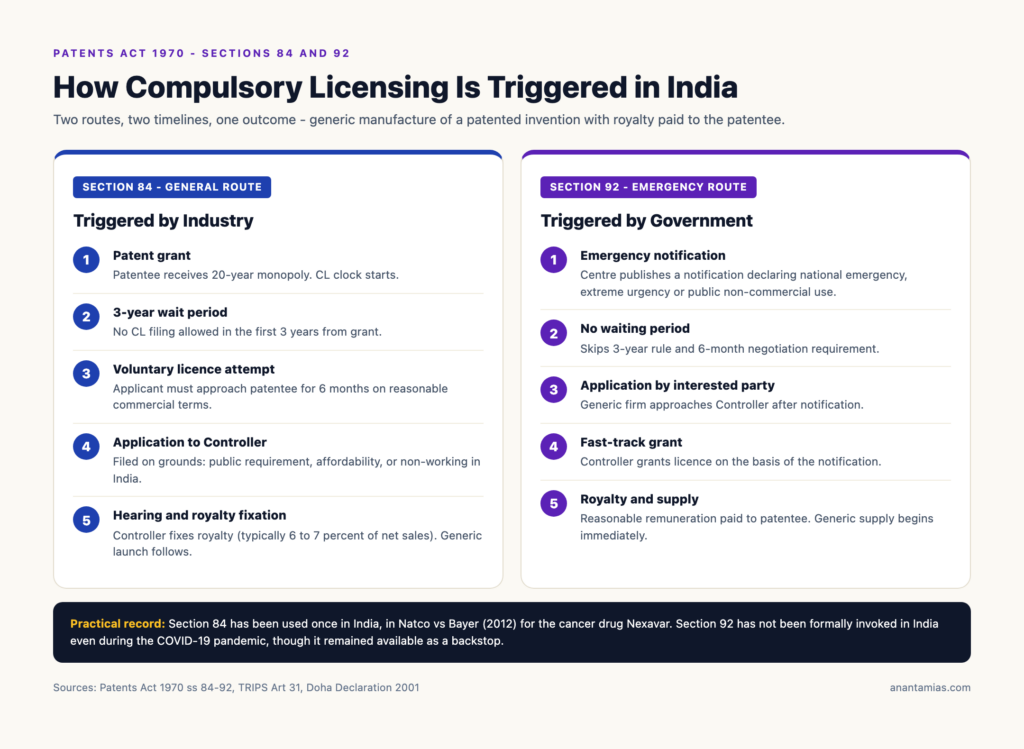
Compulsory licensing lets the government authorise a third party — usually a generic manufacturer — to make and sell a patented product without the patent holder’s consent, in return for a royalty. In India it rests on Sections 84 (general route) and 92 (emergency route) of the Patents Act, 1970, backed by Article 31 of TRIPS and the 2001 Doha Declaration. India’s only granted compulsory licence so far is the 2012 Natco–Bayer case for the cancer drug Nexavar.
A patent is a deal. The state grants a 20-year monopoly to an inventor in exchange for two things: full disclosure of the invention and a public benefit at the end of the term, when the invention enters the public domain. The deal works well most of the time. It works less well when the patented product is a life-saving drug priced beyond the reach of the people who need it. A liver cancer patient in India does not have the luxury of waiting twenty years for the patent to expire.
Compulsory licensing is the safety valve built into this deal. It is a legal mechanism by which the government can authorize a third party, usually a generic manufacturer, to make and sell a patented product without the patent holder’s consent. The patent holder still owns the patent. They simply cannot say no, and they receive a royalty in return. In Indian legal practice, this safety valve sits in two main provisions of the Patents Act, 1970: Section 84, the general route, and Section 92, the emergency route. Together they are India’s most powerful instruments to balance pharmaceutical innovation against affordable access.
This guide walks through both routes, the international legal basis under the TRIPS Agreement and the Doha Declaration, India’s first and so far only granted compulsory license in the 2012 Natco-Bayer Nexavar case, the related but distinct Bolar exemption under Section 107A, and the policy debates that surround all of this.
Quick Facts: Compulsory Licensing at a Glance
- Statutory basis: Sections 84 to 92 of the Patents Act, 1970, with Section 84 as the general route and Section 92 as the emergency route
- International basis: Article 31 of the TRIPS Agreement, 1995, reinforced by the Doha Declaration on Public Health, 2001
- First and only granted CL in India: Natco vs Bayer (2012) for the kidney and liver cancer drug Nexavar (sorafenib)
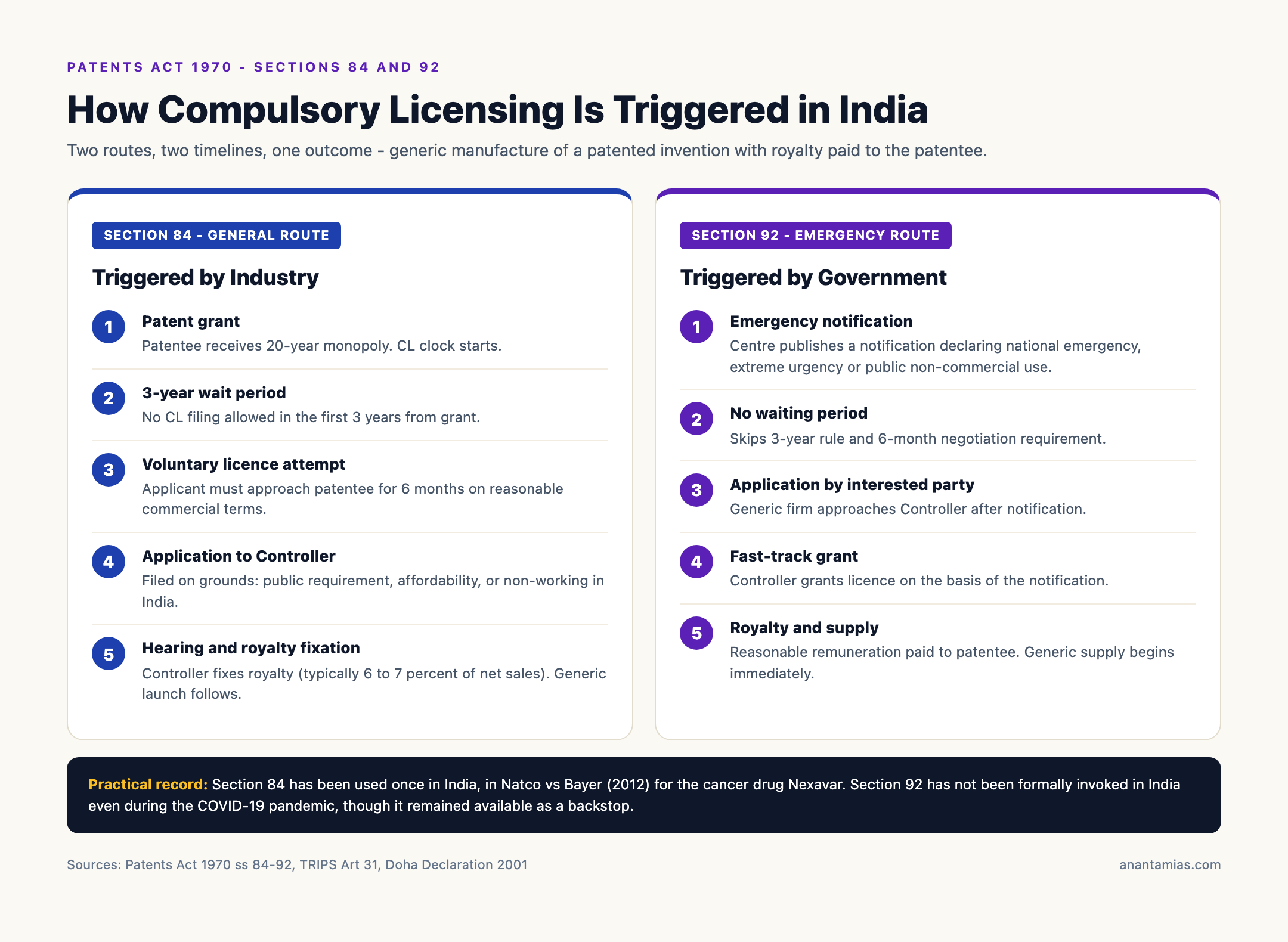
- Section 84 wait period: Cannot be filed before three years from patent grant, and the applicant must first try a voluntary license for six months
- Section 92 wait period: None, can be invoked any time on grounds of national emergency, extreme urgency or public non-commercial use
- Bolar exemption: Section 107A allows generic firms to use a patented drug for research and regulatory approval before the patent expires
- Licensing authority: The Controller General of Patents, Designs and Trade Marks
- Royalty payable to patentee: Set by the Controller, typically 6 to 7 percent of generic sales
What Is a Compulsory License?
A compulsory license is an authorization granted by a competent government authority that allows a third party, usually called the licensee, to use, manufacture, sell or import a patented invention without the patent holder’s permission. Crucially, the patent itself is not invalidated. The patent holder retains ownership and is paid a reasonable royalty determined by the granting authority. What changes is the exclusivity. The 20-year monopoly that normally lets the patent holder set the price and choose suppliers is replaced, for the duration of the license, by a regulated market.
The logic is straightforward. Patents are not granted as a natural right. They are a policy tool, granted by the state to encourage innovation. The state can place conditions on that grant. When a monopoly priced beyond public reach prevents a public good from reaching the people, the state can step in. The same logic applies in extreme emergencies, where waiting for a voluntary deal is unconscionable.
The mechanism is most visible in pharmaceuticals because the gap between marginal cost and patent-protected price is largest there, but it applies to all patentable subject matter, including agricultural chemicals, green technologies and certain industrial processes. India’s policy framework on intellectual property is laid out in our coverage of the national IPR policy and broader intellectual property rights regime.
Background and Historical Context
Compulsory licensing is older than the World Trade Organization. The United Kingdom’s Patents Act of 1883 already contained a primitive version. The Paris Convention for the Protection of Industrial Property, revised in 1925, allowed member states to grant compulsory licenses to prevent abuses of patent rights. India’s own approach took shape with the Patents Act, 1970, which deliberately weakened pharmaceutical patent protection to let domestic generics manufacturers like Cipla and Ranbaxy build a strong industry. That period is widely credited with making India the pharmacy of the developing world by the 1990s.
The arrangement changed when India joined the WTO in 1995 and signed the TRIPS Agreement, which required member states to grant 20-year product patents in all fields including pharmaceuticals. India had a transition period until 2005. The amended Patents (Amendment) Act 2005 brought India fully into TRIPS compliance but preserved compulsory licensing, parallel imports and a strict patentability standard, including the famous Section 3(d) which prevents evergreening of pharmaceutical patents through trivial modifications.
Two international milestones in this period shaped the rules. Article 31 of TRIPS expressly permits compulsory licensing. The Doha Declaration on the TRIPS Agreement and Public Health of 2001 went further. It affirmed that TRIPS does not and should not prevent member states from taking measures to protect public health, and clarified that each member has the right to grant compulsory licenses and to determine the grounds.
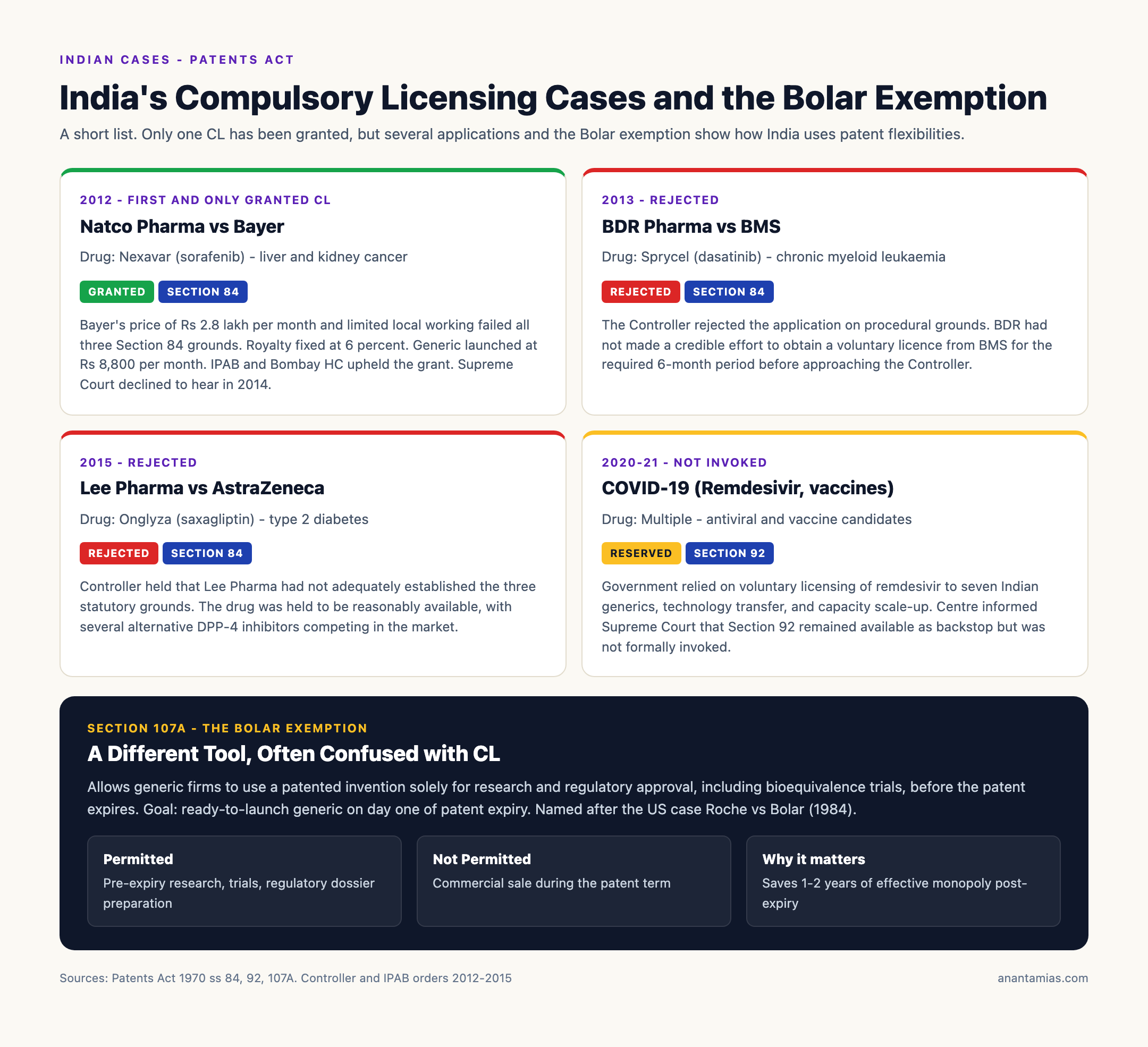
The first concrete application of these principles in India came in 2012, in the Natco-Bayer Nexavar case. Bayer’s drug Nexavar (sorafenib), used for advanced kidney and liver cancer, was priced at over Rs 2.8 lakh per month for a 120-tablet course. Natco, a Hyderabad-based generic firm, applied for a compulsory license under Section 84 in 2011. The Controller of Patents granted it in March 2012, allowing Natco to sell the same drug at about Rs 8,800 a month, with a royalty payable to Bayer. Bayer’s appeals at the Intellectual Property Appellate Board and the Bombay High Court were rejected, and the Supreme Court declined to hear the case in 2014.
Section 84: The General Route
Section 84 of the Patents Act is the workhorse provision. Any interested person, typically a generic manufacturer or a patient advocacy group, can apply to the Controller for a compulsory license after three years have passed since the grant of the patent. The applicant must first show that they tried to obtain a voluntary license from the patentee on reasonable commercial terms over a reasonable period, normally six months, and failed.
The Controller can grant the license on any of three grounds. First, that the reasonable requirements of the public with respect to the patented invention have not been satisfied. This is judged by whether existing supply meets the demand at affordable terms. Second, that the patented invention is not available to the public at a reasonably affordable price. Affordability is judged from the patient’s viewpoint, not the company’s costing model. Third, that the patented invention is not worked in the territory of India, meaning the patentee is not actually manufacturing or licensing manufacture inside India.
In the Nexavar case, all three grounds were found in Natco’s favour. Bayer had imported only small quantities, fewer than 600 patient courses a year against an estimated demand of over 8,000. The price of Rs 2.8 lakh per month was held unaffordable for the average Indian patient. And Bayer had not undertaken local manufacture. The Controller fixed a royalty of 6 percent on Natco’s net sales.
Section 92: The Emergency Route
Section 92 takes a different approach. The government itself notifies that a compulsory license is warranted on grounds of national emergency, extreme urgency or public non-commercial use. Once the notification is issued, any interested generic firm can approach the Controller, who must grant a license without going through the three-year wait or the prior voluntary-license requirement of Section 84.
The provision was designed for crises. A pandemic outbreak, a sudden epidemic of a tropical disease, or a public health emergency in a particular region would all be situations in which the government may invoke Section 92. The license terms are set by the Controller on a case-by-case basis. The patent holder receives reasonable royalty, but the procedural protections that slow Section 84 down do not apply.
Despite multiple debates, Section 92 has not yet been formally invoked in India even during the COVID-19 pandemic. The government in 2021 favoured voluntary licensing of remdesivir and other drugs, and indicated to the Supreme Court that the right to invoke Section 92 was being reserved as a backstop. The provision sits in the Act as a deterrent: knowing that the government can act quickly often pushes patent holders toward voluntary deals.
TRIPS, Doha and the International Framework
The international framework governing compulsory licensing is anchored in Article 31 of the TRIPS Agreement, supplemented by Article 31 bis added in 2005. Article 31 lists procedural conditions for a compulsory license: prior negotiation with the patent holder (waivable in emergencies), case-by-case determination, predominantly domestic supply, adequate remuneration, and judicial review of the license terms. India’s Patents Act incorporates each of these.
The Doha Declaration of November 2001 was the developing world’s response to threats by pharmaceutical companies to challenge South Africa, Brazil and other countries that were trying to access generic HIV drugs. The Declaration affirmed that TRIPS should be interpreted in a manner supportive of public health and that each member has the right to determine what constitutes a national emergency or extreme urgency. The 2003 implementation decision and Article 31 bis later allowed countries with no domestic manufacturing capacity to import generic versions made under compulsory license elsewhere, a critical lifeline for least developed countries.
These rules give India a robust legal basis for compulsory licensing under both Section 84 and Section 92. Pharmaceutical companies have at times argued that India is over-using or threatening to over-use these provisions. The empirical record shows the opposite: only one CL has actually been granted in over a decade.
Bolar Exemption: A Different Tool, Often Confused
Section 107A of the Patents Act contains what is commonly called the Bolar exemption. This provision allows generic manufacturers to use a patented invention solely for research, development and regulatory approval purposes, even while the patent is still in force. The classic example is bioequivalence testing. A generic drug company can run the trials needed for regulatory approval before the patent expires so that, on the day the patent expires, the generic version is ready to launch immediately.
Without this exemption, generic firms would have to wait until expiry to even begin testing, adding a year or two to the effective monopoly. The provision is named after the United States court case Roche Products Inc vs Bolar Pharmaceutical Co (1984), which led the US Congress to pass a similar provision in the Hatch-Waxman Act later that year.
The Bolar exemption is not a compulsory license. It does not allow commercial sale before patent expiry. It only allows the research and regulatory steps necessary to be ready for the day after expiry. It is a smaller but important part of India’s patent flexibility toolkit.
Comparative: Section 84 vs Section 92
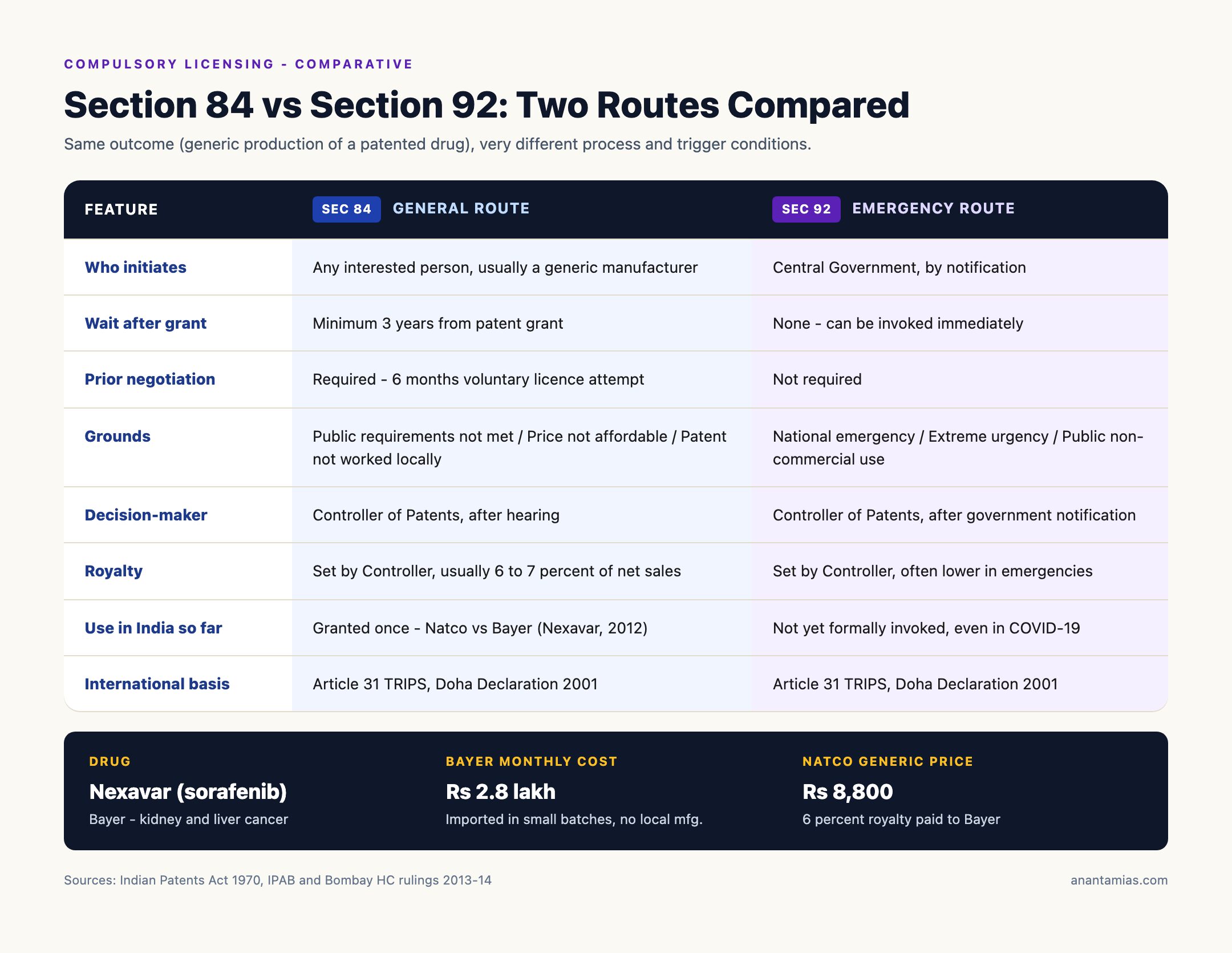
| Feature | Section 84 (General Route) | Section 92 (Emergency Route) |
|---|---|---|
| Who initiates | Any interested person, usually a generic firm | Central Government, by notification |
| Wait after patent grant | Minimum 3 years | None |
| Prior voluntary licence attempt | Required, usually 6 months | Not required |
| Grounds | Public requirements not met, price not affordable, patent not worked locally | National emergency, extreme urgency, public non-commercial use |
| Royalty | Set by Controller, e.g. 6 to 7 percent | Set by Controller, often lower in emergencies |
| Practical use in India | Granted once, Natco vs Bayer 2012 | Not yet invoked despite COVID-19 |
Challenges and Criticisms
Compulsory licensing is contested terrain. Pharmaceutical innovators argue that aggressive use of CL undermines the incentive to invest in costly drug research, particularly for diseases that affect lower-income populations. They point out that drug development costs run into billions of dollars per approved drug and that recovery depends on patent-protected pricing in a few markets.
Public health advocates push back. They argue that CL is meant to be the rare exception, used only when the gap between innovation incentive and patient access becomes intolerable. The fact that India has granted only one CL in a decade undercuts claims that it is being used as a routine tool. They also note that voluntary licensing, often informally encouraged by the threat of CL, has expanded global access to HIV antivirals, hepatitis C drugs and several oncology agents.
Procedural concerns are real. The Indian process is slow. The Natco-Bayer case took over a year at the Controller’s level and several more years through appeals. Predictability is also weak, since different cases turn on the facts and there are few precedents to guide industry. Reform proposals have included clearer guidelines on what counts as a reasonably affordable price, faster timelines for adjudication, and a more structured framework under Section 92 for public health emergencies. The 2024 amendments to the patent rules continued to focus on procedural simplification but left the substantive framework largely intact.
Prelims Pointers
- Compulsory licensing in India is governed by Sections 84 to 92 of the Patents Act, 1970.
- Section 84 is the general route and requires a three-year wait after patent grant.
- Section 92 is the emergency route and can be invoked at any time on grounds of national emergency, extreme urgency or public non-commercial use.
- The international basis is Article 31 of TRIPS and the Doha Declaration on Public Health, 2001.
- India’s first granted compulsory license was Natco vs Bayer in March 2012 for the cancer drug Nexavar (sorafenib).
- The Controller of Patents fixed a royalty of 6 percent on Natco’s net sales of the generic Nexavar.
- The Bolar exemption is contained in Section 107A and allows generic firms to conduct research and regulatory testing before patent expiry.
- Section 3(d) of the Indian Patents Act prevents evergreening of pharmaceutical patents and is a separate but related flexibility.
- The licensing authority is the Controller General of Patents, Designs and Trade Marks.
- India did not formally invoke Section 92 even during the COVID-19 pandemic, relying on voluntary licensing instead.
Mains Practice Questions
- Discuss the significance of Sections 84 and 92 of the Patents Act, 1970 in balancing innovation with public access to essential medicines. (250 words)
- Analyze the international legal basis for compulsory licensing under the TRIPS Agreement and the Doha Declaration. How has India operationalised these flexibilities? (250 words)
- The Natco vs Bayer (2012) decision is a landmark in India’s patent jurisprudence. Critically examine the case and its impact on subsequent policy. (250 words)
- Distinguish between compulsory licensing under Section 84 and the Bolar exemption under Section 107A. Why are both important? (150 words)
Way Forward
The way forward on compulsory licensing should rest on three principles. First, predictability. Industry and patient groups both benefit from clear guidelines on what counts as a reasonably affordable price and what level of local working is required. The Controller’s office could issue notes drawing on the Nexavar precedent and subsequent international practice. Second, speed. Section 92 should have a published operational protocol so that, if a public health emergency emerges, the government can act in days rather than weeks. The pandemic experience showed both the value of having such a tool ready and the political cost of not using it.
Third, voluntary licensing should be actively encouraged as the preferred route in non-emergency cases. Programs like the Medicines Patent Pool model in HIV, hepatitis C and tuberculosis show that pharmaceutical innovators can voluntarily license generics across most developing countries when the regulatory and pricing frameworks are credible. India can play a leadership role here by combining its strong generic industry with a clear set of CL backstops, much as it did during the early HIV antiretroviral period.
The wider IPR ecosystem also needs work. India should continue to invest in its patent examination capacity, deepen pharmaceutical R&D incentives that do not depend on monopoly pricing, and strengthen enforcement against genuine infringement. Pieces like our coverage of the national IPR policy and biotechnology governance lay out the larger picture into which compulsory licensing fits.
Frequently Asked Questions
What is compulsory licensing in simple terms?
Compulsory licensing is a legal mechanism that allows the government to authorize a third party, usually a generic drug manufacturer, to make and sell a patented product without the patent holder’s permission. The patent holder is paid a royalty but cannot prevent the licensed production.
Under what law is compulsory licensing granted in India?
It is granted under the Patents Act, 1970, primarily Sections 84 to 92. The international legal basis is Article 31 of the TRIPS Agreement and the Doha Declaration on TRIPS and Public Health, 2001.
What is the difference between Section 84 and Section 92?
Section 84 is the general route. Any interested person can apply after three years from patent grant, and they must first try a voluntary license. Section 92 is the emergency route, used by the central government on grounds of national emergency, extreme urgency or public non-commercial use, with no waiting period.
Has India ever actually granted a compulsory license?
Yes, once. In March 2012, the Controller of Patents granted Natco Pharma a compulsory license for Bayer’s cancer drug Nexavar (sorafenib). The price dropped from over Rs 2.8 lakh per month to about Rs 8,800 per month, with a 6 percent royalty payable to Bayer.
Does compulsory licensing violate global patent rules?
No. Compulsory licensing is expressly allowed by Article 31 of the TRIPS Agreement, and the Doha Declaration of 2001 reaffirmed that countries can grant such licenses on grounds they themselves determine, including public health.
What is the Bolar exemption and how is it different from compulsory licensing?
The Bolar exemption, under Section 107A of the Patents Act, allows generic manufacturers to use a patented invention for research and regulatory approval before the patent expires. It does not permit commercial sale during the patent term, unlike a compulsory license.
Why did India not invoke Section 92 during the COVID-19 pandemic?
The government relied on voluntary licensing of drugs like remdesivir and on technology transfer agreements rather than formally invoking Section 92. The Supreme Court was told that the option remained available but was not exercised.
What happens to the patent holder’s rights after a CL is granted?
The patent holder retains ownership of the patent and continues to receive a royalty fixed by the Controller of Patents. They lose only the exclusivity to be the sole producer for the duration and scope of the license.
Can a foreign company apply for a compulsory license in India?
Yes, in principle. Section 84 allows any interested person to apply, regardless of nationality. In practice, applications come from Indian generic manufacturers because they are best placed to manufacture and market the drug locally.
Does compulsory licensing discourage innovation in India?
The empirical evidence does not support strong claims of disincentive. India has granted only one compulsory license in over a decade, foreign direct investment in pharmaceuticals has grown, and Indian pharma R&D spending has continued to rise. CL is a backstop, not a routine tool.
Tell Google you want more of this.
Add Anantam IAS as a preferred sourceOne tap, and this site shows up more often in your own Top Stories, AI Overviews and AI Mode. Remove it any time.