Tarang Shakti: Coordinating Combat and Support Aircraft
Why in News?
The IAF announced on 27 September that Tarang Shakti 2026 was set to begin its operational phase at Jodhpur, bringing combat and support aircraft into multilateral training.
- The announced exercise window runs from 26 September to 12 October 2026.
- Participating aircraft include combat, airlift and air-to-air refuelling platforms.
- The release identifies aircrew, mission planners and support personnel as participants in professional exchanges.
- The operational phase was set to commence; the announcement does not establish completed missions or measured readiness gains.
- An aircraft formation needs fuel, support and coordinated timing to perform a mission safely.
- For defence analysis, distinguish training opportunities from demonstrated operational performance and binding alliance commitments.
UPSC Relevance
Prelims Relevance
- Tarang Shakti: a multilateral air exercise involving the Indian Air Force.
- Airlift: movement of personnel and cargo by aircraft.
- Aerial refuelling: transfer of fuel between aircraft during flight.
- Deconfliction: separating activities in space or time to reduce interference and collision risk.
- Interoperability: the ability of participating forces to work together effectively.
Mains Relevance
GS Paper 3
- Why support aircraft and logistics shape usable air power.
- How procedures, compatible equipment and safety training affect multinational missions.
GS Paper 2
- Defence exercises as practical engagement without automatic alliance obligations.
Background and Context
A mission depends on several aircraft roles
Tarang Shakti highlights the supporting work behind air operations; the following mechanisms explain general air-power principles, rather than confirmed exercise missions.
- Combat aircraft carry out assigned operational tasks, but their usefulness depends on reaching the operating area with enough fuel and receiving the support needed to return safely.
- Airlift aircraft move people, equipment and supplies. Transporting maintenance personnel or spare parts supports sustained activity; it is a different function from transferring fuel to another aircraft in flight.
- Tanker aircraft provide airborne fuel support. This can extend a compatible receiver aircraft’s endurance or reach, but it adds another aircraft, crew and rendezvous to the mission plan.
- Support availability changes what planners can realistically schedule. A large combat-aircraft inventory alone says little about the fuel support, maintenance capacity and crew preparation available for a particular operation.
- Role integration is the central lesson: the mission depends on connected functions. Counting aircraft types without examining those connections gives an incomplete picture of the capability being developed.
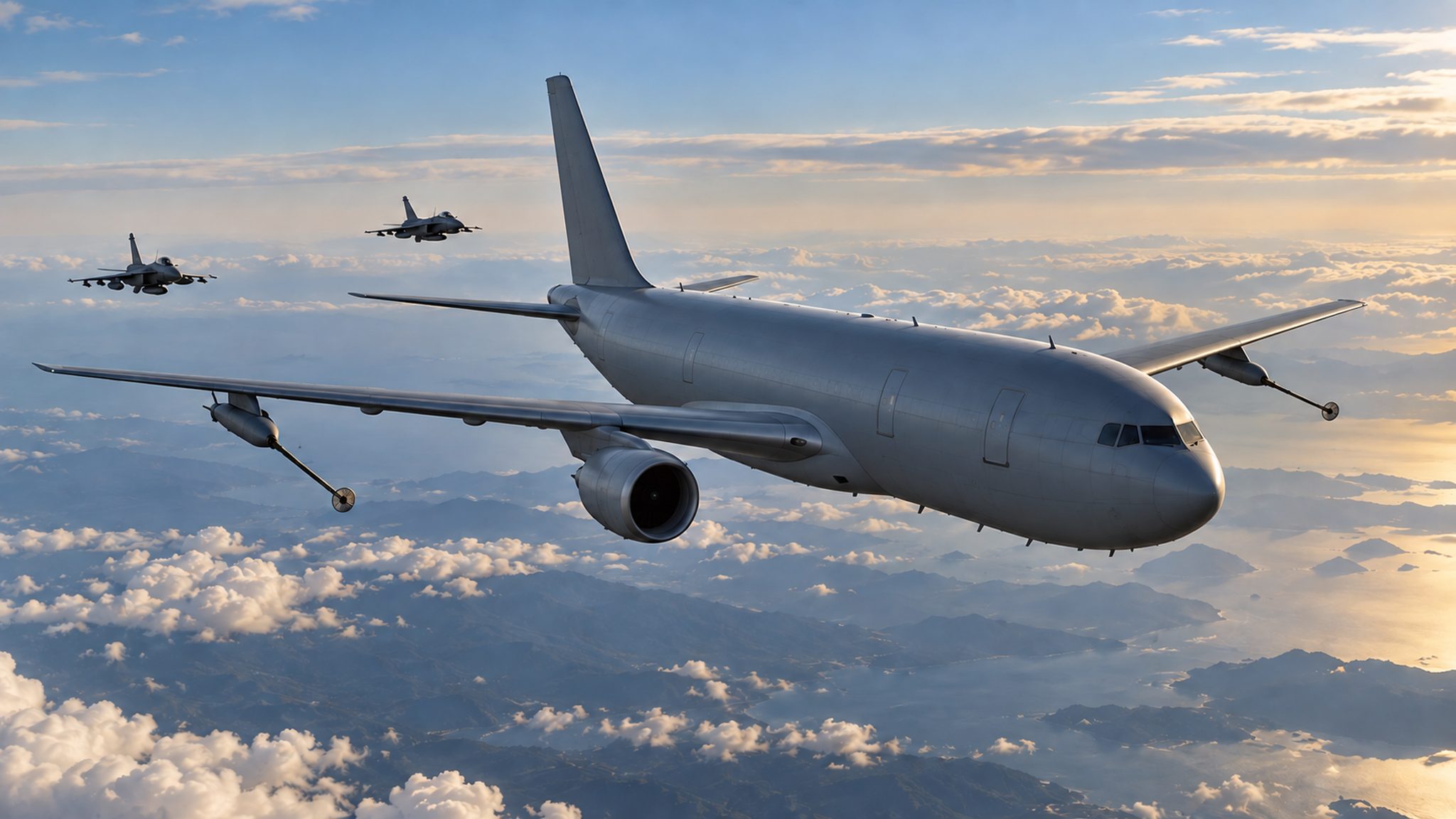
Aerial refuelling requires compatibility
Fuel transfer is a coordinated encounter between a tanker and receiver, rather than a facility every aircraft can use interchangeably.
- Boom refuelling uses a rigid extendable tube connected to a receiving receptacle. A probe-and-drogue arrangement instead uses a receiver probe and a hose ending in a stabilising basket.
- Hardware compatibility matters because these interfaces differ. The presence of tankers and fighters at the same exercise does not establish that every possible pairing can conduct a fuel transfer.
- Operating conditions matter alongside the physical connection. The aircraft must be able to meet and remain within appropriate flight conditions while trained crews perform the agreed refuelling procedure.
- General reference: the US Air Force tanker fact sheet explains boom and drogue arrangements; it does not establish which pairings Tarang Shakti will employ.
Fuel support must fit the mission clock
A suitable tanker helps only when its availability, meeting point and receiver requirements fit the planned operation.
- Rendezvous planning connects the tanker route with the receiver’s route. The meeting must allow time for fuel transfer while accounting for weather, airspace availability and the aircraft requiring support.
- Fuel allocation is a planning constraint, not an unlimited reserve. Planners must relate receiver needs to available tanker support and preserve workable options if the intended meeting cannot occur.
- Airspace deconfliction assigns compatible operating space or timing. Clear coordination reduces the risk that aircraft performing different tasks interfere with one another while approaching, manoeuvring or leaving an area.
- Schedule changes can propagate across the mission: a delayed support aircraft may require revised timings elsewhere. This illustrates why mission planners and support personnel train alongside the crews flying combat aircraft.
Training creates evidence only when assessed
The useful question is what participants can coordinate safely, and what the publicly available evidence actually demonstrates.
- Procedural learning can include understanding partners’ planning methods and operating practices. The official release announces these opportunities; it does not publish results proving that every coordination difficulty has been resolved.
- Shared participation does not establish common weapons, unrestricted information sharing or a treaty commitment. Each claim needs separate evidence beyond the fact that foreign contingents joined an exercise.
- Comparison: SLINEX teaches maritime coordination. Here, the distinctive constraints are aircraft support, refuelling compatibility and tightly connected mission timings, rather than harbour-to-sea progression.
- Observer learning, discussed in Quad-at-Sea, also differs from executing a coordinated mission. Observation can develop understanding without demonstrating the ability to perform every operational task.
Way Forward
Assess coordination through observable learning
- Record planning and safety lessons from completed training before asserting that interoperability has improved.
- Evaluate support dependencies, including refuelling arrangements and maintenance availability, alongside combat-aircraft performance.
- Use debriefing to identify communication or timing problems and revise procedures without disclosing sensitive operational information.
Conclusion
- Tarang Shakti offers a concrete way to explain how combat aircraft depend on airlift, fuel support and coordinated mission planning.
- A sound assessment separates announced training from verified results, and treats equipment compatibility, timing and safe procedures as distinct requirements for effective cooperation.
UPSC Practice Questions
Prelims MCQ 1
With reference to aerial refuelling and air exercises, consider the following statements:
- Airlift and aerial refuelling perform the same function.
- Boom and probe-and-drogue systems use different refuelling interfaces.
- The presence of tankers and fighters at an exercise proves that every pairing is compatible.
How many of the above statements are correct?
(a) Only one (b) Only two (c) All three (d) None
Answer: (a) Only one
Explanation:
Only statement 2 is correct. Airlift moves personnel and cargo, while refuelling transfers fuel in flight. Compatibility must be established for the relevant tanker and receiver.
Prelims MCQ 2
Which consideration best explains why tanker support must be integrated into mission planning?
(a) Every combat aircraft uses an identical refuelling interface. (b) Airborne fuel transfer removes the need to plan aircraft routes. (c) The tanker and receiver must meet under suitable timing, airspace and operating conditions. (d) A multinational exercise automatically creates a mutual-defence obligation.
Answer: (c) The tanker and receiver must meet under suitable timing, airspace and operating conditions.
Explanation:
Useful fuel support requires a workable rendezvous, compatible equipment and agreed operating procedures. Participation alone establishes neither universal compatibility nor alliance obligations.
UPSC Mains Questions
- Explain how support aircraft and mission planning influence the effectiveness of combat air power. (150 words)
- Multilateral air exercises can improve practical cooperation, but participation alone does not demonstrate operational readiness. Discuss with reference to Tarang Shakti. (250 words)
Sources: PIB, Ministry of Defence and US Air Force, Air Mobility Operations doctrine.
Frequently Asked Questions
What is Tarang Shakti 2026?
Tarang Shakti is a multilateral air exercise involving the IAF and partner air forces. The September announcement identifies combat, airlift and refuelling platforms and an operational phase at Jodhpur.
Why are tanker aircraft important?
Tankers transfer fuel to compatible aircraft in flight, potentially extending endurance or reach. Their usefulness depends on appropriate equipment, trained crews and a rendezvous that fits the mission’s timing and airspace.
Does aerial refuelling work between any two aircraft?
No. The tanker and receiver need compatible refuelling interfaces and suitable operating conditions. Their presence at the same exercise does not prove that every aircraft pairing can safely transfer fuel.
Does Tarang Shakti already demonstrate improved readiness?
The cited announcement describes the operational phase as set to commence and outlines training opportunities. Claims about achieved readiness require evidence from completed activities and assessment, rather than the announcement alone.