Tiger Translocation: Sariska and India’s Active Conservation Model
Why in News?
PIB said Union Environment Minister Bhupender Yadav inaugurated a national workshop on tiger translocation and reintroduction at Alwar, Rajasthan, marking 18 years of tiger reintroduction in Sariska Tiger Reserve.
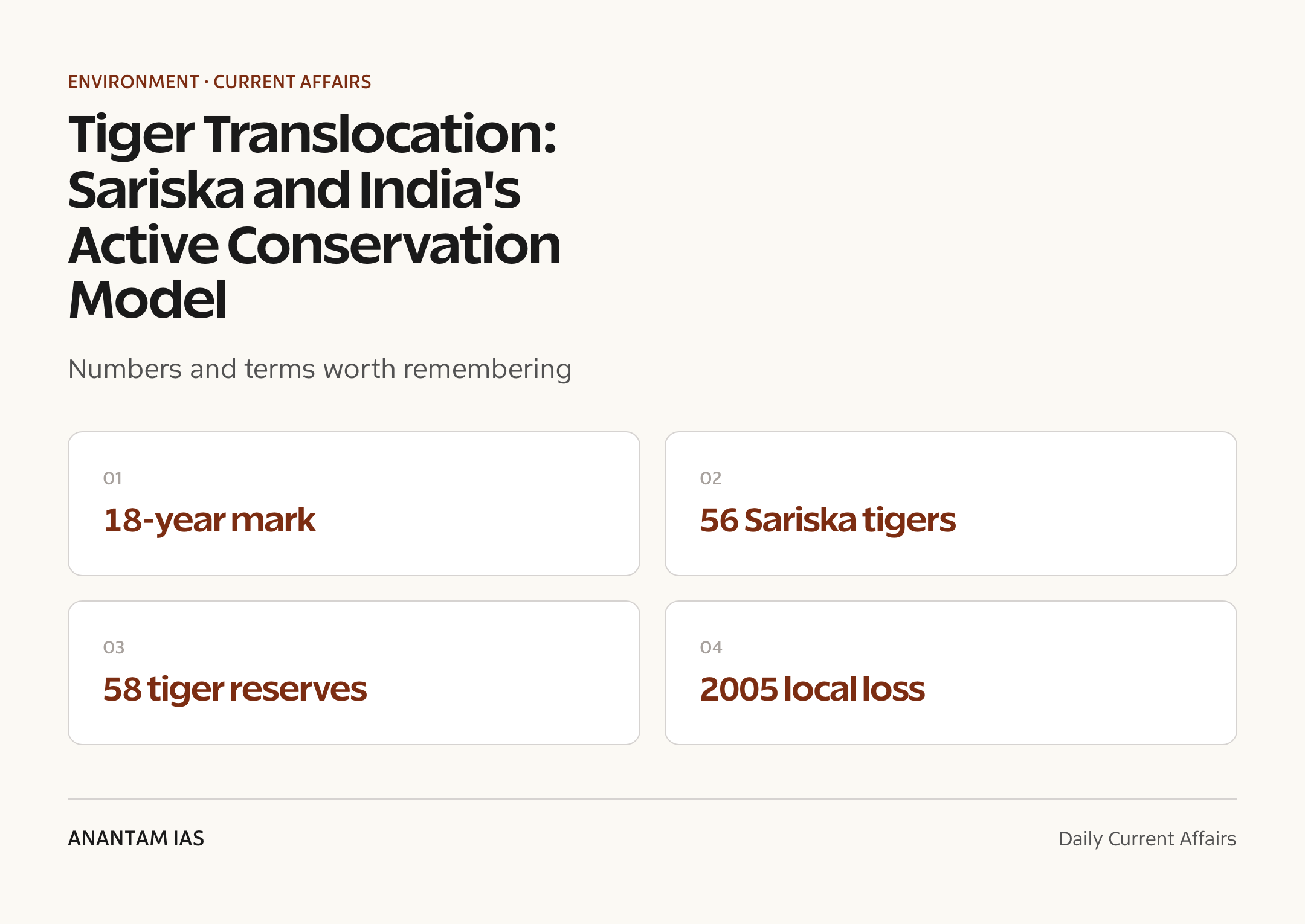
The release framed Sariska as a global example of scientific recovery after local extinction: the reserve, tiger-less around 2005, now shelters 56 tigers and is being used to discuss active management for future conservation.
- The workshop was organised by the National Tiger Conservation Authority, the Ministry of Environment, Forest and Climate Change, and the Rajasthan Government.
- Participants included field directors, chief wildlife wardens, and wildlife experts from tiger-bearing regions.
- PIB called Sariska the world’s first successful scientific tiger translocation programme in an area where tigers had become locally extinct.
- The minister said India’s tiger reserves increased from 46 to 58 in the last decade.
- Three publications were released: a framework for active tiger management, a booklet on tiger reintroduction and population recovery, and the Project Cheetah annual progress report.
The development matters in the context of:
- Tiger translocation matters because many Indian tiger landscapes have strong source populations in some reserves and weak or empty sink habitats elsewhere.
- Reintroduction is not just moving an animal; it needs prey recovery, habitat security, genetic planning, veterinary screening, conflict management, and long-term monitoring.
- Sariska and Panna show that scientific movement of animals can rebuild lost populations when local communities and field staff support the programme.
- Satkosia is the cautionary example in the PIB note: weak community support can block even a technically sound conservation design.
UPSC Relevance
Prelims Relevance
- Sariska Tiger Reserve is in Rajasthan’s Alwar region and lies in the Aravalli landscape.
- Tiger translocation means shifting wild tigers from one landscape to another for recovery, supplementation, or genetic rescue under official approval.
- Reintroduction means restoring a species to an area from which it has become locally extinct.
- NTCA functions under the Ministry of Environment, Forest and Climate Change and anchors tiger conservation with states.
- Project Tiger, launched in 1973, uses the core-buffer approach; revise the foundation through Project Tiger.
- Wildlife Protection Act, 1972 provides the legal base for protected areas, tiger reserves, and species protection.
- All India Tiger Estimation is a quadrennial exercise coordinated by NTCA, states, and scientific institutions.
- Source population means a habitat producing surplus animals; sink habitat needs immigration or management support to sustain numbers.
- Project Cheetah uses a different species and landscape, but the exam hook is similar: reintroduction, monitoring, prey base, and local consent.
Mains Relevance
GS Paper 3
- Conservation of biodiversity, protected-area management, and landscape-level recovery.
- Science-led wildlife management, including translocation, genetic safeguards, prey recovery, and monitoring.
GS Paper 2
- Centre-state coordination through NTCA, state forest departments, and local administration.
- Community participation, tribal and local livelihood concerns, and fair benefit-sharing around conservation landscapes.
Essay
- Conservation succeeds when science, state capacity, and community trust move together.
- A tiger reserve is not only a species space; it is also a forest, water, livelihood, and governance system.
Background and Context
What tiger translocation means
Tiger translocation is an active conservation tool, not a routine rescue or display exercise.
- Translocation involves capturing, transporting, releasing, and monitoring wild animals under a planned conservation objective.
- Reintroduction is a narrower case: it restores a species to a habitat where it has disappeared, as happened in Sariska after local extinction.
- Supplementation adds animals to a weak existing population, often to improve numbers, sex ratio, or genetic diversity.
- Genetic rescue may be needed when a small isolated population faces inbreeding, low reproductive success, or poor long-term viability.
- Soft release may use acclimatisation enclosures and close monitoring; hard release allows quicker entry into the wild landscape.
- Radio-collars, camera traps, pugmark confirmation, prey tracking, and veterinary follow-up convert a release into a monitored conservation project.
- For basics on the species, taxonomy, and conservation story, revise Tiger (Panthera tigris).
Why Sariska became the case study
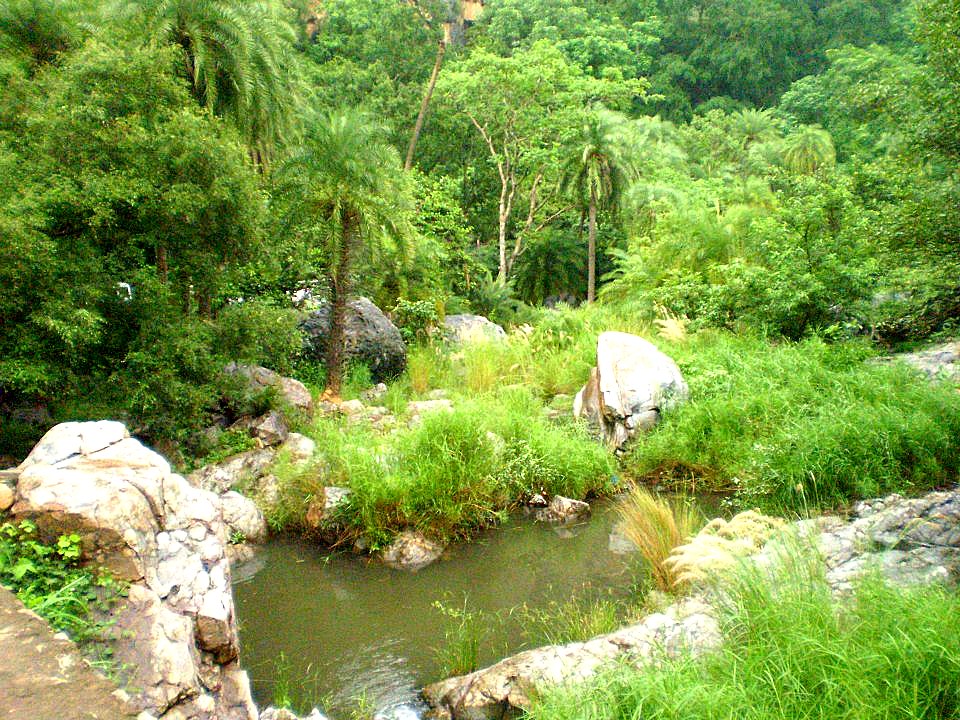
Sariska is exam-relevant because it moved from failure to recovery under a visible conservation experiment.
- Sariska Tiger Reserve had lost its local tiger population around 2005, making it a test case for whether a reserve can be rebuilt after local extinction.
- PIB said the Sariska programme is the world’s first successful scientific tiger translocation in a landscape where the species had disappeared locally.
- The reserve now has 56 tigers, according to the minister’s statement at the workshop.
- The recovery matters because it shows that tiger conservation is not limited to guarding strongholds such as Ranthambore, Corbett, or Kanha.
- Aravalli ecology adds a geography angle: dry deciduous forests, rocky hills, water stress, tourism pressure, and village interface all affect carrying capacity.
- For nearby static geography, use Ranthambore National Park as a comparison point in Rajasthan’s tiger landscape.
India's active tiger management model
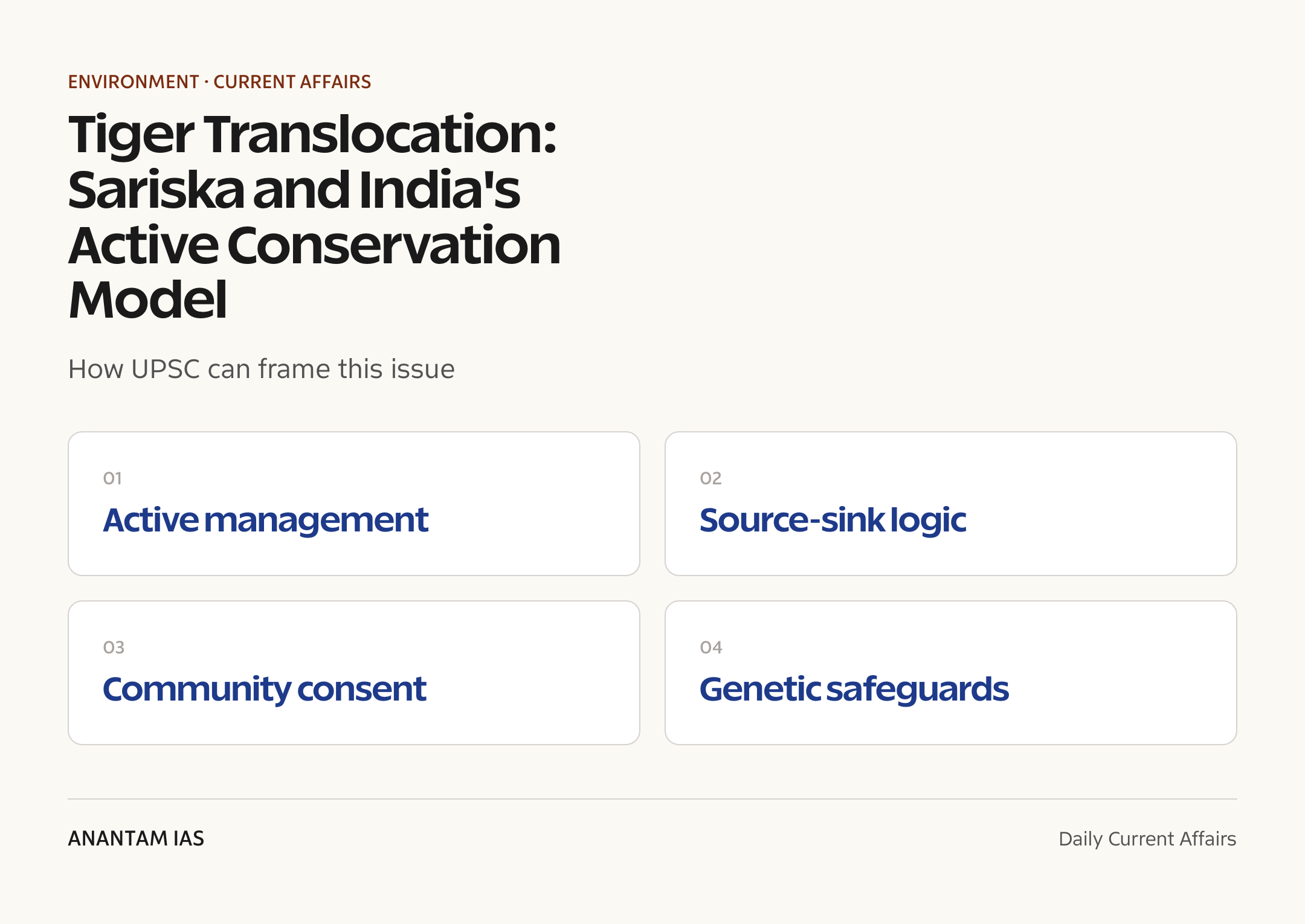
The workshop points to a shift from passive protection to planned, science-led population management.
- Active management means the state intervenes where natural recovery alone is unlikely because of local extinction, isolation, low prey base, or human pressure.
- Source-sink planning identifies reserves that can safely donate dispersing animals and reserves that need rebuilding or demographic support.
- Carrying capacity is central: a reserve cannot hold more tigers than its prey, territory, water, and human-pressure profile can sustain.
- Habitat corridors decide whether a reintroduced population can exchange genes naturally or stays trapped as an isolated island.
- Prey base recovery must precede release; without sambar, chital, nilgai, wild pig, and other prey, relocated tigers move toward livestock.
- Veterinary protocols reduce disease risks when animals are moved across landscapes.
- M-STrIPES, camera traps, field patrols, and independent scientific review keep translocation from becoming a one-time headline.
Legal and institutional framework
Tiger recovery sits inside a legal structure, not an informal conservation experiment.
- Wildlife Protection Act, 1972 is the parent law for protected areas, species protection, and wildlife crime control in India.
- Tiger reserves operate with core and buffer zones, where core areas are kept as critical tiger habitat and buffers manage coexistence pressures.
- NTCA provides technical oversight, approval, advisories, monitoring frameworks, and funding support under Project Tiger.
- State forest departments handle local field implementation: habitat works, patrolling, relocation logistics, community dialogue, and conflict response.
- Wildlife Institute of India and other scientific bodies can support capture protocols, health checks, radio-telemetry, and post-release monitoring.
- The institutional base can be revised through NTCA.
Community support as the deciding factor
The PIB note makes a clear governance point: local consent is not decorative, it can decide success or failure.
- Sariska and Panna are cited as successful because conservation agencies worked with local communities and field institutions.
- Satkosia Tiger Reserve in Odisha is cited as a difficult case where weak community support limited success.
- Human-wildlife conflict rises when tigers move through villages, prey on livestock, or generate fear around forests and grazing routes.
- Compensation systems must be fast, transparent, and trusted; delay can turn a conservation project into a political conflict.
- Eco-development should connect tourism revenue, local jobs, grassland management, fuelwood alternatives, and village-level conservation incentives.
- Relocation, where needed from core areas, must follow consent, lawful compensation, livelihood support, and long-term rehabilitation.
- This is a good case to connect with human-wildlife conflict.
Prelims data and wider significance
The news also carries compact factual data that can appear in objective questions.
- PIB said India’s tiger reserves rose from 46 to 58 in the last decade.
- PIB said India met the Saint Petersburg Declaration target of doubling wild tiger numbers by 2022 ahead of the global deadline.
- Official tiger estimation data place India’s 2022 tiger estimate at an average of 3,682, with a range of 3,167 to 3,925.
- India is home to more than 70% of the world’s wild tigers, making its conservation choices globally significant.
- Panna and Sariska show recovery after local extinction; Satkosia reminds aspirants that social acceptance is part of ecology.
- The minister also released a Project Cheetah annual progress report, linking tiger recovery with India’s wider reintroduction debates.
Way Forward
Make translocation evidence-led
- Approve tiger movement only after habitat suitability, prey base, water availability, disease risk, genetic compatibility, and conflict risk are independently assessed.
- Use source-sink mapping so donor reserves are not weakened and recipient landscapes are not overloaded beyond carrying capacity.
- Publish non-sensitive monitoring summaries so the public can track survival, dispersal, conflict incidents, breeding, and prey trends.
Protect the landscape, not only the release site
- Secure wildlife corridors through land-use planning, mitigation structures on roads and railways, and voluntary community cooperation.
- Invest in prey recovery, grassland management, water-point planning, invasive-species control, and anti-poaching patrols before adding tigers.
- Integrate reserve management with district administration, tourism rules, disaster response, and local development schemes.
Put communities at the center
- Build fast livestock compensation, early warning, insurance, and trained rapid-response teams around translocation landscapes.
- Share conservation gains through local guides, eco-tourism jobs, skill training, fuelwood alternatives, and village-level infrastructure.
- Treat consent and trust as core conservation infrastructure, not as a public-relations add-on.
Conclusion
Sariska shows that a reserve can recover from local extinction when science, field discipline, political backing, and community support work together.
The larger lesson is practical: tiger translocation is useful only when habitat, prey, genes, people, and monitoring are planned as one system.
For UPSC, the case is not just about tigers. It is about how India manages biodiversity recovery in a crowded federal landscape where conservation, livelihoods, tourism, and state capacity meet.
UPSC Practice Questions
Prelims MCQ 1
With reference to tiger reintroduction and translocation in India, consider the following statements:
- Sariska Tiger Reserve is cited by PIB as a successful scientific tiger translocation case after local extinction.
- The National Tiger Conservation Authority functions under the Ministry of Environment, Forest and Climate Change.
- Satkosia Tiger Reserve was cited in the PIB release as a case where weak community support affected translocation success.
How many of the above statements are correct?
(a) Only one (b) Only two (c) All three (d) None
Answer: (c) All three
Explanation:
All three statements are correct. PIB cited Sariska’s recovery, referred to NTCA’s role under MoEFCC, and contrasted Sariska/Panna with the Satkosia difficulty linked to weaker community support.
Prelims MCQ 2
Which of the following best describes reintroduction in wildlife conservation?
(a) Moving rescued captive animals to a zoo for breeding (b) Restoring a species to a habitat where it had become locally extinct (c) Counting wildlife with camera traps in a protected area (d) Expanding tourism infrastructure around a tiger reserve
Answer: (b) Restoring a species to a habitat where it had become locally extinct
Explanation:
Reintroduction is the planned return of a species to part of its former range after local disappearance. Sariska is relevant because tigers were restored after local extinction.
UPSC Mains Questions
- Tiger translocation can help recover locally extinct populations, but it can also deepen conflict if habitat and community concerns are ignored. Discuss with reference to Sariska, Panna and Satkosia.
- Explain the role of the National Tiger Conservation Authority in India’s tiger conservation model. How does active management differ from conventional protected-area protection?
- Biodiversity conservation in India is now a question of landscape governance, not only species protection. Examine using the example of tiger reintroduction.
Sources: PIB, Ministry of Environment, Forest and Climate Change and PIB, All India Tiger Estimation 2022.
Frequently Asked Questions
What is tiger translocation?
Tiger translocation is the planned movement of wild tigers from one habitat to another for conservation. It may support reintroduction, supplementation, or genetic rescue. It needs official approval, veterinary screening, habitat assessment, prey-base review, release planning, and long-term monitoring.
Why is Sariska important?
Sariska is important because tigers had become locally extinct there around 2005, and the reserve was later rebuilt through scientific reintroduction. PIB says Sariska now has 56 tigers and stands as a global example of successful tiger recovery after local extinction.
Who manages tiger conservation in India?
Tiger conservation is coordinated by the National Tiger Conservation Authority under the Ministry of Environment, Forest and Climate Change, with state forest departments implementing field work. Scientific institutions, local administrations, and communities also matter because tiger landscapes cross administrative and social boundaries.
Why did Satkosia face difficulty?
PIB cited Satkosia as a case where community support was weaker than in Sariska and Panna. The lesson is that a technically sound translocation plan can still struggle if local people fear conflict, distrust compensation, or see few benefits from conservation.
How is reintroduction different from supplementation?
Reintroduction restores a species to an area where it had disappeared locally. Supplementation adds individuals to an existing weak population. Both require habitat suitability, prey availability, genetic planning, disease checks, and monitoring, but the starting ecological condition is different.
Why does this matter for UPSC?
The topic connects GS3 environment with governance and ethics. It covers Project Tiger, NTCA, Wildlife Protection Act, protected-area management, human-wildlife conflict, community participation, science-led policy, and the limits of conservation when local trust is weak.