AI in Financial Services: UK Regulator Flags Systemic Risks
Why in News?
The Hindu (via Reuters) reported on 7 July 2026 that a review commissioned by the Financial Conduct Authority (FCA) — the United Kingdom’s conduct regulator for financial services — has urged it to consider regulating large language models (LLMs) such as ChatGPT, Claude and Gemini because of their growing influence on consumer financial decisions. The review, led by FCA Executive Director Sheldon Mills, was published on 6 July 2026.
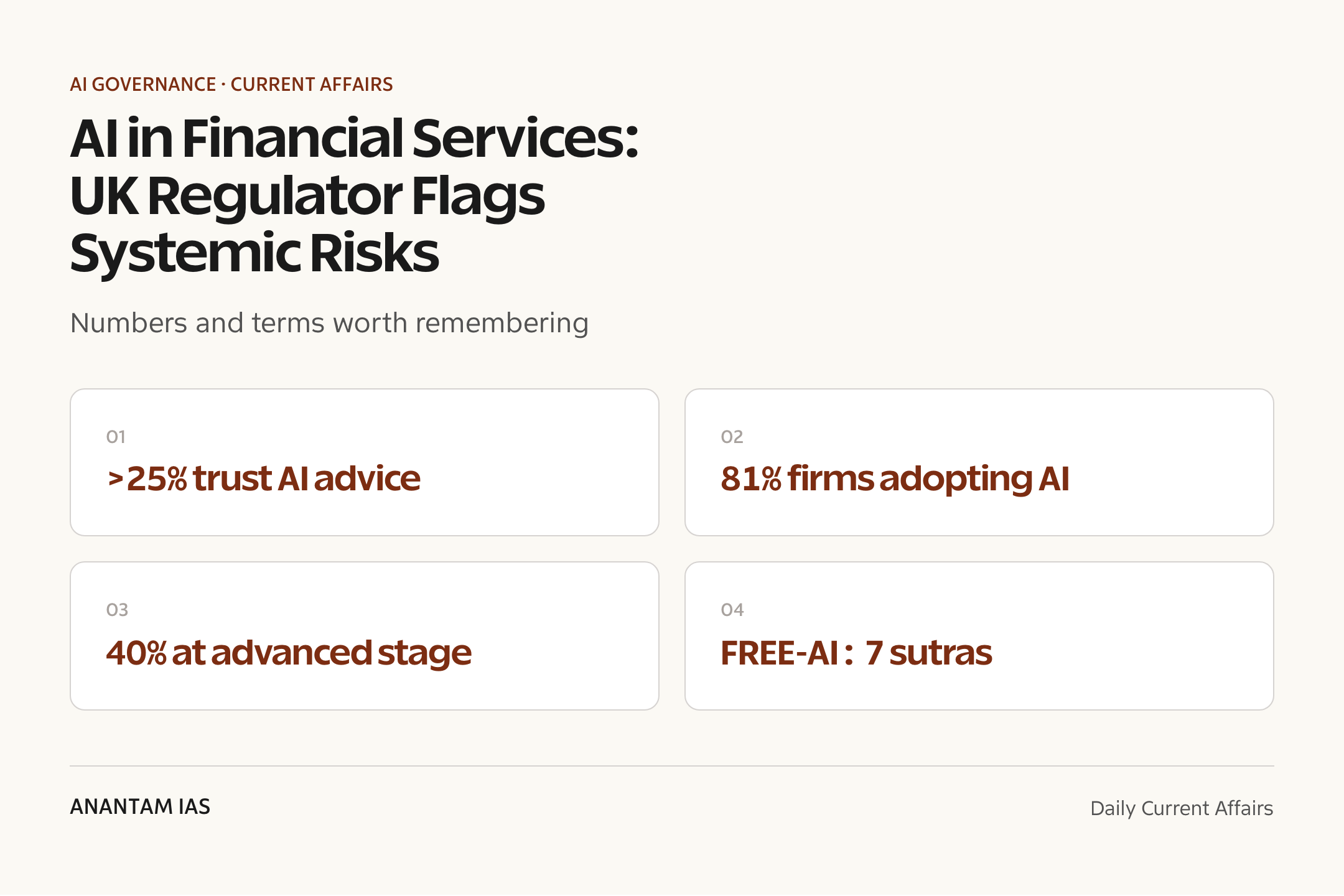
The headline finding: more than a quarter of UK consumers already trust general-purpose AI chatbots for financial advice, with little awareness that regulated-service protections don’t extend to them. The review also warned that reliance on a handful of technology providers could create system-wide risks. The FCA calls itself the first regulator globally to study AI’s impact on financial services this way.
- The review recommends the FCA decide within 3–6 months whether to “secure and adapt” the regulatory perimeter in response to AI models sitting outside it.
- A survey cited in the review found 81% of financial firms globally adopting AI at some level, with 40% at more advanced stages.
- Most use cases sit in lower-risk back-office functions, but UK firms are pushing AI into customer-facing roles such as complaints handling and investment guidance.
- A week earlier, Bank of England Deputy Governor Sarah Breeden signalled, for the first time, the need for bespoke AI regulation to contain risks from increasingly capable agentic systems.
- The FCA isn’t bound to act on the recommendations — an advisory exercise, much like the RBI’s own FREE-AI committee report of August 2025.
The development matters in the context of:
- The review matters for India because the Reserve Bank of India (RBI) has walked the same road: its FREE-AI committee delivered a full framework for responsible AI in finance in August 2025.
- It hands GS3 answers a ready comparative frame — the EU’s binding AI Act, the UK’s sectoral approach, and India’s advisory, pro-innovation model.
- The risks it names — concentration risk, herding, model risk, blurred advice boundaries — are durable syllabus concepts, not one-off news.
UPSC Relevance
Prelims Relevance
- Financial Conduct Authority (FCA) — the UK’s conduct regulator for financial services; first regulator globally to study AI’s impact on the sector.
- Regulatory perimeter — the legal boundary between activities needing regulatory authorisation (like personalised financial advice) and those outside a regulator’s remit.
- FREE-AI — RBI’s Framework for Responsible and Ethical Enablement of Artificial Intelligence; committee chaired by Dr Pushpak Bhattacharyya (IIT Bombay), report released 13 August 2025.
- FREE-AI architecture — 7 sutras and 26 recommendations under 6 pillars: Infrastructure, Policy, Capacity, Governance, Protection, Assurance.
- Agentic AI — AI systems that plan and act toward goals with limited human intervention, unlike chatbots that only respond to prompts.
- Concentration risk — many firms depending on a few AI-model or cloud providers, creating common points of failure; related: herding (correlated behaviour from shared models).
- EU AI Act — the world’s first comprehensive, binding AI law; risk-based tiers; entered into force in August 2024.
- RBI Regulatory Sandbox (2019) — live-testing framework for fintech products; MuleHunter.AI — Reserve Bank Innovation Hub model that helps banks detect mule accounts.
Mains Relevance
GS Paper 3
- Systemic risk from AI in finance — concentration, herding, correlated failures — as a new category of financial-stability threat.
- Regulating emerging technology in critical sectors: the EU’s binding law versus the UK’s review-led approach versus India’s FREE-AI advisory framework.
- Consumer protection when unregulated LLM chatbots give quasi-financial advice outside the regulatory perimeter.
GS Paper 2
- Capacity of statutory regulators (RBI, SEBI) to keep pace with general-purpose technologies; the case for coordination through the FSDC.
- Comparative governance — structuring accountability for AI without a single dedicated law.
Essay
- Trust is the real currency of finance — and machines are now minting it.
- Regulation in the age of AI: guarding the perimeter of a borderless technology.
Background and Context
What the FCA Review Actually Says
The review is a diagnosis of how fast AI has moved from the back office to the customer’s phone — and how far behind the rulebook sits.
- Commissioned by the FCA and led by Executive Director Sheldon Mills, the review was published on 6 July 2026; the regulator isn’t bound to act on it.
- It found more than a quarter of UK consumers trust tools such as ChatGPT, Claude and Gemini for financial advice — with limited awareness that regulated-service protections don’t extend to those AI services.
- It cited survey data showing 81% of financial firms globally adopting AI, and 40% at advanced stages — a primer on how these models work is in this generative AI and LLMs explainer.
- Central recommendation: within 3–6 months, the FCA should consider whether to “secure and adapt” the regulatory perimeter by reviewing the scale, nature and impact of AI models sitting outside it.
The Regulatory Perimeter Problem
The sharpest issue in the review is definitional: when does a chatbot’s answer become regulated financial advice?
- The regulatory perimeter is the boundary between activities that require a regulator’s authorisation (and carry consumer protections) and activities outside its remit.
- In the UK, financial advice is a regulated activity only authorised businesses may provide — so an AI chatbot should offer nothing beyond generic financial guidance.
- Mills warned that personal recommendations by a chatbot blur this boundary, and “continuous and adaptive” recommendations may start to look like regulated advice.
- The consumer harm is concrete: a user misled by an unregulated LLM has none of the compensation and grievance protections that apply to authorised advisers.
- Jonathan Herbst of law firm Norton Rose Fulbright noted the review proposes no immediate crackdown — the question is whether rules must evolve to match how financial services are actually delivered.
Concentration Risk: Why AI Is a Financial-Stability Issue
The deeper worry isn’t one bad answer to one consumer — it’s the whole system leaning on the same few machines.
- Widespread adoption could leave firms dependent on a small number of technology providers for critical operational capabilities.
- Shared reliance on the same models or cloud providers could create correlated behaviour, herding and common points of failure across the financial system — the classic anatomy of systemic risk.
- Regulators are also tracking frontier AI models and agentic systems — AI that acts with limited human intervention; see this explainer on agentic AI.
- Bank of England Deputy Governor Sarah Breeden put it bluntly: “Our frameworks were not built to contemplate autonomous agents, and relying on a human in the loop for all agent actions is unlikely to be realistic.”
- Model risk — a model’s errors or opacity producing bad decisions at scale — turns system-wide when everyone runs the same model; the Financial Stability Board flagged these vulnerabilities in November 2024.
India's Answer: RBI's FREE-AI Framework
India didn’t wait for London — the RBI commissioned its own AI framework well before the FCA review appeared.
- In December 2024, the RBI constituted an 8-member expert committee chaired by Dr Pushpak Bhattacharyya (IIT Bombay); its FREE-AI report came on 13 August 2025.
- It rests on 7 sutras: Trust is the Foundation; People First; Innovation over Restraint; Fairness and Equity; Accountability; Understandable by Design; Safety, Resilience and Sustainability.
- It makes 26 recommendations across 6 pillars — Infrastructure, Policy, Capacity, Governance, Protection and Assurance.
- Key asks: board-approved AI policies in every regulated entity, independent model validation and audits, disclosure to customers when AI materially affects outcomes, and AI-specific safeguards in vendor contracts.
- It explicitly targets third-party concentration — the same risk the FCA now flags — by clarifying how RBI’s outsourcing guidelines apply to AI providers.
- Like the FCA review, FREE-AI is advisory, not binding; supporting rails exist in the RBI Regulatory Sandbox (2019) and MuleHunter.AI, the Reserve Bank Innovation Hub’s mule-account detection model.
The Wider Indian AI-Governance Stack
FREE-AI sits inside a broader, deliberately sectoral Indian approach to AI governance.
- SEBI has required market intermediaries to report their AI/ML applications since 2019, and in June 2025 floated a consultation paper on responsible AI/ML use in securities markets.
- The IndiaAI Mission (approved March 2024, about ₹10,372 crore) builds the enabling side — shared GPU compute, datasets, indigenous models and an AI Safety Institute.
- The Digital Personal Data Protection Act, 2023 — Rules notified in November 2025 — governs the personal data financial AI systems train on; see this note on the DPDP Act 2023.
- India has no standalone AI statute: the strategy is pro-innovation, resting on sectoral frameworks like FREE-AI plus existing IT and data-protection law — mapped in AI governance in India.
Three Models of AI Regulation: EU, UK, India
The FCA review is a live case study in the middle path between hard law and no law.
- European Union — the EU AI Act (in force since August 2024) is a binding, horizontal law sorting AI uses into risk tiers, with the heaviest obligations on high-risk systems such as credit scoring.
- United Kingdom — no single AI law; sectoral regulators (FCA, Bank of England) apply principles and existing powers, commissioning reviews like this one before deciding whether the perimeter must move.
- India — an enabling, sector-led model: advisory frameworks (FREE-AI, SEBI’s draft norms), a state-funded capability push (IndiaAI Mission) and general statutes (DPDP Act, IT Act) rather than one omnibus AI law.
- The trade-off: binding rules give certainty but can freeze innovation; advisory frameworks stay flexible but lean on voluntary compliance and regulator vigilance.
Way Forward
For financial regulators
- Adopt risk-proportionate rules: light touch for back-office AI, hard obligations for customer-facing and credit-decision systems.
- Run periodic regulatory-perimeter reviews so adaptive chatbot ‘guidance’ can’t quietly become unregulated advice.
- Map and stress-test concentration risk: identify the models and cloud providers the sector collectively depends on, and require fallback plans; build AI incident-reporting channels so model failures surface the way cyber incidents do.
For India specifically
- Convert FREE-AI’s 26 recommendations into phased supervisory expectations, starting with board-approved AI policies and model audits.
- Use the FSDC platform for RBI–SEBI–IRDAI coordination, since the same foundation models cut across banking, securities and insurance.
- Expand the Regulatory Sandbox to test agentic-AI use cases under supervision before they reach customers at scale.
- Invest in consumer literacy: users must know a chatbot’s confident answer carries none of the protections of regulated advice.
Conclusion
The FCA review marks a turn in how supervisors think about AI: the question is no longer whether banks may use it, but whether the financial system’s plumbing — shared models, shared clouds, autonomous agents — is quietly becoming a single point of failure. Concentration, herding and blurred advice boundaries are now financial-stability vocabulary.
For India, the moment is validating rather than alarming. The FREE-AI framework anticipated nearly every risk the UK review names — a year earlier. The harder task is execution: turning sutras into supervision before an AI-driven failure, not after. For the aspirant, FCA review plus FREE-AI is a ready-made GS3 answer on regulating AI in critical sectors.
UPSC Practice Questions
Prelims MCQ 1
With reference to the RBI’s FREE-AI framework, consider the following statements:
- FREE-AI stands for the Framework for Responsible and Ethical Enablement of Artificial Intelligence, prepared by an expert committee constituted by the Reserve Bank of India.
- The committee’s report is built around seven guiding principles or ‘sutras’, the first being ‘Trust is the Foundation’.
- The report’s 26 recommendations are legally binding on all banks and NBFCs from the date of its release.
How many of the above statements are correct?
(a) Only one (b) Only two (c) All three (d) None
Answer: (b) Only two
Explanation:
Statements 1 and 2 are correct: the 8-member committee chaired by Dr Pushpak Bhattacharyya released the FREE-AI report on 13 August 2025, built on 7 sutras beginning with ‘Trust is the Foundation’. Statement 3 is wrong — the report is advisory, not a binding regulation.
Prelims MCQ 2
The term ‘regulatory perimeter’, recently seen in news in the context of artificial intelligence in finance, best describes:
(a) The physical jurisdiction within which a central bank can conduct inspections (b) The boundary separating activities that require regulatory authorisation from those outside a regulator’s remit (c) The minimum capital buffer a financial firm must hold against technology risks (d) The requirement that financial data be stored on servers located within the country
Answer: (b) The boundary separating activities that require regulatory authorisation from those outside a regulator's remit
Explanation:
The regulatory perimeter is the legal line between regulated activities (like personalised financial advice, which only authorised firms may give) and unregulated ones. The FCA review asks whether AI chatbots giving adaptive recommendations have drifted across this line.
UPSC Mains Questions
- “The systemic risk from artificial intelligence in finance arises less from any single model and more from concentration and correlated behaviour.” Examine this statement in light of recent regulatory reviews in the United Kingdom and the RBI’s FREE-AI framework. (250 words)
- General-purpose AI chatbots increasingly offer quasi-financial advice outside the regulatory perimeter. Discuss the consumer-protection challenges this creates and suggest how Indian regulators should respond without stifling innovation. (250 words)
- Compare the European Union’s binding AI Act with the sectoral, advisory approaches of the United Kingdom and India for regulating AI in the financial sector. Which model suits India’s development stage, and why? (250 words)
Sources: The Hindu (Reuters) and RBI FREE-AI Committee Report.
Frequently Asked Questions
What did the UK FCA’s AI review find?
The review, led by FCA Executive Director Sheldon Mills and published on 6 July 2026, found over a quarter of UK consumers trust chatbots like ChatGPT for financial advice without regulatory protection. It urged the FCA to decide within 3–6 months whether to adapt the regulatory perimeter, and flagged concentration risk from shared AI providers.
What is the regulatory perimeter?
It is the legal boundary separating activities that need a regulator’s authorisation — such as personalised financial advice — from activities outside its remit. Consumers dealing with authorised firms get protections like grievance redress and compensation; those relying on unregulated AI chatbots get none. The FCA fears adaptive chatbot recommendations are blurring this line.
What is RBI’s FREE-AI framework?
FREE-AI is the Framework for Responsible and Ethical Enablement of Artificial Intelligence, prepared by an 8-member RBI committee chaired by Dr Pushpak Bhattacharyya of IIT Bombay. Released on 13 August 2025, it offers 26 advisory recommendations across six pillars — Infrastructure, Policy, Capacity, Governance, Protection and Assurance.
What are the seven sutras of FREE-AI?
The seven guiding principles are: Trust is the Foundation; People First; Innovation over Restraint; Fairness and Equity; Accountability; Understandable by Design; and Safety, Resilience and Sustainability. They steer both the RBI’s policy choices and how banks, NBFCs and fintechs design, deploy and monitor AI systems.
Why is AI a systemic risk in finance?
Because many firms depend on the same few AI models, cloud platforms and vendors, a flaw in one provider can hit the whole system at once. Shared models can also produce herding — correlated decisions that amplify market moves. Agentic systems acting with limited human oversight add further unpredictability.
How do the EU, UK and India regulate AI differently?
The EU has a binding, risk-tiered AI Act in force since August 2024. The UK uses no single law — sectoral regulators like the FCA apply existing powers. India follows a pro-innovation, sectoral path: advisory frameworks like FREE-AI, the IndiaAI Mission for capability, and the DPDP Act for data.