West Asia Talks: U.S.-Iran Diplomacy and Shipping Security
Why in News?
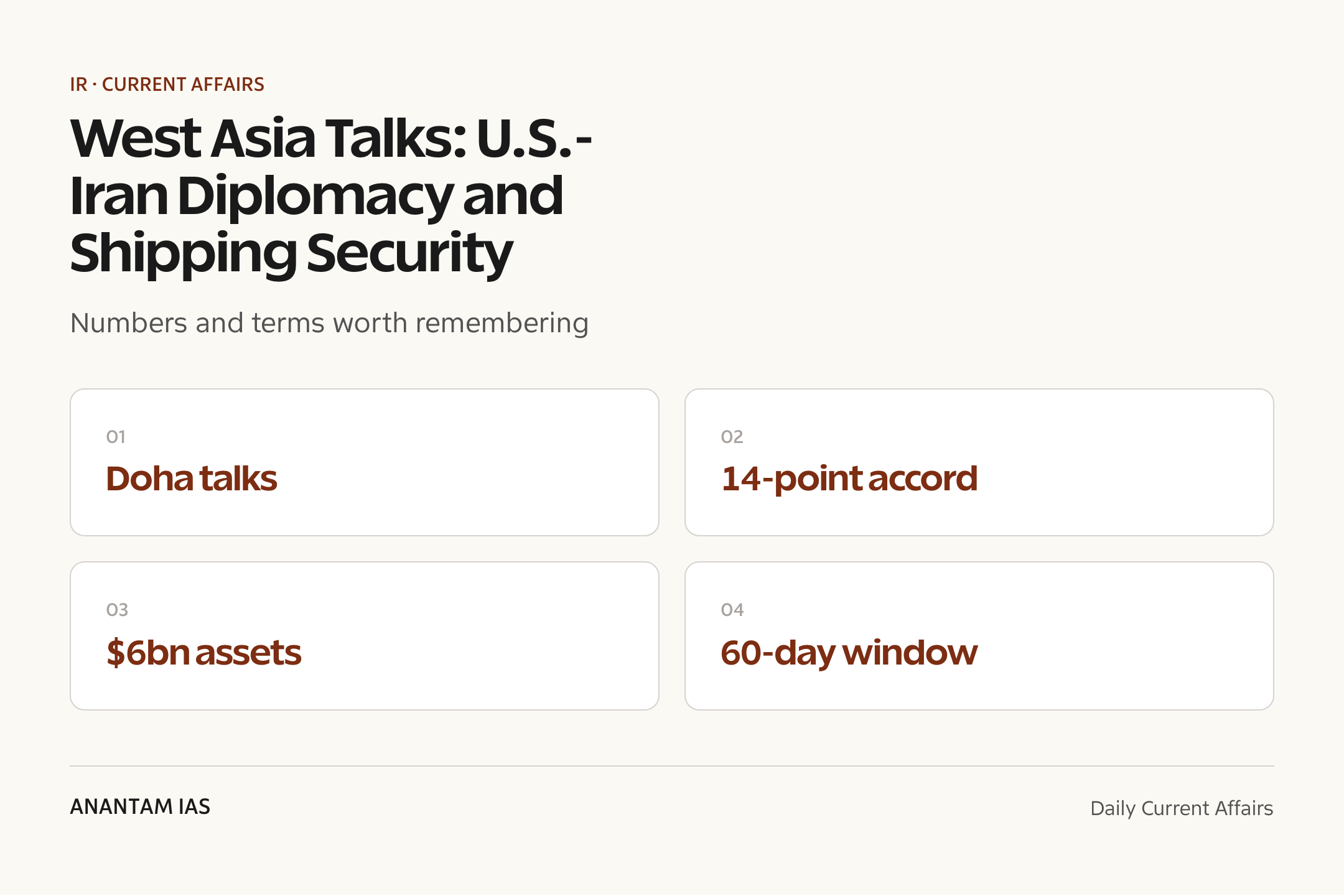
The Hindu reported that the United States and Iran held technical talks in Doha on July 1, 2026 to settle shipping flows through the Strait of Hormuz and secure a lasting ceasefire.
A linked report said Iranian President Masoud Pezeshkian claimed that $6 billion out of $12 billion in frozen Iranian assets held in Qatar would be released, even as U.S. officials said no assets had yet been released.
- Talks venue: the technical negotiations were held in Doha, with Qatar and Pakistan described as mediators.
- Immediate agenda: shipping through the Strait of Hormuz, implementation of a ceasefire, and the claimed release of frozen Iranian assets.
- Negotiation frame: the talks build on a reported 14-point interim accord signed last month, with 60 days set aside for a permanent peace deal.
- Shipping risk: The Hindu reported that Iranian attacks and threats had stopped cargo ships and tankers moving through the strait during the recent crisis.
- Energy link: the report noted that about a fifth of all traded oil and natural gas passed through the strait in peacetime.
- India angle: shipping delays, insurance costs and Gulf energy prices affect India’s import bill, inflation, seafarer safety and external-sector stability.
The development matters in the context of:
- West Asia stability is not only a diplomatic issue for India; it is also an energy, freight, diaspora and balance-of-payments issue.
- Hormuz is a chokepoint where a narrow security incident can move crude prices, LNG markets and war-risk insurance.
- Frozen assets are a sanctions-relief signal, but the dispute over whether funds have actually moved shows why implementation matters.
- India’s strategic autonomy requires engagement with the U.S., Iran, Israel, Gulf Arab states and regional mediators at the same time.
UPSC Relevance
Prelims Relevance
- Strait of Hormuz connects the Persian Gulf with the Gulf of Oman and the Arabian Sea.
- Iran lies on the northern side of the strait; Oman lies on the southern side.
- Transit passage under the law of the sea is relevant to straits used for international navigation.
- Qatar and Pakistan were described as mediators in the current U.S.-Iran talks.
- 14-point interim accord and a 60-day negotiation window are the key reported diplomatic details.
- $6 billion out of $12 billion in Iranian resources in Qatar was the claim made by Iran’s President.
- Chabahar port lies on Iran’s Makran coast and gives India a route to Afghanistan and Central Asia outside Hormuz.
- Current Account Deficit can widen when crude oil prices or freight costs rise.
- War-risk insurance is a shipping cost that rises when vessels move through conflict-prone waters.
Mains Relevance
GS Paper 2
- International relations: India’s West Asia balancing between the U.S., Iran, Israel, Qatar, Pakistan and Gulf Arab states.
- Strategic autonomy: protecting India’s energy and connectivity interests without being pulled into one regional camp.
- Diplomacy and mediation: role of small and middle powers such as Qatar, Oman and Pakistan in conflict management.
GS Paper 3
- Energy security: crude, LNG, freight and insurance exposure through the Strait of Hormuz.
- Indian economy: oil-price shocks can affect inflation, the rupee, the current account and fiscal space.
- Maritime security: protection of sea lines of communication and Indian seafarers in the Gulf region.
Essay
- Chokepoints show how geography can shape the economics of peace and conflict.
- Strategic autonomy is tested most sharply when energy security and diplomacy overlap.
- Peace agreements matter only when implementation is visible, trusted and enforceable.
Background and Context
What the Doha Talks Are About
The current round is a technical negotiation, not just a public political statement.
- Doha talks began on Tuesday night and continued on July 1, 2026, according to The Hindu’s Reuters-based report.
- Chief negotiators and specialists were expected to handle the sessions, while Jared Kushner and Steve Witkoff helped lay the groundwork by meeting Qatar’s Prime Minister.
- Qatar was described as a mediator in the talks along with Pakistan, showing the multipolar nature of West Asia diplomacy.
- U.S. priority was reported as ensuring the free flow of traffic through the Strait of Hormuz.
- Iran’s priorities included management of the strait and the release of frozen Iranian assets.
- UPSC takeaway: technical talks are often where ceasefire terms become operational rules for ships, ports, payments and military restraint.
Why Hormuz Is the Core Issue
The diplomatic dispute matters because one narrow waterway carries a large share of global energy trade.
- Strait of Hormuz links the Persian Gulf to the Gulf of Oman and the Arabian Sea.
- Peacetime flow through the strait included about a fifth of traded oil and natural gas, according to The Hindu’s AP-based report.
- Iran wants international recognition of its role in managing the strait and its claimed ability to levy fees on vessels entering or leaving the Gulf.
- United States wants predictable, free movement of civilian shipping through the waterway.
- Oman’s territorial waters matter because routes on the Omani side were reported as part of efforts to keep inbound and outbound traffic moving.
- Practical risk: even partial reopening can stay patchy if route rules, vessel tracking, escorts and fee claims remain unclear.
The Interim Accord and Its Friction Points
The reported accord creates a negotiation window, but both sides still disagree over meaning and control.
- 14-point interim accord was reported as the basis for halting the war and reopening the Strait of Hormuz.
- 60 days of negotiations were reportedly set aside for a permanent peace deal.
- Ceasefire durability depends on whether both sides accept the same rules for shipping, military restraint and asset movement.
- Public sparring over the meaning of the interim pact has already created uncertainty for markets and ship operators.
- Container-ship grounding in shallow waters outside an Iranian-designated route was cited by Iran’s state media during the talks.
- Exam lens: implementation problems often sit between law, diplomacy and operational control, not in grand treaty language alone.
Frozen Assets and Sanctions Relief
The asset-release claim is important because it signals whether sanctions relief is becoming real.
- Masoud Pezeshkian said $6 billion out of $12 billion in Iranian resources held in Qatar would be released and returned to Iran.
- U.S. officials said no frozen Iranian assets had been released so far, according to The Hindu’s AP-based report.
- Qatar had not publicly acknowledged such a transfer in the report, which keeps the claim politically sensitive.
- Domestic politics in Iran matters because the President’s statement was presented as a way to sell the interim deal to the Iranian public.
- Sanctions relief is not only a financial issue; it affects Iran’s bargaining space, oil-market expectations and regional confidence.
- India link: any credible sanctions easing can affect payment channels, crude supply expectations and projects such as Chabahar port.
India's External-Sector Exposure
For India, Hormuz tension is an economic transmission channel as much as an IR headline.
- Crude-import bill rises when West Asia risk pushes oil prices and shipping costs higher.
- Inflation can widen through fuel, transport, fertilizer, power and logistics channels.
- Current account comes under pressure when energy imports become costlier and the rupee faces imported inflation.
- Freight and insurance costs matter because war-risk premiums can rise even before a full closure of the waterway.
- Indian seafarers face direct safety risks when tankers and cargo ships operate in contested waters.
- Static link: connect this with the earlier U.S.-Iran peace-deal note for the oil, Hormuz and India framework.
Maritime Law and Shipping Security
The legal issue is whether a strategic strait can stay open when littoral states and external powers contest control.
- International navigation through straits is governed by the law-of-the-sea framework, especially rules on passage through straits used by global shipping.
- Littoral states such as Iran and Oman have coastal jurisdiction, but global commerce needs predictable transit rules.
- Shipping lanes require clear navigation routes, traffic separation, maritime advisories and deconfliction with military forces.
- Naval signalling can protect sea lanes, but it can also escalate risk if not paired with diplomacy.
- Energy chokepoints make private actors such as insurers, tanker operators and commodity traders part of the security picture.
- UPSC angle: maritime security is not only naval power; it includes law, insurance, ports, crews, energy policy and crisis communication.
Regional Spillover Risks
The Hormuz talks sit inside a wider West Asia crisis with links beyond Iran and the U.S.
- U.S.-Israeli strikes on Iran in February were cited in the report as the starting point of the latest war.
- Iranian attacks on Gulf states hosting U.S. military bases widened the regional risk environment.
- Bahrain and Kuwait were named in the AP-based report as targets of Iranian drone and missile attacks on June 29, 2026.
- Lebanon track also matters because the interim deal was reported to include an end to conflict involving Israel and Hezbollah.
- Oil prices edged higher after prior declines, showing how markets react to both de-escalation and renewed uncertainty.
- Policy lesson: India should track the Gulf as a connected security complex, not as isolated bilateral disputes.
Way Forward
Stabilise Shipping Rules
- Clear passage protocols should define approved routes, communication channels, distress procedures and incident reporting.
- Independent monitoring by neutral maritime actors can reduce disputes over whether vessels followed a declared route.
- Insurance clarity is needed so tankers and cargo ships can price risk without panic premiums.
Keep Diplomacy Multi-Channel
- Qatar, Oman and Pakistan can keep back-channel talks alive when public U.S.-Iran statements harden.
- India should quietly support de-escalation, freedom of navigation and protection of civilian shipping without entering the dispute as a party.
- Consular readiness for Indian seafarers should stay active while shipping remains uncertain.
Reduce India's Chokepoint Vulnerability
- Energy diversification across suppliers, fuels and routes can reduce exposure to a single West Asia shock.
- Strategic petroleum reserves and long-term LNG planning should be treated as economic-security tools.
- Chabahar and INSTC remain useful connectivity hedges when sanctions and sea-lane politics shift.
Separate Claims from Implementation
- Asset-release claims should be read against verifiable fund movement, official acknowledgements and sanctions waivers.
- Ceasefire claims should be tested through actual vessel movement, route safety and absence of retaliatory strikes.
- Market signals such as crude prices, tanker rates and insurance premiums can show whether confidence is returning.
Conclusion
The Doha technical talks show that West Asia diplomacy is now moving from headline ceasefire language to implementation details: shipping lanes, asset release, route control and crisis communication.
For India, the central issue is practical. If Hormuz remains open and predictable, oil prices, freight costs, seafarer safety and the current account become easier to manage.
The durable UPSC lesson is simple: energy security and foreign policy meet at maritime chokepoints, and strategic autonomy works best when India keeps multiple routes, partners and diplomatic channels open.
UPSC Practice Questions
Prelims MCQ 1
With reference to the Strait of Hormuz, consider the following statements:
- It connects the Persian Gulf with the Gulf of Oman and the Arabian Sea.
- Iran lies along its northern side and Oman along its southern side.
- It is important for global oil and natural gas trade.
How many of the above statements are correct?
(a) Only one (b) Only two (c) All three (d) None
Answer: (c) All three
Explanation:
All three statements are correct. Hormuz links the Persian Gulf to the Gulf of Oman and Arabian Sea, has Iran and Oman on opposite sides, and is a major energy chokepoint.
Prelims MCQ 2
Which statement best captures the reported July 2026 U.S.-Iran technical talks in Doha?
(a) They were only a bilateral trade negotiation between India and Iran. (b) They focused on Hormuz shipping flows, ceasefire implementation and frozen Iranian assets. (c) They created a new South Asian free-trade bloc led by Qatar. (d) They declared the Strait of Hormuz closed to all civilian shipping.
Answer: (b) They focused on Hormuz shipping flows, ceasefire implementation and frozen Iranian assets.
Explanation:
The talks were reported as U.S.-Iran technical negotiations in Doha, mediated by Qatar and Pakistan, with shipping through Hormuz and frozen-asset issues at the centre.
UPSC Mains Questions
- The Strait of Hormuz is both a maritime security issue and an economic vulnerability for India. Discuss in the context of the July 2026 U.S.-Iran technical talks.
- India’s West Asia policy requires strategic autonomy, energy security and protection of sea lines of communication. Examine with reference to U.S.-Iran diplomacy and Gulf shipping risks.
- Peace agreements often fail at the implementation stage. Analyse how shipping rules, sanctions relief and third-party mediation can shape the durability of ceasefire arrangements.
Sources: The Hindu (Reuters) and The Hindu (AP).
Frequently Asked Questions
Why do the talks matter to India?
The talks matter because Hormuz shipping affects India’s crude costs, LNG security, freight rates and inflation. If the strait stays open and predictable, India’s import bill and current-account pressure ease. If it becomes risky again, war-risk insurance and energy prices can rise quickly.
What is the shipping dispute?
The dispute is over who controls practical movement through the Strait of Hormuz. The U.S. wants free flow of traffic. Iran wants recognition of its role in managing the strait and has raised fee and route-control claims. Ship operators need predictable rules.
What is the asset-release issue?
Iran’s President said $6 billion out of $12 billion in Iranian resources held in Qatar would be released. U.S. officials said no assets had been released so far, and Qatar had not acknowledged such a transfer in the report. This makes verification central.
Why is Qatar important here?
Qatar is important because it was described as a mediator and because the frozen Iranian resources are held there. In West Asia diplomacy, smaller Gulf states often provide venues, communication channels and financial pathways that larger rivals cannot use openly.
How does Hormuz affect oil prices?
Hormuz is a narrow energy chokepoint. If tankers face attacks, detention risk or unclear routes, insurers charge more and traders price in supply uncertainty. Even a partial disruption can lift oil and LNG prices, which affects import-dependent economies such as India.
What should India watch next?
India should watch actual vessel movement, shipping advisories, crude prices, insurance premiums, asset-transfer confirmation and signs of renewed strikes. Diplomatic statements matter, but the real test is whether ships, payments and energy supplies move safely.