Why in News?
The United States and Iran announced a peace deal with a stated permanent end to military action, closing the recent flare-up in West Asia. The agreement is reported to bundle an oil-sanctions waiver, the reopening of the Strait of Hormuz to shipping, fresh limits on Iran’s nuclear programme, and a release of frozen assets.
For India, which imports close to 85% of its crude oil, the headline matters less for the diplomacy than for the sea lane: roughly a fifth of the world’s oil moves through the Hormuz chokepoint, and any easing of tension there feeds straight into pump prices, inflation and the current-account math.
- Deal reported to declare a permanent end to military action between the two sides.
- Reported components: an oil-sanctions waiver, reopening of the Strait of Hormuz, nuclear limits, and release of frozen assets.
- Caps a short, sharp West Asia war that had spiked freight, insurance and crude-oil benchmarks.
- India’s exposure is structural: about 85% dependence on crude imports and heavy reliance on Gulf sea lanes.
- The Strait of Hormuz carries roughly a fifth of globally traded oil and most of India’s Gulf-sourced crude and LNG.
The development matters in the context of:
- Reopening Hormuz removes a tail risk that had driven up war-risk insurance and tanker-rerouting costs.
- An eased Iran reconnects a sanctioned barrel back toward global supply, softening prices over the medium term.
- For India, the question is durable: how to keep energy flowing while preserving strategic autonomy across US, Iran and Gulf-Arab ties.
UPSC Relevance
Prelims Relevance
- Strait of Hormuz — connects the Persian Gulf to the Gulf of Oman and the Arabian Sea; a global oil chokepoint.
- OPEC and OPEC+ — an oil producers’ cartel that coordinates output and influences crude prices.
- JCPOA (2015) — the Iran nuclear deal between Iran and the P5+1; the US exited in 2018.
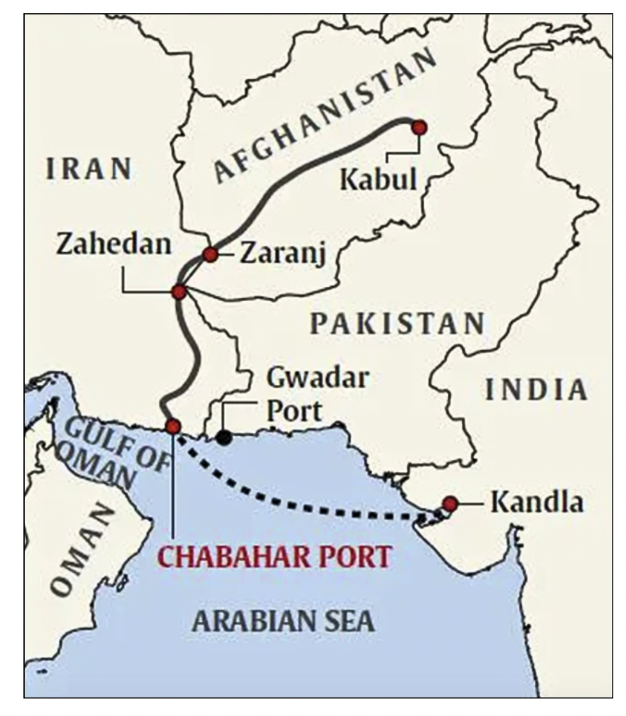
- Chabahar port — India-operated port on Iran’s Makran coast, outside the Strait of Hormuz.
- INSTC — International North-South Transport Corridor linking India, Iran, Central Asia and Russia.
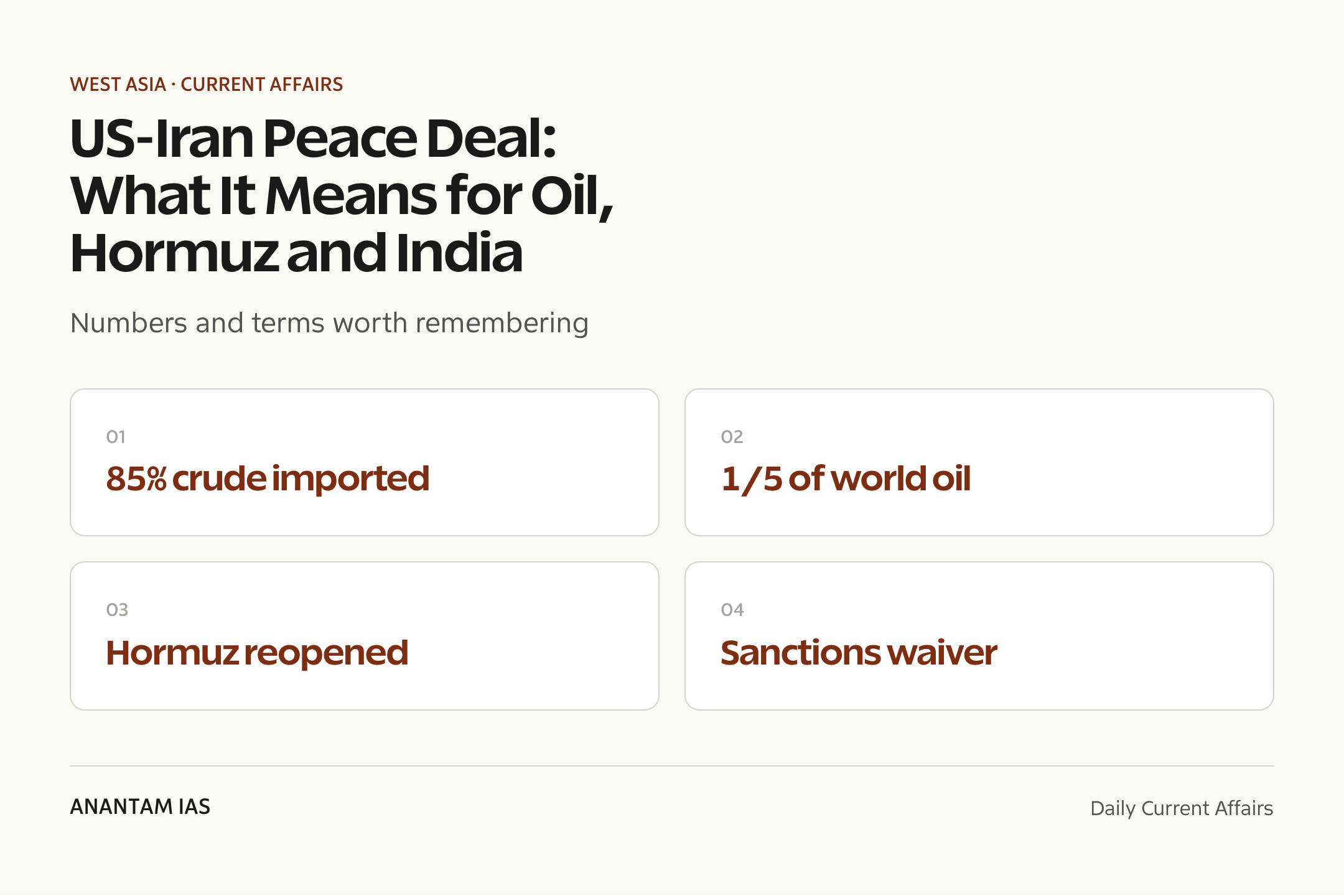
- India’s crude-import dependence — about 85% of requirement met by imports.
- Persian Gulf, Gulf of Oman, Arabian Sea — the maritime geography around Hormuz.
- Current Account Deficit (CAD) — widens when the oil-import bill rises.
Mains Relevance
GS Paper 2
- India’s West Asia balancing — managing simultaneous ties with the US, Iran, Israel and the Gulf Arab states.
- Strategic autonomy as a design principle when great-power agreements reshape a region that India depends on.
GS Paper 3
- Energy security and the economics of a crude-price shock — inflation, CAD and the import bill.
- Sea-lane security and chokepoint risk for a trade-dependent, energy-importing economy.
Essay
- Peace is cheaper than war — the economics of de-escalation for energy-importing nations.
- A nation’s foreign policy is the shadow cast by its energy needs.
Background and Context
Why the Strait of Hormuz Decides So Much
The deal’s market power comes from one narrow stretch of water, not from the diplomacy itself.
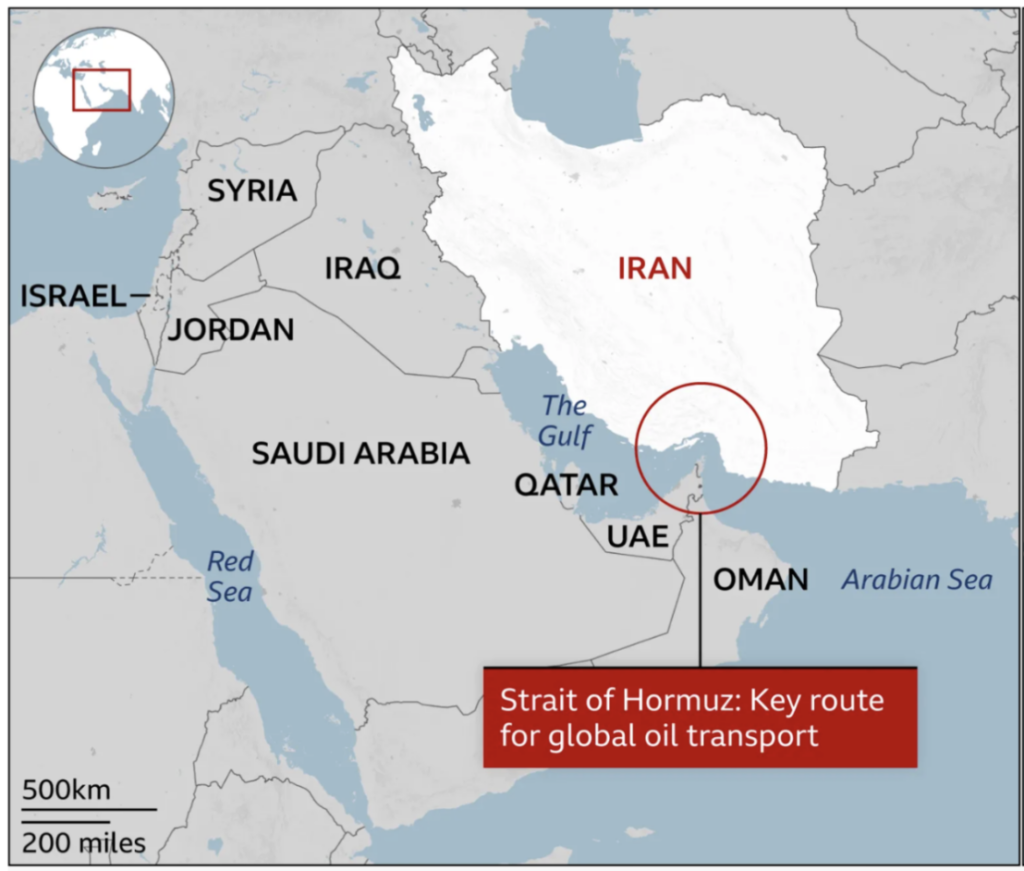
- The Strait of Hormuz links the Persian Gulf to the Gulf of Oman and onward to the Arabian Sea, the only sea exit for Gulf oil — see why the Strait of Hormuz is critical to global energy flows.
- Roughly a fifth of the world’s oil and a large share of seaborne LNG transit the strait each day.
- At its narrowest, the navigable shipping lanes are only a few kilometres wide, so even the threat of disruption moves prices.
- Iran sits on the strait’s northern shore, which is why any Iran flare-up is read by markets as a chokepoint risk.
- Reopening Hormuz to normal traffic lets tankers drop costly detours and lowers war-risk insurance premiums.
What the Deal Reportedly Contains
The reported terms touch oil, the nuclear file, money and the sea lane at once.
- A declared permanent end to military action between the United States and Iran.
- An oil-sanctions waiver that would let more Iranian crude return to the legal market.
- Fresh nuclear limits on Iran’s programme, echoing the architecture of the earlier deal.
- Reopening of the Strait of Hormuz to civilian shipping and energy cargo.
- Release of frozen Iranian assets held abroad as part of the bargain.
From JCPOA to Now — the Nuclear Backstory
This is the latest turn in a decade-long standoff over Iran’s nuclear programme.
- The JCPOA of 2015 capped Iran’s enrichment in exchange for sanctions relief, agreed with the P5+1.
- The United States exited the deal in 2018 and reimposed sanctions under a maximum-pressure approach.
- Iran then expanded enrichment beyond JCPOA limits, raising proliferation concerns.
- The new arrangement is reported to restore nuclear caps alongside the wider peace package.
- For UPSC, the durable thread is the non-proliferation bargain — limits in return for economic normalisation.
India’s Energy Stakes
India is one of the most exposed economies to anything that happens around the Gulf.
- India imports about 85% of its crude oil, much of it sourced from or shipped through the Gulf.
- A sustained crude spike feeds inflation, widens the Current Account Deficit and pressures the rupee.
- Cheaper, calmer oil eases the subsidy and import-bill burden and supports the growth path.
- Indian seafarers crew a large share of Gulf-transiting vessels, so their safety is a direct human stake.
- A reopened strait restores predictable freight and insurance costs for refiners and importers.
Chabahar, INSTC and the India-Iran Channel
India’s Iran links run through connectivity projects that survive even sanctions friction.
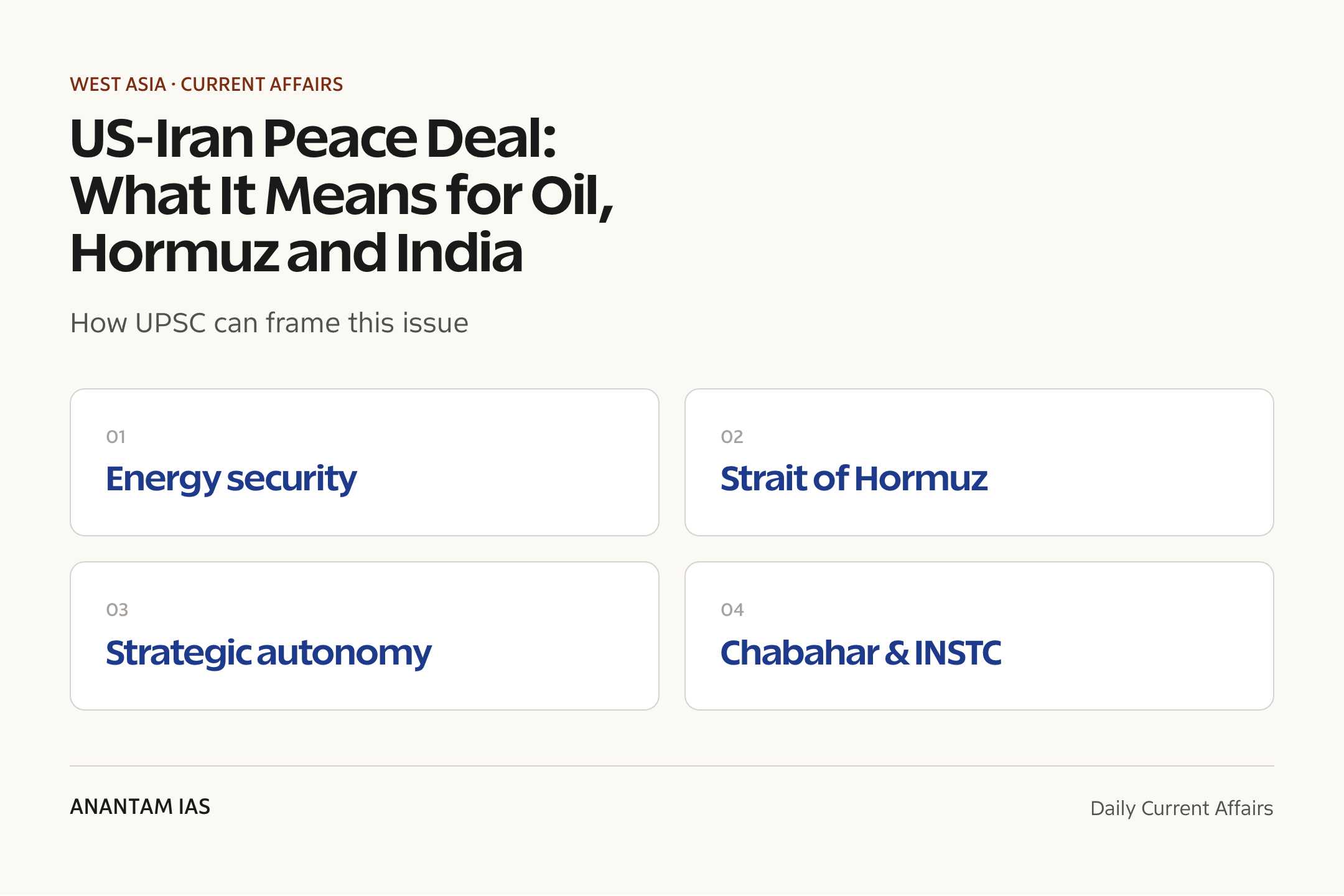
- Chabahar port on Iran’s Makran coast is India-operated and sits outside the Strait of Hormuz, a built-in chokepoint hedge.
- It gives India a route to Afghanistan and Central Asia that bypasses Pakistan.
- The INSTC ties India through Iran to Central Asia and Russia, cutting transit time versus the Suez route.
- Sanctions relief on Iran could smooth payments, shipping and investment around these projects.
- Defining the durable asset: connectivity infrastructure outlasts the news cycle of any single deal.
India’s Balancing Act in West Asia
Every Gulf development tests India’s ability to hold several relationships at once.
- India runs simultaneous ties with the United States, Iran, Israel and the Gulf Arab states.
- The Gulf hosts a large Indian diaspora and is a major source of remittances and energy.
- Strategic autonomy lets India engage all sides without being locked into one camp.
- A US-brokered peace narrows the chance of a forced choice between partners.
- India’s interest is stability and open sea lanes, not the internal politics of the deal.
Way Forward
Diversify energy sources
- Keep widening crude suppliers across regions to dilute Gulf-chokepoint dependence.
- Scale strategic petroleum reserves and renewables to blunt future price shocks.
Secure the sea lanes
- Sustain naval presence and anti-piracy cooperation across the Arabian Sea and the Gulf of Oman.
- Protect Indian seafarers through evacuation plans and shipping-safety protocols.
Bank the connectivity hedges
- Use any sanctions easing to deepen Chabahar operations and the INSTC.
- Lock in payment and logistics arrangements while the window is open.
India should treat the deal as a chance to stabilise its import bill while quietly reinforcing the alternatives — reserves, routes and partners — that protect it if calm in West Asia proves short-lived.
Conclusion
A US-Iran peace deal that reopens the Strait of Hormuz and eases oil sanctions is, for India, primarily an energy and sea-lane story. Calmer crude eases inflation and the current-account strain, while a reopened strait restores predictable freight and insurance for refiners.
The deeper lesson is about design, not the day’s diplomacy: India’s exposure to one narrow waterway argues for diversified supply, fuller reserves and live connectivity hedges like Chabahar and the INSTC. Strategic autonomy lets India welcome the calm without surrendering its room to manoeuvre if it does not last.
UPSC Practice Questions
Prelims MCQ 1
With reference to the Strait of Hormuz, consider the following statements:
- It connects the Persian Gulf with the Gulf of Oman and the Arabian Sea.
- Iran lies along its northern shore.
- A significant share of globally traded oil transits through it.
How many of the above statements are correct?
(a) Only one (b) Only two (c) All three (d) None
Answer: (c) All three
Explanation:
The Strait of Hormuz links the Persian Gulf to the Gulf of Oman and onward to the Arabian Sea, has Iran on its northern shore, and carries roughly a fifth of the world’s oil, so all three statements are correct.
Prelims MCQ 2
Which of the following is correctly matched?
(a) Chabahar port — located inside the Strait of Hormuz (b) INSTC — connects India through Iran to Central Asia and Russia (c) JCPOA — a free-trade agreement between India and Iran (d) OPEC — a UN agency regulating maritime traffic
Answer: (b) INSTC — connects India through Iran to Central Asia and Russia
Explanation:
The INSTC links India via Iran to Central Asia and Russia. Chabahar lies outside Hormuz on the Makran coast, the JCPOA is the Iran nuclear deal, and OPEC is an oil producers’ cartel, not a UN maritime body.
UPSC Mains Questions
- India imports nearly 85% of its crude oil and depends heavily on Gulf sea lanes. Examine how a US-Iran peace deal that reopens the Strait of Hormuz affects India’s energy security and macroeconomic stability.
- “India’s West Asia policy is an exercise in balancing.” In light of recent US-Iran developments, discuss how India can preserve its strategic autonomy while engaging the US, Iran, Israel and the Gulf Arab states.
- Chokepoints like the Strait of Hormuz expose trade-dependent economies to disproportionate risk. Evaluate the connectivity and supply-diversification measures India can adopt to reduce this vulnerability.
Sources: The Hindu and The Hindu.
Frequently Asked Questions
Why does the US-Iran deal matter to India?
India imports about 85% of its crude oil, much of it through or from the Gulf. A peace deal that reopens the Strait of Hormuz and eases oil sanctions tends to calm crude prices, which lowers India’s import bill, eases inflation and reduces pressure on the current-account deficit and the rupee.
What is the Strait of Hormuz?
The Strait of Hormuz is a narrow waterway connecting the Persian Gulf to the Gulf of Oman and the Arabian Sea. Iran lies on its northern shore. Roughly a fifth of the world’s traded oil and a large share of seaborne LNG pass through it, which makes it one of the most important global oil chokepoints.
How does the deal affect oil prices?
Reopening Hormuz lets tankers stop costly detours and lowers war-risk insurance, while an oil-sanctions waiver returns more Iranian crude toward the market. Together these tend to ease prices over the medium term, though the actual move depends on how quickly the reported terms are implemented.
What is India’s stake in Chabahar and the INSTC?
Chabahar is an India-operated port on Iran’s Makran coast, located outside the Strait of Hormuz, giving India a chokepoint hedge and a route to Afghanistan and Central Asia. The INSTC links India through Iran to Central Asia and Russia. Any sanctions easing on Iran could smooth payments and investment in both.
How does this connect to the JCPOA?
The JCPOA of 2015 capped Iran’s nuclear programme in return for sanctions relief. The US exited in 2018 and Iran later expanded enrichment. The new arrangement is reported to restore nuclear limits alongside the wider peace package, continuing the same limits-for-normalisation bargain.
What is India’s interest in the outcome?
India’s core interest is regional stability and open sea lanes rather than the internal politics of the deal. Calmer Gulf conditions protect Indian seafarers, steady the energy supply, and let India keep engaging all parties while preserving its strategic autonomy.
Tell Google you want more of this.
Add Anantam IAS as a preferred sourceOne tap, and this site shows up more often in your own Top Stories, AI Overviews and AI Mode. Remove it any time.