U.S.-Saudi Civil Nuclear Deal: Enrichment and Non-Proliferation Test
Why in News?
The Indian Express reported on 22 July 2026, citing reports by The Wall Street Journal and Associated Press, that U.S. President Donald Trump had approved a civil nuclear agreement with Saudi Arabia. It said the still-unannounced arrangement was expected to be sent to the U.S. Congress for review.
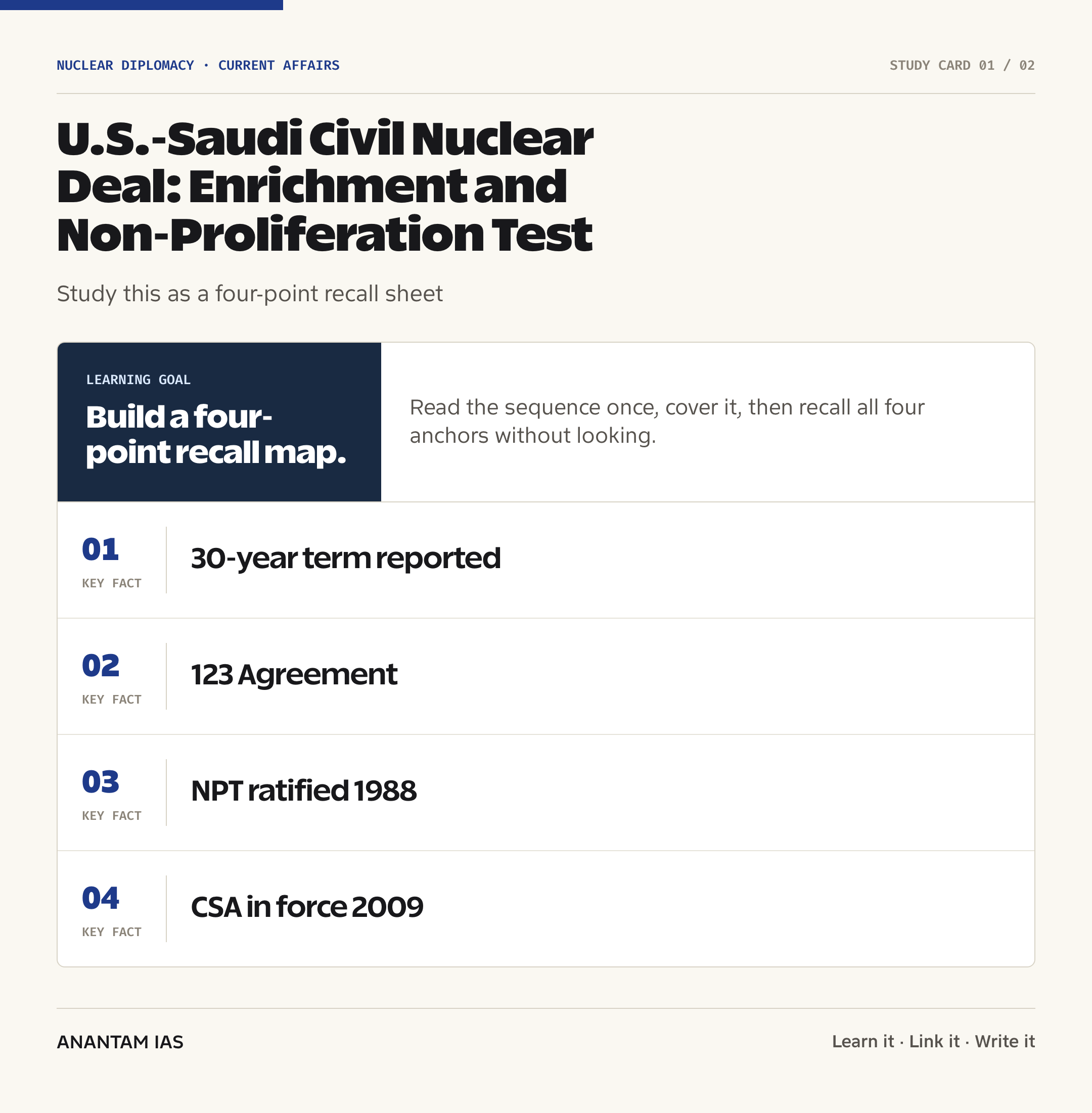
The reported terms include a 30-year duration, commercial opportunities worth tens of billions of dollars, and a possible Saudi uranium-enrichment plant after a joint review. These are reported or proposed elements, not confirmed legal obligations: no full agreement text or official U.S. announcement of those terms was public in the source material reviewed.
- The U.S. Department of Energy officially confirmed only that the two governments signed a Joint Declaration on the Completion of Negotiations on Civil Nuclear Cooperation on 18 November 2025.
- That declaration referred to American nuclear technology, bilateral safeguards and a firm commitment to non-proliferation, but the short DOE release didn’t publish the negotiated text or specify enrichment rights.
- The Indian Express said American firms could build an enrichment plant only if a future joint U.S.-Saudi study found it justified; this conditional possibility shouldn’t be described as an operating facility or unconditional authorization.
- A Section 123 Agreement is the U.S. legal framework needed for significant peaceful nuclear exports, including reactors, major components and nuclear material.
- The central policy question is whether Saudi Arabia may enrich uranium on its territory and, if so, under what limits, consent rights, monitoring and IAEA safeguards.
The development matters in the context of:
- The case tests whether commercial competition in West Asia can be reconciled with consistent non-proliferation standards.
- It also separates three layers often conflated in headlines: political approval, completion of bilateral negotiations, and legal entry into force after congressional review.
- For India, the debate bears on West Asian stability, nuclear-governance precedents and the credibility of differentiated pathways to peaceful nuclear cooperation.
UPSC Relevance
Prelims Relevance
- Section 123 of the U.S. Atomic Energy Act, 1954 governs agreements for significant peaceful nuclear cooperation with foreign partners.
- A 123 Agreement creates a legal framework; it doesn’t itself guarantee a reactor sale, fuel shipment, financing decision or export license.
- The U.S. Atomic Energy Act requires safeguards, peaceful use, physical protection and U.S. consent controls over the enrichment or reprocessing of U.S.-obligated material.
- The Act doesn’t automatically require every partner to renounce all domestic enrichment and reprocessing; a broader renunciation is a stronger negotiated condition often called the gold standard.
- Saudi Arabia ratified the Nuclear Non-Proliferation Treaty in 1988 as a non-nuclear-weapon State and has a comprehensive safeguards agreement with the IAEA in force since 2009.
- The IAEA safeguards status list dated 30 June 2025 shows no Saudi Small Quantities Protocol entry and no Additional Protocol in force.
- A Comprehensive Safeguards Agreement verifies that declared nuclear material isn’t diverted from peaceful activity; an Additional Protocol supplies broader information and access relevant to undeclared activity.
- Commercial light-water-reactor fuel is usually low-enriched uranium; enrichment is dual-use because the same general technology can produce progressively higher concentrations of uranium-235.
- Reprocessing is different from enrichment: it chemically separates materials, including plutonium, from irradiated nuclear fuel.
Mains Relevance
GS Paper 2
- International relations: U.S.-Saudi strategic ties, energy diplomacy, competition for reactor markets and the balance of power in West Asia.
- Global governance: interaction among national export law, congressional oversight, the NPT and IAEA verification.
- India’s interests: energy security, diaspora and trade links, strategic autonomy and the costs of a regional nuclear arms race.
GS Paper 3
- Science and technology: the dual-use character of uranium enrichment, fuel-cycle services and safeguards-by-design.
- Security: proliferation latency, nuclear-material accounting, physical protection and crisis stability.
- Energy: civilian nuclear power as firm low-carbon electricity for an oil-exporting economy seeking diversification.
Essay
- Technology can serve development and security at the same time, which makes institutions and verification as important as intent.
- Rules-based orders retain legitimacy only when similar risks are judged through transparent and consistent standards.
Background and Context
What Has Been Confirmed and What Remains Reported
The documentary record supports a narrower claim than the headline language of a completed and operational nuclear deal.
- On 18 November 2025, U.S. Energy Secretary Chris Wright and Saudi Energy Minister Prince Abdulaziz bin Salman signed a Joint Declaration stating that negotiations on civil nuclear cooperation had been completed.
- The official DOE release promised cooperation, bilateral safeguards and non-proliferation, but it contained neither the full agreement nor detailed fuel-cycle clauses.
- The Indian Express reported in July 2026 that President Trump had formally approved the arrangement, but also said it hadn’t been formally announced and that the White House hadn’t responded to AP’s request for comment.
- The reported 30-year term and value of tens of billions of dollars should be attributed to the reports, not treated as independently verified government data.
- The reported enrichment facility is contingent on a joint review. A study or review clause doesn’t establish that construction is approved, that a site exists, or that a permissible enrichment ceiling has been agreed.
- The distinction also matters for treaty interpretation: a political announcement can describe intent, while only the authenticated agreement text, annexes and side arrangements reveal which promises are binding and how disputes will be handled.
- Until the text is transmitted and published, claims about Saudi rights, U.S. consent, termination, monitoring or fuel take-back remain unverified details.
How a Section 123 Agreement Works
A 123 Agreement is an enabling legal framework under U.S. law, not a turnkey reactor contract.
- The DOE’s official 123 Agreement overview says such an agreement is generally required before significant U.S. nuclear material or equipment can be transferred abroad.
- The U.S. Department of State negotiates the agreement with technical assistance and concurrence from DOE’s National Nuclear Security Administration and consultation with the Nuclear Regulatory Commission.
- Section 123 sets nine non-proliferation criteria, including peaceful use, safeguards, physical protection, controls on retransfer and U.S. approval rights over specified enrichment or reprocessing.
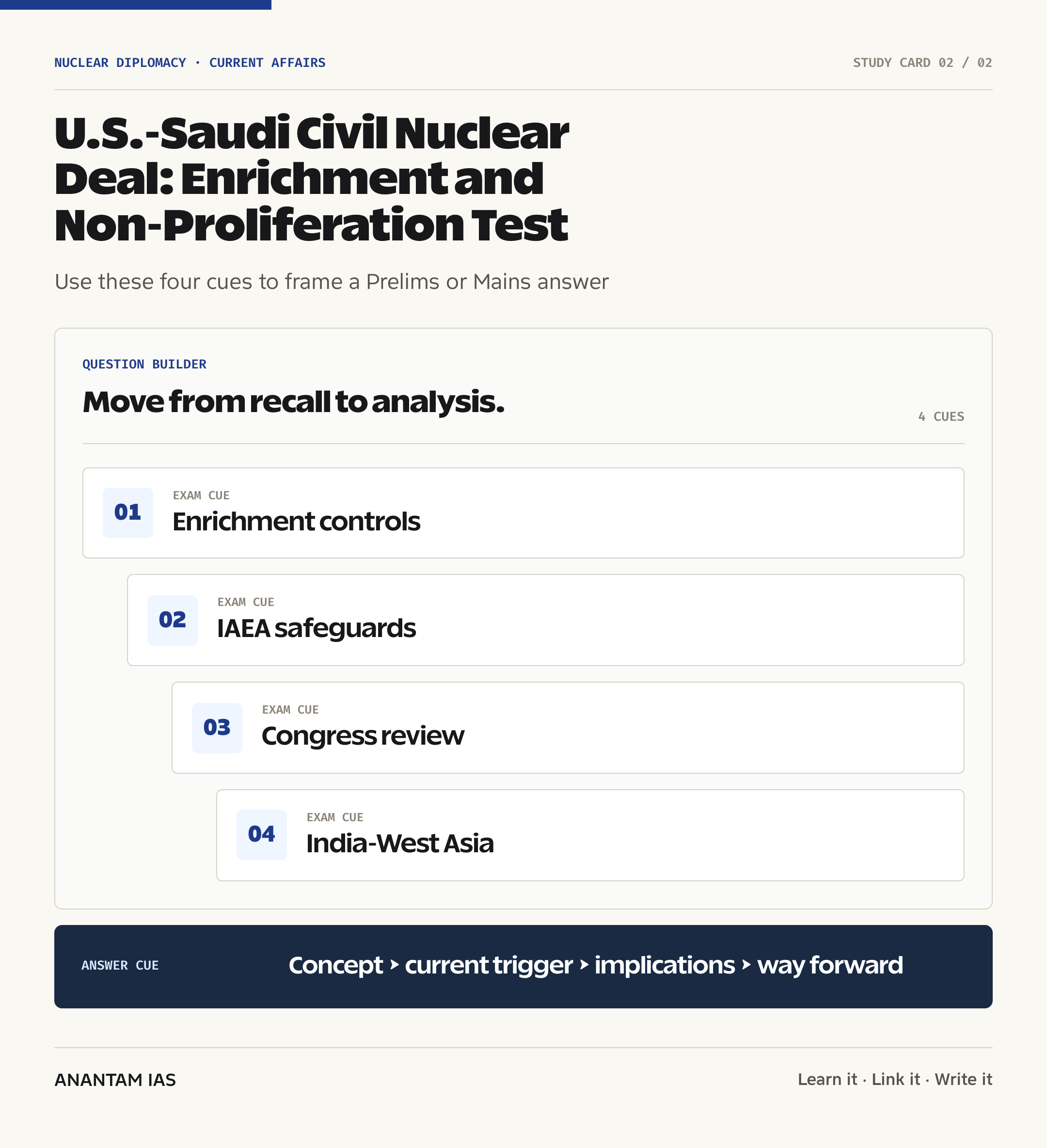
- The President submits the proposed agreement and a Nuclear Proliferation Assessment Statement to Congress. Review procedures depend on whether the agreement meets the statutory criteria or requires an exemption.
- DOE has described the review period as 90 days of continuous congressional session. Congressional scrutiny is substantive because lawmakers can examine safeguards, proliferation risk and any enrichment compromise.
- A non-exempt agreement and an agreement that departs from statutory criteria don’t follow identical approval paths. This makes the published legal classification important when assessing the actual role of Congress.
- Even after entry into force, actual exports may need separate NRC licenses, DOE authorizations, commercial contracts, financing and compliance with other export-control rules.
Why Enrichment Is the Hardest Clause
Uranium enrichment can support reactor fuel production, but the capability also shortens the technical pathway to weapons-usable material.
- Natural uranium contains only a small share of fissile uranium-235; enrichment raises that share so the material can meet a reactor’s fuel specification.
- Commercial power reactors typically use low-enriched uranium, often around 3-5% uranium-235, while uranium enriched to 20% or more is categorized as highly enriched uranium.
- Material commonly called weapons-grade uranium is enriched much further, often around 90%; risk grows before that point because enrichment effort isn’t linear and higher starting enrichment reduces later work.
- Conversion and enrichment are separate fuel-cycle steps. Conversion prepares uranium in a chemical form suitable for enrichment; enrichment changes the isotopic concentration, after which fuel fabrication produces reactor-ready assemblies.
- Gas centrifuges and associated know-how are dual-use. The policy issue isn’t whether peaceful enrichment is technically possible, but whether scale, level, stocks and access can be bounded and verified.
- The U.S. Atomic Energy Act requires consent before U.S.-origin or U.S.-obligated material is enriched or reprocessed, but that isn’t identical to a territorial ban covering every future Saudi-origin material stream.
- The uranium-enrichment process should be assessed through feed material, centrifuge capacity, enrichment level, inventory, breakout time and verification, not through a peaceful-versus-military label alone.
Saudi Arabia's NPT and IAEA Safeguards Position
Saudi Arabia already has binding non-proliferation duties, but the strength of verification depends on the safeguards instruments in force.
- As a non-nuclear-weapon State party to the NPT, Saudi Arabia must not manufacture or acquire nuclear weapons and must accept IAEA safeguards on peaceful nuclear material.
- The Kingdom’s Comprehensive Safeguards Agreement, INFCIRC/746, entered into force on 13 January 2009.
- Saudi Arabia announced in 2023 that it would rescind its old Small Quantities Protocol, which had held many safeguards procedures in abeyance for states with little nuclear material and no facilities.
- The IAEA status list as of 30 June 2025 shows Saudi Arabia’s safeguards agreement in force, no SQP entry and no Additional Protocol entry.
- An Additional Protocol would give the IAEA broader information about the nuclear fuel cycle and broader access to relevant locations, improving its ability to assess possible undeclared material and activity.
- These instruments perform different jobs. The NPT creates the non-acquisition obligation, the safeguards agreement establishes verification of nuclear material, and the Additional Protocol widens the information and access available to inspectors.
- A credible agreement should clarify whether Saudi Arabia will bring an Additional Protocol into force before sensitive facilities, material transfers or major construction begin.
The Gold Standard and Regional Precedent
The policy benchmark is the 2009 U.S.-UAE agreement, not the minimum wording that U.S. law alone requires.
- The United Arab Emirates accepted a legally binding commitment not to possess enrichment or reprocessing facilities or conduct those activities on its territory.
- That approach became known as the gold standard because it restricts the most proliferation-sensitive parts of the fuel cycle beyond the general floor of Section 123.
- The Saudi case may create a precedent for other regional states. More permissive terms could lead partners to seek matching rights and weaken incentives to rely on multinational fuel supply.
- Article IV of the NPT protects peaceful nuclear cooperation in conformity with Articles I and II. It doesn’t remove safeguards duties or compel a supplier state to transfer sensitive technology on terms the supplier considers unsafe.
- Supporters of a U.S.-Saudi deal argue that American participation brings stronger consent rights, monitoring leverage and supplier accountability than leaving the market to competitors with weaker conditions.
- Critics answer that accepting indigenous enrichment could normalize proliferation latency, especially in a region marked by Iran’s nuclear dispute and Israel’s policy of nuclear opacity.
- The best test is verifiability: clear ceilings, intrusive safeguards, long-duration monitoring, procurement controls, consequences for breach and no ambiguity about military use.
Why the Deal Matters for India
India isn’t a party to the Saudi negotiation, but the agreement could affect its energy, diplomatic and nuclear-order interests.
- India depends on a stable West Asia for energy flows, trade routes, investment and the safety of a large Indian community; a regional enrichment competition would raise strategic and economic risk.
- The Indian approach to West Asia rests on issue-based partnerships with Saudi Arabia, the UAE, Israel, Iran and the United States rather than bloc alignment.
- India’s own U.S. civil nuclear pathway was exceptional. India is outside the NPT, but the 2005-08 process involved a civilian-military separation plan, an India-specific IAEA safeguards agreement, U.S. legislation and a Nuclear Suppliers Group waiver.
- The U.S.-India 123 Agreement entered into force on 6 December 2008. The comparison shows that legal routes can differ, but both require political bargains backed by safeguards and domestic approval.
- India’s safeguards arrangement is facility-specific because India isn’t an NPT non-nuclear-weapon State. Saudi Arabia’s comprehensive safeguards arise from its different status as an NPT non-nuclear-weapon State, so the two models shouldn’t be treated as interchangeable.
- India can consistently defend its exceptional record while supporting stronger safeguards by stressing responsible conduct, export controls, non-transfer, civilian facility safeguards and universal, verifiable disarmament.
- A transparent Saudi settlement can support peaceful nuclear energy and regional confidence. A vague settlement could deepen charges of selective rules within the global nuclear order.
Way Forward
Publish the Full Legal Text
- The U.S. administration should place the agreement, assessment and side arrangements before Congress so lawmakers and partners can evaluate the actual obligations.
- Official documents should define duration, termination, consent rights, material coverage and the legal status of every enrichment condition.
Make Verification the Entry Condition
- Saudi Arabia should bring an IAEA Additional Protocol into force and complete subsidiary arrangements before receiving sensitive material or equipment.
- Facilities should adopt safeguards-by-design, remote monitoring, timely material accountancy and access arrangements suited to enrichment technology.
Prefer Assured Fuel over National Enrichment
- Long-term fuel contracts, supplier diversity, strategic inventories and take-back arrangements can give Saudi reactors fuel security without duplicating sensitive capabilities.
- If enrichment remains under consideration, any approval should specify low enrichment ceilings, limited stocks, no reprocessing, stringent procurement controls and automatic snapback consequences.
Build a Regional Non-Proliferation Compact
- West Asian states should advance universal safeguards, nuclear safety cooperation, emergency notification and a long-term weapons-of-mass-destruction-free zone dialogue.
- India should support peaceful nuclear access alongside consistent verification standards and use ties across the region to argue against a competitive fuel-cycle race.
Conclusion
The proposed U.S.-Saudi partnership could help diversify Saudi Arabia’s power system and place American technology under a rules-based export framework. But its credibility will depend less on its reported commercial scale than on the exact treatment of enrichment, safeguards and congressional oversight.
The disciplined conclusion is provisional: negotiations were officially declared complete in November 2025, while the 30-year term and conditional enrichment plant were reported in July 2026 without a published agreement text. Aspirants should distinguish reported design from signed, public and legally effective obligations.
For India, the durable lesson is that access to peaceful nuclear technology and non-proliferation needn’t be opposites. A stable nuclear order requires transparent exceptions, credible verification and equal seriousness about regional security.
UPSC Practice Questions
Prelims MCQ 1
With reference to a U.S. Section 123 Agreement, consider the following statements:
- It provides the legal framework for significant peaceful nuclear cooperation.
- It automatically prohibits all enrichment and reprocessing anywhere in every partner country.
- It is subject to review by the U.S. Congress.
How many of the above statements are correct?
(a) Only one (b) Only two (c) All three (d) None
Answer: (b) Only two
Explanation:
Statements 1 and 3 are correct. Section 123 supplies a legal framework and requires congressional review. Statement 2 is incorrect because the statute requires consent controls over covered material, but a territory-wide renunciation of enrichment and reprocessing is a stronger negotiated condition, not an automatic rule in every agreement.
Prelims MCQ 2
What is the main safeguard value of an IAEA Additional Protocol?
(a) It authorizes a state to manufacture reactor fuel without limits (b) It replaces the Nuclear Non-Proliferation Treaty (c) It gives the IAEA broader information and access relevant to undeclared nuclear activity (d) It transfers export licensing from national authorities to the IAEA
Answer: (c) It gives the IAEA broader information and access relevant to undeclared nuclear activity
Explanation:
An Additional Protocol supplements a safeguards agreement through expanded declarations and access. It improves the IAEA’s ability to assess the absence of undeclared nuclear material and activities; it doesn’t replace the NPT, erase national licensing or grant an unrestricted right to enrichment.
UPSC Mains Questions
- A civil nuclear agreement is also an exercise in strategic trust. Examine how uranium-enrichment rights, IAEA safeguards and domestic legislative oversight shape the non-proliferation credibility of the reported U.S.-Saudi nuclear arrangement. (15 marks, 250 words)
- The U.S.-Saudi nuclear negotiations illustrate the tension between energy diversification, commercial competition and regional security. Discuss the policy safeguards needed to prevent peaceful nuclear cooperation from creating proliferation latency in West Asia. (15 marks, 250 words)
- Compare the international legal setting of the proposed U.S.-Saudi civil nuclear partnership with the U.S.-India civil nuclear agreement. What lessons should India draw for its diplomacy on differentiated access and credible verification? (15 marks, 250 words)
Sources: U.S. Department of Energy and The Indian Express.
Frequently Asked Questions
Has the U.S.-Saudi nuclear agreement been published?
No full agreement text was public in the material reviewed. The U.S. Department of Energy confirmed a November 2025 joint declaration completing negotiations. The Indian Express reported presidential approval and expected congressional transmission in July 2026, but also said the arrangement hadn’t been formally announced.
What is a Section 123 Agreement?
A Section 123 Agreement is the U.S. legal framework for significant peaceful nuclear cooperation with another state. It establishes non-proliferation conditions and enables later licensing, but doesn’t itself guarantee reactor construction, nuclear-material exports, financing or a commercial contract. Congress reviews a proposed agreement under the Atomic Energy Act.
Does the reported deal permit Saudi enrichment?
The Indian Express reported that a Saudi uranium-enrichment plant could be built by American firms if a joint U.S.-Saudi review found it justified. Without the published text, the scope, enrichment ceiling, stock limits, safeguards and U.S. consent terms aren’t confirmed. A conditional study isn’t the same as final construction authorization.
Is Saudi Arabia a member of the NPT?
Yes. Saudi Arabia ratified the NPT in 1988 as a non-nuclear-weapon State. Its comprehensive safeguards agreement with the IAEA entered into force in 2009. The IAEA status list dated June 2025 shows no Saudi Additional Protocol in force, leaving a key verification issue for deeper nuclear cooperation.
Why is an Additional Protocol important?
An IAEA Additional Protocol expands the information a state must provide and the locations inspectors may access. Together with a Comprehensive Safeguards Agreement, it strengthens the IAEA’s capacity to look for undeclared nuclear material and activities across the fuel cycle. It becomes legally binding for a state after entry into force.
Why does the deal matter to India?
India has major energy, trade, diaspora and security interests in West Asia. A tightly safeguarded Saudi program could support clean-energy diversification, while permissive enrichment terms could encourage regional hedging. The case also affects debates over consistent nuclear rules, an issue relevant to India’s own exceptional 2008 civil nuclear settlement.