USTR Section 301 investigation on India
Why in News?
The United States Trade Representative (USTR) has initiated a probe under Section 301 of the Trade Act of 1974 into the “acts, policies and practices” of certain economies (including India) concerning ‘structural excess capacity and production in manufacturing sectors’ and ‘forced labour.’
India has categorically denied the allegations, calling them misplaced and factually incorrect.
| UPSC Relevance: GS-3 Economy: External Sector; GS-3 Science and Technology: IP Rights Prelims: Special 301 Report of the United States Trade Representative. Mains: IPR Protection in India- Challenges Associated. |
Special 301 Report of the United States Trade Representative:
- The USTR conducts an annual review to identify countries that:
- deny adequate and effective protection of intellectual property (IP) rights.
- deny fair and equitable market access to the US.
- Based on the review, the USTR identifies countries as Priority Foreign Countries or places them on the Priority Watch List.
- Priority Foreign Countries: Countries whose acts, policies, or practices have the greatest adverse impact on the relevant US products.
- Priority Watch List: Problems exist in that country with respect to IP protection, enforcement, or market access for the US persons relying on IP.
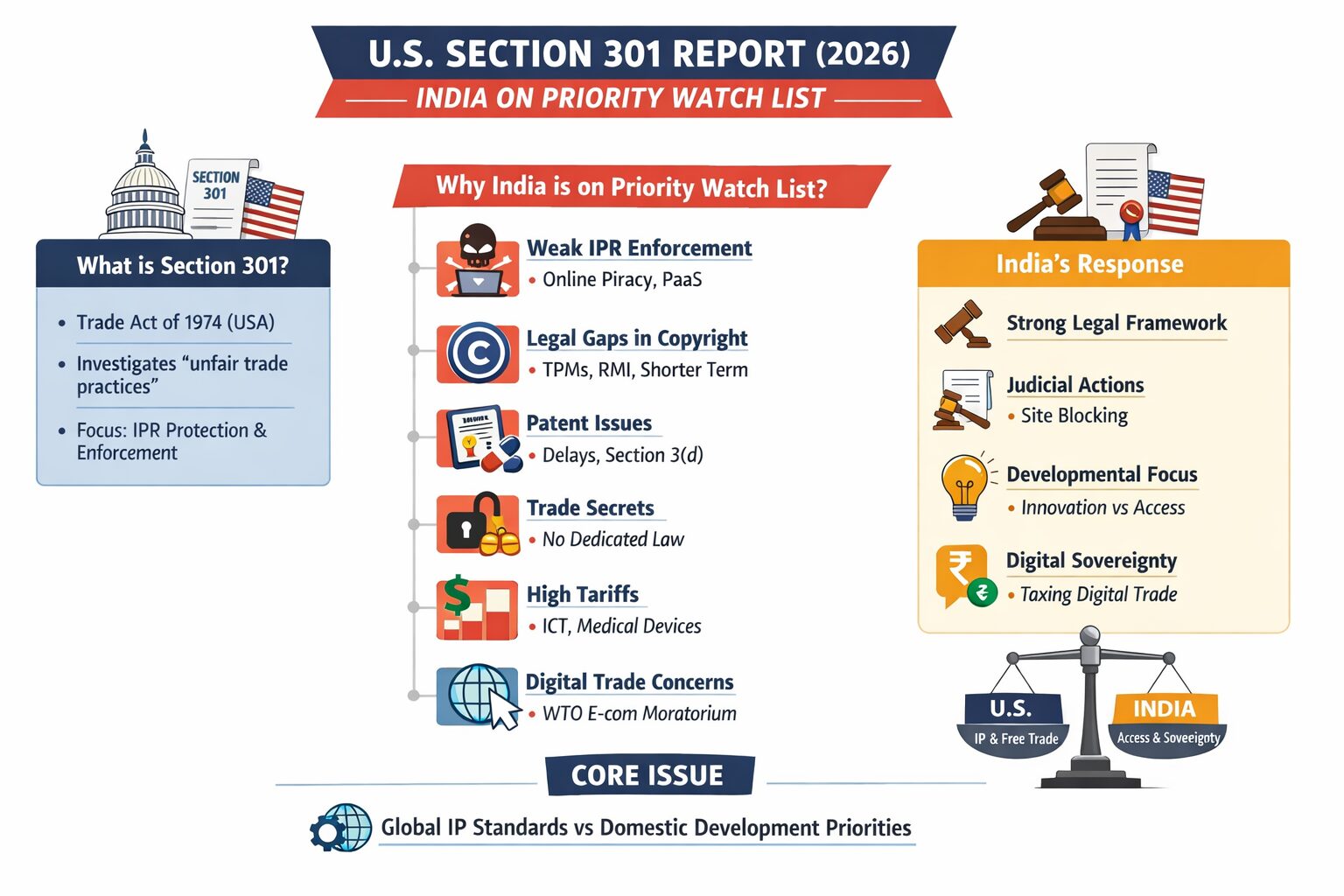
- Section 301 of the US Trade Act of 1974 is a key legal tool that allows the US to investigate and respond to foreign trade practices that it considers unfair or harmful to American commerce. USTR can launch such investigations on its own initiative.
Why India remains on the Priority Watch List?
India remains on the USTR Priority Watch List in 2026. The key reasons for placing India on the Priority Watch List include-
- Persistent Online Piracy & Weak IPR Enforcement: The report confirms “rampant internet piracy” in India. It reports a rise of Piracy-as-a-Service (PaaS) platforms, Pirate cyberlockers and hosting infrastructure (theft of digital content). Delayed compliance by ISPs (Internet Service Providers) in implementing blocking orders & inconsistent criminal enforcement across states. It calls for faster takedowns of infringing content under the IT Rules, 2021 and enforcement of the Cinematograph (Amendment) Act, 2023, to criminalise camcording and unauthorised transmission of films online.
- Gaps in the Copyright Legal Framework: Despite a Copyright Act, widespread piracy of copyrighted materials persists. E.g., Commercial-scale photocopying and unauthorised reprints of academic books. The report explicitly highlights the absence of Technological Protection Measures (TPMs), Rights Management Information (RMI) and Copyright term below the global standard (70 years). It calls on India to fully implement the World Intellectual Property Organisation (WIPO) Copyright Treaty.
- Patent Issues: Continued concern over the interpretation and application of stringent patentability criteria (Section 3(d) of the Patents Act). It creates uncertainty for investors and innovators. The lengthy patent examination process in India can lead to long waiting periods to receive patent grants. The threat of patent revocations and the procedural and discretionary invocation of patentability criteria under the Indian Patents Act impact the US companies across various sectors.
- Trade Secrets: Lack of a specific, comprehensive legal framework to protect against the misappropriation of trade secrets.
- Market Access: High tariffs on IP-intensive products, particularly in the ICT (Information and Communications Technology) and pharmaceutical sectors. This is viewed as denying fair and equitable market access to the US.
USTR Section 301 investigation on India:
India is part of a USTR investigation into industrial policies, specifically concerning “structural excess capacity” in sectors such as petrochemicals and textiles & “forced labour.” India has categorically denied the allegations, calling them misplaced and factually incorrect.
1. Structural Excess Capacity and Production in Manufacturing Sectors:
- Structural excess capacity refers to a long-term situation where a country’s industrial production capacity exceeds both domestic and global demand. When excess capacity leads to overproduction, firms try to sell surplus output abroad.
- The US concerns include:
- Global price suppression: Subsidies, incentives (E.g., PLI schemes), and state support artificially lower production costs. Excess output is exported at low prices (sometimes close to or below cost). This leads to global price suppression & dumping concerns.
- Trade imbalances: Increased imports into the US. Pressure on domestic manufacturing and jobs.
- Competitive disadvantage to the US manufacturers, especially in sectors like steel, chemicals and Pharmaceuticals (generics).
- India’s Position: India has formally rejected these allegations, arguing that its trade surplus results from macroeconomic factors (manufacturing is demand-driven; the PLI scheme aims at import substitution) rather than unfair trade practices.
2. Forced Labour:
- India’s Position: India has ratified the Forced Labour Convention, 1930 (No. 29) and the Abolition of Forced Labour Convention, 1957 (No. 105), both of which prohibit forced labour in all forms.
| Evergreening of Patents: • Section 3(d) of the Indian Patents Act, 1970 states that the mere discovery of a new form of a known substance that does not result in increased efficacy, or the use of a known process with insignificant changes, may not be considered patentable. • From the Indian point of view, the section prevents “evergreening of patents” (an extension of patent life through minor changes). • But the US (and other countries) view it as a concern, as it reduces the patent protection period, allows early entry of generics, and discourages investment in drug innovation. Further, determining whether a modification or improvement qualifies as a substantial enhancement of efficacy can be subjective and prone to legal disputes. |
Practice MCQ
Q. Which of the following best describes “Priority Watch List” under the Section 301 framework?
(a) Countries that have fully complied with global IPR norms
(b) Countries requiring bilateral trade agreements with the U.S.
(c) Countries with serious deficiencies in IPR protection or enforcement
(d) Countries facing automatic WTO dispute settlement
Answer: (c)
UPSC PYQ 2018
Q. International Labour Organisation’s Conventions 138 and 182 are related to:
(a) Child labour
(b) Adaptation of agricultural practices to global climate change
(c) Regulation of food prices and food security
(d) Gender parity at the workplace
Answer: (a)