Viksit Bharat Shiksha Adhishthan Bill: Regulator Versus Autonomy
Why in News?
The Hindu reported on July 17, 2026 that a draft report circulated to the Joint Committee on the Viksit Bharat Shiksha Adhishthan Bill, 2025 warned that extensive powers in a single central regulator could enable bureaucratic or ideological overreach and weaken the institutional autonomy available under the present framework.
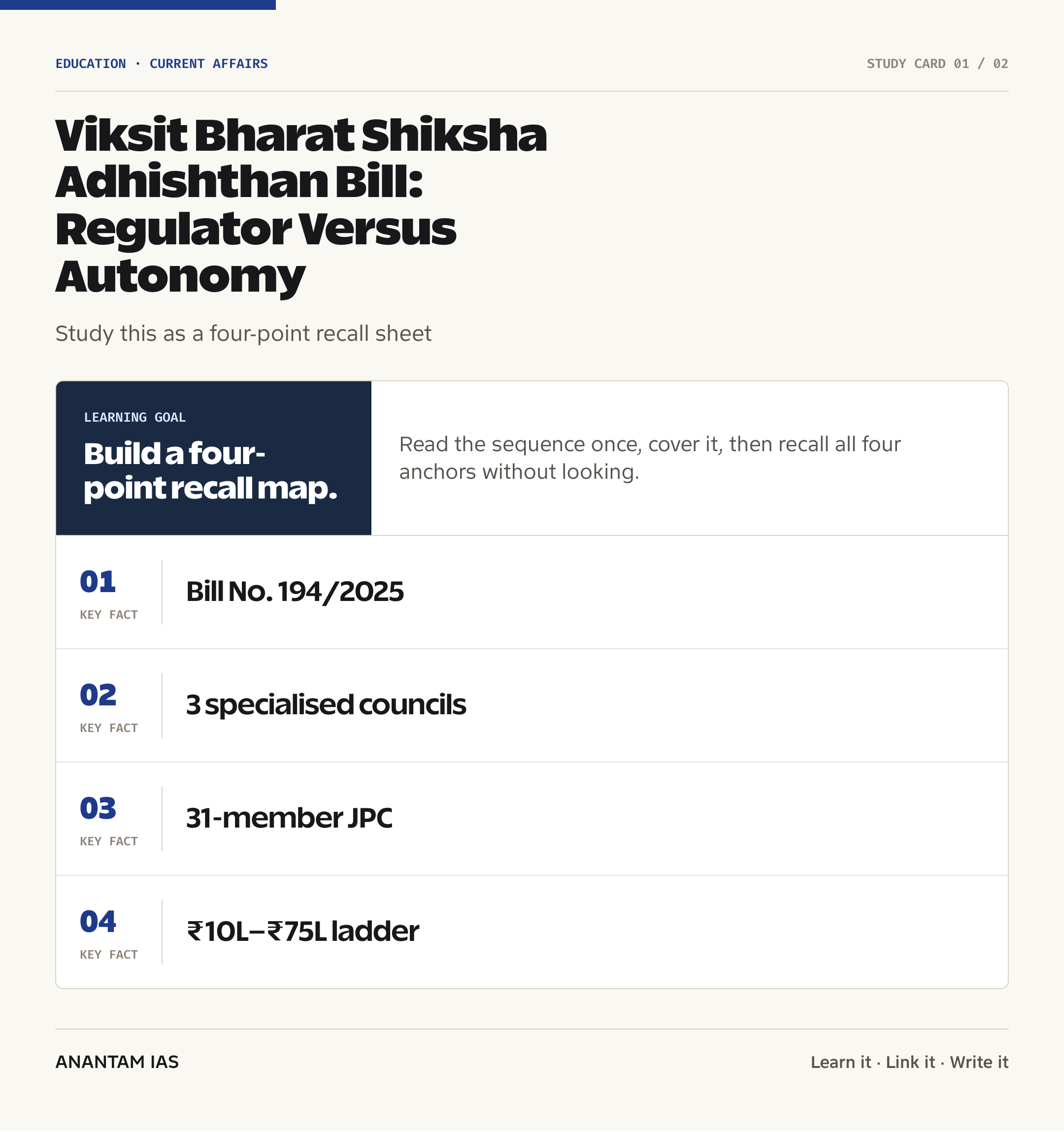
The reported document is a committee draft, while the official parliamentary text remains Bill No. 194 of 2025, introduced in the Lok Sabha on December 15, 2025. At the time of the report, the committee was to consider and adopt its draft; the Bill had not become an Act and none of its proposed institutions or penalties was yet in force.
- The proposal would replace the UGC, AICTE and NCTE with an apex Commission and three specialised Councils for regulation, accreditation and academic standards.
- The draft committee report reportedly said the graded penalty system must operate only for proven violations and must not permit arbitrary punishment by the Regulatory Council.
- For predictable vacancies, the panel reportedly sought a process beginning at least six months in advance and completion within 90 days after a vacancy arises.
- The panel reportedly accepted presidential appointment of Council presidents and full-time members on a Search-cum-Selection Committee recommendation, but suggested direct Central Government appointment of certain other members to reduce delay.
- The 31-member Joint Committee, chaired by Dr. D. Purandeswari, brings the institutional-design question into focus: can unified regulation reduce duplication without making the regulator dependent on the executive?
The development matters in the context of:
- The dispute is not simply one regulator versus three; it concerns who appoints the regulator, who hears appeals, who controls delegated rules and how institutional autonomy is protected.
- The Bill links autonomy to accreditation and compliance, but several safeguards are left to later rules or regulations. That makes the design of delegated legislation central to the final balance.
- Higher education also has a federal dimension: national coordination of standards lies with the Union, while States retain important powers over universities under the constitutional distribution of legislative subjects.
UPSC Relevance
Prelims Relevance
- Bill No. 194 of 2025 was introduced in the Lok Sabha on December 15, 2025 and referred for examination by a Joint Committee of both Houses; a Bill under committee review is not enacted law.
- Entry 66 of the Union List covers coordination and determination of standards in higher education, research, and scientific and technical institutions.
- Entry 25 of the Concurrent List covers education, including technical and medical education and universities, subject to relevant Union List entries; Entry 32 of the State List covers incorporation, regulation and winding up of universities, subject to Entries 63–66 of the Union List.
- The proposed apex body is the Viksit Bharat Shiksha Adhishthan, with a Regulatory Council, Accreditation Council and Standards Council.
- The Bill would repeal the UGC Act, 1956, AICTE Act, 1987 and NCTE Act, 1993, subject to repeal-and-savings and transitional provisions.
- Its coverage includes universities, specified Institutions of National Importance, technical and teacher-education institutions, architecture education, and recognised open, distance, online and digital education; several professional programmes, including medical and legal education, are excluded.
- Under section 33 as introduced, repeated contraventions can trigger minimum penalties of ₹10 lakh, ₹30 lakh and ₹75 lakh; an unauthorised university or HEI can face a minimum ₹2 crore penalty and closure.
- Under section 37, an appeal against an order of the Commission or a Council lies to the Central Government, whose decision is proposed to be binding.
- The Bill’s Financial Memorandum keeps grants to centrally funded HEIs outside the Commission and Councils, with disbursal through mechanisms devised by the Ministry of Education.
Mains Relevance
GS Paper 2
- Institutional design of regulatory bodies: balancing regulatory coherence with independence, expertise, transparency and review.
- Constitutional division of responsibility for higher education under Union List Entry 66, Concurrent List Entry 25 and State List Entry 32.
- Governance issues in appointments, executive directions, appeals, supersession and delegated legislation.
- Social-justice implications of accreditation-led autonomy, student protection, access, public accountability and uneven institutional capacity.
- Parliamentary committees as mechanisms for pre-legislative scrutiny and evidence-based correction of a government Bill.
Essay
- Autonomy is not freedom from accountability; it is accountability protected from arbitrary control.
- Good regulation should make power legible, reviewable and proportionate.
- Uniform standards and institutional diversity need not be opposing goals.
Background and Context
The proposed architecture: one apex body, three Councils
The Bill tries to separate specialised functions while placing them under a common strategic roof.
- The Commission would provide strategic direction, coordinate the Councils and develop road maps for multidisciplinary institutions, research, internationalisation and Bharatiya knowledge systems.
- The Regulatory Council would act as the common regulator, enforce minimum standards, require public disclosures, address grievances and facilitate graded autonomy.
- The Accreditation Council would create an outcome-based institutional accreditation framework, supervise accrediting institutions and publish accreditation information.
- The Standards Council would frame learning outcomes, qualification levels, credit-transfer norms and minimum academic standards while leaving room for institutional innovation in curriculum, pedagogy and assessment.
- The Ministry of Education presents this separation as a way to replace multiple approvals with faceless, technology-driven and disclosure-based regulation. The panel’s reported concern asks whether functional separation inside one architecture is enough when core powers and executive links remain concentrated.
Autonomy: promise in the objective, uncertainty in the mechanism
The Bill repeatedly promises self-governing institutions, but the legal route to that autonomy is conditional and partly deferred.
- Academic autonomy concerns courses, curriculum, pedagogy, admissions, examinations and research; administrative autonomy covers appointments and internal governance; financial autonomy covers spending, fees and resource mobilisation.
- Section 11 asks the Regulatory Council to move HEIs towards full accreditation and autonomy in a graded and time-bound manner, linking freedom to verified performance and disclosure.
- Section 12 would require even an existing or newly accredited university to obtain prior Regulatory Council approval before establishing constituent colleges, off-campuses or multiple campuses.
- Section 49 gives the proposed Act overriding effect. It says autonomy and independence already accorded to Institutions of National Importance and Institutions of Eminence will be protected, but the manner of protection is left to regulations requiring prior Central Government approval.
- This is the central tension: the statute declares autonomy as a goal, while important boundaries of that autonomy depend on future regulations. A durable answer should distinguish autonomy promised in policy from autonomy enforceable in law.
- For the wider reform context, see the published note on National Education Policy 2020.
Regulator independence: appointments, directions and appeals
A regulator’s credibility depends not only on its expertise but also on the legal distance between rule-maker, regulated institution and political executive.
- The proposed Commission would have a Chairperson and up to 12 members; each Council would be led by a President and have up to 14 members, drawing from academia, domain experts, State HEIs, Institutions of National Importance and government nominees.
- The Chairperson is proposed to be appointed by the President of India on the Central Government’s recommendation. Council presidents and full-time members would be chosen on the recommendation of a Search-cum-Selection Committee containing two Centre-nominated experts and the Higher Education Secretary.
- Under section 45, each body would be bound by written Central Government directions on questions of policy; if the Government and regulator disagree about whether a matter is policy, the Government’s view would be final.
- Section 37 sends appeals from Commission or Council orders to the Central Government, rather than to an independent appellate tribunal. This combines policy direction and appellate review in the same executive.
- Section 47 permits supersession of the Commission or a Council, with prior presidential approval and a show-cause opportunity, for up to six months, extendable by another period of up to six months.
- The panel’s reported vacancy timelines address delay, but speed alone cannot establish independence. The design must also secure transparent criteria, plural selection, fixed tenure, disclosed conflicts and reasoned removal.
Penalty ladder: deterrence needs due process
The penalty architecture seeks to move from correction to stronger sanctions when violations repeat or persist.
- For an initial contravention, section 33 first provides a written notice and time to rectify; failure to rectify can attract a minimum ₹10 lakh penalty.
- A further contravention can attract a minimum ₹30 lakh penalty or recommendations affecting responsible personnel, grants or the institution’s academic and administrative autonomy.
- A continuing or persistent contravention can attract a minimum ₹75 lakh penalty, with possible recommendations concerning degree-granting power, affiliation or closure.
- Establishing a university or HEI without required government approval can attract a minimum ₹2 crore penalty and immediate closure. The Bill also directs the regulator to protect enrolled students from monetary repercussions of a penalty.
- The reported draft committee view connects punishment to proven violations and habitual or repeated non-compliance. It also supports responsibility for specific promoters, leaders or trustees instead of allowing an institutional shell to hide individual wrongdoing.
- Due process still requires precise definitions, access to evidence, a meaningful hearing, proportional reasons and independent review. A graded scale becomes fair only when the decision process is as clear as the amount.
Federalism: national standards, State-created universities
Higher education sits across overlapping constitutional fields, so regulatory unification must be designed as cooperative federalism.
- The Union’s strongest constitutional basis is Entry 66 of the Union List, which supports national coordination and determination of higher-education standards.
- Education is also in Entry 25 of the Concurrent List, while States legislate on the incorporation, regulation and winding up of universities under Entry 32 of the State List, subject to the Union’s standards-related entries.
- The proposed Commission includes two academicians from State HEIs. The Regulatory and Standards Councils each include a State or Union Territory nominee on rotation, with a proposed one-year term.
- Rotational participation gives States a voice but not continuous representation for every State. A central rule that affects State universities can still create implementation conflict if consultation is episodic.
- The stronger federal model would preserve uniform minimum standards while allowing States and institutions room above that floor. The answer is neither fragmented regulation nor command-style uniformity, but shared standard-setting with recorded consultation.
NEP 2020 and the missing funding vertical
The Bill draws from NEP 2020 but does not reproduce its regulatory model in full.
- NEP 2020 envisaged a Higher Education Commission of India with four independent verticals: regulation, accreditation, funding and academic standard-setting.
- The Bill creates three Councils for regulation, accreditation and standards. It does not create a higher-education funding Council inside the Commission.
- Its Financial Memorandum states that grants to centrally funded HEIs will remain outside the proposed bodies and be disbursed through mechanisms devised by the Ministry of Education.
- Separating funding from day-to-day regulation can reduce conflict of interest. But locating funding with the Ministry also makes transparent grant criteria, predictable allocations and protection from policy leverage important.
- The existing regulatory debate is illustrated by the published note on UGC Equity Regulations 2026, where rule-making, statutory authority and judicial review intersect.
Delegated legislation: where the final balance may be set
Many operational choices are left to rules made by the Government or regulations made by the proposed bodies.
- Rules would shape appointments, adjudication, appeals, institutional closure and multiple procedural details; regulations would shape accreditation, autonomy, public disclosure and academic standards.
- Delegation is necessary in a technical sector because standards change faster than primary legislation. The risk appears when a rule fills a core policy gap that Parliament should settle itself.
- Autonomy of major institutions, criteria for proportional penalties, consultation with States and the independence of appellate review are strong candidates for statutory safeguards, not open-ended executive choice.
- Rules and regulations must be laid before Parliament, but effective scrutiny also needs explanatory memoranda, stakeholder comments, impact assessment and a clear response to the Joint Committee’s final recommendations.
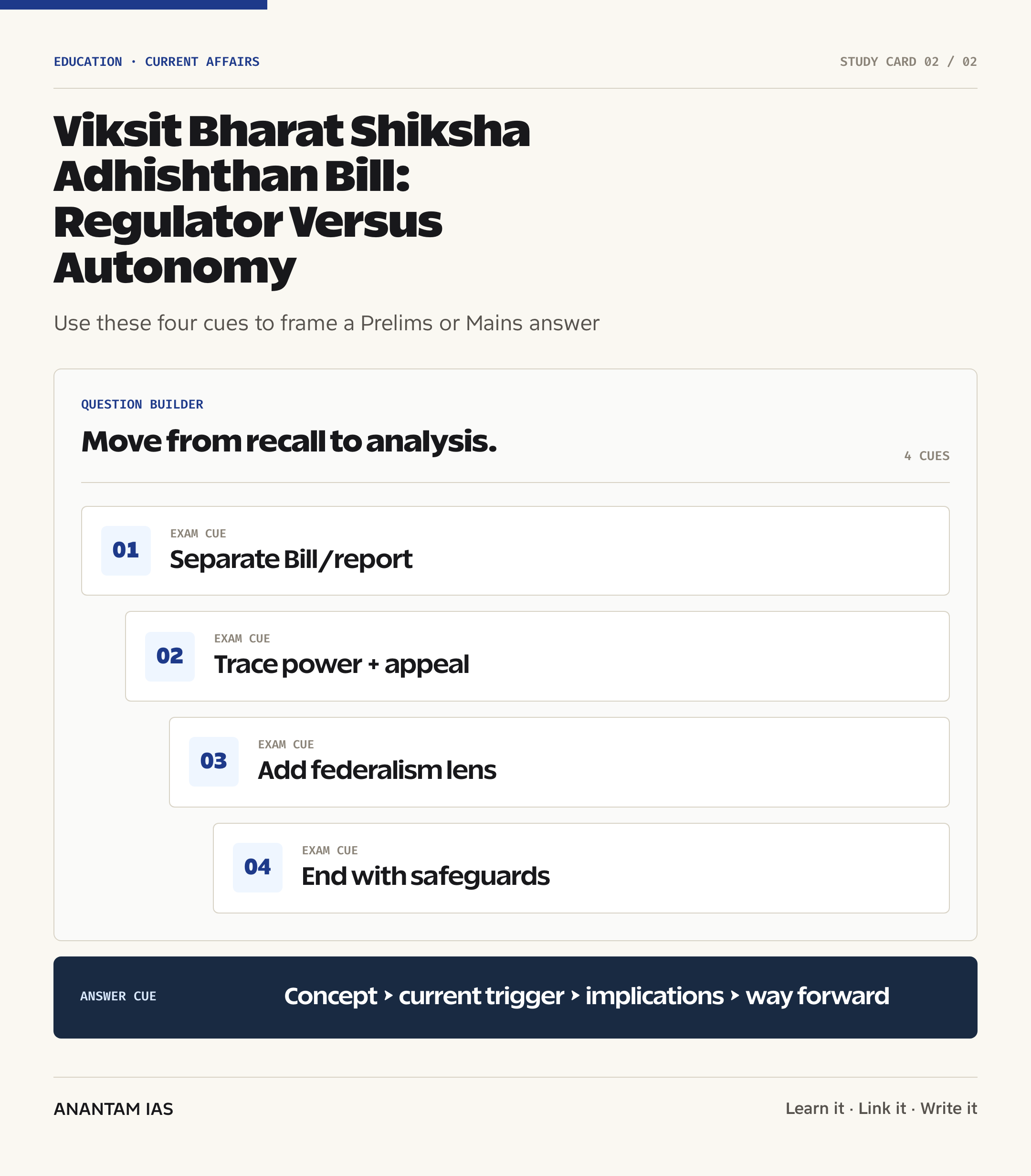
- For a Mains answer, test every delegated power through four questions: Who makes it? What limits it? Who reviews it? What remedy exists?
Way Forward
Put autonomy safeguards in the Act
- Define a minimum statutory domain of academic, administrative and financial autonomy, especially for Institutions of National Importance and high-performing accredited HEIs.
- Allow restrictions only through published criteria, a reasoned order, proportionality and a time-bound review, instead of leaving the entire protection to later regulations.
Build an independent review chain
- Create an independent appellate tribunal, or at minimum a review panel institutionally separate from the Ministry unit issuing policy directions.
- Require publication of enforcement orders, evidence relied upon, hearing records and reasons, while protecting personal data and legitimate academic confidentiality.
Make appointments timely and plural
- Adopt the reported six-month vacancy planning and 90-day completion benchmarks, backed by a public vacancy calendar.
- Broaden search bodies beyond executive nominees, disclose selection criteria and conflicts, and preserve fixed tenure with removal only through defined grounds and fair inquiry.
Turn federal consultation into a rule
- Create a standing Centre-State higher-education forum and require consultation before standards or regulations materially affecting State universities are finalised.
- Publish State submissions and the regulator’s response so consultation becomes an accountable process, not a ceremonial invitation.
Use proportionate, student-safe enforcement
- Distinguish fraud, quality failure, disclosure error and procedural delay; the same penalty ladder should not treat unlike violations alike.
- Prioritise correction plans and student continuity, reserve closure for grave or persistent breaches, and ring-fence fees, records, credits and degree pathways when an institution is sanctioned.
Conclusion
The Viksit Bharat Shiksha Adhishthan Bill seeks a simpler regulatory architecture, clearer functional roles and disclosure-led accountability. The Joint Committee’s reported draft concern identifies the decisive test: consolidation should remove duplication without converting regulation into executive command.
A sound final law would combine national standards with institutional diversity, strong enforcement with due process, and timely appointments with genuine independence. In a Mains answer, the balanced position is clear: unified regulation can be useful, but concentrated power needs statutory safeguards, federal consultation and independent review.
UPSC Practice Questions
Prelims MCQ 1
With reference to the Viksit Bharat Shiksha Adhishthan Bill, 2025 as introduced, consider the following statements:
- It proposes separate Councils for regulation, accreditation and academic standards under an apex Commission.
- It proposes a fourth Council for disbursing grants to centrally funded higher educational institutions.
- Professional programmes regulated under medical and legal education laws are outside its application.
How many of the above statements are correct?
(a) Only one (b) Only two (c) All three (d) None
Answer: (b) Only two
Explanation:
Statements 1 and 3 are correct. Statement 2 is incorrect: the Bill creates three Councils, while its Financial Memorandum keeps grants to centrally funded HEIs outside them and assigns disbursal to mechanisms devised by the Ministry of Education.
Prelims MCQ 2
Which option best states the constitutional setting for higher-education regulation in India?
(a) Education is in the Concurrent List, while Union List Entry 66 covers coordination and determination of higher-education standards. (b) Universities are exclusively a Union subject, leaving States no legislative role. (c) Higher-education standards fall exclusively under State List Entry 32. (d) The Constitution assigns all professional education only to local governments.
Answer: (a) Education is in the Concurrent List, while Union List Entry 66 covers coordination and determination of higher-education standards.
Explanation:
Entry 25 of the Concurrent List covers education subject to specified Union entries. Union List Entry 66 covers coordination and determination of standards, while State List Entry 32 retains a role over universities subject to Entries 63–66.
UPSC Mains Questions
- The Viksit Bharat Shiksha Adhishthan Bill seeks regulatory coherence, but its institutional design raises questions about autonomy and executive control. Examine the proposed structure through appointments, policy directions, appellate review and delegated legislation, and suggest safeguards. (250 words)
- National coordination of higher-education standards must coexist with the States’ role in universities. Analyse the federal implications of a unified higher-education regulator and propose a cooperative mechanism for standard-setting, implementation and dispute resolution. (250 words)
- A graded penalty architecture can strengthen accountability only when it is proportionate and procedurally fair. Discuss this statement with reference to higher-education regulation, institutional responsibility, student protection and independent review. (150 words)
Sources: Lok Sabha, Parliament of India and The Hindu.
Frequently Asked Questions
What is the VBSA Bill?
The Viksit Bharat Shiksha Adhishthan Bill, 2025 proposes an apex higher-education Commission with separate Regulatory, Accreditation and Standards Councils. It would replace the UGC, AICTE and NCTE framework for institutions within its scope. As of the reported committee draft on July 17, 2026, it remained a Bill and was not an enacted law.
Why did the parliamentary panel raise concern?
The Hindu reported that the panel’s circulated draft feared extensive power in one central regulator could permit bureaucratic or ideological overreach and affect institutional autonomy. The concern also covers how penalties are imposed, how members are appointed and whether executive influence is balanced by clear legal limits and independent review.
Which bodies would the Bill replace?
The Bill would repeal the University Grants Commission Act, 1956, the All India Council for Technical Education Act, 1987 and the National Council for Teacher Education Act, 1993. Their relevant regulatory functions would move into the proposed Commission and its three Councils, subject to transition and savings provisions.
Does the Bill cover medical education?
No, professional programmes regulated by the National Medical Commission are excluded from the Bill’s application. Legal, veterinary, pharmacy, dental, nursing, Indian systems of medicine, homoeopathy, rehabilitation and allied-health programmes governed by the listed statutory bodies are also excluded, while technical, teacher and architecture education fall within the proposed framework.
How does the penalty system work?
Section 33 proposes escalating minimum penalties of ₹10 lakh, ₹30 lakh and ₹75 lakh as contraventions remain unrectified, repeat or persist. Stronger consequences can affect personnel, grants, autonomy, degree powers, affiliation or closure. An unauthorised university or HEI can face a minimum ₹2 crore penalty and closure, with student interests to be protected.
Where is the regulator-autonomy conflict?
The Bill promises graded autonomy and independent specialised functions, but the Central Government retains important roles in appointments, policy directions, approvals, appeals and possible supersession. Some protections, including the manner of safeguarding autonomy for Institutions of National Importance, are left to later regulations requiring prior Central Government approval.