The Supreme Court on April 28, 2026 stayed the University Grants Commission’s “Promotion of Equity in Higher Educational Institutions Regulations, 2026,” and the order has reopened a fight that has been simmering on Indian campuses for over a decade. The bench called the UGC equity regulations “vague” and “open to misuse,” and asked the Centre to come back with definitions that can actually be implemented without becoming a fresh source of litigation.
That is a sharp signal. The Court did not strike the regulations down. It paused them. The implication is that the goal, protecting Dalit, Adivasi, OBC, minority and women students from caste and gender discrimination at universities, is not in dispute. What is in dispute is how the UGC drafted the rules to deliver that goal, and whether the language hands too much discretion to institutions that have historically been the source of the problem.
This explainer walks through what the UGC equity regulations actually proposed, the long backstory that produced them, where the gap between reservation in admissions and reservation in employment really sits, and why the Supreme Court order matters for affirmative action policy going forward.
Quick Facts at a Glance
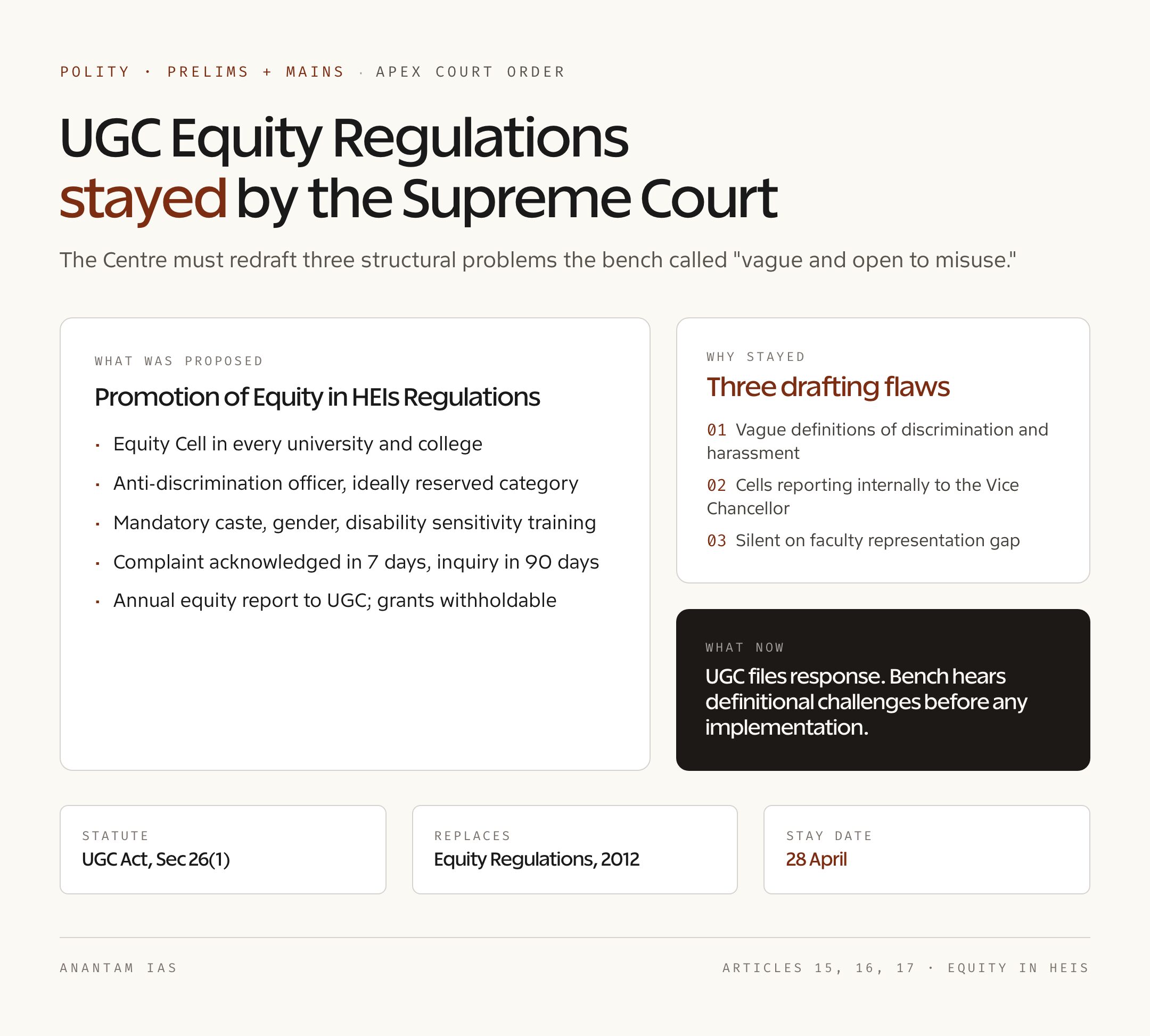
- Regulations notified by UGC in early 2026 under Section 26(1) of the UGC Act, 1956.
- Title: Promotion of Equity in Higher Educational Institutions Regulations, 2026.
- Replace the older UGC (Promotion of Equity in Higher Educational Institutions) Regulations, 2012.
- Apply to all central, state, deemed and private universities recognized under the UGC Act, plus their affiliated colleges.
- Stayed by a Supreme Court bench on April 28, 2026 in a writ petition filed by student bodies and faculty associations.
- Court directed UGC to file a response and indicated it would hear definitional challenges before allowing implementation.
- Backdrop: continuing campus suicides among reserved-category students and persistent under-representation in faculty positions.
What Just Happened
The petitioners argued that the UGC equity regulations, as drafted, recycled the 2012 framework with cosmetic changes while leaving the real enforcement gaps untouched. They pointed to three structural problems.
First, the definitions of “discrimination” and “harassment” were drafted in language so broad that any institution could either over-apply or under-apply them. The 2012 regulations already had this flaw. The 2026 version did not fix it.
Second, the regulations created an Equity Cell at every institution but kept the reporting line internal to the Vice Chancellor’s office. Past inquiries, including the Thorat Committee report on AIIMS and the JNU and University of Hyderabad inquiries that followed Rohith Vemula’s death in 2016, had already shown that internal cells under the head of the institution rarely deliver independent findings.
Third, the regulations did not address the elephant in the room: representation of SC, ST and OBC candidates in faculty appointments and senior administrative positions. The petitioners argued that without addressing the upstream gap, downstream anti-discrimination measures stay performative.
The bench accepted these arguments at the prima facie stage and stayed the regulations. The Court was careful to note that the stay does not affect the underlying constitutional protections under Articles 15, 16 and 17, or any existing reservation in admissions and recruitment.
Background and Historical Context
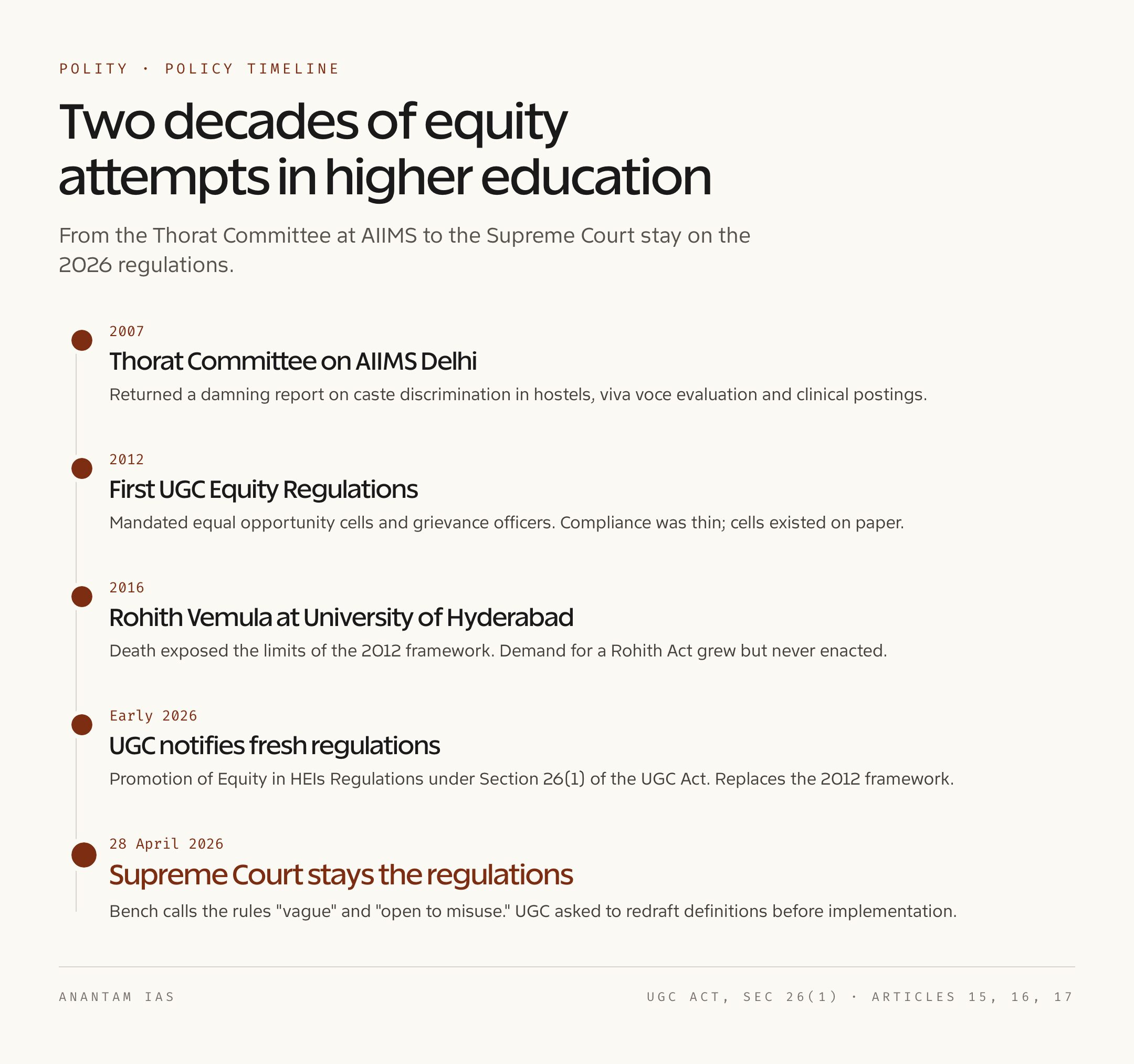
The story did not start in 2026. It started in 2007 with the Thorat Committee, which the Ministry of Health constituted to look into caste discrimination at AIIMS Delhi after a complaint by Dalit medical students. The committee returned a damning report. It found systemic exclusion in hostel allocation, viva voce evaluation, and clinical postings. That report shifted the policy conversation from the question of whether caste discrimination existed in elite Indian institutions to the question of what to do about it.
The UGC’s first formal response came as the 2012 Regulations on Promotion of Equity. The 2012 framework mandated equal opportunity cells, anti-discrimination officers, and student grievance redressal mechanisms in every higher educational institution. Compliance, however, was thin. Many institutions set up cells on paper without staff, budgets or independence.
The next major inflection was the death of Rohith Vemula at the University of Hyderabad in January 2016. His suicide note, the institutional response that followed, and the campus-wide protests that spread across the country forced the UGC and the Ministry of Education to confront the limitations of the 2012 framework. A draft “Rohith Act” was demanded by student unions but never enacted. Subsequent suicides at IITs, AIIMS Nagpur, and central universities kept the issue on the front page.
The 2026 regulations were the UGC’s attempt to reset the framework. By the time they were notified, however, the pattern was familiar. Grievance cells under the VC’s office, vague definitions, and silence on faculty representation made the regulations look more like a paper update than a structural reform. The Supreme Court has now agreed.
For a longer view of how affirmative action interacts with the constitutional framework, the explainer on cultural and educational rights covers Articles 29 and 30, and the piece on creamy layer in SC ST reservation tracks how the Supreme Court has refined reservation jurisprudence over the last two decades.
Key Provisions of the 2026 Regulations
The UGC equity regulations contained five operational pillars.
Equity Cells in every institution. Each university and college was required to constitute a standing Equity Cell with a designated faculty coordinator, student representatives, and an external member. The cell was tasked with handling complaints of caste, gender, religious and disability-based discrimination.
Anti-discrimination officer. A senior faculty member, ideally from a reserved category, would serve as the institution’s nodal officer. The role overlapped uncomfortably with existing roles for SC ST cells, women’s cells, and internal complaints committees under the POSH Act. The regulations did not clearly resolve the overlap.
Mandatory induction modules. The regulations made caste-sensitivity, gender-sensitivity and disability-sensitivity training compulsory for all new students and faculty. Existing faculty were expected to undergo refresher training every three years.
Grievance timelines. Complaints were to be acknowledged within 7 days, with an inquiry concluded within 90 days. The 2012 regulations had similar timelines, which were routinely missed without consequence.
Reporting to UGC. Institutions were to file an annual equity report to the UGC. Non-compliance could attract penalties up to and including withholding of grants. In practice, the UGC had historically used this lever sparingly.
The Court’s concern was less with the existence of these provisions and more with their drafting. Words like “appropriate action,” “necessary inquiry,” and “reasonable grounds” appeared throughout. None of these phrases survives a litigation challenge well.
Why It Matters
The UGC equity regulations sit at the intersection of three large policy currents.
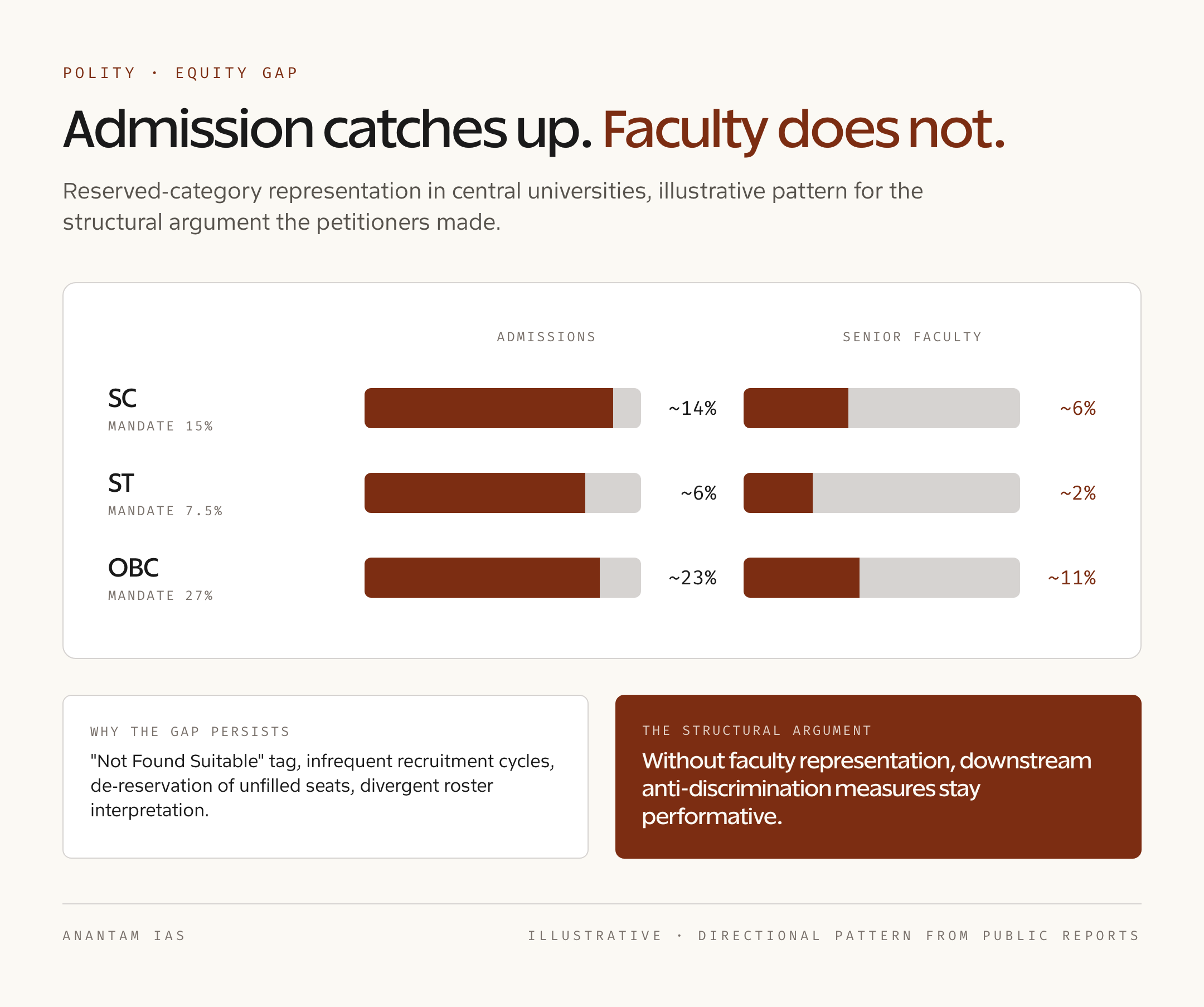
The first is the unfinished business of representation. India’s higher education system has expanded dramatically since 2010, with gross enrollment ratios climbing toward 30 percent. But that expansion has been uneven. Reserved-category students reach campuses in larger numbers than ever before, while reserved-category faculty representation in central universities and IITs continues to lag the constitutional mandate. The regulations, as written, would not have closed that gap.
The second is institutional autonomy versus regulatory enforcement. The UGC has been criticized in recent years for both over-regulation and under-enforcement. Pieces like the education ministry policy mainstream coverage show how the regulator has shifted toward setting frameworks rather than direct enforcement. Equity is one area where direct enforcement is exactly what the constitutional scheme demands.
The third is the climate on campuses. Discrimination today is not always overt. It shows up in viva marks, lab allocations, hostel rooms, and supervisor relationships. The regulations would have needed sharper definitions to catch these patterns without producing frivolous complaints.
Detailed Analysis: The Equity Gap
The clearest measure of where the system stands is the gap between reservation in admissions and reservation in employment. As per latest available data, central universities admit reserved-category students at proportions broadly aligned with constitutional mandates. The picture inverts at the faculty level. Senior faculty positions, particularly at the professor level, show reserved-category representation well below the prescribed share, and the gap widens further at the dean and director levels.
The reasons are familiar. Direct recruitment cycles are infrequent. “Not Found Suitable” remains a standing escape hatch. Roster systems are interpreted differently across institutions. Reserved positions de-reserve over time. The UGC equity regulations did not touch this machinery.
Faculty representation matters for equity outcomes because mentorship, supervision and evaluation networks reproduce themselves. Without a critical mass of reserved-category faculty, reserved-category students lose the most reliable buffer against discrimination. This is the structural point the petitioners made and the bench appeared to take seriously.
Comparative Perspective
Other jurisdictions have taken sharper approaches. The United States moved from quotas to a “holistic review” framework before the Students for Fair Admissions decision in 2023 narrowed the scope of race-conscious admissions. South Africa uses employment equity targets backed by reporting requirements at every public institution. Brazil expanded racial quotas in federal universities in 2012 and reviewed them in 2022.
India’s framework remains constitutionally distinct. Reservation is not a contingent affirmative-action tool. It is a constitutional command rooted in Articles 15(4), 15(5), 16(4) and 16(4A). The UGC equity regulations had to operate within this framework, and that meant they could not avoid the question of faculty representation. They tried. The Court flagged the omission.
Challenges and Critiques
Beyond the definitional vagueness, three critiques recur.
Cell proliferation without independence. Internal Complaints Committees under POSH, SC ST cells under the SC ST Atonement Act compliance regime, and Equity Cells under the UGC framework all sit inside the institution, all report to the same head, and all suffer from staffing and budget constraints. Stacking another cell on top did not solve the underlying independence problem.
Penalty mismatch. Grant withholding is a blunt instrument. It hurts the institution as a whole, including the very students the regulations are meant to protect. Targeted penalties on individuals (faculty, administrators, and inquiry committee members) would have been more credible.
Faculty pipeline silence. Without a coordinated push on reserved-category PhD enrollments, post-doctoral fellowships, and direct recruitment timelines, the supply side of faculty representation stays choked.
The Supreme Court’s stay creates space for the UGC to address these critiques in a revised draft. The pressure to do so is now public.
UPSC Prelims Pointers
- UGC equity regulations 2026 issued under Section 26(1) of the University Grants Commission Act, 1956.
- Replace the 2012 Promotion of Equity in HEIs Regulations.
- Stayed by the Supreme Court on April 28, 2026.
- Articles 15(4), 15(5), 16(4), 16(4A) and 17 form the constitutional backbone of anti-discrimination in higher education.
- Thorat Committee 2007 examined caste discrimination at AIIMS Delhi.
- POSH Act 2013 governs sexual harassment at workplaces, including universities.
- Equal Opportunity Cell, Anti-Discrimination Officer and Grievance Redressal Cell are mandated by the UGC framework.
- Reserved-category faculty representation lags the constitutional roster, particularly at the professor level.
Mains Practice Questions
- The Supreme Court has stayed the UGC equity regulations 2026 calling them vague. Examine the institutional design flaws in India’s higher education anti-discrimination framework and suggest reforms. (GS Paper II, 15 marks)
- Reservation in admissions has not translated into reservation in employment in higher educational institutions. Discuss the structural reasons and the policy interventions required. (GS Paper II, 15 marks)
- Critically evaluate the role of internal grievance cells in delivering equity outcomes on Indian campuses. (GS Paper II, 10 marks)
- The Thorat Committee, the Rohith Vemula episode and the 2026 UGC regulations represent three milestones in the equity debate in higher education. Trace the policy evolution and identify the unfinished agenda. (GS Paper II, 15 marks)
Way Forward
The Supreme Court’s stay is not the end of the equity push. It is a course correction. The UGC has the opportunity to come back with a sharper draft that does three things at once.
It must define discrimination, harassment and reasonable accommodation in language that survives litigation. It must restructure grievance cells with external composition and independent reporting lines, separate from the Vice Chancellor’s office. And it must address faculty representation directly, with timelines for filling reserved positions, audit of de-reservation patterns, and review of “Not Found Suitable” decisions.
If the revised UGC equity regulations do those three things, they will deliver more than the original draft promised. If they do not, the cycle of cosmetic updates will continue, and the next campus suicide will reopen the same conversation.
The constitutional command is clear. The institutional machinery is the part that needs work.
Frequently Asked Questions
What are the UGC equity regulations 2026?
A set of rules issued by the University Grants Commission to handle caste, gender, religious and disability-based discrimination at higher educational institutions. They replace the 2012 framework.
Why did the Supreme Court stay the UGC equity regulations?
The Court held that the regulations were drafted in vague language that was open to misuse, and asked the Centre to file a response with sharper definitions before implementation could proceed.
Does the stay affect existing reservation in admissions or recruitment?
No. The stay applies only to the 2026 anti-discrimination framework. Constitutional reservation under Articles 15(4), 15(5) and 16(4) is unaffected.
What is the equity gap between admissions and employment?
Reserved-category students reach campuses in proportions close to the constitutional roster. Reserved-category faculty representation, particularly at senior levels, lags well below the mandated share.
What was the Thorat Committee?
A committee constituted in 2007 to examine caste discrimination at AIIMS Delhi. Its report exposed systemic exclusion and shifted the policy conversation toward institutional remedies.
How does this connect to the Rohith Vemula case?
Vemula’s death at the University of Hyderabad in January 2016 forced the UGC to revisit the 2012 framework. The 2026 regulations were partly an answer to the gaps that case exposed.
What happens next?
The UGC will file a response. The Supreme Court will hear definitional challenges. A revised draft is likely, addressing both the language and the faculty representation gap.
Tell Google you want more of this.
Add Anantam IAS as a preferred sourceOne tap, and this site shows up more often in your own Top Stories, AI Overviews and AI Mode. Remove it any time.