Vizjinjam Port


Why in news:
The Vizhinjam seaport is set to begin its Phase Two expansion next month, with a target completion date of 2028. This phase aims to increase the port’s annual container capacity to 4.5 million TEUs and will add a break-bulk berth, a tanker berth, and a bunkering facility.
UPSC Relevance:
Ports and Connectivity have been one of the favorite areas for UPSC in Prelims examination.
Prelims PYQ 2023:
Consider the following pairs:
Port : Well known as
1. Kamarajar Port: First major port in India registered as a company
2. Mundra Port: Largest privately owned port in India
3. Vishakhapatnam Port: Largest container port in India
How many of the above pairs are correctly matched?
a) Only one pair
b) Only two pairs
c) All three pairs
d) None of the pairs
Prelims PYQ 2024:
Consider the following airports:
1. Donyi Polo Airport
2. Kushinagar International Airport
3. Vijayawada International Airport
In the recent past, which of the above have been constructed as Greenfield projects?
a) 1 and 2 only
b) 2 and 3 only
c) 1 and 3 only
d) 1, 2 and 3
About Vizjinjam Deep Sea Port:
- It is India’s first deep-water container trans-shipment port. A trans-shipment port is a hub where cargo is transferred from one large vessel to smaller ships for distribution to various regional ports.
- The port’s natural deep draft of 20 meters near the shore minimizes the need for dredging.
- This allows it to accommodate some of the world’s largest cargo and container ships, also known as “mother vessels,” which many other Indian ports cannot handle.
- It currently has an 800-meter-long container jetty that can handle one container mother ship and two feeder vessels at a time.
- The port is owned by the Government of Kerala. It was developed under a Public-Private Partnership (PPP) model on a Design, Build, Finance, Operate, and Transfer (DBFOT) basis. The Adani Group, through Adani Vizhinjam Port Private Ltd (AVPPL), holds the concession to operate the port for 40 years, which is extendable by 20 more years.
- It started commercial operations in December 2024, and has already handled nearly 1 million TEUs.
- So far, all containers handled by the port have been transshipment cargo, with 60% being international and 40% Indian.
- Previously, 75% of India’s transshipment operations occurred at foreign ports, leading to revenue loss. Vizhinjam is designed to redirect this traffic and keep revenue within India.
- Exim cargo has not yet been handled, but port officials expect it to grow to account for 20% of total cargo as the Phase Two expansion progresses and new inland connections are completed.
- The port is expected to reduce logistics costs for Indian manufacturers by 30-40%, improving the country’s export competitiveness.
- Vizhinjam’s strategic location on the East-West sea route makes it a potential hub for crew changes. Port officials are working with the government to establish an international crew change facility, which could boost the local economy through services for seafarers.
- The port is a high-tech facility with automated handling systems.The port uses sensor, radar, and AI technology to track and manage large container ships during arrival and departure.
Ports in India:
- India has a vast coastline and a large number of ports, which are categorized into major and non-major ports.
- India has 13 major ports and over 200 non-major (minor and intermediate) ports.
- The management of ports in India is divided based on their category:
- Major Ports: These ports are under the direct administrative control of the Ministry of Ports, Shipping and Waterways of the central government. They are governed by the Major Port Authorities Act, 2021. This act gives the major ports more autonomy and a more corporate structure compared to the previous system under the Major Port Trusts Act, 1963.
- Each major port is managed by a Port Authority, which functions as a board of directors.
- While the ownership of the land and waterfront remains with the central government, private sector participation is encouraged through PPP models. This allows for the development and operation of berths and terminals by private companies for a fixed period.
- Non-Major Ports: These ports are managed by the respective state governments or their maritime boards. The development and regulation of these ports fall under the jurisdiction of the state authorities. They also utilize PPP models to attract private investment for port development and operations.
12 Major Ports:

West Coast Ports
- Deendayal Port (Kandla), Gujarat
- Originally known as Kandla Port, it was renamed in 2017. It is one of the busiest and largest ports in India by volume of cargo handled. It is a tidal port and was developed to serve as the principal seaport for western India after the partition. It is also a Special Economic Zone (SEZ).
- Mumbai Port, Maharashtra
- As one of India’s oldest ports, it is a natural deep-water harbor. It primarily handles general cargo and petroleum products. The port is also a major hub for cruise tourism.
- Jawaharlal Nehru Port Trust (JNPT), Maharashtra
- Also known as Nhava Sheva, it is India’s largest container port and handles over half of the country’s total container traffic. It is a modern, artificial port with state-of-the-art facilities.
- Mormugao Port, Goa
- Located at the mouth of the Zuari River, this is a natural harbor. It is a major port for exporting iron ore. It is also a key port for handling bulk cargo.
- New Mangalore Port, Karnataka
- Situated at Panambur in Mangalore, it is a deep-water, all-weather port. It is a primary port for iron ore exports and also handles petroleum products, fertilizers, and other cargo.
- Cochin Port, Kerala
- Situated on two islands in the Vembanad Lake, this port is a natural gateway to the industrial and agricultural markets of southwestern India. It is a key trans-shipment hub and home to the Kochi International Container Transshipment Terminal (ICTT), which is India’s first trans-shipment terminal.
East Coast Ports:
- V. O. Chidambaranar Port (Tuticorin), Tamil Nadu
- It is an artificial deep-sea harbor. It is a major port in South India and handles a wide range of cargo, including coal, salt, and fertilizers.
- Chennai Port, Tamil Nadu
- Formerly known as Madras Port, it is one of the oldest and second-largest container ports in India. It is an artificial port and a key hub for automobiles, general cargo, and containers.
- Kamarajar Port (Ennore), Tamil Nadu
- Formerly known as Ennore Port, it is the first corporatized major port in India. It was developed to handle coal, especially for the thermal power plants in Tamil Nadu, and also handles automobiles.
- Visakhapatnam Port, Andhra Pradesh
- This is the deepest port in India, with a natural harbor. It is a major port for iron ore exports to Japan and handles a wide variety of cargo, including coal, alumina, and petroleum products.
- Paradip Port, Odisha
- A deep-water, all-weather port, it is crucial for the export of iron ore and aluminum. The port is a vital link for India’s trade with East Asian and Pacific regions.
- Paradip Port Authority (PPA) is the largest cargo handling port among Indian Major Ports
- Syama Prasad Mookerjee Port (Kolkata), West Bengal
- It is the oldest operating port in India and the only major riverine port. It has two distinct dock systems: the Kolkata Dock System (KDS) and the Haldia Dock Complex (HDC). It is a key port for Eastern India, handling cargo like jute, iron ore, and containers.
Major Ports Under development:
International Container Transshipment Port (ICTP), Great Nicobar Island:
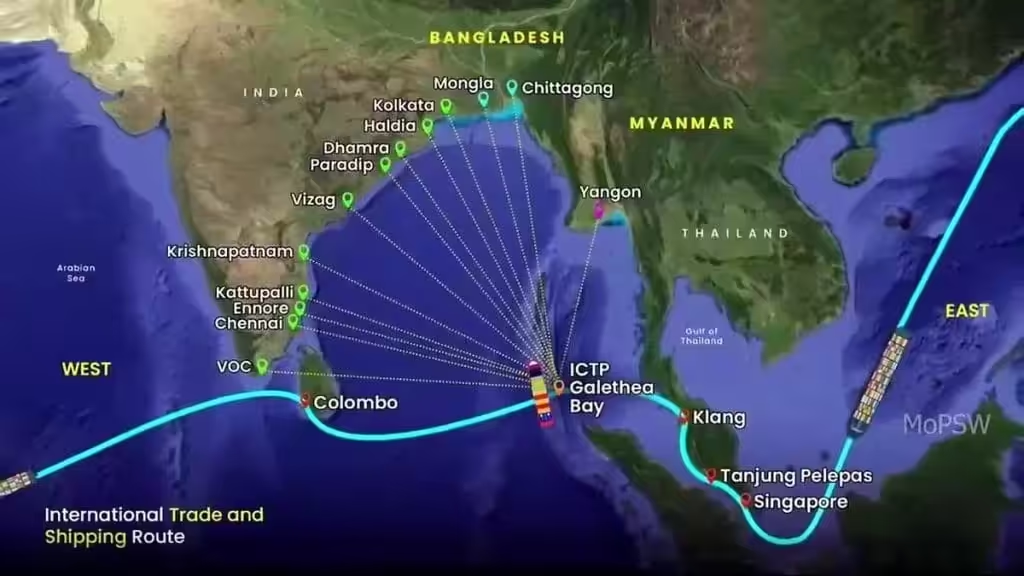
- This port, located at Galathea Bay, is India’s 13th major port. Its primary purpose is to function as a trans-shipment hub for cargo, strategically located near major international shipping routes to attract trans-shipment business away from foreign ports like Colombo and Singapore. It is a key part of the larger Great Nicobar Holistic Development Project.
Vadhavan Major Port:
- Vadhavan is a proposed deep seaport in the Palghar district of Maharashtra, near Dahanu.
- The Union Cabinet has approved the development of this port. It is being developed on a “landlord model” through a Public-Private Partnership (PPP).