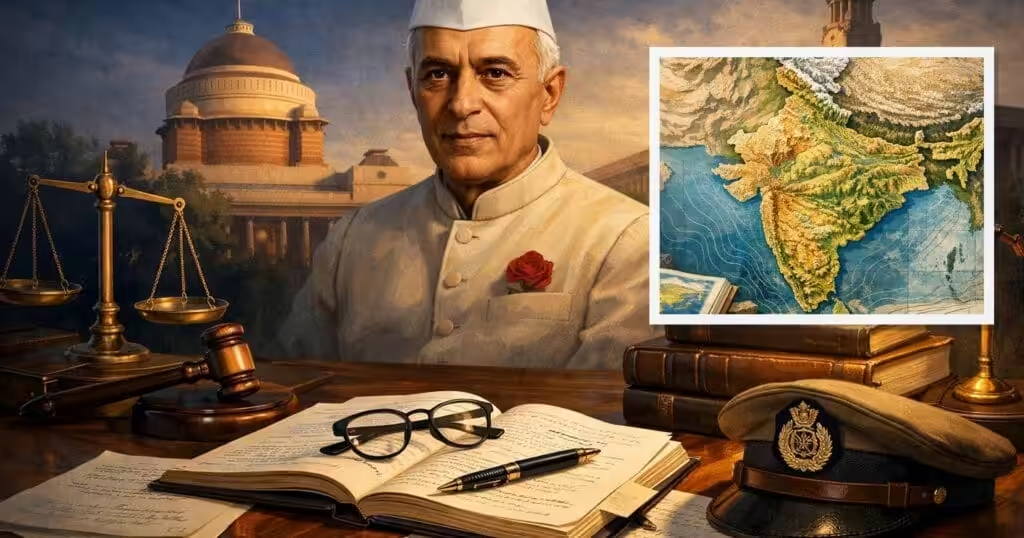
Jawaharlal Nehru (1889–1964) served as India’s first Prime Minister from 15 August 1947 until his death on 27 May 1964 — the longest-serving PM in Indian history at nearly 17 years. A central figure in the independence movement, Nehru shaped modern India’s democratic institutions, mixed economy, scientific temper, foreign policy of non-alignment, and secular constitutional framework. His vision of India as a modern, industrial, democratic, and scientifically advanced nation continues to influence Indian governance and policy.
Early Life and Education
Family Background
- Born on 14 November 1889 in Allahabad (now Prayagraj), Uttar Pradesh
- Father: Motilal Nehru — prominent lawyer, Congress president, author of the Nehru Report (1928)
- Mother: Swaruprani Thussu
- Educated at home by English tutors during childhood
- Part of a wealthy Kashmiri Pandit family
Education in England
| Period | Institution |
|---|---|
| 1905–1907 | Harrow School, London |
| 1907–1910 | Trinity College, Cambridge (Natural Sciences) |
| 1910–1912 | Inner Temple, London (Called to the Bar) |
Nehru returned to India in 1912 and began practicing law at the Allahabad High Court, but his heart was never in the legal profession. The political environment drew him irresistibly toward the freedom movement.
Intellectual Formation
Nehru's education exposed him to Fabian socialism, democratic liberalism, and scientific rationalism — ideas that profoundly shaped his political vision. Unlike Gandhi's spiritual and village-centric approach, Nehru was modernist, secular, and industrially oriented. Yet the two complemented each other extraordinarily in the freedom movement.
Role in the Freedom Movement
Entry into Politics
Nehru was drawn into politics by the Home Rule Movement (1916) and was deeply influenced by Mahatma Gandhi after the Champaran Satyagraha (1917). He formally joined the Indian National Congress and became an active participant in the Non-Cooperation Movement (1920–22).
Key Contributions to the Freedom Struggle
| Year | Event/Role | Significance |
|---|---|---|
| 1920–22 | Non-Cooperation Movement | First imprisonment; jailed 9 times during freedom struggle (total ~9 years) |
| 1927 | Brussels Congress of Oppressed Nationalities | Connected Indian freedom with global anti-colonial movements |
| 1928 | Nehru Report (with Motilal Nehru) | First Indian-drafted constitutional framework demanding dominion status |
| 1929 | Lahore Congress President | Presided over the historic session that declared Purna Swaraj (complete independence); hoisted the tricolour on 31 December 1929 |
| 1930 | Salt Satyagraha participation | Arrested and imprisoned |
| 1936, 1937 | Congress President | Led Congress during provincial elections; oversaw Congress governments in 7 provinces |
| 1942 | Quit India Movement | Arrested and imprisoned at Ahmednagar Fort until 1945 |
| 1946 | Interim Government head | Led the Interim Government as Vice-President of the Viceroy's Executive Council |
| 1947 | First Prime Minister | Delivered "Tryst with Destiny" speech on 14/15 August 1947 |
Literary Works
Nehru was a prolific writer who used his prison years productively.
- "The Discovery of India" (1946): A cultural and historical exploration of India's civilization
- "Glimpses of World History" (1934): A collection of 196 letters to his daughter Indira, covering world history
- "An Autobiography" (1936): Personal and political memoir, originally titled "Toward Freedom"
- "Letters from a Father to His Daughter" (1929): Letters to young Indira about natural history and civilizations
Nehru as Prime Minister (1947–1964)
Building Democratic Institutions
Nehru's most enduring contribution was establishing and nurturing India's democratic institutions during the critical first seventeen years.
- Constitutional framework: Oversaw the drafting of India's Constitution (enacted 26 January 1950); supported B.R. Ambedkar's role as Chairman of the Drafting Committee
- Parliamentary democracy: Established the norms and conventions of Indian parliamentary democracy
- Free elections: Conducted India's first three general elections (1952, 1957, 1962) — the world's largest democratic exercises
- Federal structure: Balanced Centre-State relations while holding a diverse nation together
- Press freedom: Maintained a free press despite political criticism
- Judicial independence: Respected judiciary's independence, setting precedents for separation of powers
Economic Vision: Nehruvian Socialism
Nehru's economic philosophy combined democratic socialism with state-led industrial planning.
Key economic policies:
| Policy | Details |
|---|---|
| Five Year Plans | Modeled on Soviet planning but within a democratic framework; First Plan (1951–56) focused on agriculture, Second Plan (Mahalanobis Model) emphasized heavy industry |
| Mixed economy | Public sector in strategic industries (steel, energy, defence); private sector in consumer goods |
| Land reforms | Zamindari abolition, tenancy reforms (implementation varied by state) |
| Public Sector Undertakings | Bhilai, Rourkela, Durgapur steel plants; BHEL, HAL, HMT, ISRO foundations |
| Import substitution | Protective tariffs and licensing to build domestic industry |
| Community Development Programme | Village-level development (1952) |
Criticism of Nehruvian economics:
- "License Raj" — excessive bureaucratic control stifled private enterprise
- Heavy industry focus at the expense of agriculture (contributed to food crises)
- Slow growth rate ("Hindu rate of growth" — approximately 3.5% per year)
- Public sector inefficiency and losses
- Neglect of primary education and basic health
Scientific Temper and Institution Building
Nehru believed passionately in science and technology as engines of national development. He called dams "the temples of modern India."
Institutions established under Nehru:
- Indian Institutes of Technology (IITs) — first IIT Kharagpur in 1951
- Indian Institutes of Management (IIMs)
- CSIR laboratories network
- Atomic Energy Commission (1948) under Homi Bhabha
- ISRO precursor — Indian National Committee for Space Research (1962)
- AIIMS (All India Institute of Medical Sciences), 1956
- UGC (University Grants Commission), 1956
Social Policy
- Secular state: Ensured India's secular character despite communal tensions after Partition
- Hindu Code Bills: Reformed Hindu personal law — giving women inheritance rights, allowing divorce, and banning bigamy (faced strong opposition from orthodox groups)
- Reservation policy: Continued reservation for SC/ST as constitutional mandate
- Children's welfare: 14 November (Nehru's birthday) celebrated as Children's Day
Foreign Policy: Non-Alignment and Panchsheel
Nehru was one of the most influential foreign policy architects of the post-colonial world.
Non-Aligned Movement (NAM)
Nehru, along with Yugoslavia's Josip Broz Tito, Egypt's Gamal Abdel Nasser, Ghana's Kwame Nkrumah, and Indonesia's Sukarno, co-founded the Non-Aligned Movement:
- Bandung Conference (1955): 29 Asian and African nations met in Indonesia — precursor to NAM
- Belgrade Summit (1961): First formal NAM summit with 25 member nations
- Core principle: Newly independent nations should not align with either the US-led Western bloc or the Soviet-led Eastern bloc during the Cold War
- India became the moral leader of decolonized nations
Panchsheel (Five Principles of Peaceful Coexistence)
Agreed upon in the 1954 Sino-Indian Agreement on Tibet, the Panchsheel principles were:
- Mutual respect for each other's territorial integrity and sovereignty
- Mutual non-aggression
- Mutual non-interference in internal affairs
- Equality and mutual benefit
- Peaceful coexistence
These principles became the foundation of India's bilateral relations and influenced international law. However, the Sino-Indian War of 1962 dealt a severe blow to the Panchsheel framework with China.
Key Foreign Policy Actions
| Action | Significance |
|---|---|
| Kashmir issue at UN (1948) | Referred Kashmir dispute to the UN — debated whether this was a strategic error |
| Recognition of PRC (1950) | India among first countries to recognize Communist China |
| Korean War mediation | India played mediatory role through V.K. Krishna Menon at the UN |
| Suez Crisis (1956) | Condemned Anglo-French-Israeli intervention in Egypt |
| Hungarian Crisis (1956) | Criticized for muted response to Soviet intervention |
| Integration of Goa (1961) | Military action to liberate Portuguese colonies in India |
| Sino-Indian War (1962) | Major military defeat that overshadowed Nehru's final years |
The 1962 Sino-Indian War
The Chinese invasion of October 1962 was the greatest crisis of Nehru's leadership. India's forward policy in Aksai Chin, combined with inadequate military preparation and intelligence failures, led to a humiliating defeat. The war exposed the limitations of Nehru's "Hindi-Chini Bhai-Bhai" idealism and shattered the Panchsheel framework. Nehru never fully recovered from the shock and died on 27 May 1964.
Nehru's Legacy: Assessment
Positive Legacy
- Built the foundational institutions of Indian democracy
- Established India's scientific and industrial base
- Created a secular, pluralistic state in a deeply diverse society
- Shaped India's international identity as an independent, non-aligned power
- Nurtured parliamentary norms and democratic culture
Criticism
- Kashmir policy — ceasefire and UN referral seen as strategic errors
- China policy — idealism over realism led to the 1962 debacle
- Economic policies — License Raj, slow growth, neglect of agriculture
- Dynastic politics — the Nehru-Gandhi family's continued dominance in Congress
- Centralization — despite federalism, tendency toward centralized decision-making
Comparison: Nehru vs Other Post-Colonial Leaders
| Aspect | Nehru (India) | Nasser (Egypt) | Mao (China) | Sukarno (Indonesia) |
|---|---|---|---|---|
| Political system | Parliamentary democracy | Military-backed republic | Communist state | Guided democracy |
| Economy | Mixed economy | Arab socialism | Command economy | Guided economy |
| Foreign policy | Non-alignment | Non-alignment + Arab nationalism | Communist bloc then independent | Non-alignment |
| Industrial policy | Heavy industry + private sector | Nationalization | State ownership | Nationalization |
| Democratic record | Free elections, free press | Authoritarian | Totalitarian | Authoritarian |
Nehru stands out as the only major post-colonial leader who maintained genuine democratic governance.
Related: Sardar Vallabhbhai Patel: Iron Man of India
Related: Mahatma Gandhi: Life and Legacy
Related: Indian Constitution: Complete Guide
Related: Non-Cooperation Movement
Frequently Asked Questions
When was Jawaharlal Nehru born and when did he die?
Jawaharlal Nehru was born on 14 November 1889 in Allahabad (now Prayagraj), Uttar Pradesh. He died on 27 May 1964 in New Delhi while serving as Prime Minister. His birthday is celebrated as Children's Day in India, reflecting his well-known affection for children.
What is Nehruvian socialism?
Nehruvian socialism refers to Nehru's economic philosophy combining state-led industrial planning with democratic governance and a mixed economy. The state controlled strategic industries (steel, energy, defence) while allowing private enterprise in other sectors. This approach was guided by Five Year Plans and the Mahalanobis Model.
What are the Panchsheel principles?
The Five Principles of Peaceful Coexistence (Panchsheel), agreed in 1954 between India and China, are: mutual respect for territorial integrity, mutual non-aggression, mutual non-interference, equality and mutual benefit, and peaceful coexistence. These principles guided India's foreign policy but were violated by China during the 1962 war.
What was Nehru's role in the Non-Aligned Movement?
Nehru co-founded the Non-Aligned Movement along with Tito (Yugoslavia), Nasser (Egypt), Nkrumah (Ghana), and Sukarno (Indonesia). The first formal NAM summit was held in Belgrade in 1961. Nehru's vision was that newly independent nations should maintain strategic autonomy rather than joining Cold War blocs.
Why is the 1962 war considered Nehru's biggest failure?
The Sino-Indian War of 1962 exposed India's military unpreparedness, intelligence failures, and Nehru's overly idealistic China policy. The defeat in the border war undermined Nehru's credibility domestically and internationally, shattered the Panchsheel framework, and traumatized Indian national consciousness about border security.
Tell Google you want more of this.
Add Anantam IAS as a preferred sourceOne tap, and this site shows up more often in your own Top Stories, AI Overviews and AI Mode. Remove it any time.