Wave-Like Heat Transport: Restricting Atomic Motion for Thermoelectrics
Why in News?
A September 14 government release described wave-like heat transport in a copper-containing crystal studied by JNCASR researchers, offering a route toward improved thermoelectric materials.
- The material is thallium copper selenide, TlCu5Se3; experiments and calculations connect its crystal framework with confined copper dynamics.
- The study reports ultralow lattice thermal conductivity alongside favorable electronic transport, a useful combination for converting heat into electricity.
- The reported zT of 1.7 is a dimensionless material-performance measure, not an electricity-conversion percentage or proof of an industrial device.
- A useful thermoelectric must maintain a temperature difference while allowing charge transport; simply blocking everything would also prevent useful electrical output.
- The finding concerns a material mechanism. Prospective waste-heat applications remain distinct from tested factory deployment or demonstrated commercial viability.
UPSC Relevance
Prelims Relevance
- Thermoelectric conversion: generating electricity from a temperature difference.
- Phonons: quantized modes of atomic vibration in a solid.
- Anharmonicity: departure from the simple harmonic description of atomic vibrations.
- Lattice thermal conductivity: heat transport associated with the vibrating atomic framework.
- zT: a dimensionless thermoelectric figure of merit.
Mains Relevance
GS Paper 3
- Materials research: connecting microscopic structure to useful energy performance.
- Waste-heat recovery: distinguishing a promising material from a deployable system.
Essay
- Scientific progress often comes from controlling movement rather than eliminating it.
Background and Context
Why heat flow and electrical flow need different treatment
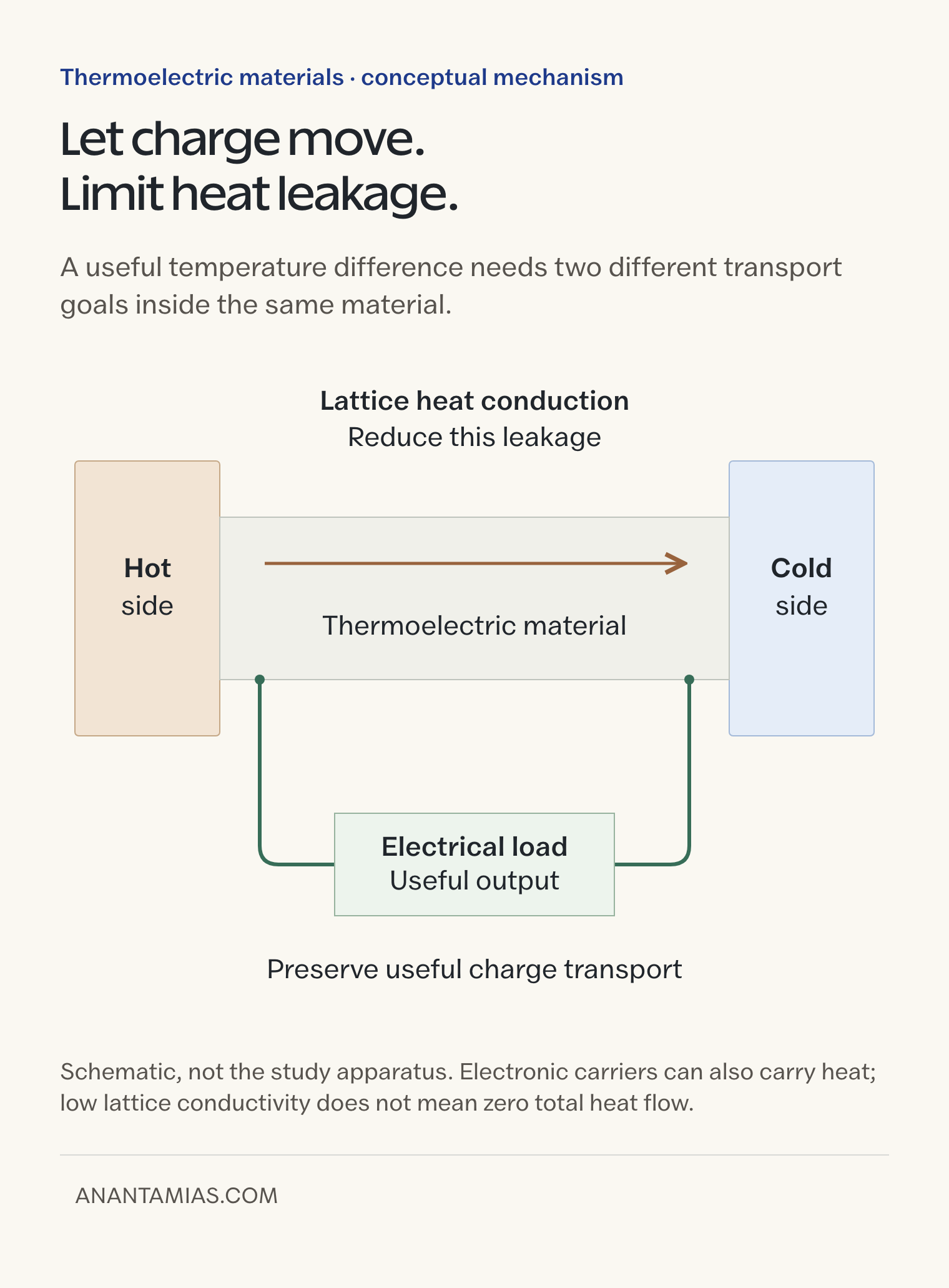
Thermoelectric generation uses a temperature difference. The design challenge is to reduce unwanted heat leakage without making the material a poor electrical conductor.
- A temperature difference across a suitable material can generate a voltage. Useful electrical output requires a connected circuit; a material result alone does not specify the output of a complete generating system.
- Unwanted thermal conduction carries heat from the hot side toward the cold side. Reducing this leakage helps preserve the difference that makes conversion possible, rather than treating heat flow as electricity itself.
- Electrical conductivity concerns charge transport; thermal conductivity concerns energy transport. Favorable electrical behavior and low lattice heat conduction can coexist, so describing the finding as simply poor conductivity would hide the central distinction.
- The lattice is the atomic framework, and its vibrations transport energy. Electronic carriers can also carry heat; lowering the lattice contribution is not equivalent to proving that every heat-transport channel has vanished.
- The wider thermoelectric design problem is a balance of properties. A good thermal insulator is not automatically a good generator if its electrical transport or voltage response is unsuitable.
How confined copper dynamics change the heat-transport picture
The study connects a complex crystal framework with restricted atomic motion, strong anharmonicity and an unusual way for vibrational modes to exchange thermal energy.
- In some superionic materials, highly mobile ions can impede lattice heat transport. The difficulty is that excessive migration may undermine structural stability; suppressing heat flow alone does not solve that stability problem.
- Here, the crystal framework confines copper dynamics rather than allowing long-range, liquid-like migration. The point is restricted motion inside an ordered material, not a claim that all atoms become stationary or motionless.
- This local motion produces strong anharmonicity: vibrations depart substantially from an ideal, simple harmonic pattern. It helps explain why the usual account of heat carried by well-defined particle-like phonons becomes insufficient here.
- The study instead describes predominantly wave-like coherence between vibrational modes. This is a microscopic account of energy transfer, not evidence of visible waves passing through a device or sound replacing an electrical circuit.
- The researchers combined experiments and theoretical calculations, including simulations of atomic motion. Agreement between structural behavior and the transport model supports the proposed explanation; simulations are evidence about a model, not industrial operating records.
What the performance claim proves, and what remains open
A promising material must still be distinguished from a practical module with durable contacts, stable operation and a useful source of temperature difference.
- zT combines electrical conductivity, the voltage response to a temperature difference, temperature and thermal conductivity. Its dimensionless value summarizes material performance; interpreting it directly as a conversion percentage is a category error.
- A device efficiency claim needs defined operating conditions and a measured ratio of useful electrical output to heat input. The release’s material figure cannot establish that ratio for a hypothetical factory installation.
- The release identifies waste-heat recovery as a possible application. It does not demonstrate continuous service at a cement plant, a steelworks or a data center, nor provide a commercial cost comparison.
- A sensible next assessment would test reproducibility and durability under repeated operating conditions. These are proposed checks before application, not claims that the reported compound has already failed or passed a deployment trial.
- Compare the separate photocatalyst charge-separation study: both link structure to function, but light-driven chemistry and thermoelectric generation use different mechanisms. Similar energy goals do not make the materials or processes interchangeable.
Way Forward
Test the path from material to module
- Measure heat and electrical transport separately under stated conditions before comparing candidate materials.
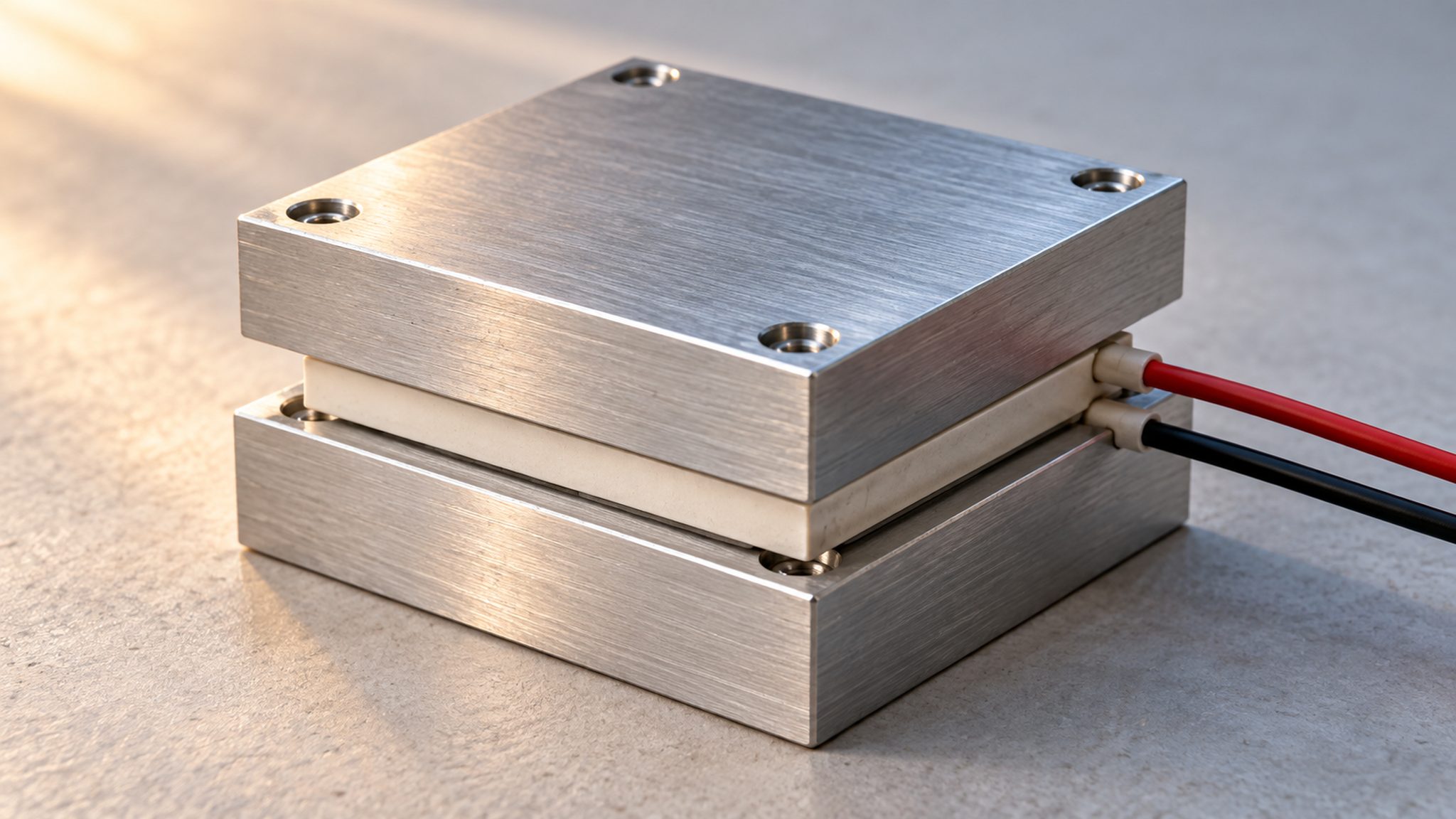
- Evaluate contacts and repeated thermal operation when moving toward a device; preserve the distinction between a laboratory specimen and an integrated module.
- Use the charged-droplet coating study as a separate example of service-condition testing, not as evidence about this compound’s durability.
Conclusion
- The useful principle is selective control: restrict lattice heat leakage while retaining favorable electronic behavior. Confined ion dynamics offer a research route toward that combination, without requiring the crystal to behave like a liquid.
- In an answer, connect structure, vibration and transport, then state the evidence limit. A material figure of merit supports further investigation; it does not certify a working industrial waste-heat system.
UPSC Practice Questions
Prelims MCQ 1
With reference to thermoelectric materials, consider the following statements:
- Low lattice thermal conductivity and favorable electrical transport can coexist.
- The dimensionless figure of merit zT is itself a percentage conversion efficiency.
- A temperature difference can generate a voltage in a suitable thermoelectric material.
How many of the above statements are correct?
(a) Only one (b) Only two (c) All three (d) None
Answer: (b) Only two
Explanation:
Statements one and three are correct. zT summarizes material properties and is dimensionless; it is not itself the percentage efficiency of a complete device.
Prelims MCQ 2
What is the central role of confined copper dynamics in the reported material?
(a) Eliminating all atomic vibration (b) Replacing electronic transport with visible waves (c) Producing strong anharmonicity while avoiding unrestricted long-range copper migration (d) Proving commercial operation in steel plants
Answer: (c) Producing strong anharmonicity while avoiding unrestricted long-range copper migration
Explanation:
The study associates confined copper motion with strong anharmonicity, wave-like vibrational transport and low lattice thermal conductivity. It does not report industrial deployment.
UPSC Mains Questions
- Explain why thermoelectric generation requires different treatment of thermal and electrical transport. How can control of atomic dynamics help address this challenge?
- How should public communication distinguish a promising materials-science result from a deployable energy technology? Discuss with reference to thermoelectric research.
Sources: PIB, Department of Science and Technology and US Department of Energy, thermoelectric research background.
Frequently Asked Questions
What was studied in the JNCASR research?
Researchers studied thallium copper selenide and linked its complex framework with confined copper motion, strong anharmonicity and predominantly wave-like heat transport. The release reports experiments alongside theoretical calculations supporting this interpretation.
Why is low thermal conductivity useful here?
It reduces unwanted heat leakage between the hot and cold sides. A thermoelectric material must also retain suitable electrical behavior; blocking heat alone does not guarantee useful electricity generation in a device.
Does wave-like transport mean visible waves or sound?
The phrase describes coherence between microscopic vibrational modes in the solid. It does not mean that visible waves pass through the material or that sound substitutes for electrical transport in a generator.
Is zT an efficiency percentage?
No. It is a dimensionless figure combining thermoelectric material properties. Device efficiency also depends on operating conditions and system performance, so the reported value cannot be read as a percentage conversion efficiency.
Has this compound been deployed in industry?
The government release presents a research result and possible waste-heat applications. It does not establish commercial deployment, prolonged industrial operation or a verified cost advantage for a complete generating system.