Why in News?
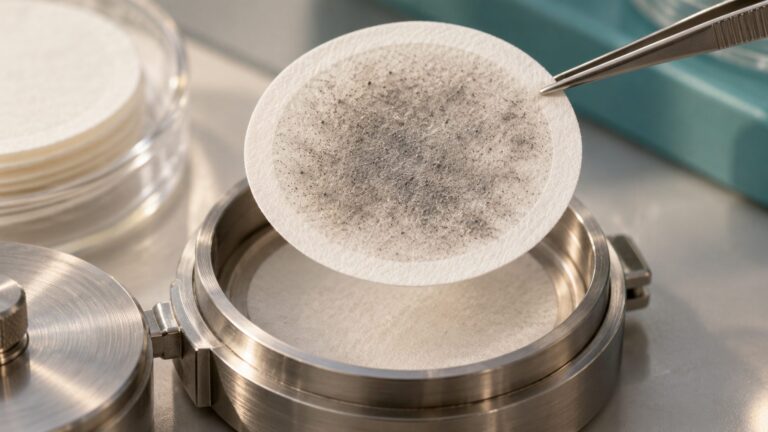
On 9 September 2026, the Ministry of Science and Technology reported that CeNS researchers developed self-assembled organic photocatalyst nanosheets with improved photocurrent during solar-driven water splitting.
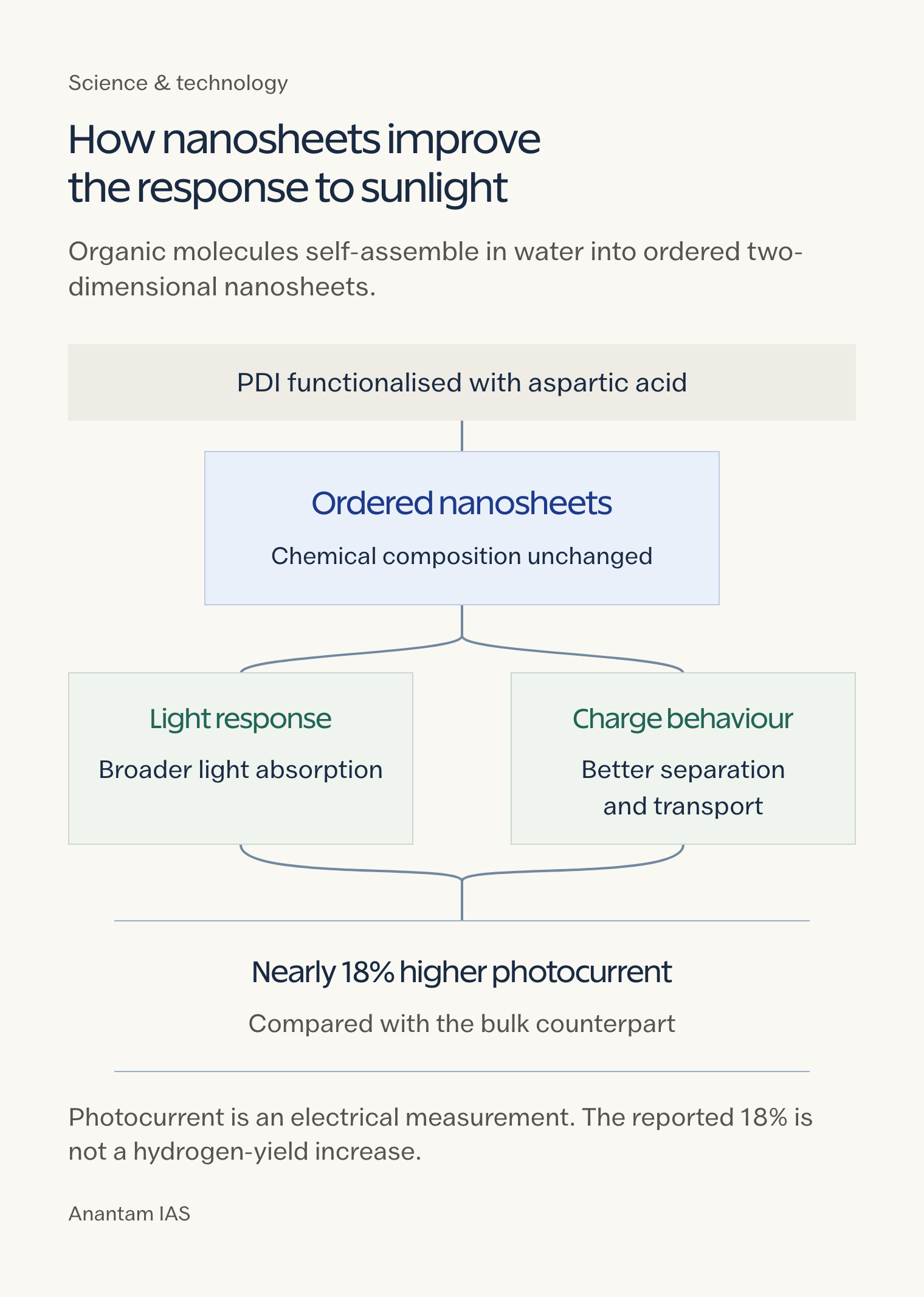
- Researchers combined perylene diimide (PDI), a light-absorbing organic molecule, with the naturally occurring amino acid aspartic acid.
- The molecules organised themselves in water into two-dimensional nanosheets through supramolecular self-assembly.
- The assembled material produced nearly 18% higher photocurrent than its bulk counterpart; this is not a reported increase in hydrogen yield.
- The work comes from the Centre for Nano and Soft Matter Sciences, Bengaluru, an autonomous institution under DST.
- Molecular organisation can change material performance without changing the chemical composition of the assembled molecule.
- Metal-free photocatalysts offer a research route for reducing reliance on costly or scarce catalytic metals; commercial suitability still requires evidence.
UPSC Relevance
Prelims Relevance
- Photocatalysis: light-assisted catalytic reactions.
- PDI: the light-absorbing organic component in this study.
- Aspartic acid: an amino acid promoting hydrogen-bonded organisation.
- Self-assembly: spontaneous organisation into larger ordered structures.
- Photocurrent: a light-induced electrical response, distinct from hydrogen yield.
Mains Relevance
GS Paper 3
- Materials design for renewable energy and solar-fuel research.
- Distinguishing laboratory performance indicators from commercial technology readiness.
Essay
- How the organisation of familiar building blocks can create new functionality.
Background and Context
What self-assembly changes
The useful innovation is an ordered arrangement of organic molecules, rather than the addition of a precious metal to the catalyst.
- Supramolecular self-assembly means individual molecules organise into a larger structure through interactions between them. Here, the functionalised PDI molecules spontaneously formed ordered sheets in water, giving the researchers a different material architecture to study.
- Aspartic acid promotes extended hydrogen bonding between the molecules. It acts as an organiser within the material, rather than merely appearing as an additional ingredient in a mixture of unrelated components.
- PDI contributes light absorption and stacking between its aromatic molecular regions, described as π–π stacking. This works together with hydrogen bonding to influence the arrangement and functional properties of the resulting material.
- Two-dimensional nanosheets describe the assembled structure, not a new chemical formula. The reported improvement followed molecular reorganisation without changing the chemical composition of the molecule being compared with its unassembled bulk counterpart.
- Structure and composition answer different questions: composition identifies the chemical building blocks, while structure describes their organisation. This distinction explains why using the same molecule need not produce the same performance in different material forms.
From sunlight to useful charge
A photocatalyst must do more than absorb sunlight: the resulting charges must separate and move efficiently enough to contribute to a reaction.
- Broader light absorption was one reported consequence of nanosheet formation. The important mechanism is an altered response to incident light, not a claim that the material captures every wavelength or absorbs all incoming solar energy.
- Charge separation keeps photo-generated charges available for the reactions they help drive. The researchers reported improved separation and reduced energy losses after self-assembly, connecting the material arrangement with its measured electrochemical behaviour.
- Charge transport concerns movement through the material after charges are generated. Electrochemical measurements and density functional theory calculations supported more efficient transport, while the amino acid increased molecular polarity and helped separate photo-generated charges.
- Accessible surface area also increased with the assembled structure, providing more exposed area for catalytic reactions. Absorption, separation, transport and surface access are complementary features; one favourable property alone does not establish a complete working technology.
- Hydrogen evolution is the reaction that the separated charges help drive in this research. The study links molecular design to solar-energy conversion, while the official account identifies photocurrent as the quantified comparison with bulk material.
Read the result without overstating it
The reported comparison is encouraging laboratory evidence, but the measured quantity and the stage of development must remain clear in an examination answer.
- Nearly 18% higher photocurrent compares the self-assembled material with its bulk counterpart. It must not be rewritten as 18% greater hydrogen production, an 18% conversion efficiency, or a reduction of that size in production costs.
- Photocurrent and hydrogen yield describe different outputs. An electrical response can support an interpretation of improved charge behaviour; a claim about the amount of hydrogen produced requires measurements of hydrogen itself under specified experimental conditions.
- Laboratory research is the demonstrated stage described in the release. It does not establish a commercially deployed reactor, industrial production capacity, operating lifetime, or an economically competitive replacement for existing hydrogen production systems.
- Metal-free material design addresses dependence on catalytic metals in this research. It does not, by itself, prove that the entire production system has negligible environmental impact or that all manufacturing and operating inputs are sustainable.
- Technology assessment should ask for stability, reproducibility, measured hydrogen output and performance beyond laboratory conditions. These are evaluation needs, not results already established by the reported photocurrent improvement or by the proposed future applications.
Way Forward
Measure the complete performance chain
- Report hydrogen output alongside photocurrent and experimental conditions so that electrical improvement is not mistaken for a quantified fuel-production gain.
- Test durability and repeatability before drawing conclusions about dependable operation over time.
- Evaluate manufacturing, resource inputs and system costs before describing the material as commercially sustainable.
Conclusion
- Self-assembly shows how organising organic molecules can improve light absorption and charge behaviour without changing the assembled molecule’s chemical composition. The central lesson is to connect material structure with function, rather than memorise an isolated percentage.
- Use the correct evidence boundary: the news reports higher photocurrent in laboratory research relevant to solar hydrogen. A claim of more hydrogen, lower costs or commercial readiness needs separate supporting measurements and validation.
UPSC Practice Questions
Prelims MCQ 1
With reference to the reported CeNS organic photocatalyst research, consider the following statements:
- Aspartic acid helps promote hydrogen-bonded molecular organisation.
- Self-assembly produced ordered two-dimensional nanosheets in water.
- The reported nearly 18% improvement measures hydrogen yield.
How many of the above statements are correct?
(a) Only one (b) Only two (c) All three (d) None
Answer: (b) Only two
Explanation:
The first two statements are correct. The reported improvement concerns photocurrent compared with the bulk counterpart, not hydrogen yield.
Prelims MCQ 2
Which feature best describes supramolecular self-assembly in this study?
(a) Replacement of the organic molecule with a precious metal (b) Spontaneous organisation of molecules into ordered structures (c) Industrial compression of hydrogen into transport cylinders (d) Measurement of commercial hydrogen production costs
Answer: (b) Spontaneous organisation of molecules into ordered structures
Explanation:
Interactions including hydrogen bonding and π–π stacking help organise the functionalised molecules into ordered nanosheets.
UPSC Mains Questions
- Explain how supramolecular self-assembly can improve the performance of organic photocatalysts. Distinguish material design from changes in chemical composition.
- Why should an improvement in laboratory photocurrent not be equated with commercial readiness for green hydrogen production? Discuss the additional evidence required.
Source: PIB, Ministry of Science & Technology.
Frequently Asked Questions
What did the CeNS photocatalyst study achieve?
Researchers organised aspartic acid-functionalised PDI molecules into nanosheets in water. The self-assembled material produced nearly 18% higher photocurrent than its bulk counterpart during solar-driven water splitting.
What role does aspartic acid play?
Aspartic acid promotes extended hydrogen bonding and helps regulate molecular organisation. The study also links it with increased molecular dipole moment, supporting separation of charges generated when the material absorbs light.
Does higher photocurrent mean 18% more hydrogen?
No. Photocurrent is an electrical response, while hydrogen yield measures the amount of hydrogen produced. The official release quantifies the photocurrent improvement and does not establish an equivalent percentage increase in hydrogen output.
Is this a commercially deployed hydrogen technology?
The release describes laboratory research and possible future applications. It does not establish commercial deployment, industrial production capacity, long-term operating stability or competitiveness with existing hydrogen production systems.
Tell Google you want more of this.
Add Anantam IAS as a preferred sourceOne tap, and this site shows up more often in your own Top Stories, AI Overviews and AI Mode. Remove it any time.