OBC Reservation: West Bengal’s legislative reset
Why in News?
Indian Express Explained reported that the West Bengal Assembly passed two amendment Bills on 29 June 2026 to reset the state’s OBC reservation framework after the Calcutta High Court’s 2024 ruling.
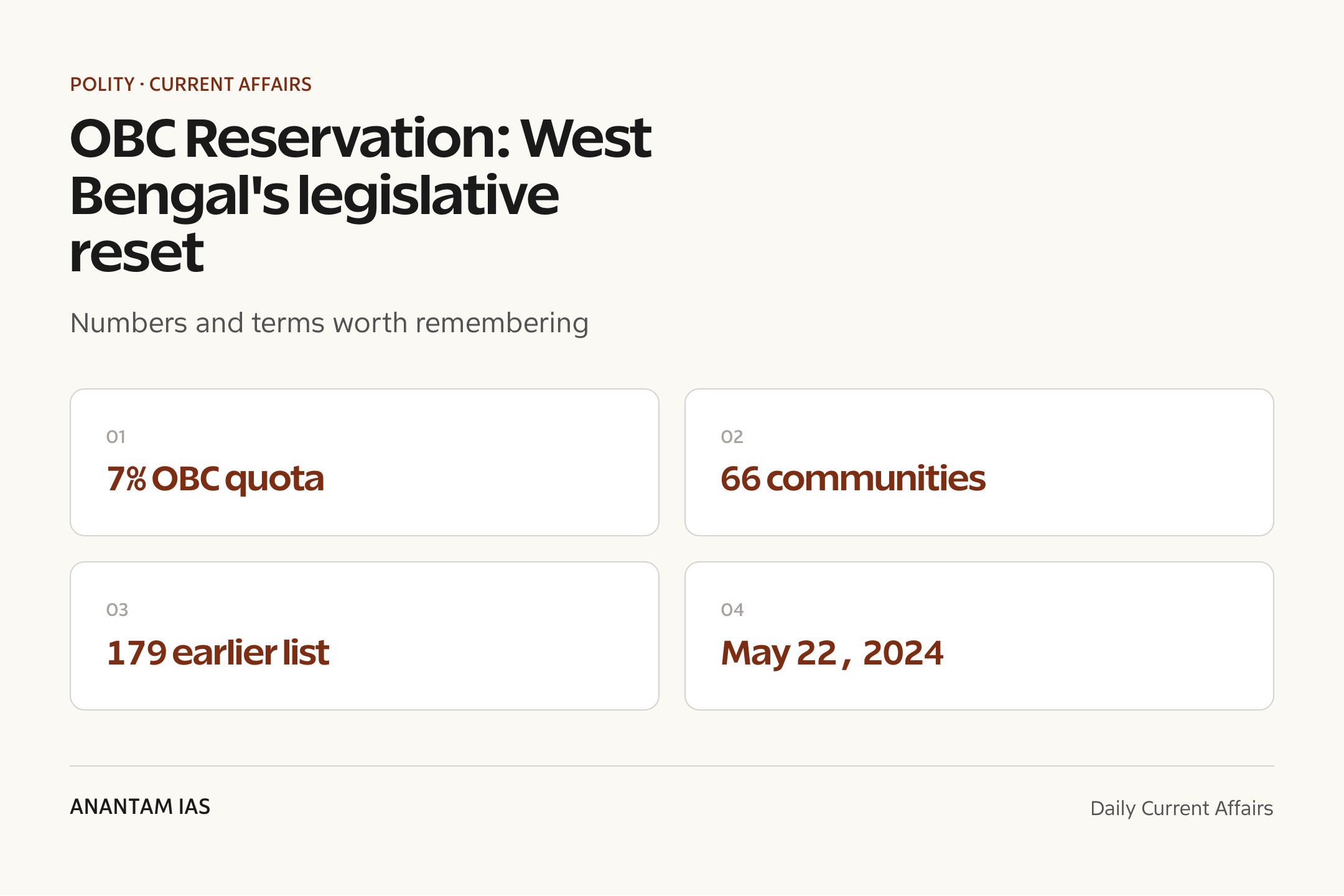
The immediate change is a rollback from 17% reservation to 7% reservation, with the recognised list reduced from 179 sub-castes to 66 sub-castes.
- Two Bills were passed: the West Bengal Backward Classes (Other than SCs and STs) Reservation of Vacancies in Services and Posts (Amendment) Bill, 2026, and the West Bengal Commission for Backward Classes (Amendment) Bill, 2026.
- Reservation quantum now returns to 7%, the level associated with the pre-2010 OBC framework in the state.
- Post-2010 inclusions are the main target of the reset, after the High Court questioned the legal basis for several additions.
- Calcutta High Court on 22 May 2024 cancelled OBC certificates issued after 2010 but protected people already in service or already selected.
- Backward Classes Commission remains central for future inclusion, because fresh additions must rest on inquiry, recommendation and statutory compliance.
The development matters in the context of:
- Affirmative action must balance social justice with constitutional equality and administrative fairness.
- Backward-class identification needs measurable social and educational backwardness, not political claims or religion alone.
- Legislature-court relations are tested when a state amends reservation law after judicial invalidation of earlier classifications.
UPSC Relevance
Prelims Relevance
- Article 15(4) allows special provisions for socially and educationally backward classes, SCs and STs.
- Article 16(4) permits reservation in public employment for a backward class not adequately represented in state services.
- Article 46 directs the State to promote educational and economic interests of weaker sections.
- Article 340 enables appointment of a commission to investigate conditions of backward classes.
- Article 338B gives constitutional status to the National Commission for Backward Classes.
- Article 342A(3), added by the 105th Amendment, clarifies state power to maintain a State SEBC list.
- Indra Sawhney is linked with the 50% ceiling, creamy layer exclusion and commission-based review.
- OBC-A and OBC-B refer to West Bengal’s earlier sub-categorisation into more backward and backward groups.
Mains Relevance
GS Paper 2
- Polity: judicial review of reservation laws, limits of legislative correction and institutional role of backward-class commissions.
- Social justice: empirical identification of backwardness, creamy layer, sub-categorisation and safeguards against exclusion.
- Governance: certificate validity, transition protection, public employment rules and administrative trust.
GS Paper 1
- Indian society: caste, community, religion and backwardness as overlapping but distinct social categories.
- Social empowerment: affirmative action as a tool for dignity, representation and access to state opportunities.
Essay
- Justice and equality: how a republic corrects historical disadvantage without weakening constitutional neutrality.
- Evidence in welfare: why social policy needs field data, not only electoral urgency.
Background and Context
What Changed in West Bengal
The 2026 Bills reset the statutory list and quota design for OBC reservation in West Bengal.
- Quota level has been revised from 17% to 7%, reversing the expanded structure that grew after 2010.
- Recognised communities have been reduced to 66, compared with 179 listed earlier.
- Legislative route was chosen because the High Court questioned statutory provisions and executive additions linked to the 2012 framework.
- Ministerial position, as reported by Indian Express Explained, is that 113 classes included without field survey have been removed.
- Future inclusion is not closed; the government said any Commission-backed recommendation can be considered under the rules.
How the State List Expanded
The dispute comes from a long expansion of the OBC list through executive and legislative steps.
- 1993 framework began with 66 OBC sub-castes in West Bengal, including 54 Hindu and 12 Muslim sub-castes, as reported by Indian Express Explained.
- 2010 executive orders added 42 new classes between 5 March and 10 September 2010; 41 were Muslim communities.
- 17% structure emerged with 10% for OBC-A or more backward groups and 7% for OBC-B groups.
- 2012 Act provided the statutory basis for reservation of vacancies in state services and posts for backward classes other than SCs and STs.
- Later additions under the previous state government expanded the total list, which became the core of the court challenge.
Constitutional Basis of OBC Reservation
OBC reservation is constitutionally permitted, but the permission is conditional and evidence-driven.
- Article 14 permits reasonable classification, but the classification must have an intelligible differentia and a rational link with the objective.
- Article 15(4) supports special provisions for socially and educationally backward classes; see the Anantam IAS explainer on Articles 15 and 16.
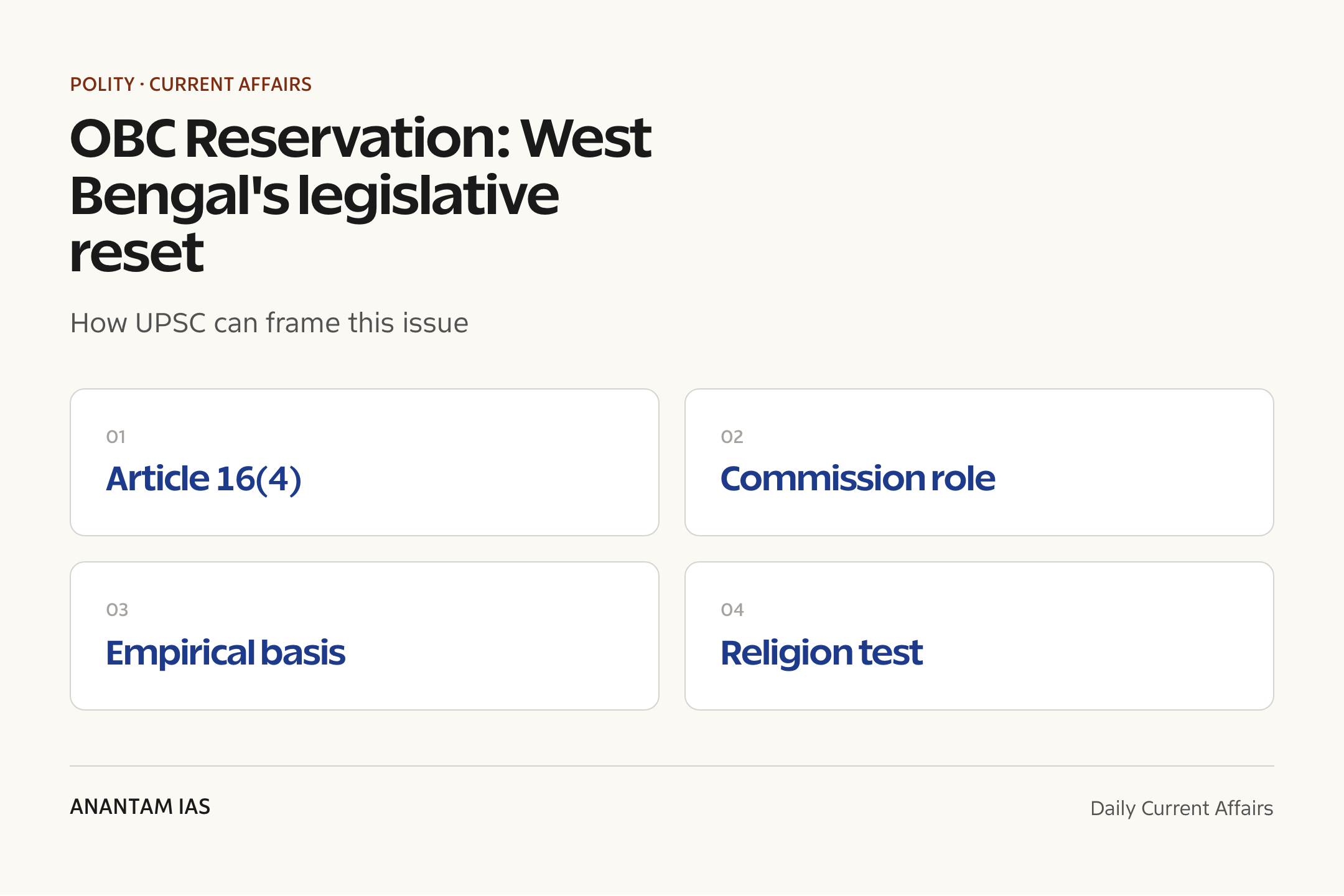
- Article 16(4) is an enabling provision for public employment reservation, not an automatic fundamental right to quota.
- Article 340 gives the commission model constitutional legitimacy because backwardness must be investigated, not merely asserted.
- SEBC identification must distinguish caste, class, occupation, social exclusion and educational disadvantage; see Socially and Educationally Backward Classes.
- 105th Amendment restored clarity on state power to prepare State SEBC lists; see the Anantam IAS note on the 105th Amendment.
Why the High Court Order Matters
The 2024 Calcutta High Court order turned the dispute from a policy debate into a constitutional compliance problem.
- Judgment date was 22 May 2024, in petitions challenging West Bengal’s OBC classification and certificate regime.
- Core objection was that religion appeared to be the sole criterion for granting OBC status to 77 communities.
- Commission role was central because the court faulted the state for excluding or weakening the statutory Commission’s role in identification.
- Certificate impact was limited by a saving clause for people already in service, already benefiting from reservation or already successful in a selection process.
- State obligation after such a ruling is not merely to re-pass a law, but to rebuild the evidentiary basis for each inclusion.
- Judicial review does not ban OBC reservation; it checks whether the classification is constitutionally valid.
Mandal Logic and Creamy Layer
The West Bengal debate should be read with the national reservation framework developed after Mandal.
- Mandal Commission shaped the modern OBC framework by recommending 27% reservation for OBCs in central services; see Mandal Commission notes.
- Indra Sawhney upheld OBC reservation but insisted on the creamy layer principle and normally capped total reservation at 50%.
- Creamy layer prevents socially advanced sections within OBCs from cornering benefits meant for the backward sections.
- Sub-categorisation can be used to prevent dominant OBC groups from capturing the quota, but it also needs data and legal design.
- Religion alone cannot be the basis of reservation, though communities belonging to any religion may qualify if they meet social and educational backwardness tests.
- Reservation in India remains a constitutional tool for representation, not a substitute for schooling, jobs and anti-discrimination enforcement; see analysis of reservation in India.
Governance Issues for the State
A quota reset creates administrative questions beyond courtroom compliance.
- Certificate verification must separate invalidated future claims from protected past benefits.
- Recruitment rules need clear transition dates so candidates and departments know which list applies.
- Education admissions may need aligned instructions if state institutions use the same OBC lists or categories.
- Data collection should include occupation, literacy, representation, income proxies, landholding and local disadvantage where relevant.
- Public reasoning matters because reservation disputes quickly become communal or electoral unless decisions are transparent.
- Litigation risk will remain high if future inclusions bypass inquiry, ignore objections or use unclear criteria.
Way Forward
Use an Evidence-First Identification Process
- Household and community data should support each claim of social and educational backwardness.
- Backwardness indicators must go beyond religion and include education, occupation, representation and social exclusion.
- Public notice should invite objections before final inclusion so the list can survive judicial scrutiny.
Strengthen the Commission Route
- Backward Classes Commission should be the filter for inclusion, exclusion and sub-categorisation.
- Reasoned reports should record the data considered, criteria applied and reasons for accepting or rejecting a claim.
- Periodic review can remove stale entries and assess whether benefits are reaching the most disadvantaged groups.
Protect Administrative Fairness
- Saved beneficiaries must be clearly protected where the court has preserved appointments or completed selections.
- Pending candidates need unambiguous instructions on certificate validity and applicable quota.
- Departmental manuals should be updated so recruiters do not apply old OBC-A and OBC-B rules by mistake.
Reduce Communal Polarisation
- Policy communication should explain that communities from any religion can qualify if they satisfy backwardness criteria.
- Social justice framing should focus on deprivation, representation and constitutional equality.
- Legislative debate should keep the issue tied to evidence and rights, not identity mobilisation.
Conclusion
West Bengal’s OBC reset is not only about a fall from 17% to 7%. It is a test of whether affirmative action can remain both socially responsive and constitutionally disciplined.
For UPSC, the issue connects Articles 15 and 16, the Backward Classes Commission, Indra Sawhney, the 105th Amendment and the larger question of how courts review welfare classifications without freezing social justice.
UPSC Practice Questions
Prelims MCQ 1
With reference to OBC reservation and backward-class identification, consider the following statements:
- Article 15(4) permits special provisions for socially and educationally backward classes, Scheduled Castes and Scheduled Tribes.
- Article 16(4) creates an automatic fundamental right to reservation for every community declared backward.
- Article 340 enables appointment of a commission to investigate the conditions of backward classes.
How many of the above statements are correct?
(a) Only one (b) Only two (c) All three (d) None
Answer: (b) Only two
Explanation:
Statements 1 and 3 are correct. Article 16(4) is an enabling provision for the State; it does not create an automatic quota right for every listed group.
Prelims MCQ 2
The 2026 West Bengal OBC amendment Bills are best understood as a response to which issue?
(a) Creation of a new all-India Central OBC list (b) Implementation of EWS reservation in state services (c) Judicial scrutiny of post-2010 OBC inclusions and certificate validity (d) Abolition of all reservation in public employment
Answer: (c) Judicial scrutiny of post-2010 OBC inclusions and certificate validity
Explanation:
The Bills followed the Calcutta High Court’s 2024 order questioning post-2010 inclusions and the legal process used for OBC identification in West Bengal.
UPSC Mains Questions
- The West Bengal OBC reservation controversy shows the tension between social justice and constitutional discipline. Discuss the role of empirical data, backward-class commissions and judicial review in maintaining this balance.
- Reservation policy cannot be based on identity labels alone, but it also cannot ignore historical social disadvantage. Examine this statement with reference to OBC classification, creamy layer and sub-categorisation.
- How should legislatures respond when courts strike down welfare classifications? Discuss with reference to separation of powers, institutional dialogue and protection of affected beneficiaries.
Sources: Indian Express Explained and India Code, West Bengal Act XXXIX of 2012.
Frequently Asked Questions
What did West Bengal change?
West Bengal passed two OBC amendment Bills in June 2026. The reported effect is a return from 17% reservation to 7% reservation and a reduction of the recognised OBC list from 179 to 66 sub-castes.
Why did the High Court object?
The Calcutta High Court questioned post-2010 OBC inclusions because religion appeared to be the sole criterion for many communities. It also found problems in the role given to the Backward Classes Commission during identification.
Is religion always irrelevant to OBC status?
A community from any religion can qualify as socially and educationally backward. The constitutional problem arises when religion itself becomes the sole basis. The test must focus on backwardness, representation and evidence.
What is OBC-A and OBC-B?
OBC-A referred to the more backward category in West Bengal’s earlier structure, linked with 10% reservation. OBC-B referred to the backward category, linked with 7% reservation. The 2026 reset moves away from that expanded design.
Which constitutional articles matter here?
Article 15(4), Article 16(4), Article 46, Article 340, Article 338B and Article 342A are important. Together, they frame affirmative action, commission-based inquiry and state power over SEBC lists.
What should students remember for Mains?
Use the case to show that affirmative action is valid only when backed by evidence, procedure and constitutional purpose. It is a strong example for answers on social justice, judicial review and welfare governance.