Articles 15 and 16 are the working extensions of Article 14. While Article 14 announces a general guarantee of equality, Articles 15 and 16 spell out how that guarantee plays out in two concrete arenas — social access to public spaces and benefits (Art. 15) and public employment (Art. 16). The Supreme Court has repeatedly described Articles 14, 15 and 16 as a single code of constitutional guarantees, with Article 14 as the genus and Articles 15 and 16 as its species. The 2022 EWS verdict in Janhit Abhiyan and the 2024 sub-classification of Scheduled Castes ruling have together reshaped how this code operates today, making this one of the most live areas of UPSC Polity.
Text and Constitutional Architecture
Articles 15 and 16 sit inside the Right to Equality (Articles 14–18) and form the prohibition-and-affirmative-action backbone of Part III.
| Article | What it does |
|---|---|
| 15(1) | Bars State discrimination on grounds of religion, race, caste, sex, place of birth |
| 15(2) | Bars discrimination by any person in access to shops, public restaurants, wells, tanks, roads |
| 15(3) | Permits special provision for women and children |
| 15(4) | Permits special provision for SEBCs, SCs and STs (added by 1st Amendment, 1951) |
| 15(5) | Permits reservation in private and aided educational institutions (93rd Amendment, 2005) |
| 15(6) | Permits reservation for EWS in education, including private institutions (103rd Amendment, 2019) |
| 16(1) | Equality of opportunity in matters of public employment |
| 16(2) | Bars discrimination in public employment on five grounds |
| 16(3) | Permits residence requirement for State jobs (by Parliament) |
| 16(4) | Permits reservation for any backward class not adequately represented |
| 16(4A) | Permits reservation in promotions for SCs and STs (77th Amendment) |
| 16(4B) | Permits carry-forward of unfilled vacancies (81st Amendment) |
| 16(5) | Permits religion-based qualifications for posts in religious institutions |
| 16(6) | Permits 10% EWS reservation in public employment (103rd Amendment, 2019) |
Article 15(1): Prohibition of State Discrimination
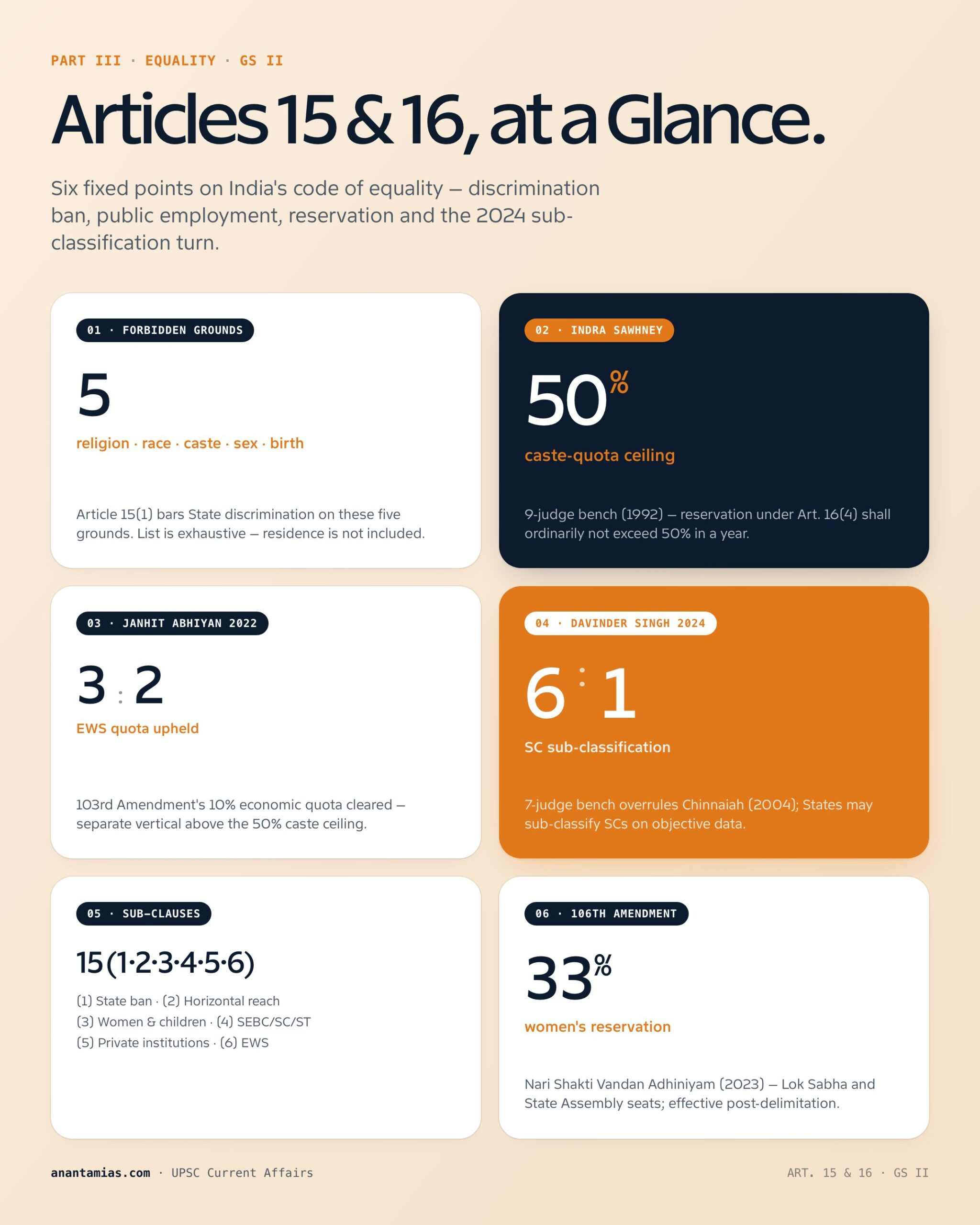
Article 15(1) is an extension of Article 14. It expresses a particular application of the general principle of equality. Just as the principle of reasonable classification applies to Article 14, it applies equally to Article 15(1).
The five forbidden grounds are religion, race, caste, sex, place of birth. The list is exhaustive, not illustrative — discrimination on other grounds (such as residence) is not barred under Art. 15(1). However, classification is allowed if it is based on intelligible differentia unrelated to these forbidden grounds.
Examples worked out by the courts:
- A statute reserving seats for women in local bodies is not discrimination on grounds of sex alone — it is permitted by Article 15(3).
- A rule that a married daughter is not a "family member" for compassionate appointment was held to discriminate on grounds of sex and was struck down.
- "Place of birth" is different from "place of residence". Residence-based reservations in some State employment have been upheld; birth-based exclusion has not.
Article 15(2): The Horizontal Reach
Article 15(2) is the only sub-clause that does not confine itself to the State — it operates against private persons too. It bans discrimination on the same five grounds in:
- Access to shops, public restaurants, hotels and places of public entertainment;
- Use of wells, tanks, bathing ghats, roads and places of public resort maintained wholly or partly out of State funds, or dedicated to the use of the general public.
The Supreme Court has held that if a section of the public claims exclusive use of a public well, it must establish that the well was dedicated to that section alone, not to the general public. Otherwise, exclusion violates Article 15(2). The provision was crafted to dismantle untouchability and caste-based exclusion from common civic resources.
Articles 15(3), 15(4), 15(5), 15(6): The Affirmative Action Carve-Outs
These four sub-clauses are exceptions to 15(1) and 15(2). Their structure:
- 15(3) — special provision for women and children. The State may make protective laws (maternity benefits, juvenile laws, women's reservations in panchayats and the Nari Shakti Vandan Adhiniyam, 2023).
- 15(4) — special provision for socially and educationally backward classes (SEBCs), SCs and STs. Added by the First Amendment, 1951, after State of Madras v. Champakam Dorairajan struck down communal reservation. It is enabling, not mandatory — the Court has held no mandamus can issue to compel the State to provide reservation under Art. 15(4).
- 15(5) — added by the 93rd Amendment, 2005 to overcome P.A. Inamdar; permits reservation in private unaided educational institutions, except minority institutions.
- 15(6) — inserted by the 103rd Amendment, 2019; allows reservation up to 10% for Economically Weaker Sections (EWS) in education.
The Janhit Abhiyan Verdict (2022) — EWS Reservation Upheld
In Janhit Abhiyan v. Union of India (2022), a 5-judge Constitution Bench upheld the 103rd Amendment by 3:2. Key holdings:
- Reservation solely on economic criteria does not violate the basic structure.
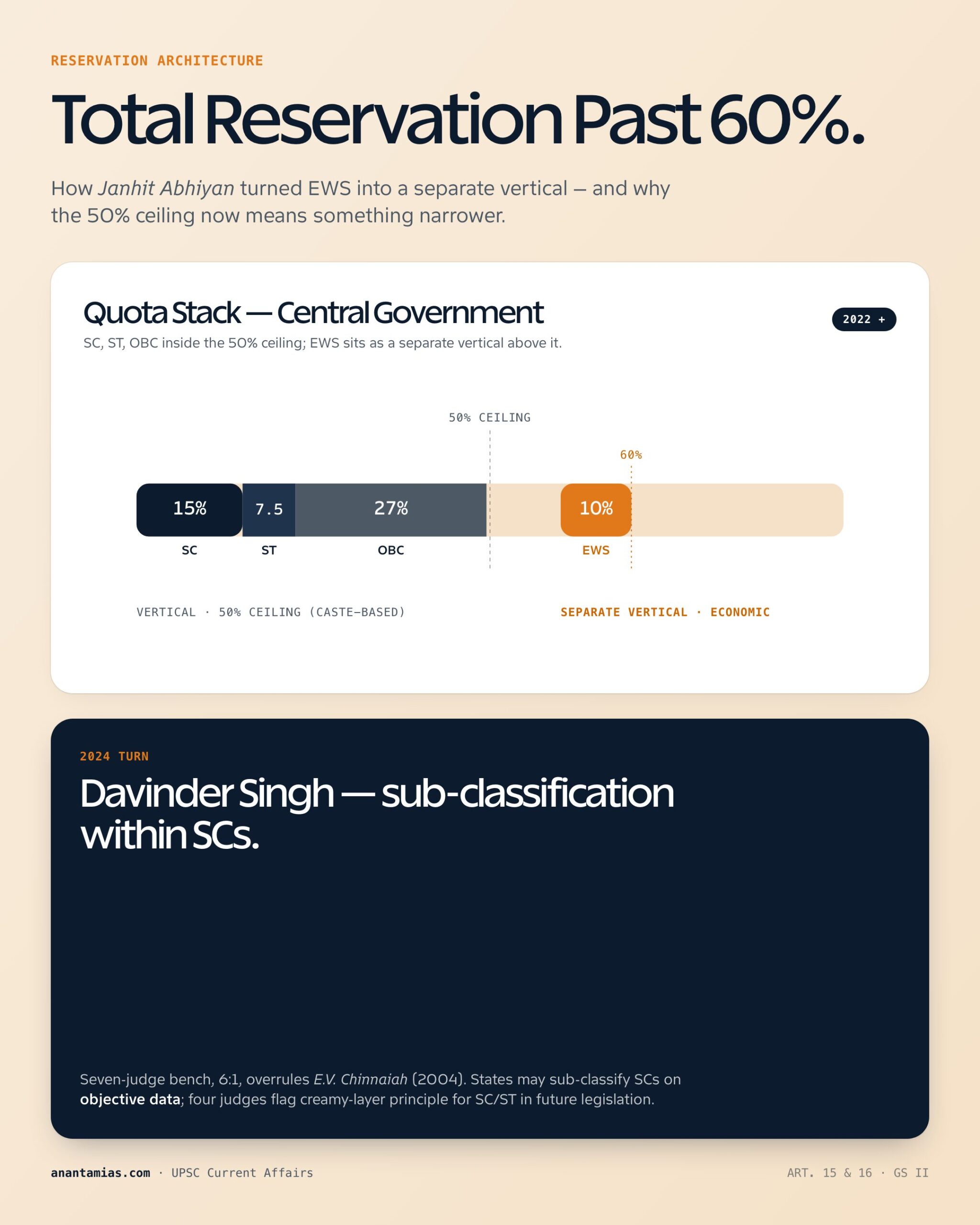
- The 50% ceiling laid down in Indra Sawhney (1992) applies only to caste-based reservation under Art. 16(4); the EWS quota is a separate vertical.
- Excluding SC/ST/OBCs (already covered) from the EWS quota is permissible classification.
The dissents (Justices Bhat and Lalit) warned that excluding the poorest SC/ST/OBCs from the EWS pool was discriminatory. The verdict has effectively pushed total reservation in many States past 60%.
Article 16: Equality of Opportunity in Public Employment
Article 16(1) and 16(2) guarantee equality of opportunity in matters of public employment and forbid discrimination on grounds of religion, race, caste, sex, descent, place of birth, residence (or any of them). The State may, however, make:
- A residence requirement for certain posts (16(3));
- Reservations for backward classes not adequately represented in services under the State (16(4));
- Reservations in promotions for SCs and STs (16(4A));
- Carry-forward of unfilled reserved vacancies (16(4B));
- Religion-based qualifications for posts in religious institutions (16(5));
- Reservation up to 10% for EWS (16(6)).
Indra Sawhney (1992): The Mandal Verdict
The 9-judge bench in Indra Sawhney laid down the architecture that still governs caste-based reservation:
- Reservation under Art. 16(4) shall ordinarily not exceed 50% in a year;
- The creamy layer among OBCs must be excluded — economic and social advancement disqualifies the individual;
- Reservation in promotions is impermissible (later overcome by 77th Amendment adding Art. 16(4A));
- Backward classes can be identified on grounds other than caste, but caste is a relevant factor.
M. Nagaraj (2006) and Jarnail Singh (2018)
For reservation in promotions under Art. 16(4A), the State must collect quantifiable data showing (i) backwardness, (ii) inadequacy of representation, and (iii) impact on administrative efficiency. Jarnail Singh clarified that the "backwardness" test does not apply to SC/STs since their backwardness is presumed; the creamy layer principle, however, applies even to SC/STs in promotions.
State of Punjab v. Davinder Singh (2024): Sub-Classification of SCs
In August 2024, a 7-judge Constitution Bench in State of Punjab v. Davinder Singh overruled the 2004 E.V. Chinnaiah judgment by 6:1. The verdict allows States to sub-classify Scheduled Castes for the purpose of granting more favourable reservation to the most disadvantaged groups within the SC list.
Key takeaways for UPSC:
- Scheduled Castes are not a homogeneous group; empirical evidence shows uneven access to reservation benefits.
- Sub-classification must be based on objective data of inadequate representation, not on political expediency.
- Four of the seven judges (the majority concurring opinions) observed that the creamy layer principle should apply to SCs and STs, putting Parliament on notice for future legislation.
- The President's notification under Article 341 is not disturbed; sub-classification operates within the existing list.
This judgment is the most consequential reservation ruling since Indra Sawhney and is a near-certain UPSC mains question for 2025–26.
Recent Hooks (2024–2026) for Mains Answers
| Year | Development | Relevance |
|---|---|---|
| 2022 | Janhit Abhiyan upholds 103rd Amendment | EWS, basic structure |
| 2023 | Nari Shakti Vandan Adhiniyam (106th Amendment) — 33% women's reservation in Lok Sabha and State Assemblies | Art. 15(3), 330A, 332A |
| 2024 | State of Punjab v. Davinder Singh — sub-classification of SCs upheld | Art. 15(4), 16(4), 341 |
| 2024 | Karnataka and Telangana announce sub-classification within SC quota | Federal implementation |
| 2025 | Renewed debate on caste census; Bihar Caste Survey (2023) data feeds reservation policy | Art. 15(4), 340 |
| 2025 | Several High Courts examine NEET-PG and faculty quota cases under Art. 15(5) | Reservation in higher education |
Comparison: Articles 15 and 16
| Feature | Article 15 | Article 16 |
|---|---|---|
| Field | Discrimination in social/civic life | Public employment |
| Available to | Citizens only | Citizens only |
| Forbidden grounds | Religion, race, caste, sex, place of birth | Religion, race, caste, sex, descent, place of birth, residence |
| Reservation cap | None expressly stated, but linked to 16(4) cap | 50% ceiling (Indra Sawhney) for caste; +10% EWS |
| Promotion reservation | N/A | Permitted under 16(4A) for SC/ST |
| Creamy layer | Applies to OBC under 15(4)/(5) | Applies to OBC; per Jarnail also to SC/ST in promotions |
Articles 15 and 16 in the UPSC Syllabus
- GS Paper II — Indian Constitution: features, amendments, significant provisions.
- GS Paper II — Welfare schemes for vulnerable sections and mechanisms for the protection of these vulnerable sections.
- Essay paper: equality, reservation, social justice.
- Prelims: amendment numbers (1st, 77th, 81st, 85th, 93rd, 103rd, 105th, 106th), creamy layer thresholds, judgments.
Doctrines That Tie 15 and 16 Together
Five judge-made doctrines stitch the two articles into a working code of equality.
- Reasonable classification — borrowed from Article 14, applied identically under 15(1) and 16(1). Classification must rest on intelligible differentia with rational nexus to the object.
- Arbitrariness as a ground of invalidity — E.P. Royappa (1973) read arbitrariness into Article 14, and that reading flows downstream into 15 and 16.
- Creamy layer — first articulated for OBCs in Indra Sawhney, extended to SC/ST promotions in Jarnail Singh (2018), and signalled as constitutionally available even in plain SC reservation by the Davinder Singh concurring opinions in 2024.
- 50% ceiling — judicial limit on caste-based vertical reservation; survives Janhit Abhiyan for caste quotas, while EWS sits as a separate vertical above it.
- Quantifiable data requirement — M. Nagaraj and Jarnail Singh require empirical data on backwardness, inadequacy of representation, and administrative efficiency before any promotion-quota policy.
Common UPSC Mistakes
Aspirants routinely confuse:
- Place of birth (Art. 15(1) and 16(2)) with place of residence — only the former is forbidden under 15(1); residence-based preference is allowed in some State employment under 16(3) by an Act of Parliament.
- Article 15(4) reservation in admissions with Article 16(4) reservation in employment — these are parallel but distinct, and the Indra Sawhney 50% rule was framed for 16(4).
- 103rd Amendment EWS quota as a "10% over and above" or "10% within 50%" — it is a separate vertical above the 50% ceiling per Janhit Abhiyan.
- 77th Amendment (16(4A) — promotion quota for SC/ST) with 81st Amendment (16(4B) — carry-forward) and 85th Amendment (consequential seniority) — three distinct insertions, often asked together in prelims.
Conclusion
Articles 15 and 16 translate the abstract promise of Article 14 into two of the most contested fields of Indian constitutional life — social access and public employment. The Constitution starts with a flat prohibition of discrimination, then carves out a carefully limited space for affirmative action, hemmed in by the creamy layer, the 50% ceiling, the basic structure, and now — after 2024's sub-classification verdict — by an emerging principle that the most disadvantaged within reserved categories must get a fair share of the quota. For UPSC, mastery here means holding three things together: the text of each sub-clause, the judicial doctrine built around it, and the 2022–24 wave of EWS, women's reservation and SC sub-classification rulings that have redrawn the map.
Tell Google you want more of this.
Add Anantam IAS as a preferred sourceOne tap, and this site shows up more often in your own Top Stories, AI Overviews and AI Mode. Remove it any time.