Copernicus data: Western Europe logs its hottest June as heatwaves surge
Why in News?
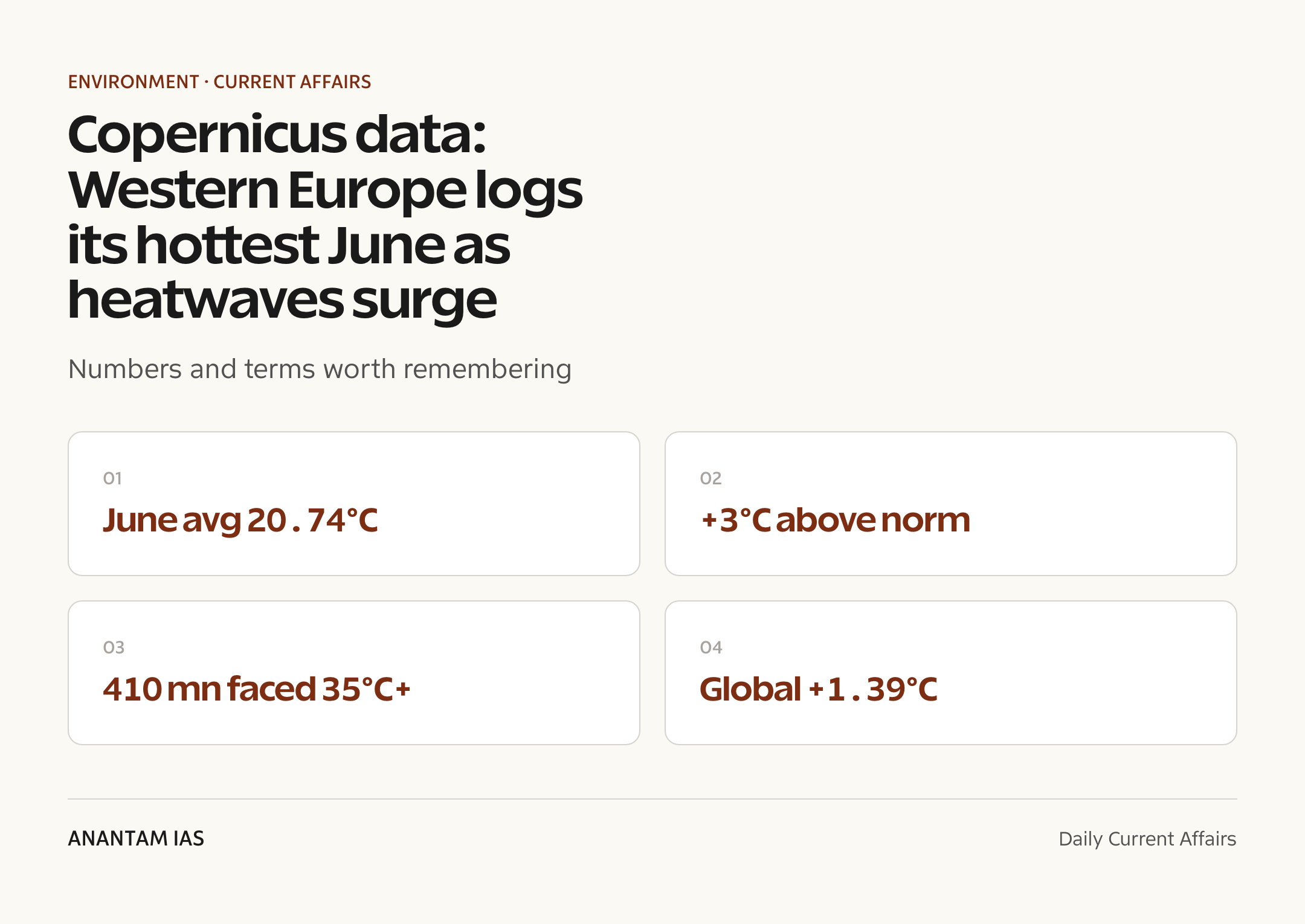
The EU’s Copernicus Climate Change Service (C3S) reported on 9 July 2026 that Western Europe experienced its hottest June on record, with the region’s average temperature reaching 20.74°C — more than 3°C above the 1991–2020 norm — breaking the previous record set only a year earlier, in June 2025. The Hindu reported the findings as a fresh heatwave was already battering the continent this week.
Globally, it was the second-hottest June ever recorded, with world temperatures running 1.39°C above the pre-industrial (1850–1900) average. The world’s oceans also logged their highest June temperatures on record, with a developing El Niño forecast to strengthen in the tropical Pacific.
- Western Europe’s June average hit 20.74°C — the hottest June since records began, per Copernicus C3S.
- An AFP analysis found 410 million people — over two-thirds of Europeans — endured temperatures above 35°C during the June 15–30 heatwave.
- A heat dome — a stagnant high-pressure system acting like a lid on a boiling pot — drove all-time and monthly records in several countries.
- Thousands of deaths were linked to the June heatwave, mostly in France, Spain and Belgium.
- The Mediterranean Sea recorded its own record-breaking marine heatwave, cutting off night-time cooling along the coasts.
- World Weather Attribution called the June event Europe’s most severe heatwave ever recorded and “virtually impossible” without climate change.
The development matters in the context of:
- Europe is the world’s fastest-warming continent — its heat extremes preview what tropical countries like India face at lower warming thresholds.
- The data lands amid the Paris Agreement debate on holding warming to 1.5°C: monthly readings like June’s +1.39°C show how little headroom remains.
- For India, the episode strengthens the case for Heat Action Plans (HAPs), accurate heat-mortality reporting and climate-resilient urban design.
UPSC Relevance
Prelims Relevance
- Copernicus Climate Change Service (C3S) — the climate arm of the EU’s Copernicus Earth-observation programme, implemented by the ECMWF (European Centre for Medium-Range Weather Forecasts).
- ERA5 — the C3S global reanalysis dataset that blends billions of satellite, aircraft, ship and station observations into a consistent climate record.
- Heat dome — a persistent high-pressure ridge that traps hot air, suppresses clouds and rainfall, and bakes the surface for days.
- Marine heatwave — a prolonged period of anomalously high sea-surface temperatures (typically above the 90th percentile for 5+ days).
- Pre-industrial baseline — the 1850–1900 average against which Paris Agreement warming limits (1.5°C / 2°C) are measured.
- World Weather Attribution (WWA) — the scientist network that runs rapid studies quantifying how climate change altered a specific extreme event.
- El Niño — anomalous warming of the central-eastern tropical Pacific that adds a temporary boost on top of the long-term warming trend.
- Tropical nights — nights when the minimum temperature stays at or above 20°C, a key humidity-linked health stressor.
- IMD heatwave criteria — 40°C+ in the plains (30°C+ in hills) with a departure of 4.5–6.4°C from normal; above 6.4°C it is a severe heatwave.
Mains Relevance
GS Paper 3
- Climate change and extreme events: how attribution science converts single disasters into evidence for mitigation and loss-and-damage claims.
- Disaster management: designing Heat Action Plans — early warning, cool shelters, work-hour shifts, mortality surveillance — for Indian cities.
- The compounding chain: heat dome → drought → wildfire (Iberian Peninsula, southern France) as a model of cascading climate risk.
GS Paper 1
- Geography of atmospheric circulation: blocking highs, jet-stream meandering and why mid-latitude Europe warms faster than the global mean.
- Ocean-atmosphere coupling: how marine heatwaves eliminate the sea-breeze relief and amplify coastal heat stress.
GS Paper 2
- Global climate governance: what record months mean for the UNFCCC process, NDC ambition and climate finance for adaptation.
Essay
- Climate change is no longer a forecast; it is the weather report — the ethics of acting on the present, not the future.
- Adaptation and mitigation are not rivals: a civilisation that only builds seawalls will drown behind them.
Background and Context
What Copernicus actually reported
The C3S monthly climate bulletin for June 2026 stacked several records into a single month.
- Western Europe’s June average of 20.74°C was more than 3°C above the 1991–2020 norm — a huge margin for a monthly continental average.
- It broke the previous regional record set in June 2025, meaning back-to-back record Junes in consecutive years.
- For the world and for Europe as a whole, it was the second-hottest June on record; global temperatures ran 1.39°C above the 1850–1900 pre-industrial average.
- The global ocean surface saw its warmest June ever, with a strengthening El Niño expected to add further heat through the year.
- June followed an unusually early spring hot spell in May and preceded another heatwave in early July — a pattern of longer, earlier, repeating heat seasons.
- C3S said the June heatwave “contributed to severe health impacts, including heat-related deaths“, with dry conditions raising drought risk in eastern Europe and feeding wildfires in the Iberian Peninsula and southern France.
Copernicus C3S and ERA5: the world's climate scorekeeper
For prelims, the institution behind the numbers matters as much as the numbers.
- Copernicus is the European Union’s flagship Earth-observation programme; its climate arm, the Copernicus Climate Change Service (C3S), is implemented by the ECMWF.
- C3S publishes monthly climate bulletins built on ERA5, a reanalysis dataset that fuses satellite, ship, aircraft and weather-station observations into a seamless global record from 1940 onwards.
- Because ERA5 updates within days, Copernicus is usually the first authoritative voice on whether a month or year set a record — ahead of NASA, NOAA and the WMO’s consolidated reports.
- Samantha Burgess, strategic climate lead at ECMWF, framed the moment starkly: climate change is shifting “from an abstract statistical future problem… to a concrete present and disruptive feature of daily life”.
- Per Copernicus, 2024 was the first full calendar year to run more than 1.5°C above pre-industrial levels — a warning shot, though the Paris limit refers to a multi-decadal average, not a single year.
Why Western Europe is cooking: heat domes and circulation change
Europe’s geography and shifting atmospheric dynamics make it the fastest-warming continent.
- A heat dome — a quasi-stationary high-pressure ridge — parked over Europe in June, compressing and heating sinking air while blocking rain-bearing systems, “like a lid on a boiling pot”.
- Changes in atmospheric circulation, including a wavier, slower jet stream, are making such blocking patterns more frequent and persistent over Europe.
- Extreme humidity worsened the toll: consecutive tropical nights denied the human body its recovery window, a classic driver of heat mortality among the elderly.
- Europe’s ageing population, dense old housing stock built for a cooler climate, and historically low air-conditioning penetration turn meteorological heat into public-health disasters.
- The result: thousands of excess deaths concentrated in France, Spain and Belgium, echoing the 2003 European heatwave that killed an estimated 70,000 people.
The ocean signal: marine heatwaves
The sea around Europe was as anomalous as the air above it.
- The Mediterranean logged a record-breaking marine heatwave in June, while Europe’s Atlantic coasts were hit by their own hot spells.
- A warm sea removes the sea-breeze and night-time cooling effect — “there’s no coolness coming from the ocean” — so coastal cities stay hot around the clock.
- Marine heatwaves stress fisheries, seagrass meadows and coral, trigger mass mortality of marine species, and load extra moisture into the air, intensifying humid heat onshore.
- For India, the same physics operates in the Indian Ocean — one of the fastest-warming ocean basins — with implications for the monsoon, cyclogenesis in the Arabian Sea, and coastal humid-heat extremes.
Attribution science: putting a number on blame
Event attribution has turned “is this climate change?” from speculation into arithmetic.
- World Weather Attribution (WWA) assessed Europe’s June heatwave as the most severe ever recorded for the region studied, based on three-day average peak temperatures.
- WWA concluded such an event would have been “virtually impossible” without climate change; a comparable June 2003 event would have been about 2°C cooler.
- Attribution studies compare today’s climate with a modelled counterfactual world without human emissions, estimating how much likelier or hotter an event has become.
- This science underpins the loss and damage agenda under the UNFCCC and is increasingly cited in climate litigation against states and corporations.
- For mains answers, attribution is the bridge between a single disaster and the policy claim that mitigation delay has a body count.
Lessons for India: heat as a governance test
Europe’s June is a preview of the heat governance challenge India already lives with every April–June.
- The India Meteorological Department (IMD) declares a heatwave at 40°C+ in the plains with a 4.5–6.4°C departure from normal, and a severe heatwave beyond that — but thresholds alone miss humid heat, which is India’s deadliest variant.
- Ahmedabad’s 2013 Heat Action Plan — South Asia’s first — cut heat mortality through early warnings, cool roofs and hospital protocols; the NDMA now guides Heat Action Plans across 23-plus states, though most remain underfunded and poorly targeted.
- Europe’s mortality numbers highlight India’s own undercounting problem: official heat-death tallies capture only a fraction of excess mortality, as covered in our note on undercounting of India’s heatwave deaths.
- Priorities for India: wet-bulb temperature-based warnings, worker protections (shifted hours, hydration mandates under labour codes), cool-roof and urban-greening programmes, and treating heat as a notified disaster for relief funding.
- Burgess’s adaptation warning applies doubly to India: infrastructure “built for a climate that no longer exists” describes much of the subcontinent’s housing, power grid and water systems.
Way Forward
Mitigation: close the emissions gap
- Accelerate the global transition to net-zero emissions — Burgess’s blunt formula: heatwaves “will only get worse the more fossil fuel we pump into the atmosphere”.
- Strengthen NDC ambition in the next UNFCCC cycle, backed by credible climate finance so developing countries can decarbonise without sacrificing growth.
Adaptation: plan for the climate we have
- Scale up Heat Action Plans with dedicated budgets, legally mandated triggers and city-specific vulnerability maps rather than one-size-fits-all templates.
- Retrofit buildings and cities — cool roofs, shaded streets, urban water bodies — since much of the built stock predates today’s climate.
- Build heat-mortality surveillance into public-health systems so excess deaths are counted, not buried in cardiac and renal statistics.
Science and early warning
- Invest in reanalysis and attribution capacity in the Global South — India’s forecasting under Mission Mausam should extend into rapid event attribution.
- Mainstream marine heatwave monitoring for the Indian Ocean, given its bearing on the monsoon, fisheries and coastal heat stress.
Conclusion
June 2026 is not an outlier; it is a staircase step. Western Europe’s 20.74°C record, the world’s second-hottest June, and the warmest June ocean on record all point the same way — and a strengthening El Niño means the next records are already loading.
For the exam and for policy, the takeaway is identical: attribution science has ended the era of plausible deniability. The choice left is between planned adaptation with rapid mitigation, and unplanned suffering counted in excess-mortality tables.
UPSC Practice Questions
Prelims MCQ 1
With reference to the Copernicus Climate Change Service (C3S), consider the following statements:
- It is implemented by the European Centre for Medium-Range Weather Forecasts (ECMWF) on behalf of the European Union.
- According to C3S, Western Europe’s June 2026 average temperature was more than 3°C above the 1991–2020 norm, its hottest June on record.
- June 2026 was also the hottest June ever recorded globally.
How many of the above statements are correct?
(a) Only one (b) Only two (c) All three (d) None
Answer: (b) Only two
Explanation:
Statements 1 and 2 are correct. C3S is the climate arm of the EU’s Copernicus programme, run by ECMWF, and it reported Western Europe’s hottest June at 20.74°C (3°C+ above the 1991–2020 norm). Statement 3 is wrong — globally, June 2026 was the SECOND-hottest June on record.
Prelims MCQ 2
The term “heat dome”, frequently in the news, best describes which of the following?
(a) A layer of greenhouse gases concentrated over urban areas that traps outgoing radiation (b) A persistent high-pressure system that traps and compresses hot air over a region, suppressing clouds and rainfall (c) The urban heat island effect measured at night over dense city cores (d) A pool of anomalously warm sea-surface water that persists for weeks
Answer: (b) A persistent high-pressure system that traps and compresses hot air over a region, suppressing clouds and rainfall
Explanation:
A heat dome is a quasi-stationary high-pressure ridge under which air sinks, compresses and heats, while clouds and rain are suppressed — ‘like a lid on a boiling pot’. Option (d) describes a marine heatwave.
UPSC Mains Questions
- Europe, the world’s fastest-warming continent, recorded its most severe heatwave in June 2026. Examine the meteorological drivers of such extreme heat events and discuss what lessons Europe’s experience holds for India’s heat governance. (250 words)
- “Attribution science has transformed climate change from a forecast into a finding.” Explain how event attribution works and evaluate its significance for global climate negotiations, loss-and-damage claims and climate litigation. (250 words)
- Marine heatwaves are emerging as silent multipliers of terrestrial heat stress and ecological loss. Discuss their causes and consequences, with special reference to the Indian Ocean and the Indian monsoon. (150 words)
Sources: Copernicus Climate Change Service (C3S) and The Hindu.
Frequently Asked Questions
What did Copernicus report about June 2026?
The Copernicus Climate Change Service reported that Western Europe logged its hottest June on record, averaging 20.74°C — over 3°C above the 1991–2020 norm. Globally it was the second-hottest June, at 1.39°C above the pre-industrial average, and the world’s oceans saw their warmest June ever.
What is the Copernicus Climate Change Service?
C3S is the climate arm of the European Union’s Copernicus Earth-observation programme, implemented by the ECMWF. It publishes monthly climate bulletins based on the ERA5 reanalysis dataset, which merges satellite and ground observations into a consistent global temperature record from 1940 onwards.
What is a heat dome?
A heat dome is a persistent high-pressure system that sits over a region like a lid on a boiling pot. Sinking air compresses and heats, clouds and rain are suppressed, and temperatures build day after day. One such dome drove Europe’s record June 2026 heatwave.
How deadly was Europe’s June 2026 heatwave?
Thousands of deaths were linked to the June heatwave, concentrated in France, Spain and Belgium. About 410 million people — over two-thirds of Europeans — faced temperatures above 35°C during June 15–30, with humid tropical nights denying the body recovery time.
What did World Weather Attribution conclude?
World Weather Attribution, a network of climate scientists, assessed the June 2026 event as Europe’s most severe heatwave ever recorded and said it would have been virtually impossible without human-caused climate change. A comparable event in June 2003 would have been about 2°C cooler.
Why does a European heatwave matter for UPSC?
It packages several syllabus themes in one story: Copernicus and ERA5 for prelims, heat domes and atmospheric circulation for geography, attribution science and UNFCCC politics for GS2–GS3, and direct lessons for India’s Heat Action Plans, IMD heatwave criteria and heat-mortality reporting.