Why in News?
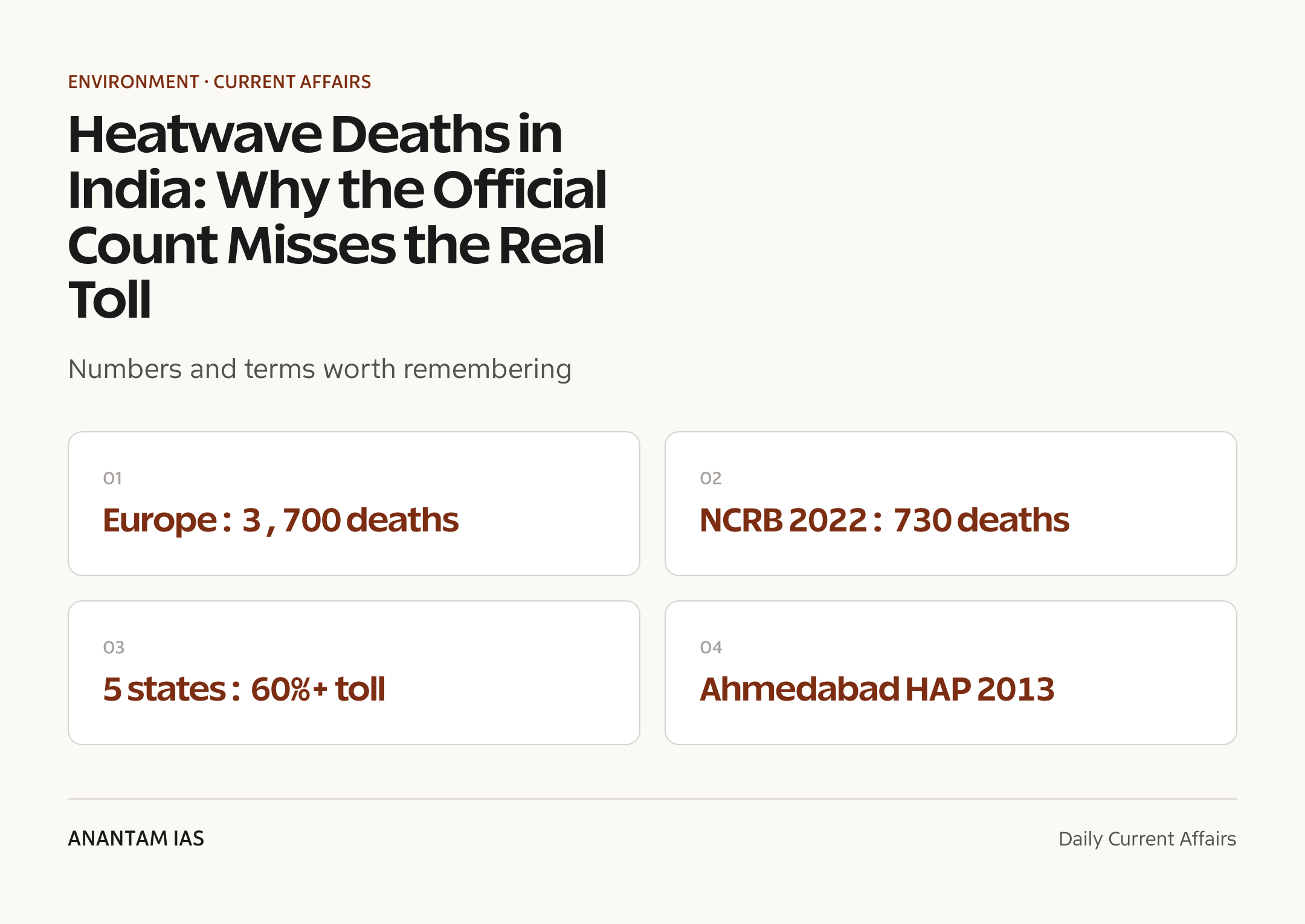
Europe has just lived through its deadliest June heatwave: between June 20 and 28, 2026, France, Belgium and the Netherlands together recorded about 3,700 excess deaths, with power supplies disrupted and hospitals overwhelmed. Scientists attributed the extreme heat almost entirely to climate change. The United States, in the grip of a heat dome, reported at least 25 deaths over the Fourth of July weekend, with more than 20 states crossing 38°C.
Experts writing in The Indian Express’s Explained section (July 7) drew the uncomfortable comparison with India — where heatwaves are more frequent, last longer and expose hundreds of millions of people each year, yet there is still no comprehensive system to measure heat-related mortality. The official count captures only certified heatstroke deaths, leaving the true human cost of rising temperatures largely unknown.
- Europe estimates excess deaths during heat events within days; India has no comparable near-real-time mortality surveillance.
- India’s official data counts only heatstroke deaths, not the far larger category of heat-related deaths triggered by cardiac, renal and respiratory failure.
- The NCRB’s Accidental Deaths and Suicides in India (ADSI) series recorded just 730 heat/sun-stroke deaths for 2022 — a figure researchers treat as a floor, not the toll.
- Official series exclude undigitised records and the private health sector, which delivers nearly two-thirds of all inpatient care.
- A 2026 mortality study found five states — Uttar Pradesh, Bihar, Madhya Pradesh, Rajasthan and Gujarat — account for over 60% of estimated heatwave deaths.
The development matters in the context of:
- Undercounting is not a statistical quibble: mortality data drives Heat Action Plan design, compensation, and the case for treating heat as a notified disaster.
- With climate change making heatwaves longer and more intense, measurement is core adaptation infrastructure — you cannot manage what you refuse to count.
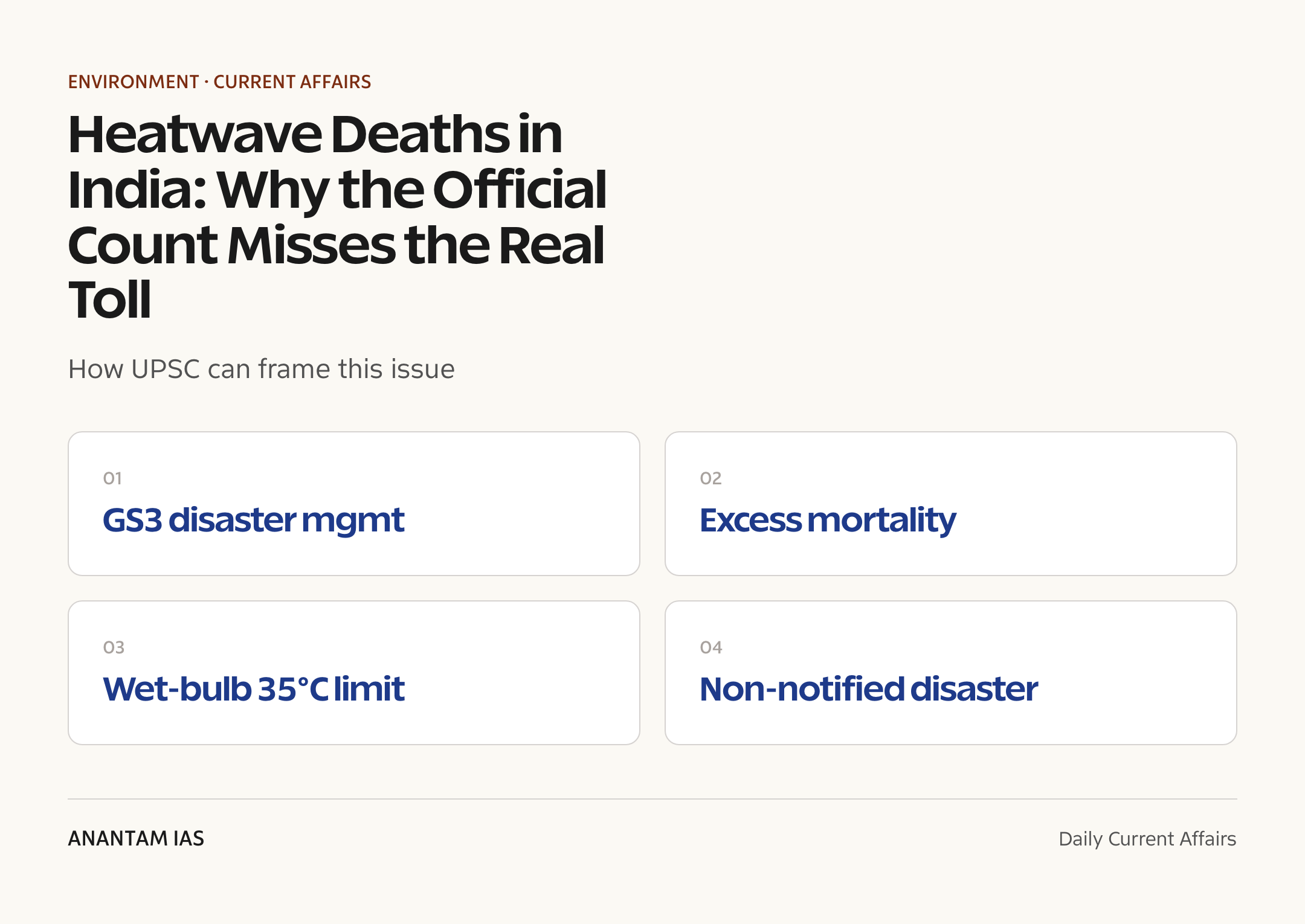
- The issue knits together GS3 disaster management, GS2 public health and the political economy of informal-sector work — a ready case study for Mains.
UPSC Relevance
Prelims Relevance
- IMD heatwave criteria — maximum temperature at least 40°C in the plains, 37°C on the coast, 30°C in the hills, with a departure of 4.5–6.4°C from normal (severe heatwave: above 6.4°C); declared when met at 2+ stations in a meteorological sub-division for 2 consecutive days.
- Actual-temperature route: maximum of 45°C or more is a heatwave; 47°C or more is a severe heatwave, irrespective of departure.
- Wet-bulb temperature combines heat and humidity; prolonged exposure above 35°C wet-bulb can be fatal even for healthy, acclimatised people, since sweat cannot evaporate.
- Excess mortality — observed all-cause deaths during an event minus the baseline expected from historical trends; captures indirect deaths that death certificates miss.
- NCRB ADSI is the official series recording deaths by ‘heat/sun stroke’ — 730 deaths in 2022; NDMA and Ministry of Earth Sciences counts differ widely, a documented data discrepancy.
- Heatwave is NOT among the 12 notified disasters under SDRF/NDRF norms (cyclone, drought, earthquake, fire, flood, tsunami, hailstorm, landslide, avalanche, cloudburst, pest attack, frost and cold wave) — cold wave is in, heat is out.
- States may spend up to 10% of their SDRF allocation on state-notified ‘local disasters’ — the window some states use for heatwave ex gratia.
- Ahmedabad Heat Action Plan (2013) — South Asia’s first HAP; an evaluation credits it with avoiding 1,000+ deaths a year.
- NDMA guidelines for prevention and management of heat wave (2016, updated 2019) anchor state and city HAPs.
- Short-lived climate pollutants (SLCPs) — black carbon, methane, tropospheric ozone, HFCs; a UNEP–WMO assessment found global SLCP action could avoid about 0.5°C of warming by 2050.
Mains Relevance
GS Paper 3
- Disaster management by data: how a heatstroke-only definition, undigitised records and excluded private hospitals cripple evidence-based heat governance.
- Heat as a test of climate adaptation: Heat Action Plans, urban heat islands, cool roofs, and why alerts without enforceable on-ground action fail wage-dependent workers.
- The notified-disaster question: SDRF/NDRF architecture, the 10% local-disaster window, and the fiscal case for treating heat as a standing public-health threat.
- SLCP mitigation (black carbon, refrigerants) as the bridge between mitigation and adaptation — cooling the planet within years, not centuries.
GS Paper 2
- Health-system weakness as governance failure: death certification and registration gaps, and the case for integrating private-sector data into public surveillance.
- Protecting vulnerable sections: outdoor and informal workers with no paid sick leave, and instruments like SEWA’s parametric heat insurance.
Essay
- What gets measured gets managed — the invisible deaths of a warming India.
- Climate adaptation is ultimately a public-health project, not an engineering one.
Background and Context
Why the official count misses most heat deaths
The undercount is structural — it follows directly from how deaths are certified and collated in India.
- Heat is treated as a contributing factor, not a cause: when extreme heat strains a weak heart, the death certificate records a heart attack. Heat rarely appears on the certificate at all.
- Official data counts only heatstroke — the direct, clinically certified death — and not the broader category of heat-related deaths from cardiac, kidney and respiratory failure that heat silently triggers in people with co-morbidities.
- The count excludes undigitised records and the entire private health sector, which delivers nearly two-thirds of all inpatient care in India.
- Sources are fragmented, each with its own definition: the NCRB, the India Meteorological Department and state relief departments routinely publish divergent heat-death numbers for the same year.
- NCRB’s ADSI report recorded 730 heat/sun-stroke deaths in 2022 — while excess-mortality research suggests actual heat-attributable deaths in bad years run far higher. The gap is the story.
Excess mortality: the method India lacks
Europe’s 3,700 figure was possible because of a counting method India has never institutionalised.
- Excess mortality compares total observed deaths during a heat episode with the baseline expected from historical data for the same period; the difference is attributed to the event.
- The method captures indirect deaths — heart attacks, strokes, kidney failure — that certificate-based counting misses, which is why it typically yields tolls several times the official one.
- European public-health agencies run near-real-time death surveillance, letting them publish credible estimates within days of a heatwave.
- India’s Civil Registration System and medical certification of cause of death remain incomplete, so daily all-cause mortality cannot yet be matched against daily temperature.
- The Indian Express experts note that juxtaposing heat-related deaths with the day’s temperature would give policymakers the evidence base to design tailor-made heat-management solutions — the missing first step.
The science: IMD criteria, wet-bulb heat and city heat traps
The metrics that decide when heat turns lethal are precise — and worth memorising.
- The India Meteorological Department declares a heatwave when the maximum reaches 40°C in the plains (37°C coast, 30°C hills) with a departure of 4.5–6.4°C from normal — above 6.4°C it is a severe heatwave. An actual maximum of 45°C (or 47°C for severe) qualifies on its own. The criteria must hold at two stations in a sub-division for two consecutive days; details in this site’s explainer on the heat wave in India.
- Absolute temperature understates danger — which is why forecasts report a ‘feels like’ temperature. The key variable is wet-bulb temperature, which tracks humidity alongside heat.
- Sweat must evaporate to cool the body; humidity blocks evaporation. So the same 38°C is far deadlier on a humid coast than in dry Rajasthan. Prolonged exposure above a 35°C wet-bulb reading can kill even fit, acclimatised people.
- Indians are adapted, not biologically evolved, to heat: ventilated architecture, coolers, fans and clay matkas evolved around a hot climate. Europe never built for heat, which is why its heatwaves prove so deadly — but India’s adaptation buffer erodes as thresholds climb.
- Cities add the urban heat island penalty: concrete, waste heat and lost tree cover keep nights warm and deny the body recovery time — the governance angle covered in heat as an urban governance test.
Who bears the risk: the geography and sociology of heat death
Heat mortality is not randomly distributed — it maps onto work, age and poverty.
- The most exposed are outdoor workers: farmers, construction labourers, street vendors and delivery riders, who face the sun for a living.
- Most of them are in the informal sector — no paid sick leave, no shade norms, no cover under formal protection measures. Unable to afford a lost day’s wage, they work through red alerts.
- Research flags infants, the elderly, pregnant women and people with chronic illness as the other high-risk demographics.
- Geography concentrates the danger: a 2026 mortality study found Uttar Pradesh, Bihar, Madhya Pradesh, Rajasthan and Gujarat account for more than 60% of estimated heatwave deaths.
- Poverty runs through all of it — those who cannot afford cooling or rest carry the greatest risk, which makes heat mortality an inequality indicator as much as a weather statistic.
The policy stack: NDMA guidelines, HAPs and heat insurance
India’s heat governance toolkit exists and works where implemented — the gaps are coverage, money and enforcement.
- The NDMA issued national guidelines for the prevention and management of heat wave in 2016 (updated 2019), anchoring state, district and city Heat Action Plans (HAPs) across heat-prone states.
- HAPs bundle early-warning colour alerts, cooling centres and water points, public-awareness drives, and adjusted hours for outdoor work and schools.
- The template is the Ahmedabad HAP, piloted in 2013 — South Asia’s first. An evaluation estimated it avoids 1,000+ deaths a year, at modest cost.
- But a widely cited Centre for Policy Research assessment of 37 HAPs found most lack local vulnerability mapping, dedicated funding and any legal mandate — plans on paper, not in the field.
- New instruments are emerging: SEWA’s parametric heat insurance pays women workers part of their lost wages when temperature crosses a threshold for three consecutive days — covering 50,000 women across 22 districts.
- The biggest gap is implementation: a heat alert that reaches a labourer who cannot afford to stop working protects nobody. Alerts must trigger mandatory on-ground action — rescheduled work, rest, shade and water.
A disaster that isn't: heat outside the notified list
India’s disaster-finance architecture still treats heat as a seasonal nuisance rather than a killer.
- SDRF/NDRF norms recognise 12 notified disasters — cyclone, drought, earthquake, fire, flood, tsunami, hailstorm, landslide, avalanche, cloudburst, pest attack, and frost and cold wave. Cold wave is in; heatwave is out.
- Non-notified status keeps heat outside dedicated relief funding — no automatic ex gratia for families, no earmarked response money, unlike floods and cyclones.
- The partial workaround: states may spend up to 10% of their SDRF on ‘local disasters’ they notify themselves, and several heat-prone states have used this window for heatwave relief.
- Successive Finance Commissions have kept the national list unchanged, even as heat exposure has grown — the institutional design question examined in this site’s guide to disaster management for GS3.
- Undercounting and non-notification feed each other in a loop: low official tolls weaken the case for notification, and non-notification removes the incentive to count deaths properly.
Way Forward
Count honestly
- Widen the definition from heatstroke-only to heat-related mortality, with clear clinical protocols for certifying heat as a contributing cause.
- Digitise death records and pull the private sector — two-thirds of inpatient care — into a single mortality surveillance system.
- Build an Indian excess-mortality system that matches daily all-cause deaths against daily temperature, giving HAPs a real evidence base.
Protect the exposed
- Convert alerts into enforceable triggers: mandatory rescheduling of outdoor work, rest breaks, shade and water at worksites on red-alert days.
- Scale parametric heat insurance and wage-protection schemes so informal workers can afford to stop working when it is dangerous.
- Treat heat as a standing public-health threat in disaster finance — either notify it nationally or standardise the SDRF local-disaster route with clear ex gratia norms.
- Cool cities structurally: trees, shade and reflective ‘cool’ roofs, prioritising informal settlements that trap the most night-time heat.
Cut the fast climate levers
- Act on short-lived climate pollutants — black carbon and HFC refrigerants — which warm intensely but briefly, so cuts slow warming within years, not centuries.
- A UNEP–WMO assessment found global SLCP action could avoid about 0.5°C of warming by 2050 — preventing millions of heat-related deaths.
- Push climate-friendly refrigerants and sustainable cooling access under the India Cooling Action Plan, treating cooling as a development need, not a luxury.
Conclusion
Europe’s 3,700 excess deaths in nine days made headlines because Europe counted them. India’s heat toll stays out of the headlines for the opposite reason: a heatstroke-only definition, paper records and an excluded private sector keep most heat deaths invisible. Invisible deaths buy no funding, notify no disasters and reform no labour norms.
The fixes are unglamorous — better death certification, digitised registries, an excess-mortality baseline — but they are the foundation on which every Heat Action Plan, insurance product and cool-roof programme must stand. As climate change loads the dice toward longer, wetter, hotter heatwaves, counting the dead honestly is the first act of protecting the living.
UPSC Practice Questions
Prelims MCQ 1
With reference to heatwaves in India, consider the following statements:
- The India Meteorological Department considers a heatwave in the plains only when the maximum temperature reaches at least 40°C.
- A departure of more than 6.4°C from the normal maximum temperature qualifies as a severe heat wave.
- Heatwave is one of the notified disasters eligible for relief under the national SDRF/NDRF norms.
How many of the above statements are correct?
(a) Only one (b) Only two (c) All three (d) None
Answer: (b) Only two
Explanation:
Statements 1 and 2 are correct: IMD’s plains threshold is 40°C (37°C coastal, 30°C hilly), with a 4.5–6.4°C departure marking a heatwave and above 6.4°C a severe heatwave. Statement 3 is incorrect — heatwave is not among the 12 notified disasters (frost and cold wave are included, heat is not); states can only use the 10% SDRF local-disaster window.
Prelims MCQ 2
Which one of the following best describes the ‘excess mortality’ method of estimating heatwave deaths?
(a) Counting only deaths clinically certified as heatstroke in government hospitals (b) Comparing total observed deaths during a heat event with the baseline expected from historical data, capturing indirect deaths (c) Multiplying the number of heatwave days by a fixed mortality coefficient set by WHO (d) Surveying households in affected districts after the heatwave ends
Answer: (b) Comparing total observed deaths during a heat event with the baseline expected from historical data, capturing indirect deaths
Explanation:
Excess mortality measures the gap between all-cause deaths observed during an event and the historical baseline for the same period. It captures indirect deaths — cardiac, renal, respiratory — that heat triggers but death certificates attribute to other causes, which is why it usually far exceeds the official heatstroke count.
UPSC Mains Questions
- India’s official heatwave mortality data captures only a fraction of actual deaths. Examine the structural reasons for this undercounting and discuss how an excess-mortality surveillance system would strengthen heat governance and Heat Action Plans.
- Heat Action Plans have proven effective where implemented, yet heatwave remains outside India’s list of notified disasters. Critically evaluate the institutional and financial architecture for heatwave management and suggest reforms to protect outdoor and informal workers.
- “Cutting short-lived climate pollutants is the fastest lever against heat mortality.” Discuss the role of SLCP mitigation, urban cooling and adaptive infrastructure in reducing India’s heat-related deaths.
Sources: NDMA, Heat Wave and Indian Express Explained.
Frequently Asked Questions
Why are India’s heatwave deaths undercounted?
Heat is treated as a contributing factor, not a cause, so it rarely appears on death certificates. Official data counts only certified heatstroke deaths, excludes undigitised records, and leaves out the private sector, which delivers nearly two-thirds of inpatient care. Fragmented agencies also use different definitions, producing widely divergent numbers.
What is excess mortality?
Excess mortality compares total deaths observed during an event with the baseline expected from historical data; the difference is attributed to the event. It captures indirect deaths — heart attacks, strokes, kidney failure triggered by heat — which is how Europe estimated about 3,700 deaths in the June 2026 heatwave within days.
How does IMD define a heatwave?
IMD declares a heatwave when the maximum temperature reaches 40°C in the plains (37°C coastal, 30°C hilly) with a 4.5–6.4°C departure from normal; above 6.4°C it is severe. An actual maximum of 45°C (47°C for severe) also qualifies. Criteria must hold at two stations for two consecutive days.
Is heatwave a notified disaster in India?
No. The 12 notified disasters under SDRF/NDRF norms include frost and cold wave but not heat. So heat deaths attract no automatic relief funding or ex gratia. States can, however, notify heatwave as a local disaster and spend up to 10% of their SDRF allocation on it.
What are Heat Action Plans and do they work?
Heat Action Plans bundle early-warning alerts, cooling centres, water points, awareness drives and adjusted work and school hours. Ahmedabad’s 2013 plan — South Asia’s first — is estimated to avoid over 1,000 deaths a year. But assessments find most HAPs lack local vulnerability mapping, dedicated funding and legal enforcement.
Which groups face the highest heat-death risk?
Outdoor workers — farmers, construction labourers, street vendors, delivery riders — mostly informal, with no paid sick leave. Infants, the elderly, pregnant women and the chronically ill are also high-risk. A 2026 study found Uttar Pradesh, Bihar, Madhya Pradesh, Rajasthan and Gujarat account for over 60% of estimated heatwave deaths.
Tell Google you want more of this.
Add Anantam IAS as a preferred sourceOne tap, and this site shows up more often in your own Top Stories, AI Overviews and AI Mode. Remove it any time.