Dal Lake, Srinagar: Location, Importance & Facts
Dal Lake Srinagar covers location in Jammu and Kashmir, houseboats, wetlands, ecological stress, and UPSC relevance in Kashmir geography.
Dal Lake is an urban freshwater lake in Srinagar, the summer capital of Jammu and Kashmir, situated at an altitude of 1,583 metres in the Kashmir Valley. It covers approximately 18 sq km and is known worldwide for its houseboats, shikaras, and floating vegetable gardens (rad). For UPSC, Dal Lake is a critical case study in urban wetland degradation, eutrophication, tourism-ecology conflict, and Himalayan regional geography.
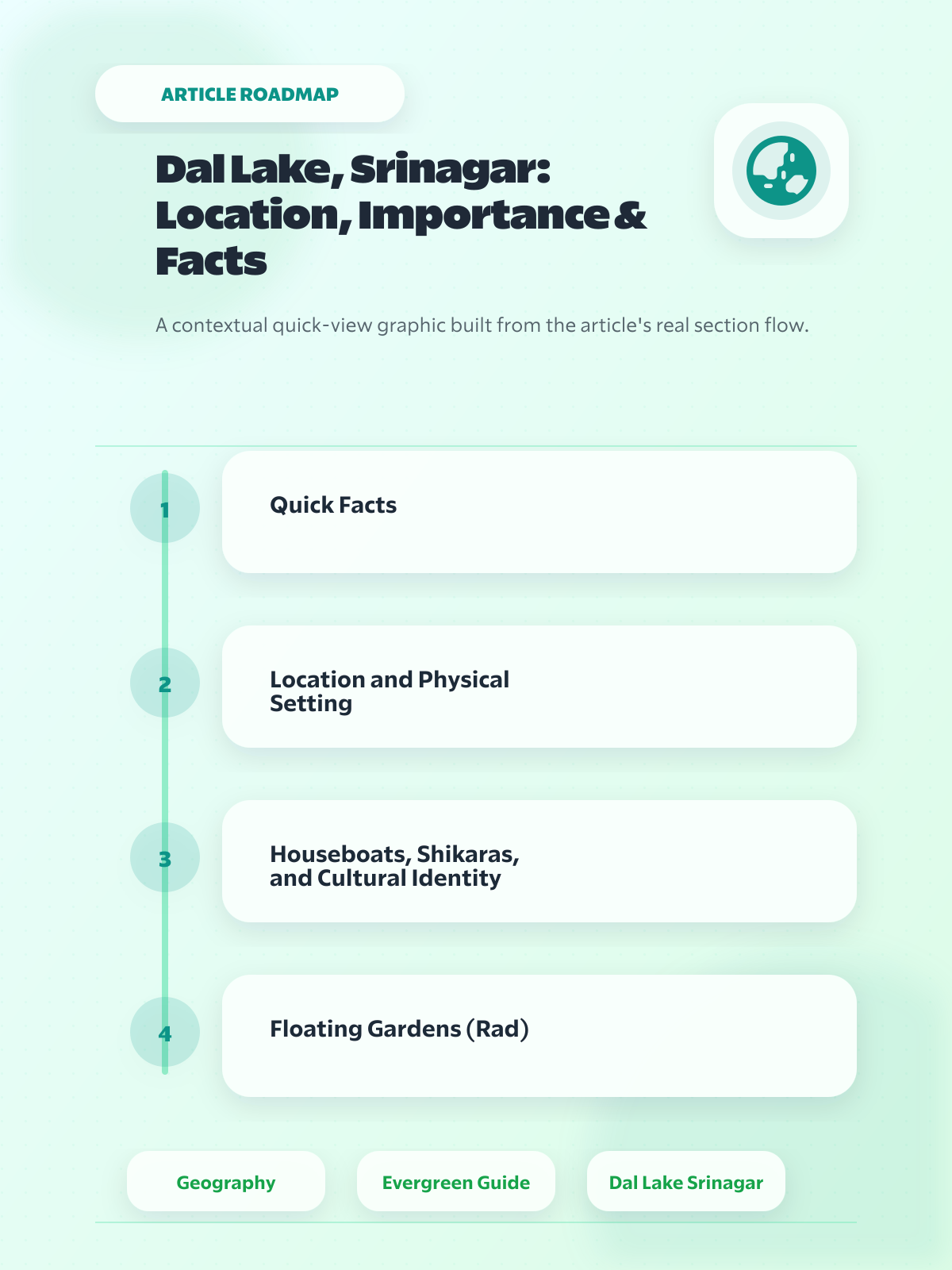
Quick Facts
| Parameter | Details |
|---|---|
| Lake Name | Dal Lake |
| State | Jammu & Kashmir |
| District | Srinagar |
| Type | Freshwater (urban lake) |
| Area | ~18 sq km (reduced from ~25 sq km in the 1950s) |
| Maximum Depth | ~6 metres (originally deeper; reduced by siltation) |
| Altitude | 1,583 metres above sea level |
| Ramsar Status | Not designated (proposed multiple times) |
| UNESCO Status | Not designated |
| Key Feature | Houseboats, shikaras, floating gardens, Mughal garden connection |
Location and Physical Setting
Dal Lake lies in central Srinagar, surrounded by the Zabarwan Hills to the east and the urban sprawl of Srinagar to the west. The lake is fed by Dachigam Nallah from the Dachigam National Park catchment, along with several smaller streams and springs.
The lake is divided into four basins: Gagribal (nearest to the city centre and Mughal gardens), Lokut Dal, Bod Dal (the largest), and Nagin (sometimes considered a separate lake). This multi-basin structure is important because pollution and encroachment affect each basin differently.
Houseboats, Shikaras, and Cultural Identity
Dal Lake's identity is inseparable from its houseboats. There are approximately 900-1,000 houseboats on the lake, a tradition dating to the British colonial period when non-Kashmiris were not permitted to buy land. Houseboats became floating hotels.
Shikaras are the traditional wooden boats used for transport, vending, and tourism on the lake. They are functionally equivalent to gondolas and serve as the primary mode of lake transport.
The lake also borders three Mughal-era gardens: Shalimar Bagh, Nishat Bagh, and Chashme Shahi. These 17th-century gardens, built by Mughal emperors Jahangir and Shah Jahan, are integral to Kashmir's tourism landscape and directly overlook Dal Lake.
Floating Gardens (Rad)
One of Dal Lake's most distinctive features is the rad — floating vegetable gardens anchored to the lake bed. Farmers cultivate tomatoes, cucumbers, melons, and leafy vegetables on these floating plots made of matted vegetation and lake-bed soil.
For UPSC, the rad system is an example of traditional ecological knowledge where livelihoods and wetland systems are intertwined rather than separate.
Ecological Significance
Biodiversity:
- Over 60 species of aquatic plants, including lotus, water chestnut, and various pondweeds
- Around 20 fish species, including schizothoracine (snow trout) native to Kashmir and introduced species like common carp
- Migratory birds including mallard, teal, gadwall, and pochard use the lake during winter
- The adjacent Dachigam National Park supports the endangered Hangul (Kashmir stag), and the park's streams feed into Dal Lake
Key threats:
- Eutrophication is the most severe ecological problem — excess nutrient loading from sewage causes dense weed growth and oxygen depletion
- Encroachment has shrunk the lake from approximately 25 sq km in the 1950s to ~18 sq km today
- Sewage inflow from over 50,000 people living in and around the lake, including houseboat residents
- Siltation from catchment runoff and degraded stream channels
- Solid waste from tourism activities and lakeside settlements
Tourism and Economic Importance
Dal Lake is the economic backbone of Srinagar's tourism industry, which is the largest employment sector in the Kashmir Valley.
- Houseboats generate direct income for approximately 5,000-7,000 families in hospitality, catering, and services
- Shikara operators number in the thousands, providing transport and tourist rides
- The floating market at Dal Gate sells vegetables, flowers, and handicrafts from boats
- Mughal gardens along the lakeshore attract over 1 million visitors annually
- Related industries: Kashmiri handicrafts (papier-mache, walnut wood, pashmina) sold from lakeside shops and houseboats
The economic dependence means that lake degradation directly threatens livelihoods. This is why restoration is not just an environmental issue but a socio-economic imperative.
Eutrophication: The Central Environmental Challenge
Eutrophication is the process by which excess nutrients (nitrogen and phosphorus from sewage) cause excessive plant and algal growth, depleting dissolved oxygen and degrading water quality.
Dal Lake is one of the most cited examples of eutrophication in Indian geography. Key data:
| Indicator | Status |
|---|---|
| Nutrient loading | High (untreated sewage from lakeside settlements) |
| Weed coverage | Estimated 40-60% of lake surface affected |
| Dissolved oxygen | Below healthy levels in multiple basins |
| Transparency | Reduced from historical levels |
| Area loss | ~7 sq km lost to encroachment and land conversion since 1950s |
LAWDA: Lakes and Waterways Development Authority
The Lakes and Waterways Development Authority (LAWDA) was established in 1997 by the J&K government specifically for Dal Lake restoration. Its mandate includes:
- Sewage interception through pipelines to divert waste away from the lake
- De-weeding operations to remove aquatic weeds
- Encroachment removal and boundary demarcation
- Catchment area treatment to reduce silt inflow
LAWDA has faced criticism for slow progress. The National Green Tribunal (NGT) has issued multiple orders directing faster action on sewage treatment and encroachment removal.
Comparison with Other Important Indian Lakes
| Lake | State | Type | Area (sq km) | Key Feature | Ramsar Status |
|---|---|---|---|---|---|
| Dal Lake | Jammu & Kashmir | Freshwater | ~18 | Houseboats, shikaras, Mughal gardens | No |
| Sukhna Lake | Chandigarh | Man-made | ~1.5 | Le Corbusier's planned city lake | No |
| Chilika Lake | Odisha | Brackish lagoon | ~1,100 | Largest brackish lagoon in Asia | Yes (1981) |
| Wular Lake | Jammu & Kashmir | Freshwater | ~130 | Largest freshwater lake in India | Yes (1990) |
| Pangong Tso | Ladakh/China | Salt lake | ~604 | Trans-border endorheic lake at 4,350 m | No |
| Vembanad Lake | Kerala | Brackish | ~2,033 | Longest lake in India, Kuttanad farming | Yes (2002) |
UPSC Relevance
Prelims: Questions on Dal Lake typically test location (Srinagar, not Jammu), lake type (freshwater, not brackish), environmental issues (eutrophication is the keyword), and associated features (houseboats, shikaras, floating gardens).
Mains applications:
- Eutrophication as a process and Dal Lake as a case study (GS3: Environment)
- Sustainable tourism vs ecological carrying capacity (GS3: Economy/Environment)
- Urban wetland degradation and institutional response through LAWDA (GS2: Governance)
- Himalayan regional geography and Kashmir Valley landforms (GS1: Geography)
- Traditional livelihoods and their conflict with conservation (GS1/GS3)
Key Prelims fact: Dal Lake = Srinagar + freshwater + houseboats + floating gardens + eutrophication + LAWDA.
Frequently Asked Questions
Where is Dal Lake located?
Dal Lake is located in Srinagar, the summer capital of Jammu and Kashmir, at an altitude of 1,583 metres in the Kashmir Valley. It is surrounded by the Zabarwan Hills to the east and the Srinagar urban area to the west.
Why is Dal Lake famous?
Dal Lake is famous for its houseboats, a tradition dating to the British colonial era, and for shikara rides on its waters. It is also known for floating vegetable gardens (rad), proximity to Mughal gardens, and its status as one of India's most iconic landscape symbols.
What are the main environmental problems of Dal Lake?
The most severe problem is eutrophication caused by untreated sewage from lakeside settlements, which triggers excessive weed growth and oxygen depletion. Other threats include encroachment that has reduced the lake from ~25 sq km to ~18 sq km, siltation, and tourism-related waste.
What is LAWDA?
LAWDA stands for Lakes and Waterways Development Authority, established in 1997 by the Jammu and Kashmir government. It is responsible for Dal Lake restoration, including sewage interception, de-weeding operations, encroachment removal, and catchment area treatment.
Why is Dal Lake important for UPSC?
Dal Lake combines physical geography (Kashmir Valley, altitude, freshwater lake), environmental science (eutrophication, wetland degradation), governance (LAWDA, NGT interventions), and economy (tourism, traditional livelihoods) into one high-yield topic for both Prelims and Mains.