Introduction
Shahabuddin Muhammad Shah Jahan, born Khurram on 5 January 1592 at Lahore, was the fifth Mughal emperor and ruled from 14 February 1628 to 31 July 1658. His thirty-year reign is the architectural and cultural peak of the Mughal Empire. The Taj Mahal at Agra, the Red Fort and Jama Masjid at Delhi, the planned imperial capital of Shahjahanabad, the Peacock Throne and the Moti Masjid sit on his account. He died in confinement at Agra Fort on 22 January 1666 after eight years of imprisonment by his son Aurangzeb, and was buried beside his queen Mumtaz Mahal in the Taj Mahal.
For UPSC 2026 aspirants, Shah Jahan is the most-tested Mughal emperor after Akbar and Aurangzeb. Prelims questions cover his architectural commissions, the Peacock Throne, the founding of Shahjahanabad, the Padshahnama and the war of succession of 1657-1658. GS1 Mains questions test the political economy of the architectural boom, the Deccan and Central Asian campaigns, the famine of 1630-1632, and the religious shift from Akbar’s Sulh-i-Kul to a more orthodox Sunni stance. This guide walks through Shah Jahan’s life, court, building programme, succession war and legacy with cross-references to Akbar, Aurangzeb and the wider Mughal Empire.
Quick Facts at a Glance
| Attribute | Detail |
|---|---|
| Birth name | Shahabuddin Muhammad Khurram |
| Regnal name | Shah Jahan I (King of the World) |
| Born | 5 January 1592, Lahore |
| Died | 22 January 1666, Agra Fort |
| Father | Jahangir |
| Mother | Jagat Gosain (Bilqis Makani, Jodh Bai of Marwar) |
| Chief queen | Mumtaz Mahal (Arjumand Banu Begum), married 1612 |
| Coronation | 14 February 1628, Agra |
| Reign | 1628 to 1658 (30 years) |
| Capital shifts | Agra → Shahjahanabad (Delhi) from 1648 |
| Sons | Dara Shikoh, Shah Shuja, Aurangzeb, Murad Bakhsh |
| Daughters | Jahanara Begum, Roshanara Begum |
| Court historian | Abdul Hamid Lahori (Padshahnama) |
| Chief architect | Ustad Ahmad Lahauri (Taj Mahal) |
| Major buildings | Taj Mahal, Red Fort, Jama Masjid Delhi, Moti Masjid Agra |
| Throne | Peacock Throne (Takht-i-Taus), commissioned 1635 |
| Deposed by | Aurangzeb, 31 July 1658 |
| Burial | Taj Mahal, beside Mumtaz Mahal |
Background and Historical Context
Khurram was Jahangir‘s third son and his favourite. Akbar personally chose the name, which means joy in Persian, when the boy was born in 1592, and Khurram grew up at Akbar’s court rather than in his own father’s harem. From his teens he ran successful campaigns: against Mewar in 1614-1615 (the negotiated settlement that ended the long Mughal-Mewar war), against Ahmadnagar in 1617 (which earned him the title Shah Jahan), and against the Deccan throughout the 1620s. By the time of Jahangir’s death in October 1627 he was the strongest Mughal field commander.
The succession was contested. Nur Jahan favoured her son-in-law Shahriyar, Jahangir’s youngest surviving son. Asaf Khan, Mumtaz Mahal’s father and Khurram’s father-in-law, controlled the imperial treasury and army. He proclaimed Khurram’s son Dawar Bakhsh as nominal emperor while Khurram raced from the Deccan to Agra, eliminating rival claimants in transit. Shahriyar was blinded and killed; Dawar Bakhsh was put aside; Khurram was crowned Shah Jahan at Agra on 14 February 1628. The reign that followed produced the most lavish court culture in Indian history.
The empire Shah Jahan inherited was at its institutional peak. Akbar‘s Mansabdari and Dahsala had matured under Jahangir. Mughal silver coinage, the Persian-Indian court culture, the painting school and the Indo-Islamic architectural idiom were all in place. Shah Jahan’s task was less to build institutions than to push the existing ones to extravagant cultural expression while extending the southern frontier into the Deccan. He largely succeeded in the first; the second produced wars that, taken together with the famine of 1630-1632, drained the treasury through the 1640s.
Key Aspects of Shah Jahan’s Reign
Mumtaz Mahal and the Taj Mahal
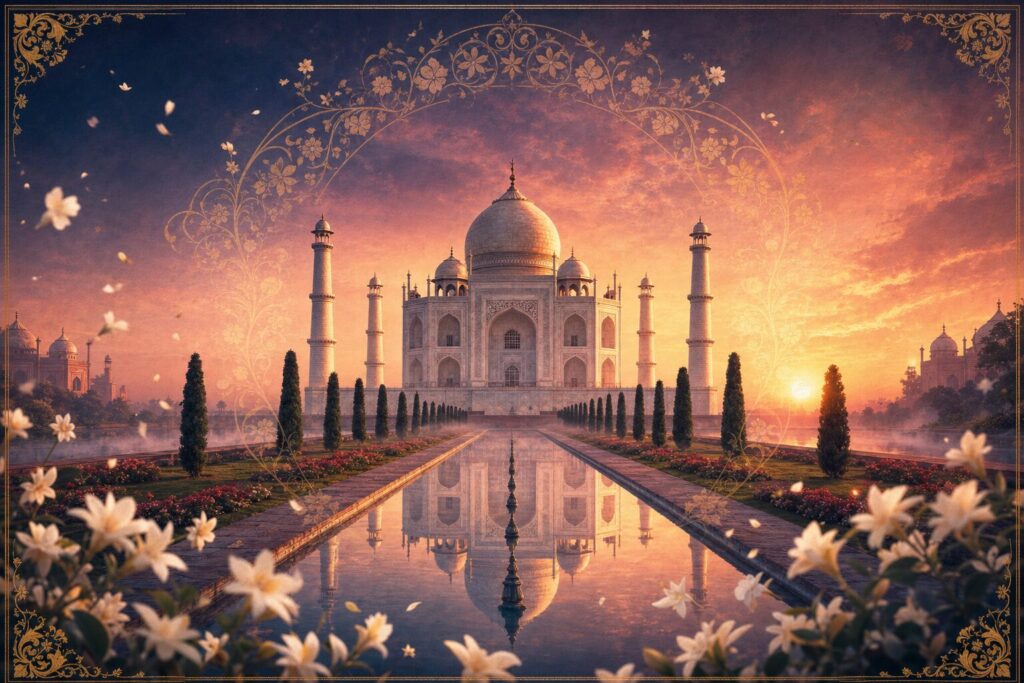
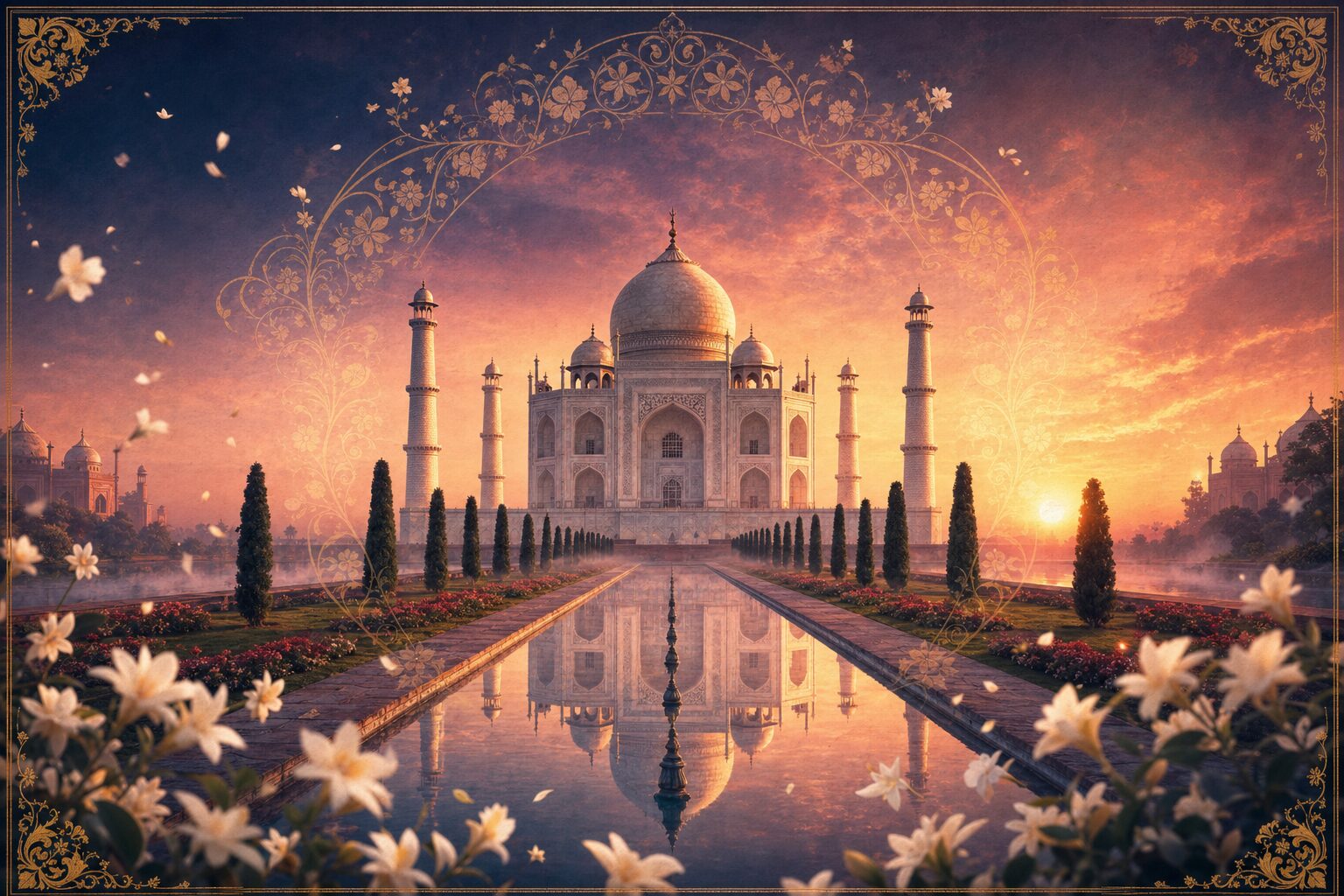
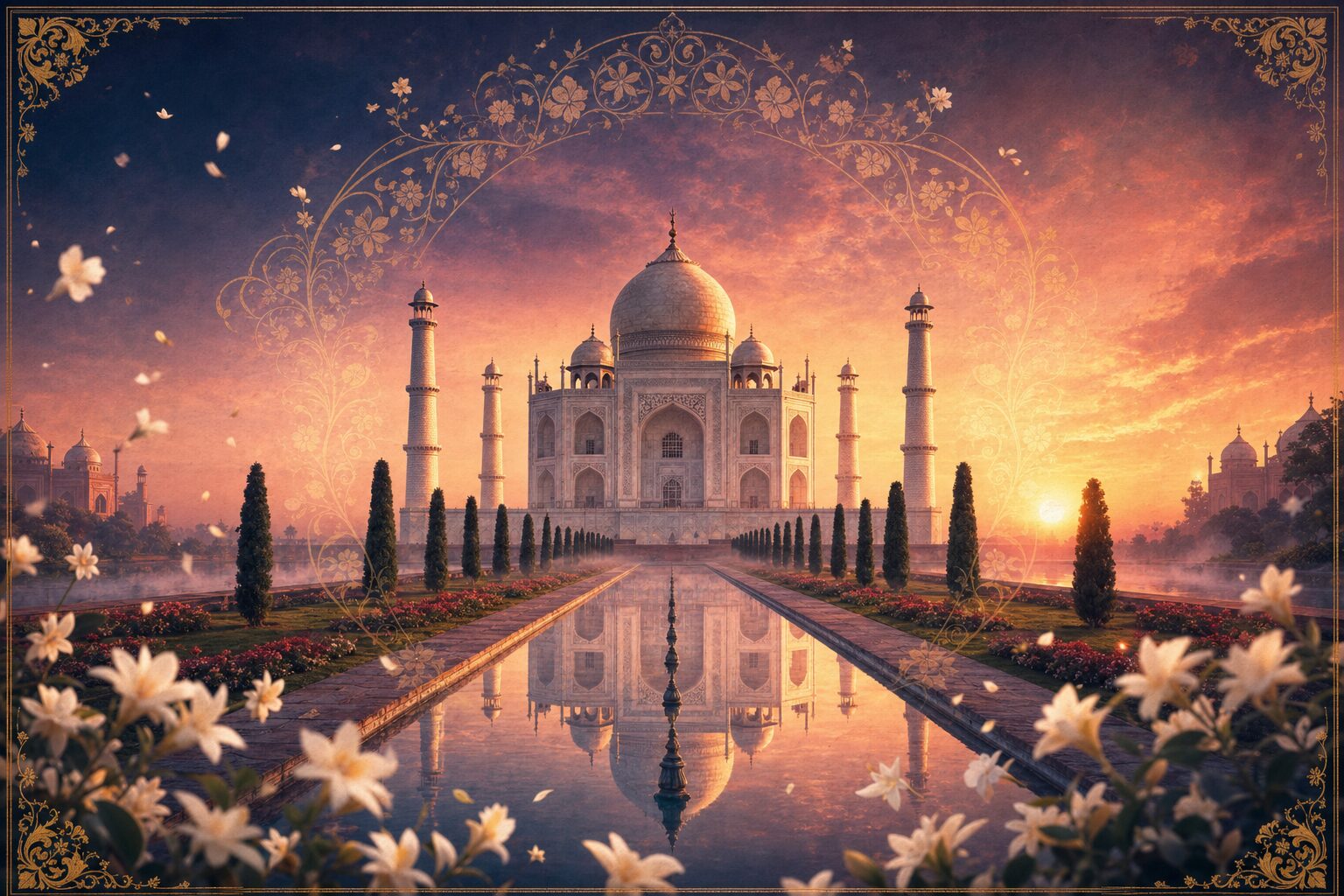
Arjumand Banu Begum, given the title Mumtaz Mahal at her marriage to Khurram in 1612, was the chief queen and the political confidante of the reign. She bore fourteen children before dying at Burhanpur on 17 June 1631 during the birth of her last child Gauhar Ara Begum. Shah Jahan began work on the Taj Mahal at Agra in 1632 under the chief architect Ustad Ahmad Lahauri, with Ustad Hamid as the principal calligrapher. The mausoleum was substantially complete by 1648 and the surrounding charbagh and outbuildings by 1653, at a documented cost of about 32 million rupees and an estimated 22 years of labour by 20,000 craftsmen.
Shahjahanabad and Delhi’s Reinvention
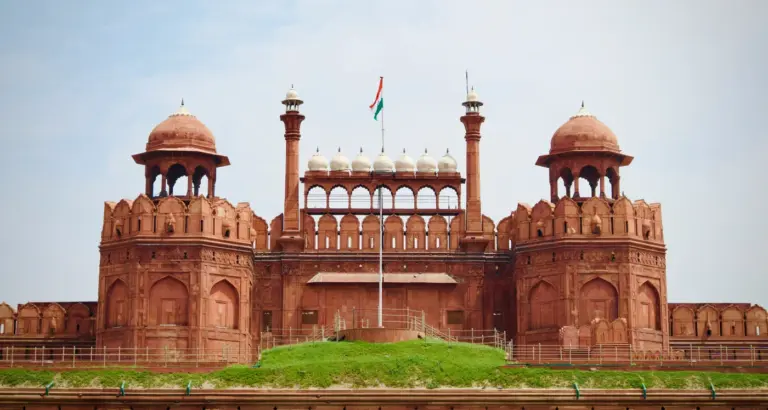
In 1639 Shah Jahan decided to relocate the imperial capital from Agra to a new city at Delhi. Construction of Shahjahanabad began that year and was substantially complete by 1648 when the court moved in. The walled city covered about 1,500 acres, with the Red Fort (Lal Qila) at its core, the Jama Masjid as the largest congregational mosque in India (completed 1656), and Chandni Chowk as the central commercial axis. The plan was the work of the architects Ustad Ahmad Lahauri and Ustad Hamid, with Princess Jahanara contributing the design of the Chandni Chowk bazaar. The shift restored Delhi as the imperial capital after a gap of nearly two centuries.
Peacock Throne and the Court Spectacle
The Peacock Throne (Takht-i-Taus) was commissioned in 1628 and completed in 1635, designed by the imperial goldsmith Bebadal Khan. It was set with the Koh-i-Noor and Timur Ruby among hundreds of other gemstones, sat under a canopy supported by twelve emerald columns, and weighed about 1,150 kilograms of gold. Court records put the cost at 10 million rupees, twice the cost of the Taj Mahal at the time. The throne was looted by Nadir Shah of Persia after the sack of Delhi in 1739; its components have not survived intact, though the Koh-i-Noor moved through several hands and now sits in the Crown Jewels of the United Kingdom.
Deccan and Central Asian Campaigns
The Deccan front absorbed enormous resources. Ahmadnagar was finally absorbed in 1636 after long campaigns against Malik Ambar and his successors. Bijapur and Golconda were forced into vassal treaties in 1636 by which they accepted Mughal suzerainty and paid tribute, but neither submitted entirely. The Deccan would consume the energies of Shah Jahan’s son Aurangzeb for the next half-century. The Central Asian campaigns of 1646-1647 against Balkh and Badakhshan, intended to recover Babur’s ancestral lands, were a costly failure; Mughal forces under Murad Bakhsh and then Aurangzeb took Balkh briefly but could not hold it against Uzbek counter-attacks. The repeated Kandahar campaigns of 1638, 1649, 1652 and 1653 also failed; the city was permanently lost to the Persians.
Religious Policy and Famine
Shah Jahan’s religious policy moved from Akbar’s Sulh-i-Kul toward more conventional Sunni orthodoxy without going as far as Aurangzeb’s later sharia revival. He banned the construction of new churches and Hindu temples (the latter ban was patchily enforced), reaffirmed the imperial right to demolish recently built non-Muslim religious sites, and ordered the demolition of some temples in Banaras, Allahabad and Gujarat in the 1630s. He also retained the Sulh-i-Kul-style accommodation of Rajputs at the highest mansab ranks and continued the tolerant practical politics of his father. The Deccan famine of 1630-1632, which killed an estimated 7 to 10 percent of the population in the affected regions, was the worst humanitarian crisis of the reign; Shah Jahan ordered tax remissions and grain distribution but the relief was insufficient. The Padshahnama, the official chronicle by Abdul Hamid Lahori, records both the building programme and the famine in unusual detail.
Significance for UPSC and General Knowledge
- Prelims staple for medieval Indian history: dates, buildings, court chronicles, war of succession
- GS1 Mains: Indo-Islamic architecture at its peak, court culture, Deccan policy
- UNESCO World Heritage: Taj Mahal (1983), Red Fort Complex (2007), Humayun’s Tomb (1993)
- Source-based questions: Padshahnama by Abdul Hamid Lahori, Inayat Khan’s Shah Jahan-nama
- Disaster history: Deccan famine of 1630-1632 and the early-modern climate context
- Religious history: shift from Sulh-i-Kul toward orthodoxy, prelude to Aurangzeb
- Diplomatic history: failed Balkh-Badakhshan campaigns, lost Kandahar, Mughal-Safavid frontier
Reign and Administration: Detailed Analysis
Shah Jahan’s administrative system kept Akbar’s framework but stretched its fiscal limits. The Mansabdari ceiling rose, with princes holding ranks of 30,000 zat and above. The number of mansabdars grew from about 1,800 under Jahangir to nearly 8,000 under Shah Jahan, with the gap between nominal and actual cavalry obligations widening dangerously. The shift to jagirdari assignments at higher ranks moved revenue away from the central treasury and created a structural crisis that historians like Satish Chandra and Athar Ali identified as the proximate cause of the empire’s later strain.
Architecture absorbed the surplus. The Taj Mahal cost roughly 32 million rupees, the Red Fort Delhi about 6 million, the Jama Masjid Delhi 1 million, the Peacock Throne 10 million, and Shahjahanabad as a whole around 60 million when summed across walls, gates, the canal system, and the Chandni Chowk bazaar. The total architectural and ceremonial spend for the thirty-year reign exceeded 150 million rupees, an enormous sum relative to annual revenues of about 220 million. The empire could afford it as long as Deccan and Central Asian campaigns did not run simultaneously; when they did, in the late 1640s, the deficits began.
The war of succession began in September 1657 when Shah Jahan fell ill at Delhi. Each of his four sons claimed the throne. Dara Shikoh, the eldest, was based at Agra and held the imperial parchment of designation; Shah Shuja ruled Bengal; Aurangzeb ran the Deccan; Murad Bakhsh held Gujarat. The decisive battles were Bahadurpur (February 1658) where Shah Shuja was checked, Dharmat (April 1658) and Samugarh (29 May 1658) where Aurangzeb defeated Dara, and Khajwa (January 1659) and Deorai (March 1659) where Aurangzeb finished both Shah Shuja and Dara. Aurangzeb deposed Shah Jahan on 31 July 1658 and imprisoned him at Agra Fort. Shah Jahan lived another seven and a half years under his daughter Jahanara’s care and died on 22 January 1666.
Comparative Perspective
Shah Jahan’s reign sits at the apex of the Mughal architectural and cultural project. The closest contemporary parallels are Louis XIV of France, the Ming-Qing transition emperors of China and Shah Abbas II of Persia. Each used architecture as state propaganda, though the Mughal version was the most elaborate.
| Ruler | Reign | Capital | Architectural commission | Lasting legacy |
|---|---|---|---|---|
| Shah Jahan | 1628 to 1658 | Agra and Shahjahanabad | Taj Mahal, Red Fort, Jama Masjid | Architectural peak of the Mughal Empire |
| Akbar | 1556 to 1605 | Agra, Fatehpur Sikri | Fatehpur Sikri, Agra Fort | Institutional template of the empire |
| Aurangzeb | 1658 to 1707 | Aurangabad and Delhi | Bibi Ka Maqbara, Badshahi Mosque | Maximum territorial extent, Deccan strain |
| Louis XIV (France) | 1643 to 1715 | Versailles | Palace of Versailles | Absolutist state and court culture |
| Shah Abbas II (Safavid) | 1642 to 1666 | Isfahan | Chehel Sotoun, Hasht Behesht | Persian cultural revival |
The Versailles parallel is closest in ambition. Both Louis XIV and Shah Jahan built monumental capitals to project absolutist authority, both spent ruinous sums on court ceremony, and both left successors who inherited the architectural prestige but also the fiscal damage. Versailles outlived Louis XIV by a century; Shahjahanabad and the Taj Mahal still define India’s cultural image globally, though the empire that built them had collapsed by 1739.
Controversies and Debates
Three debates dominate writing on Shah Jahan. The first is whether the architectural programme was imperial overreach. Older accounts treat the building boom as one of the causes of the Mughal financial crisis that emerged under Aurangzeb. Modern fiscal historians like Shireen Moosvi and Najaf Haider argue that the architectural spend was substantial but absorbable; the bigger problem was the simultaneous Deccan, Central Asian and Kandahar campaigns. The empire could have built Shahjahanabad or fought Balkh, but not both.
The second debate is the religious shift. Shah Jahan’s reign is often described as the bridge between Akbar’s tolerance and Aurangzeb’s orthodoxy. Audrey Truschke and others have shown that the picture is more nuanced; Shah Jahan retained Rajput nobles at the highest ranks, sponsored Sanskrit translation projects, and patronised Hindu temples in some contexts even while ordering selective demolitions in others. The shift was real but partial.
The third debate concerns Aurangzeb’s deposition. The traditional reading, drawn from Niccolao Manucci and Khafi Khan, treats Aurangzeb as a parricidal usurper who tortured a saintly father. Modern scholarship is more sceptical of the polemic and more interested in the structural drivers, including Dara Shikoh’s political weakness, the four-way succession dispute that the Mughal absence of primogeniture made inevitable, and Shah Jahan’s own preference for Dara that alienated the other three sons. The deposition was ugly but not unique; every Mughal succession from Babur to Aurangzeb involved violence among brothers, and Shah Jahan himself had eliminated rivals to take the throne in 1628.
Prelims Pointers
- Birth name Khurram, regnal name Shah Jahan I
- Born 5 January 1592 at Lahore to Jahangir and Jagat Gosain
- Married Arjumand Banu Begum (Mumtaz Mahal): 1612
- Title Shah Jahan: 1617, after Ahmadnagar campaign
- Mewar settlement with Maharana Amar Singh: 1615
- Coronation: 14 February 1628, Agra
- Reign: 1628 to 1658 (30 years)
- Mumtaz Mahal died: 17 June 1631 at Burhanpur
- Taj Mahal: built 1632 to 1648 (main structure), 1653 (complete); architect Ustad Ahmad Lahauri
- Peacock Throne (Takht-i-Taus): commissioned 1628, completed 1635 by Bebadal Khan; cost 10 million rupees
- Deccan famine: 1630 to 1632
- Ahmadnagar absorbed: 1636; Bijapur and Golconda treaties: 1636
- Shahjahanabad founded: 1639; Red Fort completed: 1648; Jama Masjid completed: 1656
- Balkh-Badakhshan campaigns: 1646-1647 (failed)
- Kandahar campaigns: 1638, 1649, 1652, 1653 (all failed)
- War of succession: 1657 to 1659
- Battle of Samugarh: 29 May 1658 (Aurangzeb defeated Dara Shikoh)
- Deposed by Aurangzeb: 31 July 1658, imprisoned at Agra Fort
- Court historian: Abdul Hamid Lahori (Padshahnama)
- Other chronicles: Inayat Khan (Shah Jahan-nama), Muhammad Salih Kanbo (Amal-i-Salih)
- Died: 22 January 1666, Agra Fort; buried in Taj Mahal
- Successor: Aurangzeb Alamgir
Mains Practice Questions
Q1. “Shah Jahan’s reign represents the architectural and cultural peak of the Mughal Empire, but also sowed the seeds of its later financial crisis.” Examine. (15 marks, 250 words)
- Document the architectural commissions: Taj Mahal, Red Fort, Jama Masjid, Shahjahanabad, Peacock Throne
- Explain the cumulative cost relative to annual revenue and the rise in mansabdar numbers
- Weigh the simultaneous Deccan, Central Asian and Kandahar campaigns as the bigger fiscal drain
- Conclude with the linkage to the jagirdari crisis under Aurangzeb
Q2. Trace the war of succession of 1657-1658 and its consequences for the Mughal Empire. (10 marks, 150 words)
- Outline the four-way contest: Dara Shikoh, Shah Shuja, Aurangzeb, Murad Bakhsh
- Identify Bahadurpur, Dharmat, Samugarh, Khajwa and Deorai as the decisive engagements
- Note the deposition of Shah Jahan and the reorientation of religious and political policy under Aurangzeb
Conclusion
Shah Jahan’s thirty years gave India the buildings that still anchor its global cultural image. The Taj Mahal, the Red Fort, the Jama Masjid and the planned city of Shahjahanabad are the canonical Indo-Islamic monuments and remain among the most-visited heritage sites in the country. The Padshahnama records the architectural programme as the visible expression of a confident imperial age, and the surviving buildings still carry that confidence into the present.
But the cultural peak masked structural strain. The simultaneous Deccan, Central Asian and Kandahar campaigns, the rising mansabdar count, and the architectural spend stretched the fiscal base. The four-way war of succession that began in 1657 and ended at Deorai in 1659 settled the crown on Aurangzeb, who would rule for forty-nine years and push the empire to its maximum territorial extent while exposing the same fiscal and military overreach his father had begun. The arc from Shah Jahan to Aurangzeb is the arc from grandeur to overreach, and that is why this reign matters for UPSC well beyond the Taj Mahal photographs.
Frequently Asked Questions
Who was Shah Jahan?
Shah Jahan, full name Shahabuddin Muhammad Shah Jahan and birth name Khurram, was the fifth Mughal emperor of India. Born on 5 January 1592 at Lahore to Jahangir and Jagat Gosain, he ruled from 14 February 1628 to 31 July 1658. His reign is the architectural peak of the Mughal Empire, with commissions including the Taj Mahal, the Red Fort and Jama Masjid at Delhi, and the planned imperial capital Shahjahanabad.
When did Shah Jahan build the Taj Mahal?
Shah Jahan began work on the Taj Mahal at Agra in 1632, the year after Mumtaz Mahal died at Burhanpur on 17 June 1631 in childbirth. The main mausoleum was substantially complete by 1648, and the surrounding charbagh garden, gateway and outbuildings were finished by 1653. The chief architect was Ustad Ahmad Lahauri and the principal calligrapher was Ustad Hamid. The project employed an estimated 20,000 craftsmen and cost about 32 million rupees of the period.
What is Shahjahanabad?
Shahjahanabad is the walled imperial capital that Shah Jahan founded at Delhi in 1639 and substantially completed by 1648, when the court moved there from Agra. It covered about 1,500 acres, with the Red Fort (Lal Qila) at its core, the Jama Masjid as its largest mosque (completed 1656), and Chandni Chowk as its central commercial street designed by Princess Jahanara. The walled city is the historic core of what is today Old Delhi.
What was the Peacock Throne?
The Peacock Throne, in Persian Takht-i-Taus, was Shah Jahan’s imperial throne, commissioned in 1628 and completed in 1635 by the goldsmith Bebadal Khan. It was set with the Koh-i-Noor diamond, the Timur Ruby and hundreds of other gemstones, sat under a canopy supported by twelve emerald columns, weighed about 1,150 kilograms of gold, and cost approximately 10 million rupees. The throne was looted by Nadir Shah of Persia after the sack of Delhi in 1739 and was dismantled; its components were dispersed and the original throne does not survive intact.
How was Shah Jahan deposed?
Shah Jahan fell ill in September 1657, triggering a four-way war of succession among his sons Dara Shikoh, Shah Shuja, Aurangzeb and Murad Bakhsh. Aurangzeb defeated Dara at the Battle of Samugarh on 29 May 1658 and entered Agra in early June 1658. He deposed Shah Jahan on 31 July 1658 and imprisoned him at Agra Fort. Shah Jahan lived another seven and a half years under his daughter Jahanara’s care and died on 22 January 1666. He is buried in the Taj Mahal beside Mumtaz Mahal.
Why is Shah Jahan important for UPSC?
Shah Jahan is essential for UPSC 2026 across Prelims and Mains. Prelims regularly tests his architectural commissions, the Peacock Throne, the founding of Shahjahanabad and the war of succession dates. GS1 Mains questions explore the political economy of the architectural programme, the Deccan and Central Asian campaigns, the famine of 1630-1632, and the religious shift from Sulh-i-Kul toward orthodox Sunni rule that prefigured Aurangzeb. Source-based questions draw on the Padshahnama by Abdul Hamid Lahori. Art and culture questions cover the white-marble idiom, pietra dura inlay, and the planned imperial capital.
Tell Google you want more of this.
Add Anantam IAS as a preferred sourceOne tap, and this site shows up more often in your own Top Stories, AI Overviews and AI Mode. Remove it any time.