David Hume: The Is–Ought Problem, Moral Sentiment and the Limits of Reason (UPSC Ethics — GS IV)
Hume noticed that no amount of description of how the world is can, by itself, establish how it ought to be. Once you see the gap, you cannot unsee it in a policy argument.
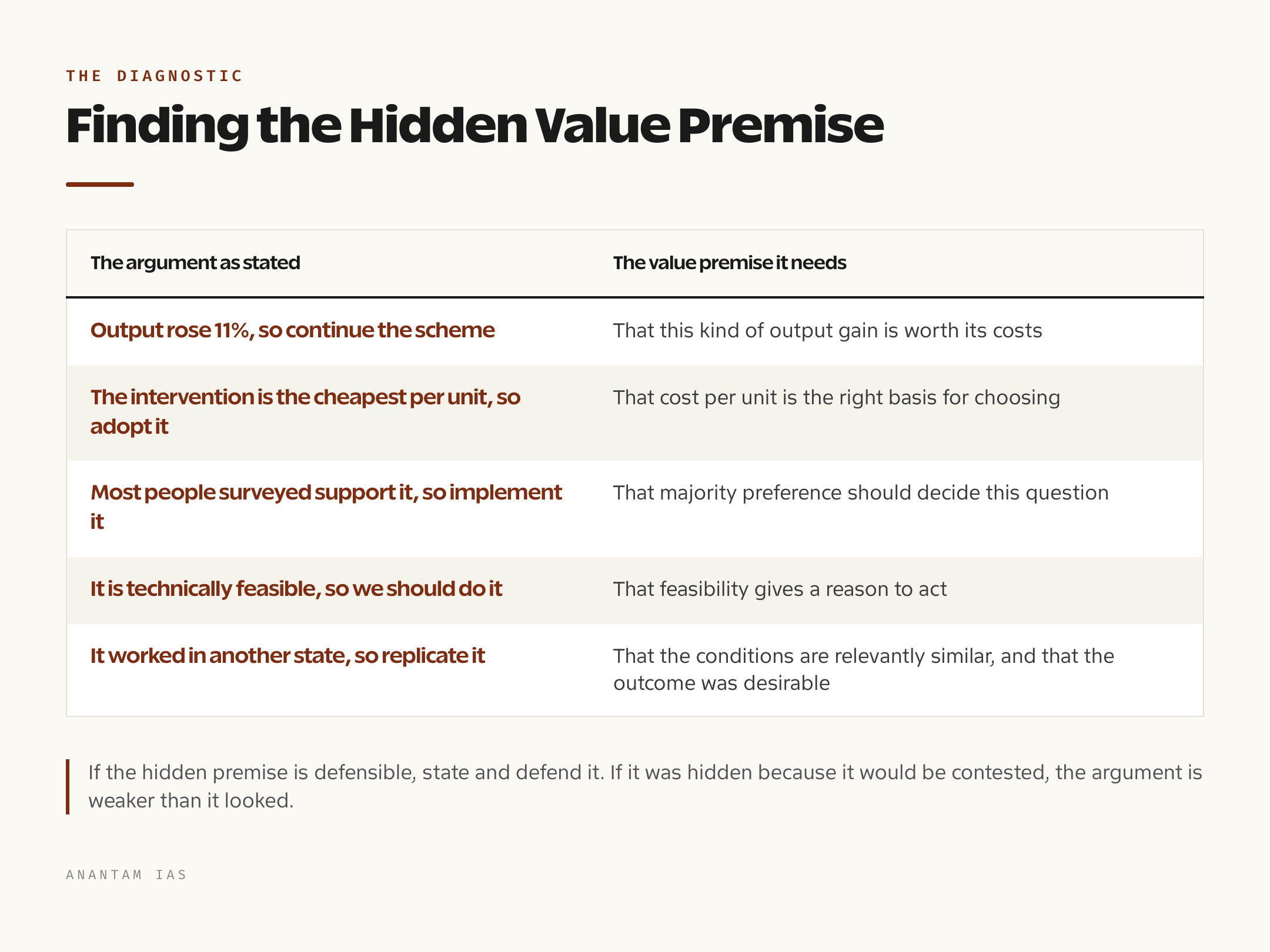
A committee reports that a policy raised output by eleven per cent. Someone says: so it should be continued. The move feels so natural that it takes an effort to notice a step has been skipped — namely, that raising output is desirable. Supply that premise and the argument works. Leave it out and it does not, because no description of what is the case can by itself establish what ought to be.
David Hume noticed this in the eighteenth century, and it has been unsettling ethics ever since. His observation is not a trick; it is the reason evidence never settles a normative dispute on its own, and the reason two people can agree on every number in a report and still disagree about what to do. For an aspirant, Hume is the thinker who explains why a well-researched answer can still be a bad one.
The Is-Ought Problem
In the Treatise of Human Nature, Hume observed that writers on morality proceed for a while with statements about what is and is not the case, and then, without explanation, begin producing statements connected with ought and ought not. Because the conclusion contains a term absent from the premises, he argued, some account is owed of how the transition is made — and none is usually given.
This is the is-ought gap, sometimes called Hume’s guillotine. Two clarifications matter.
First, Hume is not saying moral conclusions are impossible or that values are arbitrary. He is saying they cannot be derived from factual premises alone; a value premise must be present somewhere. Most sound moral arguments have one, stated or unstated.
Second, the gap is not the same as G.E. Moore’s later naturalistic fallacy, though they are related and often conflated. Moore’s target is defining goodness in terms of some natural property. Hume’s is inferential: you cannot derive an ought from an is. Getting this distinction right is a small mark of precision that separates a careful answer from a recycled one.
The practical use is diagnostic. When a policy argument feels compelling, find the value premise. If it is defensible, say so and defend it. If it has been hidden because it would be contested, the argument is weaker than it looked.
Reason Is Not the Master
Hume’s second claim is more provocative: reason alone cannot motivate action. His formulation is that reason is, and ought only to be, the slave of the passions.
The argument is structural. Reason performs two functions — establishing matters of fact, and tracing relations between ideas. Neither produces a motive. Knowing that a course of action will cause suffering explains nothing about why you would care, unless you already have some aversion to suffering. Desire supplies the end; reason finds the means.
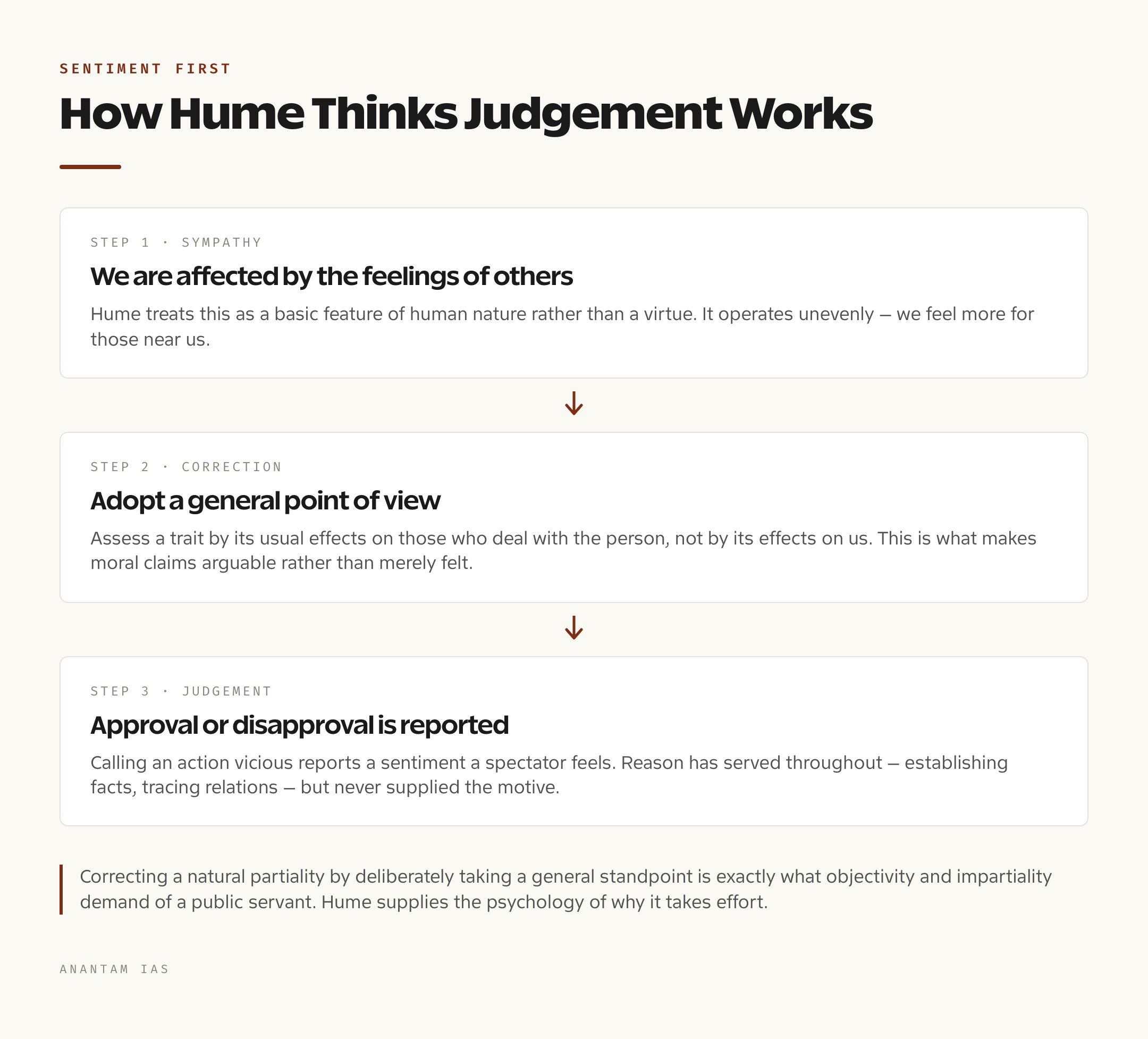
This is why Hume thought a purely rational immoralist is not strictly irrational, only differently disposed. It is also why he denied that moral distinctions are discovered by reason: they are felt. When we call an action vicious, we are reporting a sentiment of disapproval that a spectator feels on contemplating it.
The contrast with Kant could not be sharper. Kant grounds morality in reason alone, holding that the moral law binds any rational being regardless of what it desires. Hume holds that reason without desire is inert. Setting these two against each other is one of the most productive comparisons available in this paper; see Kant’s categorical imperative.
Sympathy and the Common Point of View
If morality rests on sentiment, the obvious objection is that it collapses into whatever anyone happens to feel. Hume’s answer is sympathy — our capacity to be affected by the feelings of others, which he treats as a basic feature of human nature rather than a virtue.
Sympathy naturally operates unevenly: we feel more for those near us. Hume’s move is to argue that moral judgement requires correcting for this by adopting a common or general point of view — assessing a character trait by its usual effects on those who deal with the person, rather than by its effects on us in particular. This is how a sentiment-based ethics generates judgements we can argue about: two people can dispute whether a trait is generally beneficial, which is a discussable question.
Notice how close this comes to something the paper does test directly. Correcting a natural partiality by deliberately taking a general standpoint is what objectivity and impartiality require of a public servant, and Hume gives the psychological account of why it takes effort. See objectivity in civil services.
Justice as an Artificial Virtue
Hume distinguishes natural virtues from artificial ones. Benevolence and generosity are natural: we approve of them immediately, and they benefit people directly, case by case.
Justice is different. A single act of justice can be harmful — returning a fortune to a miser who will waste it, enforcing a contract that ruins a decent person. We approve of justice not because each act does good but because the system of rules does, and only when generally observed. Justice is therefore artificial: a human convention arising because moderate scarcity plus limited generosity make stable rules of property and promise-keeping necessary.
Two consequences are examinable. It gives a rule-consequentialist reason for following rules even when a particular application seems suboptimal — the argument an officer needs when tempted to make an exception for a sympathetic case. And it makes the value of law depend on general observance, which is why selective enforcement damages a legal order more than the individual lapse suggests.
Hume also used this to attack the social contract. If political obligation rests on an original agreement, he asked, where is it, and who consented? His answer is that we obey because a functioning political order is useful, not because of a promise nobody made — a criticism aimed at Hobbes and Locke.
Why Hume Matters for Governance
Evidence does not settle values. This is the single most useful takeaway. A cost-benefit analysis, a survey, an efficiency finding — each requires a value premise before it recommends anything. Presenting a normative conclusion as a technical finding is a way of removing it from argument, and recognising the move is part of ethical competence. It is the same failure diagnosed in the ethics of automation, where efficiency claims quietly carry a judgement about whose interests count.
Emotion is not the enemy of good judgement. Hume implies that a decision-maker with no affective response is not thereby more objective, only less motivated. That reframes emotional intelligence: the task is not to eliminate feeling but to correct its partiality — which is precisely the emotional intelligence claim in the syllabus.
Rules deserve respect beyond the instant case. His account of justice supports institutional integrity against well-meaning improvisation.
The limits of the position. Hume’s critics argue that sentimentalism cannot condemn a society whose settled sentiments are cruel, because there is no standpoint outside sentiment from which to judge. Hume’s general point of view helps but is drawn from human nature as he found it, and the objection that this smuggles in a norm is serious. It is why Kantians insist morality must bind independently of what anyone feels.
FAQ
What is the is-ought problem? Hume’s observation that arguments cannot validly move from purely factual premises to a conclusion about what ought to be, because the conclusion contains a term absent from the premises. A value premise must be supplied.
Does Hume think morality is arbitrary? No. He thinks moral distinctions come from sentiment rather than reason, but sentiment is corrected by adopting a general point of view — assessing traits by their usual effects on those who deal with a person, which makes moral claims arguable.
What does “reason is the slave of the passions” mean? That reason establishes facts and traces relations but supplies no motive. Desire sets the end; reason works out the means. A purely rational agent with no desires would have no reason to act.
How is the is-ought gap different from the naturalistic fallacy? Hume’s point is inferential — you cannot derive an ought from an is. Moore’s naturalistic fallacy concerns defining goodness in terms of a natural property. They are related but distinct, and are frequently conflated.
Why does Hume call justice an “artificial” virtue? Because individual acts of justice can be harmful, and we approve of justice for the benefit of the system of rules when generally observed — unlike benevolence, which benefits directly in each instance.
What is Hume’s objection to the social contract? That no such original agreement exists and nobody consented to it. We obey because a functioning political order is useful, not because of a promise, which undercuts contract-based accounts of political obligation.
Practice Questions
Prelims MCQs
- The is-ought problem holds that: (a) facts are unknowable (b) normative conclusions cannot be validly derived from purely factual premises (c) all values are equally valid (d) reason determines moral truth — Answer: (b) A value premise must be present for an ought-conclusion to follow.
- “Reason is, and ought only to be, the slave of the passions” expresses Hume’s view that: (a) emotion should be suppressed (b) reason supplies no motive to act (c) morality is irrational (d) passions are always virtuous — Answer: (b) Desire supplies the end; reason finds the means.
- Hume classified justice as an artificial virtue because: (a) it is enforced by the state (b) individual just acts can be harmful and approval attaches to the system of rules (c) it is a recent invention (d) it conflicts with benevolence — Answer: (b) Its value depends on general observance rather than case-by-case benefit.
- Hume’s “general point of view” functions to: (a) eliminate sentiment from judgement (b) correct the natural partiality of sympathy (c) derive ought from is (d) establish innate moral knowledge — Answer: (b) It assesses traits by their usual effects rather than their effects on us.
- Hume’s criticism of the social contract was that: (a) it grants the sovereign too little power (b) no original agreement exists and nobody consented (c) it ignores natural rights (d) it presupposes the general will — Answer: (b) He grounded obligation in utility instead.
Mains Practice Questions
- “No amount of evidence establishes what ought to be done.” Examine Hume’s is-ought distinction and its implications for evidence-based policymaking. (15 marks, 250 words)
- Contrast Hume and Kant on the role of reason in morality. Which account better explains why people act morally? (15 marks, 250 words)
- Explain Hume’s account of justice as an artificial virtue, and discuss what it implies for an officer tempted to make an exception in a sympathetic case. (15 marks, 250 words)
- “A decision-maker with no affective response is not more objective, only less motivated.” Discuss with reference to emotional intelligence in administration. (10 marks, 150 words)
- Can a sentiment-based ethics condemn a society whose settled sentiments are cruel? Evaluate this objection to Hume. (10 marks, 150 words)