Technology has displaced workers for two centuries, and the standard answer has always been that it creates more jobs than it destroys. Handloom weavers lost; mill towns gained. Typists lost; software gained. The aggregate reassurance has usually been right over decades — and it has never once been a reply to the person whose livelihood ended this quarter.
What makes the current wave an ethics question rather than an economics one is that firms are now saying the quiet part aloud. Executives are naming artificial intelligence as the reason for cuts, sometimes with striking bluntness. That candour is useful, because it moves the discussion from prediction to obligation. If a company can do the same work with fewer people, does it owe the displaced anything beyond their notice period? And who decides?
The Question Behind the Layoff Announcements
Strip away the technology and the ethical structure is old. An employment relationship is not only a contract; it involves dependence, asymmetry of power, and a reasonable expectation built up over years of service. When the relationship ends because the employer found a cheaper method, three distinct questions arise, and they are usually run together.
Is the decision itself permissible? Almost every framework says yes in principle. Refusing to adopt a better method is not a virtue, and firms that fall behind eventually fail everyone who depends on them — a slower harm, but a real one.
Does permissibility settle the matter? No. That a decision is allowed says nothing about how it must be carried out, what warning is owed, or what the firm owes to the people whose position it created and then removed.
Who bears the transition cost? This is where the real disagreement lives. Gains from automation are concentrated and immediate. Losses are dispersed, delayed, and land on people with the least capacity to absorb them. Ethics is mostly a debate about whether that distribution can be justified.
Notice that the last question is not answered by pointing at aggregate job creation. Even if the economy nets out positive, the specific worker displaced at fifty-two, in a saturated market, is not made whole by jobs created for others somewhere else. Aggregates do not compensate individuals — a limitation of consequentialist reasoning explored in the utilitarians.
What the 2025-26 Wave Actually Shows
The record is more ambiguous than either the boosters or the alarmists suggest, and the ambiguity is itself ethically important.
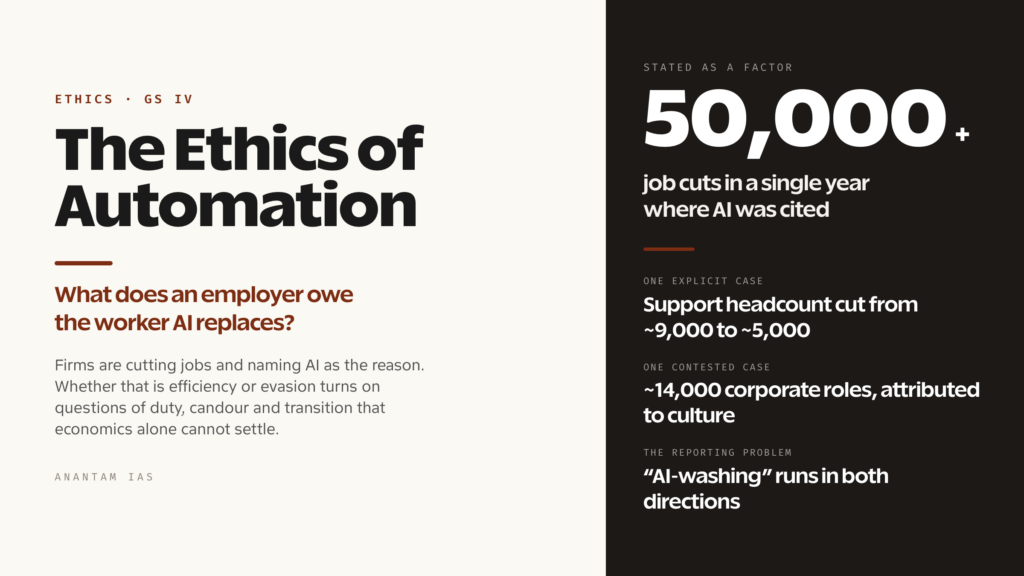
Some attributions are explicit. Salesforce reduced its customer-support organisation by around 4,000 roles, and its chief executive Marc Benioff described the move in unusually direct terms — that support headcount had gone from roughly 9,000 to about 5,000 because, in his words, he needed fewer heads. The company credited its Agentforce system, saying support case volumes had fallen and it no longer needed to backfill support-engineer roles. In February 2026, Block’s Jack Dorsey cut close to half his staff, citing AI. By December 2025, business reporting counted AI as a stated factor in more than 50,000 job cuts across the year. In April 2026, roughly 20,000 announced cuts at Meta and Microsoft prompted open discussion of whether an AI-driven labour disruption had arrived.
Other cases point the opposite way. Amazon announced about 14,000 corporate job cuts in October 2025, part of reductions that grew past 30,000 corporate roles — and its chief executive Andy Jassy explicitly rejected both cost-cutting and AI as the explanation, attributing the cuts to culture and bureaucracy. Business commentators have argued it is an oversimplification to attribute this round of white-collar reductions mostly to AI substitution, noting that productivity tools had been widely available for years without human replacement materialising at scale.
Two details capture the strangeness of the moment. In June 2026, Amazon engineers in Seattle publicly criticised their own employer over AI data-centre expansion while layoffs continued. In July 2026, Amazon cut roles inside its artificial general intelligence unit — automation reaching the people building it.
Four Frameworks, Four Different Answers
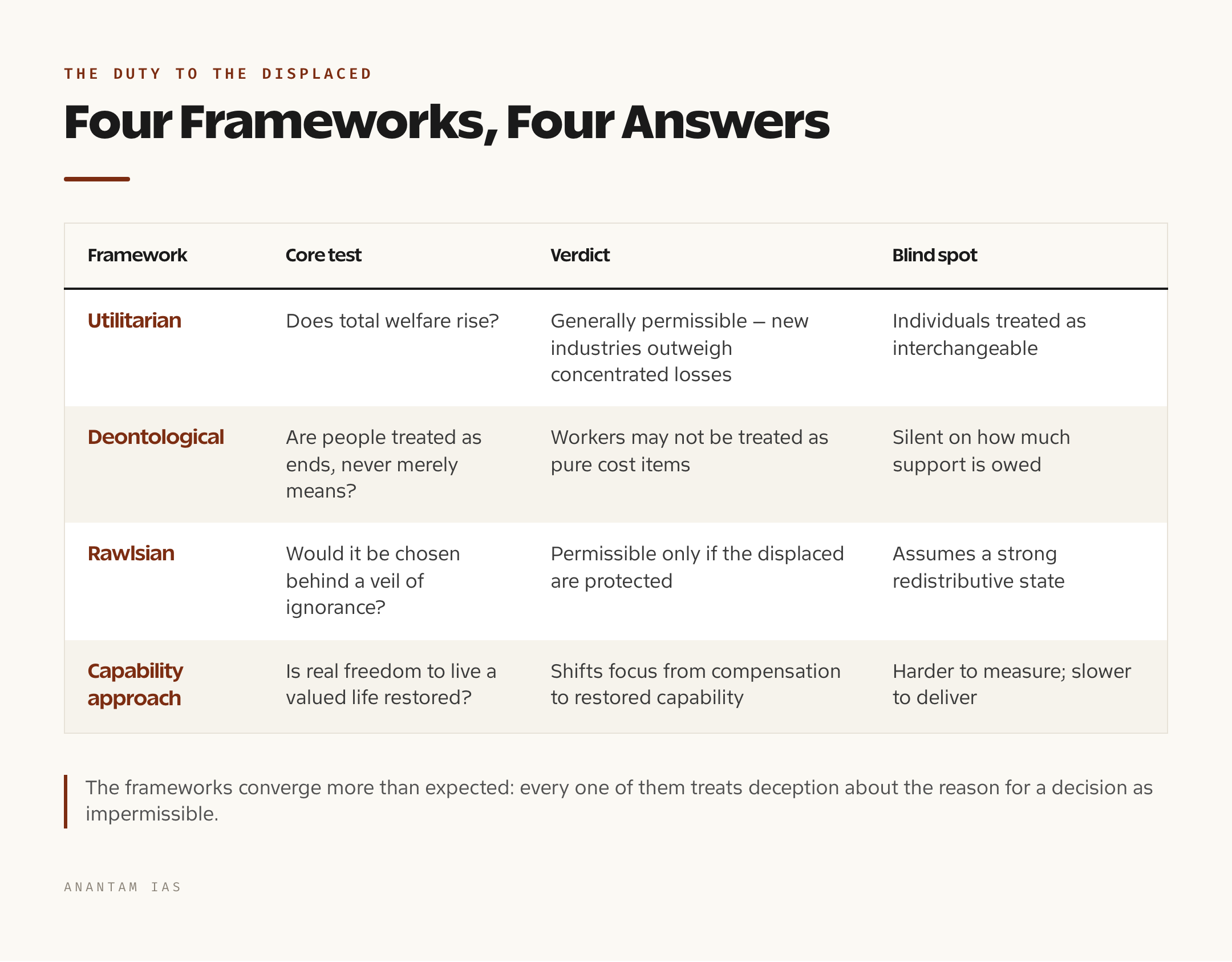
The disagreement is not about facts. It is about which moral consideration is decisive.
| Framework | Core test | Verdict on automation cuts | Blind spot |
|---|---|---|---|
| Utilitarian | Does total welfare rise? | Generally permissible; cheaper goods and new industries outweigh concentrated losses | Treats individuals as interchangeable; a large gain to many can justify ruin for a few |
| Deontological (Kant) | Are people treated as ends, never merely as means? | Impermissible to treat workers as pure cost items; duties of honesty and dignity survive the termination | Gives little guidance on how much transition support is owed |
| Rawlsian | Would the arrangement be chosen behind a veil of ignorance? Does it help the worst-off? | Permissible only if the displaced are protected — gains must not come at the expense of the least advantaged | Assumes a strong redistributive state that may not exist |
| Capability approach (Sen) | Does the person retain real freedom to live a life they value? | Focus shifts from compensation to restored capability — retraining, health cover, genuine re-entry | Harder to measure; slower to deliver than a severance cheque |
The frameworks converge on more than students expect. Even the utilitarian case, taken seriously, requires attention to transition: unemployment scarring, lost skills and regional collapse are real welfare costs, not externalities. And every framework treats deception about the reason for a decision as impermissible — which is what makes the attribution question below an ethical one rather than a public-relations one.
For the Indian tradition, Gandhi’s idea of trusteeship offers a distinctive angle: capital is held in trust for the community that helped generate it, so the owner’s discretion is real but not absolute. It is a demanding standard, and its practical content is precisely the transition duties set out below. The framework is developed further in Gandhian philosophy.
The Attribution Problem
A striking feature of this wave is a phenomenon business journalists have labelled AI-washing: attributing to artificial intelligence reductions that are driven by ordinary cost-cutting, over-hiring corrections, tariff pressure or falling demand.
Why would a firm overstate AI as a cause? Because the two explanations carry different reputational prices. “We hired too many people and misjudged demand” is an admission of managerial failure. “We are being transformed by AI” signals technological leadership to investors. The incentive runs toward the more flattering story.
This is an ethics problem with several victims. Shareholders receive a misleading account of why margins improved. Displaced workers are told their skills were superseded when in fact a forecast was wrong — a difference that matters enormously to how a person understands their own career and what they retrain for. Policymakers calibrating reskilling programmes work from corrupted data. And public debate about a genuinely important transition gets conducted on inflated numbers.
The reverse error also occurs, and Amazon is the clearest instance: a company may understate AI’s role to avoid appearing callous or inviting regulatory attention. Jassy’s insistence that the cuts were about culture rather than AI may be entirely accurate; the point is that from outside, neither claim is verifiable, and the firm controls the only evidence.
The applicable ethical duty here is candour — the same duty that governs any disclosure to those who rely on you. It maps directly onto the honesty and accountability requirements described in the foundational values of civil services, which apply to corporate as much as public office. In corporate-governance terms it is a reporting-integrity obligation, and it is currently almost entirely unenforced.
The Language Problem
How a decision is described shapes what it becomes permissible to do. In May 2026, the chief executive of Standard Chartered, Bill Winters, apologised after saying that “lower value human capital” would be automated by AI — an apology that acknowledged the hurt caused by the phrasing.
The episode is worth dwelling on, because the objection was not merely to rudeness. Describing people as human capital of differing value performs a specific moral move: it converts persons into assets ranked by yield. Once that framing is accepted, retiring a low-yield asset requires no more justification than replacing an old machine. The Kantian objection is exact — a person may be employed as a means, but never treated merely as a means, because they remain a source of claims in their own right.
This is not squeamishness about jargon. Administrative and corporate language routinely does this work: “rationalisation”, “surplus staff”, “headcount”. Each is a small act of moral distancing that makes the next decision easier. Noticing it is part of ethical competence.
What a Just Transition Would Require
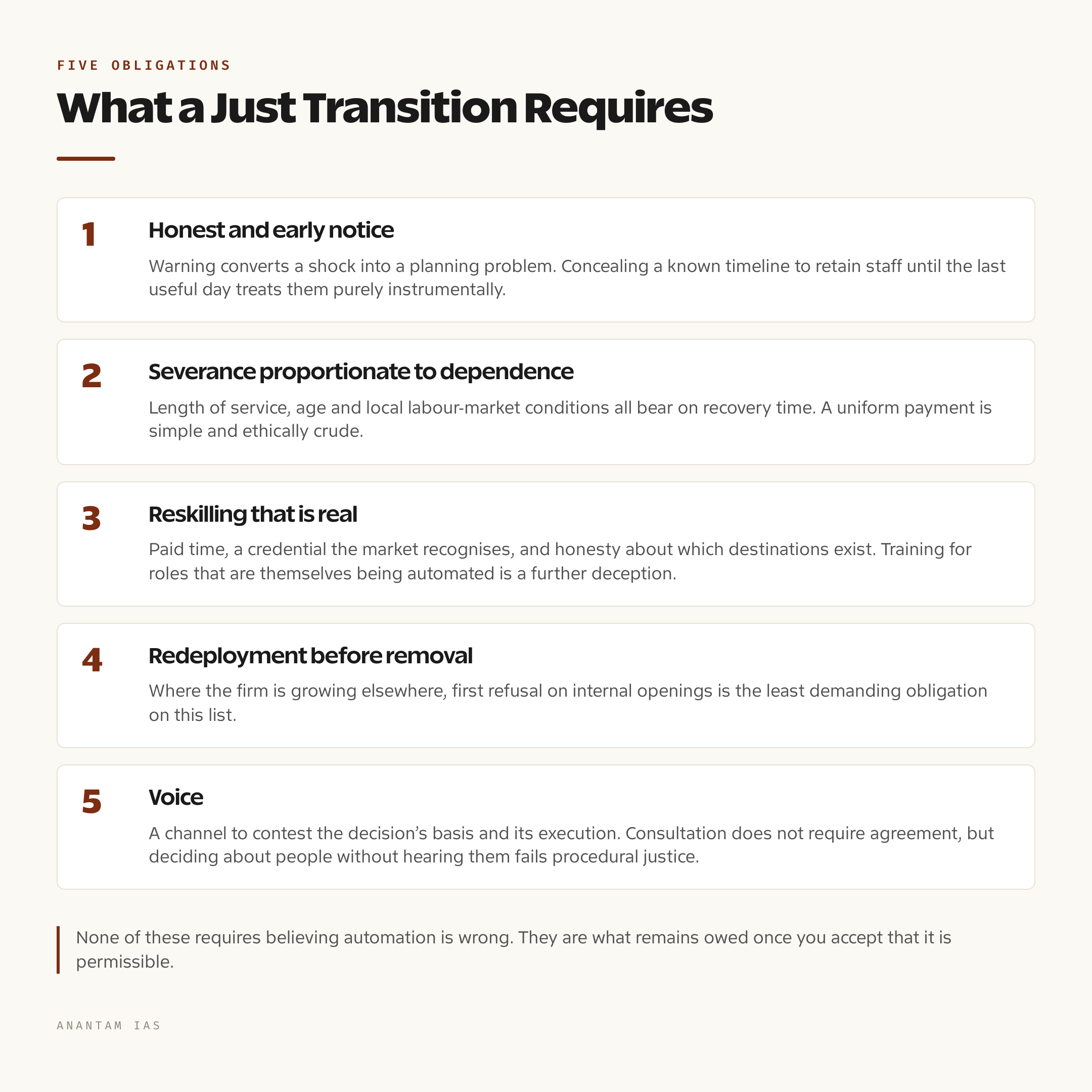
If the decision to automate is permissible but the manner and distribution are constrained, the obligations become fairly concrete. A defensible transition has five parts.
Honest and early notice. Warning has real value: it converts a shock into a planning problem. Concealing a known timeline to retain staff until the last useful day treats them purely instrumentally.
Severance proportionate to dependence. Length of service, age and local labour-market conditions all bear on how long recovery will take. A uniform payment is administratively simple and ethically crude.
Reskilling that is real. A subscription to an online course is not a transition programme. Genuine reskilling requires paid time, a credential the market recognises, and honesty about which destinations actually exist. Offering training for roles that are themselves being automated is a further deception.
Redeployment before removal. Where the firm is growing elsewhere, first refusal on internal openings is the least demanding obligation on this list. Salesforce’s later decision to hire 1,000 new graduates while having cut support roles illustrates the tension: capacity to hire coexisted with the reductions.
Voice. Those affected should have a channel to contest the decision’s basis and its execution. Consultation does not require agreement, but a decision made about people without hearing them fails procedural justice regardless of outcome.
None of these five requires believing automation is wrong. They are what remains owed once you accept that it is permissible.
The Indian Context
India’s exposure differs from the American one in ways that change the ethical weight.
The affected work is concentrated in services — IT services, business-process operations, global capability centres, customer support and back-office processing — precisely the categories where agentic systems are advancing fastest. This is also the sector that carried a generation into the middle class, so displacement threatens a mobility ladder rather than only current income.
The entry-level question is sharpest here. If AI absorbs the routine tasks that junior staff traditionally learned on, the first rung disappears. That harms the cohort with no bargaining power and no track record — and, over time, hollows out the supply of experienced people needed to supervise the systems. A firm that stops hiring juniors optimises this year and undermines its own capability later.
India’s formal protections were built for a different shape of employment: retrenchment rules aimed at industrial establishments, social security tied to formal employment, and a labour-law architecture still consolidating. Large numbers of affected workers are on contracts and platforms outside these protections entirely. The gap between who is displaced and who is covered is the central policy fact.
That gap makes the corporate duty heavier rather than lighter. Where the state cannot cushion the transition, the argument that firms may externalise transition costs because a safety net exists loses its premise. This is the practical content of ethics in governance applied to private institutions — and it is why corporate governance sits inside the ethics syllabus rather than beside it.
FAQ
Is it unethical for a company to automate jobs? Not in itself. Almost every ethical framework permits adopting better methods, and refusing to do so can harm the firm’s own workers over time. What is constrained is how the change is made and who absorbs the transition cost.
What is AI-washing? Attributing job cuts to artificial intelligence when the real drivers are ordinary cost-cutting, over-hiring corrections or falling demand. It misleads investors, misinforms policymakers, and gives displaced workers a false account of why their role ended.
Doesn’t automation create more jobs than it destroys? Historically, over long periods, usually yes. But that is an aggregate claim across decades, and it does not discharge a duty to a specific person displaced now. New jobs also appear in different places, requiring different skills, on a different timetable from the losses.
What does a “just transition” mean in practice? Five things: honest early notice, severance proportionate to length of service and local conditions, reskilling that is paid and market-recognised, first refusal on internal openings, and a genuine channel for affected workers to be heard.
Why is calling workers “human capital” treated as an ethical issue? Because language licenses action. Ranking people as assets by yield makes removing the low-yield ones seem to need no more justification than replacing equipment. The Kantian objection is that a person may be employed as a means but never treated merely as a means.
Where does this topic sit in the ethics syllabus? It falls under ethical concerns and dilemmas in private institutions, corporate governance, and the application of moral frameworks to public policy — with a direct link to accountability and honest disclosure.
Practice Questions
Prelims MCQs
- The term “AI-washing” in the context of employment refers to: (a) cleaning training data of bias (b) attributing to AI job cuts actually driven by other causes (c) automating sanitation work (d) using AI to screen job applications — Answer: (b) It describes overstating artificial intelligence as the reason for reductions that stem from cost-cutting or demand changes.
- Which framework judges an automation decision primarily by whether the least advantaged are protected? (a) Utilitarianism (b) Virtue ethics (c) Rawlsian justice (d) Ethical egoism — Answer: (c) Rawls’ difference principle asks whether inequalities work to the benefit of the worst-off.
- Gandhi’s doctrine of trusteeship holds that: (a) property should be abolished (b) capital is held in trust for the community (c) trustees must be appointed by the state (d) workers should own all enterprises — Answer: (b) Owners retain discretion but hold wealth on behalf of the community that helped create it.
- The capability approach associated with Amartya Sen would assess displacement primarily by: (a) total output lost (b) severance amount paid (c) whether real freedom to live a valued life is restored (d) shareholder returns — Answer: (c) The focus is on restored capabilities rather than compensation alone.
- Which of the following is the least demanding transition obligation on an employer that is simultaneously hiring elsewhere? (a) Full salary continuation (b) First refusal on internal openings (c) Lifetime health cover (d) Equity compensation — Answer: (b) Where vacancies exist within the firm, offering displaced staff first consideration imposes minimal additional cost.
Mains Practice Questions
- “That a decision is permissible says nothing about how it must be carried out.” Examine this statement with reference to the ethics of workforce reduction driven by automation. (15 marks, 250 words)
- Aggregate job creation does not discharge an obligation to the individual displaced. Critically evaluate the adequacy of consequentialist reasoning in the ethics of technological unemployment. (15 marks, 250 words)
- Discuss “AI-washing” as an ethical failure of corporate disclosure. Who is harmed, and what governance mechanisms could address it? (15 marks, 250 words)
- “Language licenses action.” Analyse how administrative and corporate vocabulary can enable moral distancing, with examples. (10 marks, 150 words)
- India’s labour protections were designed for a different shape of employment. Discuss the ethical implications of this gap for corporate duties towards displaced service-sector workers. (10 marks, 150 words)
Tell Google you want more of this.
Add Anantam IAS as a preferred sourceOne tap, and this site shows up more often in your own Top Stories, AI Overviews and AI Mode. Remove it any time.