Diversity in Indian Society: UPSC Indian Society Guide
UPSC GS-I guide on diversity in Indian society — linguistic, religious, racial, caste, regional and tribal pluralism — with constitutional anchors, sociological theory, and 2024-26 data.
The Indian nation-state is, by almost every measure, the most socially and culturally diverse country in the world. With 22 scheduled languages, 121 mother tongues with over 10,000 speakers, six major religions, 4,000+ jatis, 705 Scheduled Tribes, six physiographic zones, and a population of over 1.43 billion (UN 2024), India is less a country than a civilisational federation. For UPSC GS-I (Indian Society) and Essay aspirants, diversity is the master variable — every other theme (caste, communalism, gender, urbanisation, secularism, federalism) is shaped by it.
This guide unpacks the types of diversity, the unity that binds them, the sociological theories that explain it, the constitutional architecture that protects it, and the 2024-26 stresses that test it.
The Concept of Diversity
Diversity denotes collective differences among people — differences that mark off communities of one kind from another. It is not the same as disparity (which is unequal access to resources). India has both — and they often overlap.
Sociological Frame
- Émile Durkheim: Differentiation is the engine of organic solidarity. Modern societies integrate through interdependence, not similarity.
- Louis Dumont: Indian society is structured by hierarchy and the pure-impure axis — diversity is internally hierarchical.
- M.N. Srinivas: The "vertical" (caste-based) and "horizontal" (regional-linguistic) dimensions of diversity simultaneously.
- Andre Beteille: Diversity in India is a fact; pluralism (positive valuation of diversity) is a project.
- K.M. Panikkar: India is a "geographical entity, a cultural unity, a political idea."
Types of Diversity in Indian Society
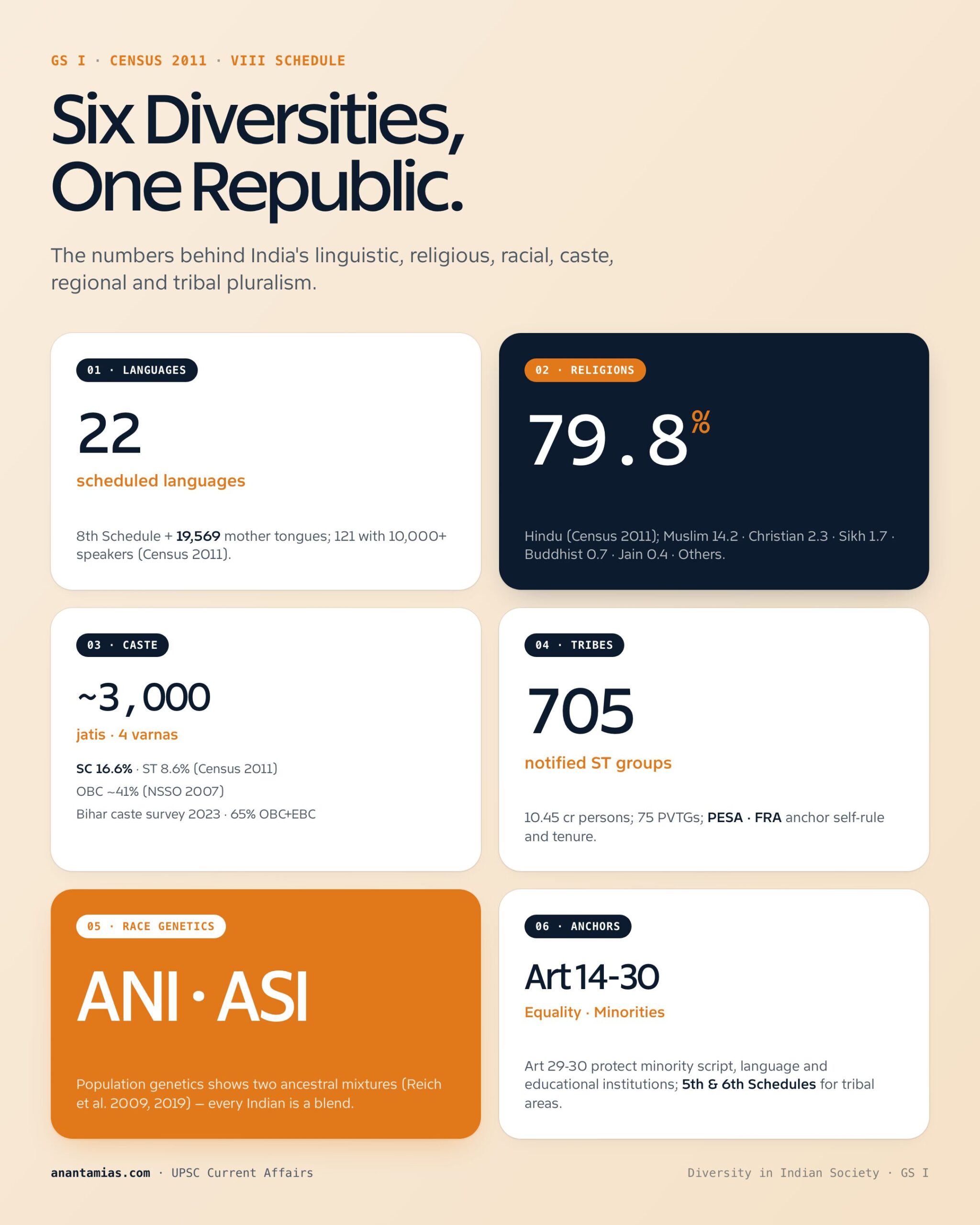
| Dimension | Key Markers | Numbers |
|---|---|---|
| Linguistic | Languages, dialects, scripts | 22 scheduled, 121 with >10,000 speakers (Census 2011) |
| Religious | Faiths, sects, syncretic traditions | 6 major + many minor |
| Racial | Anthropological types | 6 (Guha 1935, contested today) |
| Caste | Jatis, sub-castes | 4,000+ jatis; 1,234 SC, 705 ST |
| Regional | Physiographic, cultural macro-regions | 6 physiographic, 6+ cultural |
| Tribal | Adivasi communities, PVTGs | 705 STs; 75 PVTGs |
| Ethnic | Shared ancestry, customs | Northeast, Andaman, Himalayan groups |
| Gender & Sexual | Cis-women, trans, queer, third gender | 4.88 lakh trans persons (Census 2011) |
1. Linguistic Diversity
India's linguistic diversity is structured federally and constitutionally.
Language Families
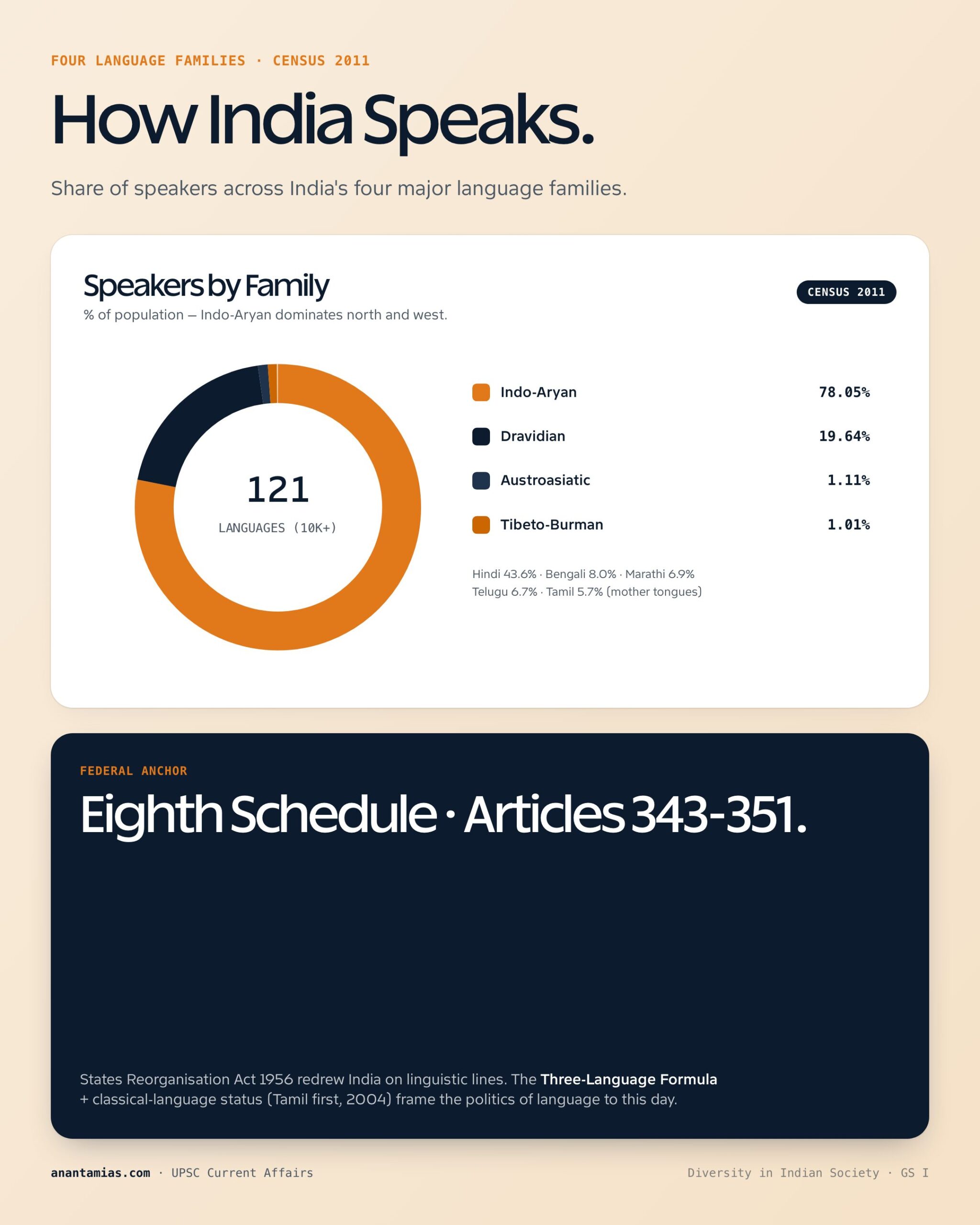
- Indo-Aryan (Hindi, Bengali, Marathi, Punjabi) — 78%.
- Dravidian (Tamil, Telugu, Kannada, Malayalam) — 19%.
- Austric/Austro-Asiatic (Santhali, Mundari, Khasi).
- Tibeto-Burman (Manipuri, Bodo, Naga languages).
- Andamanese — endangered; Sentinelese unstudied.
Constitutional Anchors
- Eighth Schedule: 22 official languages. Latest: Bodo, Dogri, Maithili, Santhali (2003, 92nd Amendment).
- Articles 343-351: Language of the Union, States, communication.
- Article 350-A: Mother-tongue instruction for linguistic minorities.
- Article 350-B: Special Officer for linguistic minorities.
2024-26 Issues
- NEP 2020 three-language formula debate — Tamil Nadu's continued resistance.
- Classical language status granted to Marathi, Pali, Prakrit, Assamese, Bengali (October 2024) — taking the total to 11.
- UNESCO 2024 atlas: ~196 endangered Indian languages.
2. Religious Diversity
India is the birthplace of four world religions (Hinduism, Buddhism, Jainism, Sikhism) and home to large populations of three others (Islam, Christianity, Zoroastrianism).
Composition (Census 2011)
| Religion | Share | Population |
|---|---|---|
| Hindu | 79.8% | 96.6 crore |
| Muslim | 14.2% | 17.2 crore |
| Christian | 2.3% | 2.78 crore |
| Sikh | 1.7% | 2.08 crore |
| Buddhist | 0.7% | 0.84 crore |
| Jain | 0.4% | 0.45 crore |
Sects and Syncretism
- Hinduism: Shaiva, Shakta, Vaishnava, Smarta, Bhakti, Advaita.
- Islam: Sunni, Shia, Bohra, Ismaili, Sufi.
- Christianity: Catholic, Protestant, Syrian Orthodox, Mar Thoma.
- Syncretic traditions: Sufism (Chishti, Qadiri), Sant tradition (Kabir, Nanak), Bhakti, folk Islam.
Constitutional Architecture
- Articles 25-28: Freedom of conscience and religion.
- Article 29-30: Cultural and educational rights of minorities.
- Article 44: UCC as DPSP — operationalised by Uttarakhand UCC (2025).
3. Racial Diversity
B.S. Guha (1935) classified Indian populations into six racial elements:
| Race | Region |
|---|---|
| Negrito | Andaman, parts of Kerala |
| Proto-Australoid | Central, peninsular India |
| Mongoloid | Northeast, Ladakh |
| Mediterranean | South India |
| Western Brachycephal | Maharashtra, Gujarat, Bengal |
| Nordic | Indo-Gangetic plains |
Modern population genetics (e.g., Reich et al., Nature 2009; Indian Genome Variation Consortium 2008) shows that Indians are mixtures of Ancestral North Indian (ANI) and Ancestral South Indian (ASI) populations with later contributions from Austro-Asiatic and Tibeto-Burman migrations. Race as a biological category is contested — ethnicity is a more accurate term.
4. Caste Diversity
Caste is hereditary, endogamous, hierarchical, segmental (Ghurye). India has:
- 4,000+ jatis (sub-castes).
- 1,234 SCs, 705 STs notified.
- OBC list continuously updated; the Bihar Caste Survey 2023 reported OBC share at 63%.
The Census 2027 will be India's first caste-enumerated decennial census since 1931.
5. Regional Diversity
India has six physiographic zones — Himalayas, Indo-Gangetic plain, Peninsular plateau, Coastal plains, Thar Desert, Islands. Cultural macro-regions include North, South, East, West, Northeast, Central, each with distinctive food, dress, kinship, and dialect patterns. Federalism (Articles 1-4, 245-263, 7th Schedule) is the political response to this diversity.
6. Tribal Diversity
India has 8.6% Scheduled Tribes (10.43 crore) — Census 2011, with 705 STs and 75 Particularly Vulnerable Tribal Groups (PVTGs). The PM-JANMAN scheme (November 2023, ₹24,104 crore) targets PVTGs across 9 sectors. Tribal protection rests on:
- Fifth and Sixth Schedules (mainland and Northeast tribal areas).
- PESA 1996 — Panchayats Extension to Scheduled Areas.
- Forest Rights Act 2006.
- Tribal Sub Plan and now Development Action Plan for STs (DAPST).
7. Gender and Sexual Diversity
- NALSA judgment 2014: Recognition of trans persons as third gender.
- Section 377 read down (Navtej Johar, 2018): Decriminalisation of same-sex relations.
- Transgender Persons (Protection of Rights) Act 2019.
- Supriyo @ Supriya Chakraborty 2023: SC declined marriage equality but called for civil unions framework.
Unity in Diversity: How India Holds Together
| Source of Unity | Mechanism |
|---|---|
| Geographical | Subcontinental cohesion bounded by Himalayas and oceans |
| Historical | Mauryan, Mughal, British pan-Indian polities |
| Cultural | Sanskrit-Persian-Tamil literary continuum, pilgrimage circuits, epics |
| Constitutional | Single citizenship, Fundamental Rights, federal structure |
| Economic | National market, GST, GIFT, single rail/digital grid |
| Linguistic syncretism | Hindi-Urdu, Bengali-Bangla, Tamil-Telugu cultural exchanges |
| Cinema and sports | Bollywood, regional cinema, IPL, Olympics 2024 unity |
The phrase "Unity in Diversity" was Nehru's framing in Discovery of India (1946); the Preamble's commitment to "fraternity assuring the dignity of the individual and the unity and integrity of the Nation" is the constitutional articulation.
Sociological Theories on Indian Diversity

Social Change in Modern India — M.N. Srinivas (Orient BlackSwan)
- 196 pages, Orient BlackSwan, revised edition
- Sanskritisation, Westernisation and secularisation, in the words that coined them
- The source every Indian Society answer borrows from

Modernization of Indian Tradition — Yogendra Singh (Rawat)
- 280 pages, the Rawat classic
- Tradition and modernity as a single process, not a contest
- The framework behind the 'modern yet traditional' feature of Indian society
| Theorist | Concept | Application |
|---|---|---|
| G.S. Ghurye | Caste, tribe, religion as integrative | Pan-Indian unity through Hindu cultural pool |
| M.N. Srinivas | Sanskritisation, Dominant Caste | Internal mobility within diversity |
| Louis Dumont | Hierarchy as unifying principle | Diversity is structured hierarchy |
| Andre Beteille | Caste, class, power | Multiple stratification axes |
| Dipankar Gupta | Hierarchies of difference | Diversity is identity, not just hierarchy |
| Yogendra Singh | Modernisation of tradition | Diverse traditions modernise plurally |
Constitutional and Legal Architecture
- Preamble: Unity and integrity of the Nation; secular, sovereign, democratic, socialist, republic.
- Article 14, 15, 16, 17: Equality, non-discrimination, untouchability abolition.
- Articles 25-30: Religious and minority rights.
- Articles 343-351: Language of the Union and States.
- Eighth Schedule: 22 scheduled languages.
- Fifth and Sixth Schedules: Tribal area governance.
- Articles 244, 244-A; PESA 1996; FRA 2006: Tribal autonomy.
- Article 51-A(f): Duty to value composite culture.
Government Initiatives Promoting Diversity & Pluralism
- Ek Bharat Shreshtha Bharat (2015) — paired states cultural exchange.
- National Foundation for Communal Harmony (1992).
- Sahitya Akademi, Sangeet Natak Akademi, ICCR — cultural promotion.
- PM-JANMAN (2023) — PVTG welfare.
- Eklavya Model Residential Schools (728 sanctioned).
- Linguistic Survey of India revival under Ministry of Education.
- Mission Vatsalya, Mission Shakti — gender, child welfare.
2024-26 Stresses on Diversity
- Communalism: 272 communal riot cases in 2022 (NCRB).
- Hate speech surge: Centre for Study of Society and Secularism, 2024 report.
- Linguistic conflicts: NEP 2020 three-language formula, "Hindi imposition" debates in TN, KA, TS.
- Caste mobilisation: Maratha, Patidar, Jat OBC demands; sub-quota verdict (2024).
- Tribal displacement: 50+ million displaced since 1947 (estimates from Walter Fernandes).
- Region-religion overlap: Northeast tensions (Manipur 2023-24), CAA implementation 2024.
- Gender backlash: Marital rape pending in SC; queer marriage equality denied (2023).
Data Snapshot (2024-26)
| Indicator | Value | Source |
|---|---|---|
| Population | 1.43 billion | UN WPP 2024 |
| Scheduled languages | 22 | Eighth Schedule |
| Classical languages | 11 (after Oct 2024) | MoC |
| Religious composition | Hindu 79.8%, Muslim 14.2% | Census 2011 |
| ST share | 8.6% (10.43 crore) | Census 2011 |
| Trans population | 4.88 lakh | Census 2011 |
| Communal riot cases | 272 (2022) | NCRB |
| SC/ST atrocity | 57,582 (2022) | NCRB |
| World Press Freedom | 159/180 | RSF 2024 |
| Endangered languages | ~196 | UNESCO 2024 |
| Female LFPR | 41.7% | PLFS 2023-24 |
Challenges in Managing Diversity
- Identity politics that hardens difference into hostility.
- Majoritarianism corroding minority confidence.
- Linguistic chauvinism in domicile policies and signage.
- Disparity inside diversity — adivasis, Dalits, Pasmanda Muslims face compounded disadvantage.
- Regional inequality — North-South GDP per capita gap widening.
- Internal migration tensions in metro cities.
- Digital divide along caste, gender, region (NSO Comprehensive Modular Survey 2022-23).
Way Forward
- Constitutional patriotism as the unifying political ethic (Habermas; Bhargava).
- Fraternity — operationalise the Preamble's third pillar via curriculum (NEP 2020), public rituals (Ek Bharat Shreshtha Bharat), and media.
- Disaggregated data through caste census 2027, NFHS, PLFS to inform policy.
- Strengthen federalism — fiscal devolution, language equity, cultural funding.
- Operationalise PESA, FRA, Sixth Schedule with genuine local consent.
- Anti-hate-speech architecture: Implement Bhagwati and Vishaka-style guidelines per Shaheen Abdulla (2023) directives.
Mains Hook
"Indian diversity is not a problem to be managed but a resource to be governed." Critically discuss in light of recent stresses on India's pluralist fabric. (GS-I, 250 words, 15 marks)
Prelims Pointers
- Eighth Schedule: 22 languages.
- Classical Languages: 11 (after October 2024 additions — Marathi, Pali, Prakrit, Assamese, Bengali).
- Five major language families: Indo-Aryan, Dravidian, Austro-Asiatic, Tibeto-Burman, Andamanese.
- Six races (Guha 1935): Negrito, Proto-Australoid, Mongoloid, Mediterranean, Western Brachycephal, Nordic.
- PVTGs: 75 groups; PM-JANMAN scheme (November 2023).
- Article 29 vs 30: 29 protects all minorities; 30 lets religious/linguistic minorities run institutions.
- Sixth Schedule: Assam, Meghalaya, Tripura, Mizoram autonomous councils.
- PESA 1996: Panchayats Extension to Scheduled Areas.
- NALSA 2014: Trans persons recognised.
- Census 2027: First caste-enumerated census since 1931.
Diversity is the structural condition of Indian society and the regulative ideal of the Indian Constitution. Mastering it means seeing pluralism not as rhetorical comfort but as a daily political project.