Official languages of India are governed by a constitutional architecture that runs from Article 343 to Article 351 and the Eighth Schedule of the Constitution. The framework establishes Hindi in Devanagari as the official language of the Union, retains English as an associate official language under the Official Languages Act 1963, and lists 22 languages in the Eighth Schedule that the Union has a duty to draw on while developing Hindi. Hindi Diwas is observed on 14 September each year, marking the date in 1949 when the Constituent Assembly adopted Hindi in Devanagari as the official language of the Union.
The Constitution does not name a national language of India. The phrase national language has no constitutional basis. The Gujarat High Court, in Suresh Kachhadia v. Union of India in 2010, held in clear terms that Hindi is the official language but not the national language of India. The official-versus-national distinction is the most frequently misstated fact in language-policy debates and the one UPSC most often tests.
This explainer walks through each Article from 343 to 351, the Eighth Schedule, the official-language commission framework under Article 344, the three-language formula and its evolution into the National Education Policy 2020, and the recent disputes including the southern resistance to Hindi imposition and the demand to expand the Eighth Schedule.
The constitutional architecture
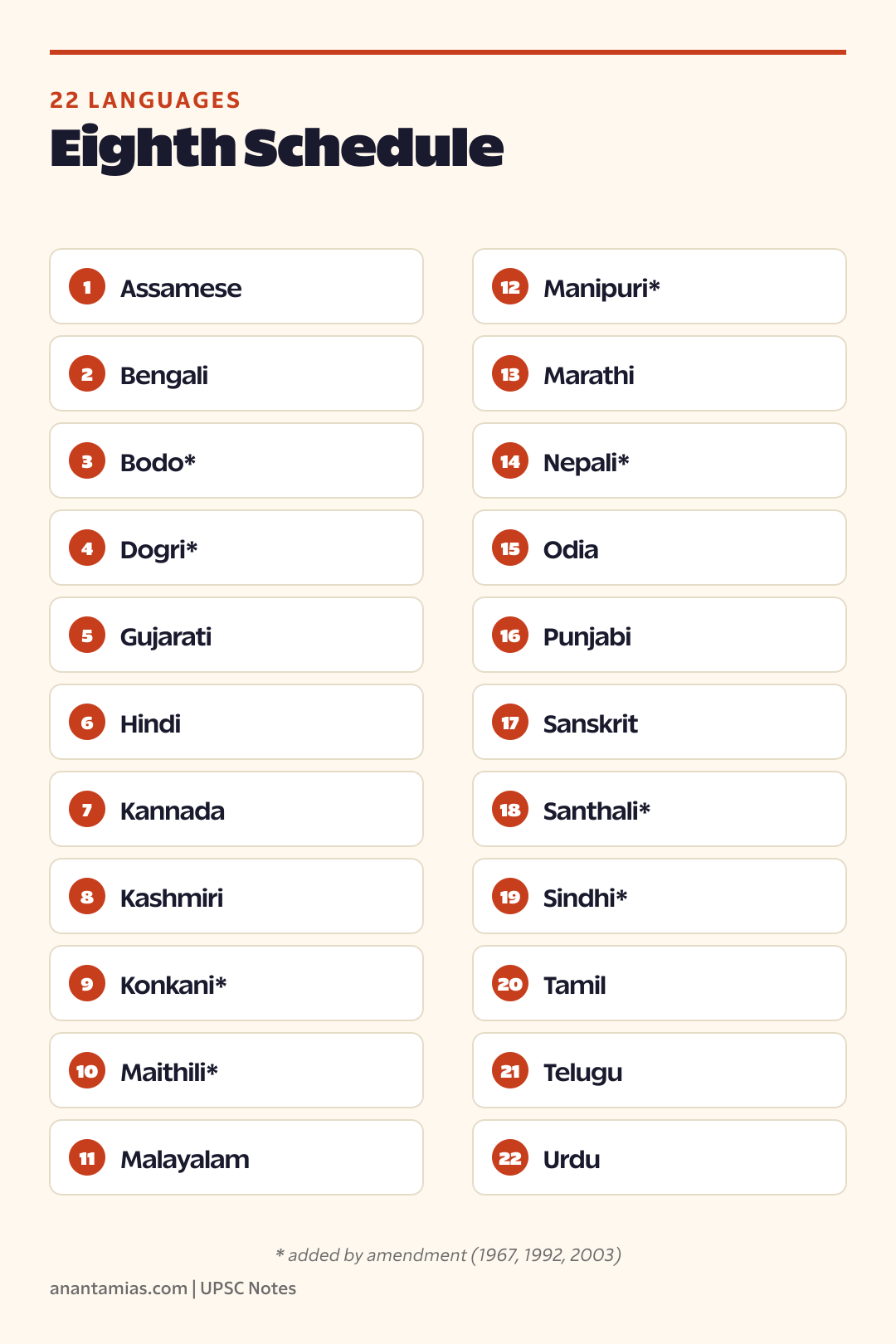
The Constitution treats language across two interlocking frameworks. Part XVII, comprising Articles 343 to 351, governs the language of the Union, the states, the judiciary, and the Centre’s duty toward Hindi. The Eighth Schedule, framed under Articles 344 and 351, lists 22 languages whose presence triggers specific obligations on the Union government.
The two frameworks are independent of the classical-language framework, which is administrative and runs through the Ministry of Culture. The classical languages of India post covers that separate framework in detail.
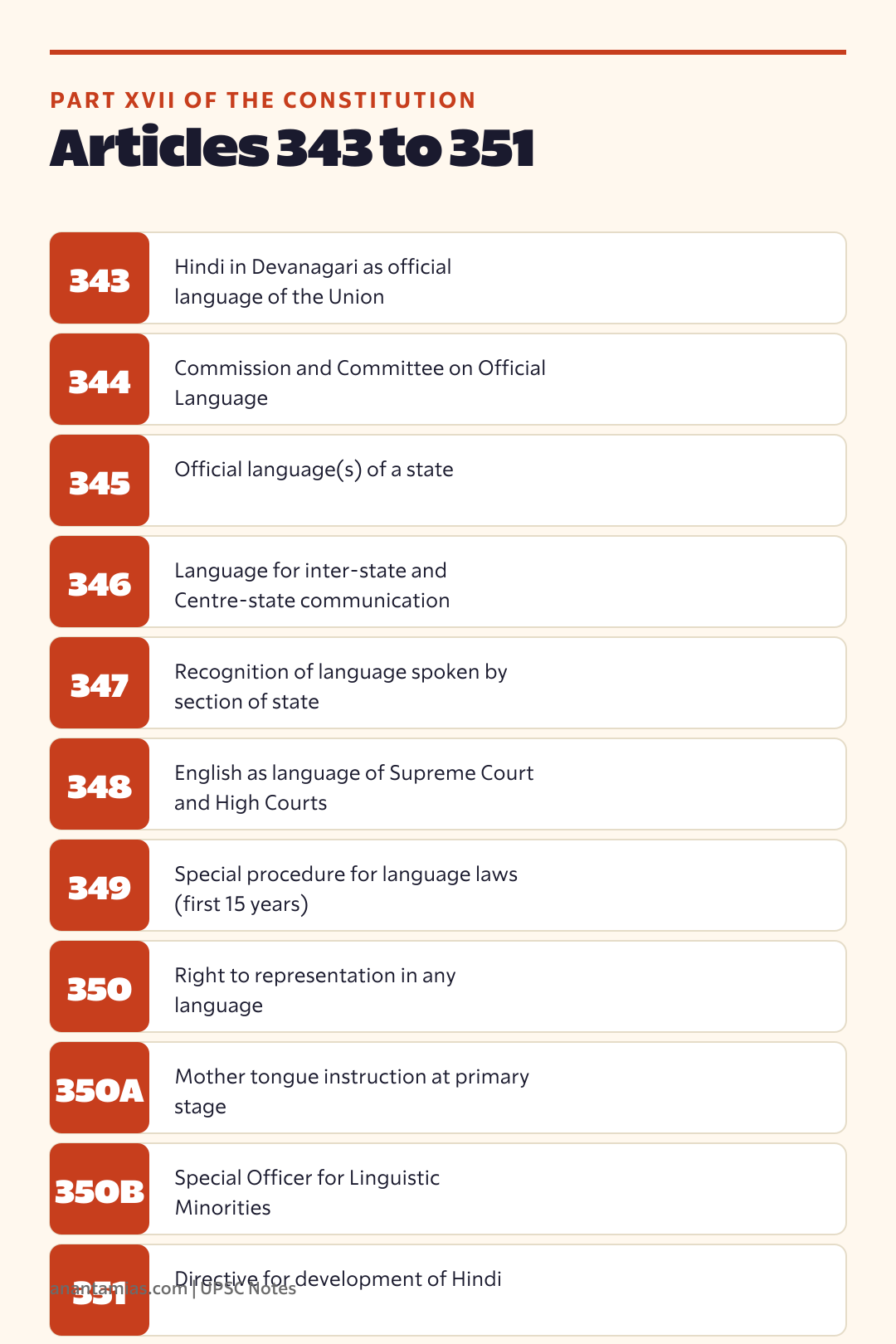
Article 343 — Official Language of the Union
Article 343 establishes Hindi in Devanagari script as the official language of the Union. The international form of Indian numerals is to be used for official purposes. The Article also provided that English would continue for official purposes for fifteen years from the commencement of the Constitution, that is until 26 January 1965. Parliament was given the power to provide for English to continue beyond that date by law.
Parliament exercised that power through the Official Languages Act 1963, which made English an associate official language indefinitely. The Act was amended in 1967 after the anti-Hindi agitations in Tamil Nadu, to guarantee that English would continue to be used as long as any non-Hindi-speaking state desired it.
Article 344 — Commission and Committee on Official Language
Article 344 provides for the President to constitute a Commission on Official Language, which shall make recommendations on the progressive use of Hindi, restrictions on the use of English, and the form of numerals for official purposes. The first Commission was set up in 1955 under B G Kher. A parliamentary committee on the Commission’s recommendations was constituted in 1957.
The Article also provides for a Committee of Parliament on Official Language, with 20 Lok Sabha and 10 Rajya Sabha members, to review the progress made in the use of Hindi for official purposes and to submit reports to the President.
Articles 345 to 347 — Language of the States
Article 345 allows a state Legislature to adopt one or more of the languages in use in the state, or Hindi, as the official language of the state. Article 346 deals with the language for official communication between states and between a state and the Union, prescribing the Union official language in default. Article 347 allows the President to direct that any language be officially recognised by a state if a substantial proportion of the population so desires.
Article 348 — Language of the Supreme Court and High Courts
Article 348 prescribes English as the language of the Supreme Court and the High Courts, and as the language in which all Bills, Acts, Ordinances, orders, rules, regulations, and bye-laws shall be issued at the Union level. The proviso allows the Governor of a state, with the previous consent of the President, to authorise the use of Hindi or any other language for proceedings in a High Court.
The use of Hindi in High Court proceedings has been authorised for the High Courts of Uttar Pradesh, Madhya Pradesh, Bihar, and Rajasthan. Repeated requests from the High Courts of Punjab and Haryana, Tamil Nadu, Karnataka, Gujarat, and Chhattisgarh to use regional languages have been deferred by the Union Government, most recently in 2017.
Article 349 — Special procedure for enactment of certain laws relating to language
Article 349 prescribes a special procedure during the first fifteen years from the commencement of the Constitution for any law relating to the language of the courts or High Court proceedings. The Article has limited current relevance.
Article 350, 350A, 350B — Linguistic minorities
Article 350 confers the right to submit a representation for the redress of grievances to any authority of the Union or a state in any of the languages used in the Union or the state. Article 350A, inserted by the Seventh Amendment 1956, imposes a duty on every state to provide adequate facilities for instruction in the mother tongue at the primary stage of education for children belonging to linguistic minorities. Article 350B, also inserted in 1956, provides for the appointment of a Special Officer for Linguistic Minorities by the President.
Article 351 — Directive for development of Hindi
Article 351 imposes a duty on the Union to promote the spread of Hindi, to develop it so that it may serve as a medium of expression for all the elements of the composite culture of India, and to draw, wherever necessary or desirable, on the languages listed in the Eighth Schedule for vocabulary. The Article is a directive, not an enforceable obligation, and it is the constitutional basis for the development funding that flows through the Department of Official Language.
The Eighth Schedule and its 22 languages
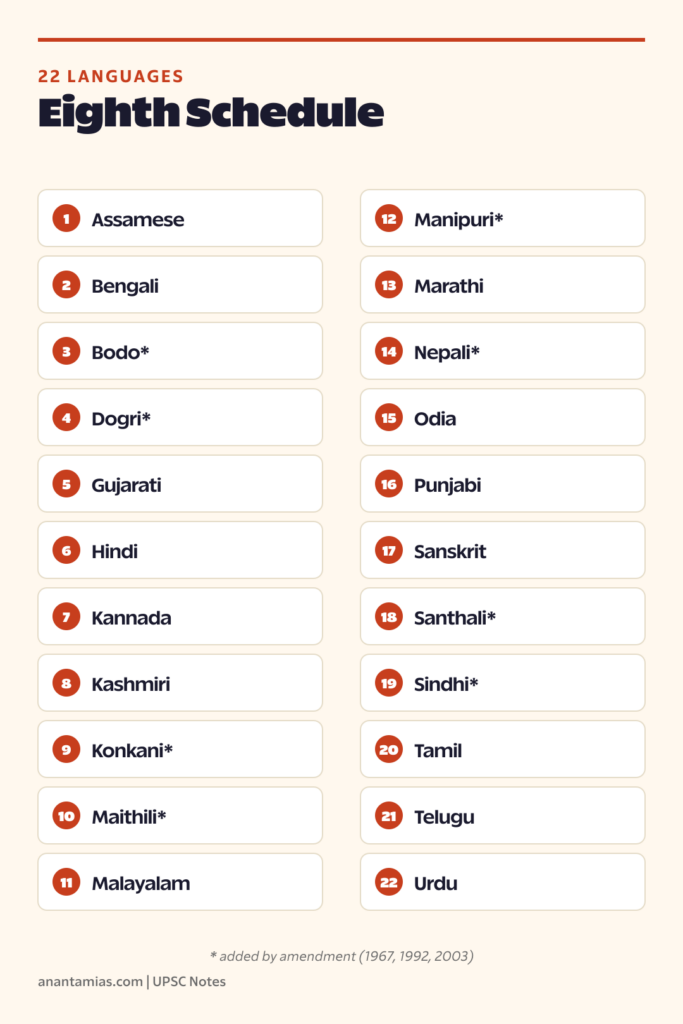
The Eighth Schedule of the Constitution originally listed 14 languages in 1950. The list now stands at 22 languages after four amendments. The current list is:
- Assamese
- Bengali
- Bodo, added by 92nd Amendment 2003
- Dogri, added by 92nd Amendment 2003
- Gujarati
- Hindi
- Kannada
- Kashmiri
- Konkani, added by 71st Amendment 1992
- Maithili, added by 92nd Amendment 2003
- Malayalam
- Manipuri, added by 71st Amendment 1992
- Marathi
- Nepali, added by 71st Amendment 1992
- Odia
- Punjabi
- Sanskrit
- Santhali, added by 92nd Amendment 2003
- Sindhi, added by 21st Amendment 1967
- Tamil
- Telugu
- Urdu
Membership of the Eighth Schedule triggers four entitlements. Candidates for civil services examinations can choose any Eighth Schedule language as a medium for the written examination. The Sahitya Akademi recognises the language and runs prize and translation programmes for it. The Bureau of Indian Languages, formerly the Central Hindi Directorate, undertakes terminology and translation work. And under Article 351, the Union has a duty to draw on the language while developing Hindi.
Several languages have demands for inclusion pending. The Bhasha Sammelan and the Sitakant Mahapatra Committee of 2003 had recommended a transparent process for inclusion. The list of demands, communicated periodically by state governments, includes Bhojpuri, Rajasthani, Bhoti, Bhota, Bhumij, Karbi, Khasi, Kodava, Kok-Barak, Kumaoni, Mizo, Nagpuri, Pahari with several variants, Pali, and Sanskari. None has been added since the 92nd Amendment 2003. The eighth schedule languages post tracks the pending demands in detail.
Hindi as official language, not national language
Hindi is the official language of the Union under Article 343. There is no national language declared by the Constitution. The Constituent Assembly debated the question intensely between 1946 and 1949. The compromise reached, after the Munshi-Ayyangar formula was adopted on 14 September 1949, was that Hindi in Devanagari would be the official language with English continuing for fifteen years.
The Gujarat High Court in Suresh Kachhadia v. Union of India, 2010, in a writ proceeding on the use of Hindi by traders for labelling goods, held that Hindi is the official language of India under Article 343 but not its national language. The case is the most frequently cited authority on the distinction. The Supreme Court has not contradicted this position in any subsequent judgment.
The political claim that Hindi is the national language of India therefore has no legal foundation. The constitutional position is settled: India has an official language at the Union level, multiple official languages at the state level, and 22 scheduled languages, but no national language.
The three-language formula
The three-language formula was first articulated by the Kothari Commission in 1966 and adopted as policy in the National Policy on Education 1968. Its design was to ensure that every Indian student learns three languages: the regional or state language, Hindi, and English in Hindi-speaking states; and the regional language, Hindi or English, and English in non-Hindi-speaking states.
The formula has been implemented unevenly. Tamil Nadu has consistently followed a two-language policy of Tamil and English since 1968, in deference to the anti-Hindi sentiment after the 1965 agitations. Most other states adopted the formula formally but with significant variation in the third language chosen.
The National Education Policy 2020 retained the three-language formula but with a key modification. The 2020 formula requires no state to impose any specific language. Each state and student is to choose three languages, of which at least two are to be native to India. The Tamil Nadu government has rejected the 2020 formulation, treating it as an indirect route to Hindi imposition.
For further reading, the one nation one language post traces the political economy of the Hindi-imposition debate in detail.
Recent disputes and developments
Three recent disputes track the current state of the official-language debate.
First, the southern resistance to Hindi imposition flared up in 2020 with the draft NEP and again in 2024 with the Centre’s notification on Hindi-language Bills introduced in Parliament. Tamil Nadu, Kerala, and Karnataka governments objected. The Union Government clarified that no state would be required to impose any specific language under the NEP 2020.
Second, the Parliamentary Committee on Official Language, in its eleventh report submitted in 2022, recommended that Hindi be used as the medium of instruction in central government technical and higher education institutions located in Hindi-speaking states, and that Hindi be used in correspondence with non-Hindi states only where necessary. The recommendations drew opposition from non-Hindi states.
Third, the demand for Bhojpuri to be added to the Eighth Schedule has acquired political weight given speaker numbers across eastern Uttar Pradesh, western Bihar, and the Bhojpuri diaspora in Mauritius, Fiji, Suriname, and Trinidad. The demand has been pending since the 2010s without forward movement.
UPSC angles to track
For prelims, the testable facts are the Articles 343 to 351 grid, the Eighth Schedule list and the amendments that added each language, and the distinction between official and national language. The most common confusion is treating Hindi as the national language of India. It is not.
For mains, the GS-II governance paper has used official languages as an anchor for federalism and minority rights questions. The 2021 paper carried a question on language policy and national integration. The 2023 paper carried a question on the three-language formula. The essay paper has used the question of language and identity as a theme. The Constituent Assembly debates on the Munshi-Ayyangar formula are testable as a case study.
The ground to prepare is the Article-by-Article grid, the four amendments to the Eighth Schedule, the official-versus-national distinction, and the three-language formula in its 1968 and 2020 versions.
Frequently Asked Questions
What is the official language of India?
Hindi in Devanagari script is the official language of the Union under Article 343 of the Constitution. English continues as an associate official language under the Official Languages Act 1963. India does not have a national language declared by the Constitution.
What is the difference between official and national language?
An official language is the language designated by law for the conduct of government business. A national language is a language declared to represent the nation as a whole. India has an official language at the Union level, Hindi, and multiple official languages at the state level. The Constitution does not declare any national language.
How many languages are in the Eighth Schedule?
There are 22 languages in the Eighth Schedule of the Constitution. The list began with 14 languages in 1950 and was expanded to 22 through four amendments: Sindhi in 1967, Konkani, Manipuri, and Nepali in 1992, and Bodo, Dogri, Maithili, and Santhali in 2003.
What is Article 343 of the Constitution?
Article 343 establishes Hindi in Devanagari script as the official language of the Union. It also provided that English would continue for fifteen years from the commencement of the Constitution. Parliament extended English indefinitely through the Official Languages Act 1963.
What is Article 351 of the Constitution?
Article 351 imposes a duty on the Union to promote the spread of Hindi, to develop it so that it may serve as a medium of expression for all the elements of the composite culture of India, and to draw on the languages in the Eighth Schedule for vocabulary. It is a directive, not an enforceable obligation.
What is the three-language formula?
The three-language formula, first articulated by the Kothari Commission in 1966 and adopted in the National Policy on Education 1968, requires every Indian student to learn three languages: the regional language, Hindi, and English in Hindi-speaking states, and the regional language, Hindi or English, and English in non-Hindi states. The NEP 2020 retained the formula but allows states to choose any three languages of which two are native to India.
Why does Tamil Nadu follow a two-language policy?
Tamil Nadu has followed a two-language policy of Tamil and English since 1968, in deference to the anti-Hindi sentiment after the 1965 agitations. The state government has consistently rejected the three-language formula and has reiterated the position under the NEP 2020.
What is Hindi Diwas?
Hindi Diwas is observed on 14 September each year, marking the date in 1949 when the Constituent Assembly adopted Hindi in Devanagari as the official language of the Union. The decision followed the Munshi-Ayyangar formula, which was the compromise text between supporters of Hindi as a national language and supporters of multilingualism.
Which Articles cover linguistic minorities?
Article 350 confers the right to submit a representation in any language used in the Union or the state. Article 350A imposes a duty on states to provide instruction in the mother tongue at the primary stage of education for linguistic minorities. Article 350B provides for the appointment of a Special Officer for Linguistic Minorities.
Can Eighth Schedule status be granted to Bhojpuri?
A constitutional amendment is required to add any language to the Eighth Schedule. The demand for Bhojpuri has been pending since the 2010s. No language has been added since the 92nd Amendment 2003, which added Bodo, Dogri, Maithili, and Santhali.
Which High Courts use Hindi?
The High Courts of Uttar Pradesh, Madhya Pradesh, Bihar, and Rajasthan are authorised to use Hindi in their proceedings under the proviso to Article 348. Requests from other High Courts to use regional languages have been deferred by the Union Government, most recently in 2017.
Tell Google you want more of this.
Add Anantam IAS as a preferred sourceOne tap, and this site shows up more often in your own Top Stories, AI Overviews and AI Mode. Remove it any time.