D.K. Balaji Ethics Book: A Practical Study Guide
Turn D.K. Balaji's ethics concepts into decisions you can defend. Work through an original scholarship case and use a practical answer-review rubric.
The D K Balaji ethics book, A Practical Approach to Ethics, Integrity and Aptitude, is useful only if your reading turns into decisions you can defend. Remembering “integrity” won’t tell you what to do when a senior asks you to approve a doubtful payment. That’s the gap your practice should close.
I recommend using it as one working source for concepts, followed by your own written case analysis. Keep your current ethics book if you already understand the concepts and can apply them. Buy Balaji’s book after checking a sample you can read comfortably; collecting another explanation won’t fix a habit of avoiding answers.
Identify The Book
The book is credited to D.K. Balaji IAS and published by JICE Publications. Product listings use small variations of the title, including A Practical Approach to Ethics Integrity Aptitude for Civil Services Examination.
- The JICE title listing identifies D.K. Balaji and the publisher.
- Confirm the title page, edition statement, language and contents for the copy you’re buying.
- A seller’s printing date doesn’t establish a new revised edition. Don’t pay extra solely for a current-year sticker.
- Choose a lawful sample or inspect a library copy before deciding whether the explanations suit you.
The book’s identity is clear enough for a reading guide. A claim that its newest printing has superior case studies would need direct comparison of those pages. I wouldn’t use that claim to justify your purchase.
For a broader resource decision, use our ethics booklist. If you already work from Lexicon, the Lexicon Ethics guide can help you organize that source. Finish an answer cycle before switching books.
Connect Concepts To Decisions
Use the book’s index to find each concept, then give it a practical test. These are suggested study tasks, not a claim about the book’s chapter sequence.
| Concept | Question To Ask | Output To Write |
|---|---|---|
| Integrity | Would I apply the same standard when the requester has influence? | A consistent rule and the action it requires |
| Impartiality | Are relevant criteria deciding the case, or someone’s identity? | A fair selection process with reasons |
| Empathy | Whose difficulty have I overlooked? | A response that understands the difficulty without inventing eligibility |
| Accountability | Who can check my decision later? | A reasoned record, review route and responsible person |
| Conflict of interest | Could a personal connection affect judgment? | Disclosure and an independent decision process |
| Probity | What protects public resources from misuse? | Verifiable procedures and transparent records |
Think of a concept as a lens that reveals part of a situation. Empathy helps you see the applicant’s difficulty; accountability helps you explain your response. The analogy has a limit: naming more lenses doesn’t automatically produce a better decision. Your answer still needs facts, authority and workable action.
Work Through A Payment Case
This is an original hypothetical practice case, not a UPSC question. You supervise a district scholarship payment team. A student says a delay may force her to leave college. Her application has a missing income certificate. A senior asks you to approve the payment immediately because her family is personally known to him. Assume the scheme requires that certificate and permits a formal review of delayed applications; it does not allow you to waive the requirement yourself.
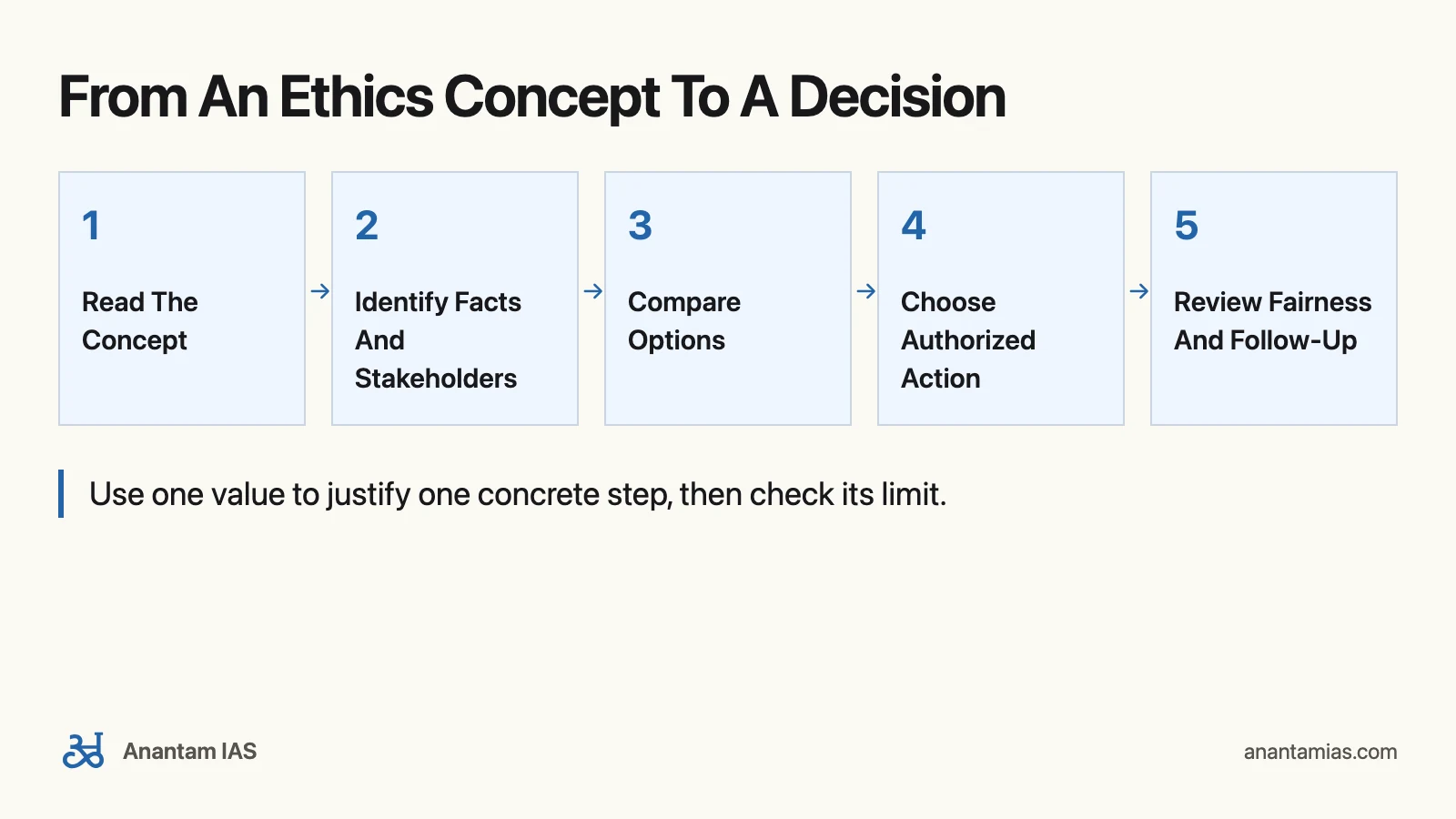
“I will show empathy and integrity” is an incomplete answer. Let’s build the reasoning.
Establish The Facts And Stakeholders
Separate the stated facts from information you still need. The certificate is missing; the student’s need and the senior’s request don’t establish eligibility. Ask whether the document was submitted elsewhere, why it is missing and what the formal review process permits.
- Student: needs a timely, fair decision and clear information.
- Other applicants: deserve the same criteria and access to the review process.
- Payment team and public authority: must use funds within the scheme rules.
- Senior: may provide relevant information, but a personal connection cannot replace evidence.
- Public: has an interest in fair administration and accountable spending.
This is a conflict between urgency and an unresolved eligibility condition. It also raises an impartiality concern because personal influence is being offered as a reason for approval.
Compare The Available Options
Compare consequences and authority together. An attractive outcome doesn’t give you a power the scheme hasn’t granted.
| Option | Benefit | Problem | Decision |
|---|---|---|---|
| Approve without the required certificate | Immediate payment | Assumes eligibility and waives a condition without authority | Reject |
| Reject permanently with no guidance | Ends the pending file | Treats a potentially repairable gap as final | Reject |
| Explain the gap, assist document completion and request formal review | Preserves fairness while responding to urgency | Payment may still take time | Choose |
| Ignore the request until the senior stops calling | Avoids a confrontation | Leaves the student without a decision or help | Reject |
Write The Action
A defensible response would say:
“I would explain the missing requirement to the student and help her identify the authorized route for obtaining or locating the certificate. I would check the application’s history and seek an urgent review through the scheme’s formal process, recording the reasons for urgency. I would apply the same route to similarly placed applicants. I would tell the senior that a personal recommendation cannot substitute for eligibility evidence. If pressure continues, I would document it and use the appropriate supervisory channel. I would communicate the next step and follow up on the review, without promising approval.”
The chosen action protects integrity by retaining the eligibility condition, empathy by offering useful help and accountability by leaving a checkable record. It doesn’t guarantee a payment date. That limit matters: an ethical answer should not promise a result outside your authority.
Review Your Own Answer
A good self-review asks whether the response would still make sense if somebody had to implement it. Use this rubric after each case.
| Check | Weak Response | Useful Revision |
|---|---|---|
| Facts | Assumes the applicant is eligible | Names what is known and what must be checked |
| Values | Lists five virtues | Connects a value to a specific decision |
| Options | Makes one option obviously foolish | Compares plausible options fairly |
| Authority | Invents an emergency power | States the rule or flags the missing authority |
| Action | Says “take necessary steps” | Names the first step, review channel and follow-up |
| Fairness | Helps only the influential applicant | Explains how similar cases receive the same treatment |
You don’t have to sound heroic. A careful response that resolves the actual problem is stronger than a dramatic promise to resign or punish everyone. Where the facts don’t support wrongdoing, ask for evidence rather than announcing a culprit.
Build A Reading And Writing Routine
Read one concept, close the book and apply it to a small situation before moving to the next. You can use a four-week cycle and extend any stage that needs more practice.
- Week 1: read core concepts; write a plain-language definition and one application for each.
- Week 2: practice short responses that distinguish related terms, such as impartiality and empathy.
- Week 3: write cases using facts, stakeholders, options and action; review them with the rubric.
- Week 4: mix concept questions and cases, then rewrite weak answers after a gap.
For a 50-minute session, use 15 minutes to read, 10 to recall and connect a concept, 15 to write, and 10 to review. With 30 minutes available, use a smaller case and keep the review. These are planning suggestions, not an exam timing rule.
Maintain a small example bank with the concept, situation, action and limitation. Label fictional examples as hypothetical. Use real examples only when the event and details can be checked, and don’t invent quotations to make an answer look scholarly.
Your next task is to write the scholarship case once without copying the model. Change one fact: suppose the scheme explicitly permits an alternative document. Then identify how your action changes. If it doesn’t change at all, reread the authority part of your answer.
Frequently Asked Questions
What is the name of D.K. Balaji’s ethics book?
It is A Practical Approach to Ethics, Integrity and Aptitude, credited to D.K. Balaji IAS and published by JICE Publications. Seller listings use minor title variations.
Should I buy it if I already use Lexicon?
Keep Lexicon if it supports your conceptual understanding. Write and review answers before changing sources. Add Balaji only for a specific learning gap after inspecting a sample.
Which edition should I choose?
Check the actual edition statement, title page and language of the copy. A reprint date or current-year sticker does not establish a revised edition.
How should I practice ethics case studies?
Separate stated facts from missing information, identify stakeholders, compare plausible options and explain an action within your authority. Review fairness and follow-up.
Are the worked case and timing plan official UPSC material?
No. The scholarship case is an original hypothetical teaching example, and the session timings are adjustable study suggestions.