Important Articles of the Indian Constitution: DPSP, Parliament and PM Powers
UPSC guide to Directive Principles (Articles 36-51), Parliament (79-122) and Prime Minister powers (74-75). Key articles, amendments and Prelims-ready list.
Introduction
Article numbers are the most tested factual layer of the Indian Constitution in the UPSC Prelims. A candidate who can place the right number against the right provision turns a difficult paper into a comfortable one. Yet isolated memorisation does not survive Mains questions, which ask why a principle exists, how it has been interpreted, and what its contemporary relevance is.
This article takes three clusters that together dominate question papers: Directive Principles of State Policy (Articles 36 to 51), the articles related to Parliament (79 to 122), and the articles related to the Prime Minister (74, 75, 78 and allied). For each cluster, we set out the provisions, the interpretation through landmark cases and amendments, and the exam angle. The article is designed as a consolidated reference for Polity revision and as a basis for structured Mains answers.
Quick Facts at a Glance
| Cluster | Article range | Part | Core theme |
|---|---|---|---|
| Directive Principles | 36 to 51 | Part IV | Non-justiciable guidelines for state policy |
| Fundamental Duties | 51A | Part IV-A | Citizen duties added by 42nd Amendment 1976 |
| Parliament | 79 to 122 | Part V, Chapter II | Union legislature, procedure, privileges |
| President & Council | 52 to 78 | Part V, Chapter I | Executive head, Council of Ministers, PM |
| Prime Minister | 74, 75, 78 | Part V | PM as head of government; aid and advice |
| Amendment | 368 | Part XX | Procedure to amend the Constitution |
| Emergency | 352 to 360 | Part XVIII | National, President’s Rule, Financial |
| Supreme Court | 124 to 147 | Part V, Chapter IV | Apex judiciary |
Background and Historical Context
India’s Constitution, adopted on 26 November 1949 and commenced on 26 January 1950, drew its design from multiple sources. The Directive Principles were consciously modelled on the Irish Constitution of 1937, which in turn drew on the Spanish Republican Constitution of 1931. The framers led by B. R. Ambedkar, Alladi Krishnaswami Ayyar and K. M. Munshi debated whether social and economic rights should be justiciable. The compromise was Part IV, non-justiciable but “fundamental in the governance of the country”.
Articles governing Parliament and the executive were shaped by the Government of India Act 1935, adapted to a parliamentary rather than viceregal model. The Cabinet Mission Plan 1946, Constituent Assembly debates from December 1946 to November 1949, and the Objectives Resolution of December 1946 moved by Jawaharlal Nehru provided the political frame.
Three lines of constitutional interpretation are indispensable for understanding how article numbers translate into working law today. First is the evolution from the Minerva Mills (1980) clarification that Fundamental Rights and Directive Principles together form the basic structure. Second is the Keshavananda Bharati (1973) basic structure doctrine itself, flowing from Article 368. Third is the doctrine of harmonious construction, which has been used consistently to read Parts III and IV as complementary.
Amendments reshape article content. The 42nd Amendment 1976 added Articles 39A, 43A and 48A, inserted Part IV-A with Article 51A, and expanded the preamble. The 44th Amendment 1978 restored judicial review. The 73rd and 74th Amendments 1992 added Articles 243 to 243ZG for Panchayats and Municipalities, a natural extension of Article 40.
Key Provisions of the Three Clusters
Directive Principles of State Policy (Articles 36 to 51)
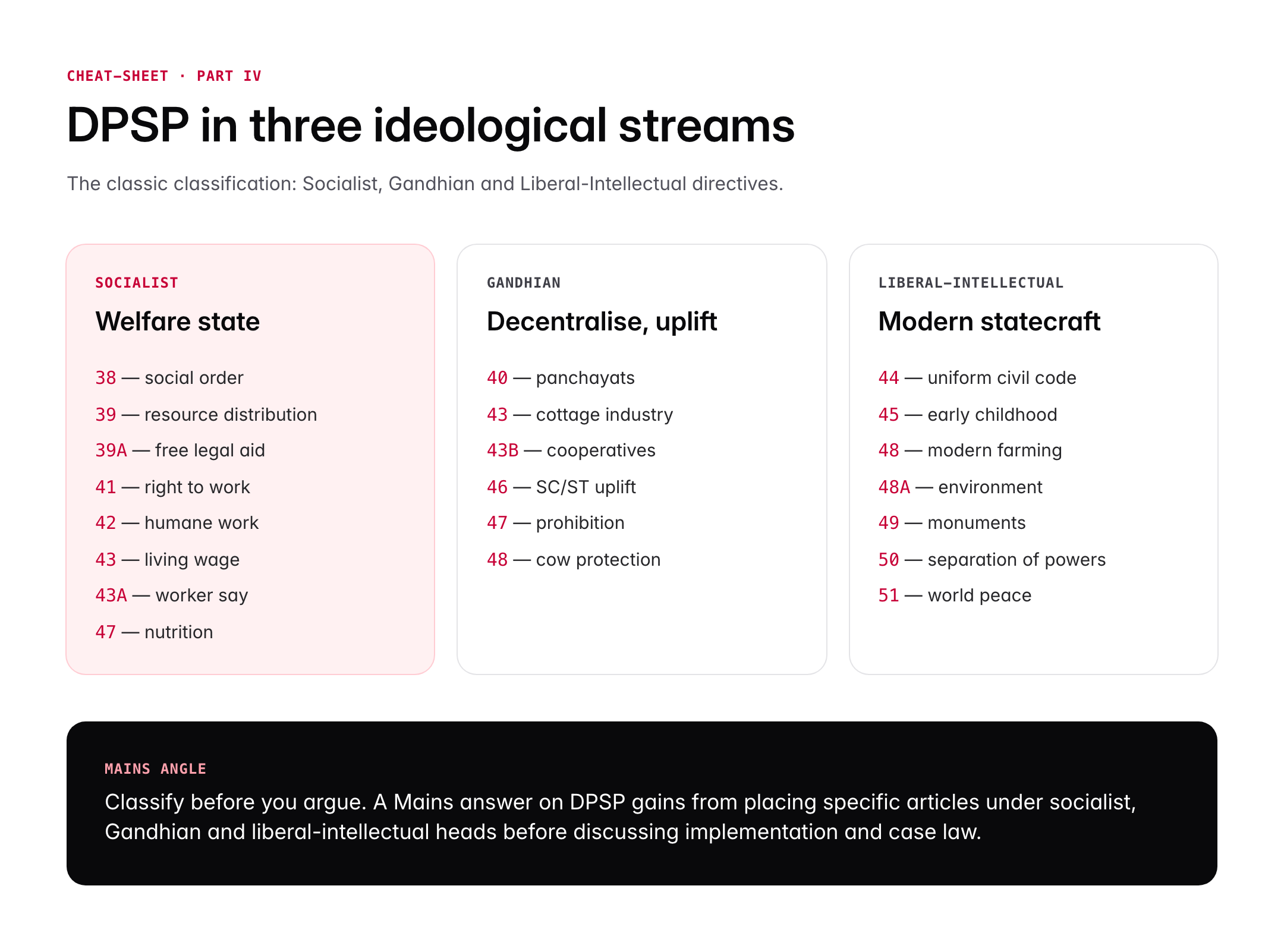
Part IV classifies the Directive Principles along three ideological streams: socialist, Gandhian and liberal-intellectual. The core numbers are:
- Article 36: Definition of “State” for Part IV purposes
- Article 37: Application of Directive Principles, non-justiciable but fundamental
- Article 38: State to secure a social order promoting welfare; sub-clause (2) added by 44th Amendment on reducing inequalities
- Article 39: Principles for certain policies — equal right to livelihood, fair distribution of resources, equal pay for equal work, protection of children
- Article 39A: Equal justice and free legal aid (added by 42nd Amendment)
- Article 40: Organisation of village panchayats
- Article 41: Right to work, to education and to public assistance
- Article 42: Just and humane conditions of work, maternity relief
- Article 43: Living wage, decent standard of life
- Article 43A: Workers’ participation in management (added by 42nd Amendment)
- Article 43B: Promotion of cooperative societies (added by 97th Amendment 2011)
- Article 44: Uniform Civil Code
- Article 45: Early childhood care and education for children below six (post-86th Amendment 2002)
- Article 46: Educational and economic interests of SCs, STs and weaker sections
- Article 47: Nutrition, standard of living, prohibition
- Article 48: Agriculture and animal husbandry
- Article 48A: Environment, forests and wildlife (added by 42nd Amendment)
- Article 49: Monuments of national importance
- Article 50: Separation of judiciary from executive
- Article 51: International peace and security
Articles Related to Parliament (79 to 122)
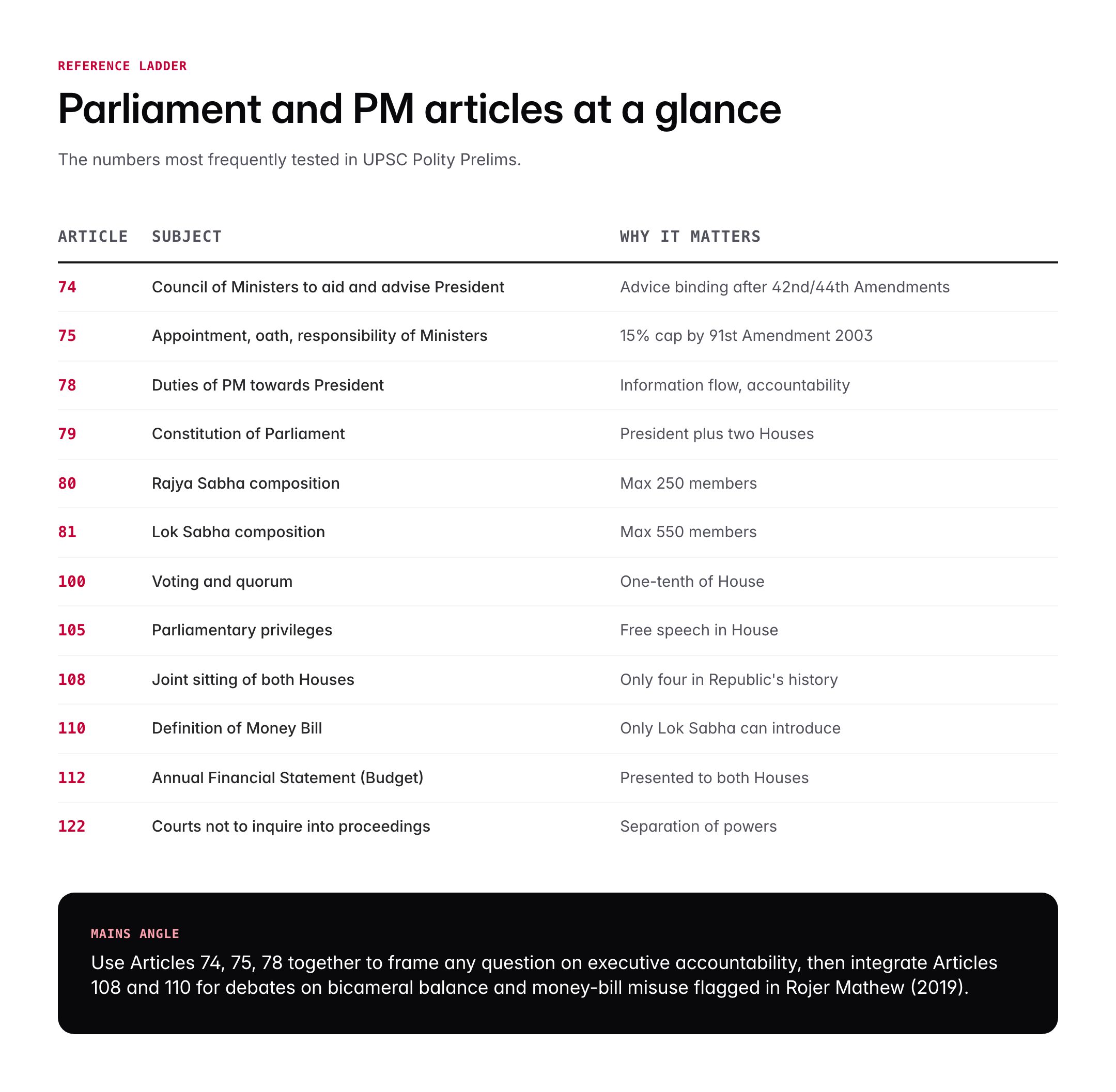
Part V Chapter II sets out the composition, powers and procedure of the Union legislature:
- Article 79: Constitution of Parliament — President plus two Houses
- Article 80: Composition of Rajya Sabha, maximum 250 members
- Article 81: Composition of Lok Sabha, maximum 550 members
- Article 82: Readjustment after each census
- Article 83: Duration of Houses, Rajya Sabha permanent, Lok Sabha five years
- Article 84: Qualifications for membership
- Article 85: Sessions, prorogation, dissolution
- Article 86: Right of President to address Parliament
- Article 87: Special address by President
- Article 88: Rights of Ministers and Attorney-General
- Article 89-92: Chairman and Deputy Chairman of Rajya Sabha
- Article 93-97: Speaker and Deputy Speaker of Lok Sabha
- Article 98: Secretariat of Parliament
- Article 99: Oath by members
- Article 100: Voting, quorum
- Article 101-104: Vacation of seats, disqualifications, penalties
- Article 105: Parliamentary privileges
- Article 106: Salaries and allowances
- Article 107-111: Legislative procedure — introduction, passing, assent
- Article 108: Joint sitting
- Article 109: Money Bills
- Article 110: Definition of Money Bills
- Article 112: Annual Financial Statement (Budget)
- Article 113-114: Demands for grants, appropriations
- Article 115: Supplementary grants
- Article 116: Votes on account, credit, exceptional grants
- Article 117: Special provision for Financial Bills
- Article 118-122: Procedure, rules, language, validity of proceedings
Articles Related to the Prime Minister (74, 75, 78)
- Article 74: Council of Ministers headed by PM to aid and advise the President; 42nd and 44th Amendments make the advice binding subject to reconsideration once
- Article 75: Appointment and terms of Ministers — PM appointed by President; Ministers by President on PM’s advice; collective responsibility to Lok Sabha; sub-clause (1A) limits Council size to 15 percent of Lok Sabha strength (91st Amendment 2003)
- Article 78: Duties of PM regarding information to be furnished to the President
- Article 85: PM advises summoning and prorogation of Houses
- Article 352: Proclamation of National Emergency on written advice of Cabinet, after 44th Amendment
Significance for UPSC and General Knowledge
- Article numbers are the backbone of Prelims Polity MCQs; high-yield from Part III, IV and V.
- Mains GS2 questions on welfare, federalism, accountability and legislative procedure draw heavily on these articles.
- DPSP provides the constitutional anchor for schemes like MGNREGS, PMJAY and the Right to Education.
- The interplay of Articles 14, 19, 21 and Directive Principles underpins the modern jurisprudence of socio-economic rights.
- For current affairs integration, 97th Amendment (cooperatives), 91st Amendment (ministry size) and 86th Amendment (RTE) connect DPSP to live policy.
- Articles on money bills (109-110) and joint sittings (108) test on near-every Prelims paper.
Detailed Analysis: DPSP in Action
The Directive Principles have been operationalised through law, policy and judicial interpretation. Article 39(b) and (c), on equitable distribution of material resources, provided the constitutional ground for the nationalisation cases of the 1960s and 1970s, including the bank nationalisation and privy purse decisions. Article 39A led to the Legal Services Authorities Act 1987 and the Lok Adalat system. Article 40 was given teeth by the 73rd Amendment Act 1992, inserting Part IX with Articles 243 to 243O.
Article 41 and 45, read together with Article 21 as interpreted in Unnikrishnan (1993) and the 86th Amendment (2002) inserting Article 21A, translated the promise of education into a justiciable right, followed by the Right of Children to Free and Compulsory Education Act 2009. Article 42 supports maternity benefit law and the labour codes of 2020. Article 43 inspires minimum wage legislation and the new wage code. Article 43B anchors the 97th Amendment’s cooperative provisions.
Article 44 on a Uniform Civil Code remains the most debated directive, invoked in Shah Bano (1985), Sarla Mudgal (1995) and Shayara Bano (2017). Article 47 underlies prohibition policy in some states and the National Food Security Act 2013. Article 48A and Article 51A(g) have been used by the Supreme Court to build environmental jurisprudence, notably in M. C. Mehta and Vellore Citizens Welfare Forum. Article 50 guided the Criminal Procedure Code 1973 reforms separating police from judiciary in districts.
The Minerva Mills case definitively held that Parts III and IV are complementary, overruling the earlier view in Champakam Dorairajan (1951) that Fundamental Rights override Directive Principles. This harmonious reading is the operative doctrine today.
Comparative Perspective
How do Directive Principles compare with their counterparts elsewhere?
| Feature | India (DPSP) | Ireland (1937) | South Africa (1996) | United Kingdom |
|---|---|---|---|---|
| Location | Part IV, Articles 36-51 | Article 45 | Socio-economic rights in Bill of Rights | No codified constitution |
| Justiciability | Non-justiciable, but fundamental | Not cognisable by courts | Justiciable, progressive realisation | Political, through statute |
| Scope | Social, economic, international | Social and economic | Housing, health, education, food | Statutory welfare |
| Source of inspiration | Irish model | Spain 1931 | ICCPR, ICESCR | Common law |
| Constitutional weight | Fundamental in governance | Guiding for legislature | Binding on state | Convention |
The Indian approach sits between the Irish and South African models. It is formally non-justiciable but has been used by courts to interpret Fundamental Rights expansively, particularly through Articles 14 and 21.
Challenges and Criticisms
Three lines of criticism recur. First, non-justiciability is argued to make DPSP a “pious wish”. Supporters respond that judicial interpretation of Articles 14 and 21 has operationalised many Directive Principles anyway, and that legislative compliance is widespread. Second, contradictions are alleged between directives, for example Article 43 on living wage and Article 47 on prohibition, or Article 44 on Uniform Civil Code and Article 29 on minority cultural rights. These are best read as political priorities to be balanced rather than legal contradictions. Third, the question of implementation gap is real. India’s social indicators on child nutrition, primary education outcomes, and sanitation lag the aspirations of Articles 45, 47 and 48A.
On Parliament-related articles, contemporary debates include the frequency of joint sittings (only four in the Republic’s history, under Article 108), the declining time spent on legislative scrutiny, and the constitutionality of money-bill routing under Article 110 flagged by the Supreme Court in Rojer Mathew (2019). On Prime Minister-related articles, the 91st Amendment’s 15-percent cap and the convention-heavy character of Articles 74, 75 and 78 raise accountability questions.
Prelims Pointers
- DPSP is in Part IV, Articles 36 to 51; Fundamental Duties in Part IV-A, Article 51A
- Article 39A, 43A and 48A added by the 42nd Amendment 1976
- Article 43B added by the 97th Amendment 2011
- Article 21A on right to education added by the 86th Amendment 2002
- Rajya Sabha maximum strength 250, Lok Sabha 550 (Articles 80 and 81)
- Article 108 for joint sitting, presided by Lok Sabha Speaker
- Article 110 defines Money Bills; only Lok Sabha can introduce
- Article 112 mandates the Annual Financial Statement (Budget)
- Article 74 aid-and-advice binding on President after 42nd Amendment 1976
- Article 75(1A) limits Council of Ministers to 15 percent of Lok Sabha strength
- Article 78 lists PM’s duties to inform the President
- Article 368 governs the constitutional amendment procedure
- Article 352 for National Emergency; only on written Cabinet advice after 44th Amendment
Mains Practice Questions
- “Directive Principles are not legally enforceable but are constitutionally fundamental.” Examine the role of judicial interpretation in bridging this gap. (250 words)
- Doctrine: harmonious construction from Champakam to Minerva Mills
- Operationalisation through Article 14 and 21 — Unnikrishnan, Olga Tellis, Vishakha
- Continuing gaps: Article 44, environment, labour
- Critically analyse the articles governing the Prime Minister and the Council of Ministers, especially in the context of accountability. (250 words)
- Articles 74, 75, 78 and allied provisions
- Conventions versus text, binding advice since 42nd/44th Amendments
- 91st Amendment’s 15 percent cap and anti-defection interplay
Conclusion
Polity for the UPSC is less about memorising 470-odd articles and more about understanding how three or four dense clusters produce the bulk of questions. The Directive Principles, the Parliament chapter and the articles governing the Prime Minister together account for a significant share of both Prelims factual questions and Mains analytical questions.
The aspirant’s real task is to combine three layers: article numbers, landmark amendments, and key case law. A table of article numbers without cases produces a dull Prelims answer; a case law summary without article numbers produces a shallow Mains answer. This article has tried to interleave the two so that the reader leaves with both the reference list and the interpretive frame needed for full marks.
Frequently Asked Questions
What are DPSP articles in the Indian Constitution?
Directive Principles of State Policy are contained in Part IV of the Indian Constitution, Articles 36 to 51. They set out guidelines for the state in making laws and policies towards a welfare society. Though not justiciable under Article 37, they are declared fundamental in the governance of the country and are a key source of legislation on social and economic rights.
Why are DPSP articles important for UPSC?
Article numbers within Part IV are frequent Prelims factual questions, while Mains GS2 answers on welfare, socio-economic rights, federal governance and judicial activism rely on DPSP. Amendments like the 42nd, 44th, 86th, 91st and 97th that added or modified DPSP and related articles link the Constitution to current policy, making them high-yield for both papers.
How are DPSP articles related to Parliament and PM articles?
DPSP (Part IV) set the substantive goals of governance. Parliament articles (79-122, Part V Chapter II) provide the legislative machinery to translate these goals into statutes, while Articles 74, 75 and 78 on the Prime Minister and Council of Ministers shape executive implementation. Together they form a complete governance loop from principles to procedure to policy delivery.
Which amendments added new DPSP articles?
The 42nd Amendment 1976 added Articles 39A (equal justice and free legal aid), 43A (workers’ participation in management) and 48A (environment, forests and wildlife). The 86th Amendment 2002 modified Article 45. The 97th Amendment 2011 added Article 43B on cooperative societies. Fundamental Duties under Article 51A were also added by the 42nd Amendment.
What is the difference between Fundamental Rights and DPSP?
Fundamental Rights (Part III, Articles 12 to 35) are justiciable and enforceable by writs in the Supreme Court under Article 32. DPSP (Part IV, Articles 36 to 51) are non-justiciable under Article 37 but constitutionally fundamental. The Minerva Mills judgment (1980) held that both parts form the basic structure and must be read harmoniously.
Which articles of the Constitution relate to Parliament?
Articles 79 to 122 in Part V Chapter II govern Parliament. Important numbers: 79 (composition), 80-81 (Rajya Sabha and Lok Sabha size), 83 (duration), 100 (quorum), 105 (privileges), 108 (joint sitting), 109-110 (Money Bills), 112 (Annual Financial Statement or Budget) and 122 (bar on courts from inquiring into Parliamentary proceedings).
Which articles govern the Prime Minister?
Articles 74, 75 and 78 are the core provisions. Article 74 mandates a Council of Ministers headed by the PM to aid and advise the President; since the 42nd and 44th Amendments this advice is binding subject to one reconsideration. Article 75 covers appointment, oath, responsibility to Lok Sabha and the 15 percent cap added by the 91st Amendment. Article 78 lists PM’s duties to inform the President.
What is Article 44 and why is UCC debated?
Article 44 is a Directive Principle requiring the state to endeavour to secure a Uniform Civil Code (UCC) for citizens throughout India. It is debated because personal laws on marriage, divorce, inheritance and adoption currently differ across religious communities. Supreme Court observations in Shah Bano (1985), Sarla Mudgal (1995) and Shayara Bano (2017) have urged implementation, while opponents cite minority rights under Articles 25 to 30.