e-Zero FIR Initiative: Online FIR Filing, BNSS Section 173, and Jurisdiction Transfer
Complete guide to the e-Zero FIR initiative: digital filing through CCTNS, the difference between Zero FIR and e-FIR, BNSS Section 173 statutory backing, the three-day signature rule, and the step-by-step transfer of a Zero FIR to the jurisdictional police station.
The e-Zero FIR initiative is a small reform with a large reach. It takes two ideas that have lived in Indian criminal procedure for years, the Zero FIR and the e-FIR, and stitches them into a single workflow that lets a citizen file an FIR from a phone, anywhere, for an offence committed anywhere else. The technical backbone is the Crime and Criminal Tracking Network and Systems, better known as CCTNS. The legal backbone is Section 173 of the Bharatiya Nagarik Suraksha Sanhita, 2023, which replaces and substantially strengthens the position of the older Code of Criminal Procedure.
The reform speaks to a recurring complaint about Indian policing. Victims who try to file a complaint at the wrong police station are often turned away on jurisdictional grounds. Victims who do not have the time or the strength to physically reach a police station drop out of the criminal justice system altogether. The e-Zero FIR is an attempt to remove both these frictions and to do so within a statutory framework that the Bharatiya Nyaya Sanhita and the BNSS have just put in place.
This guide walks through what a Zero FIR is, how the digital layer changes the citizen’s experience, the precise text and effect of BNSS Section 173, the three-day signature rule that translates a digital complaint into a legally enforceable FIR, and the way the initiative interacts with related systems such as the Indian judiciary and the Supreme Court directives that pushed Indian policing toward digitisation.
What a Zero FIR Is
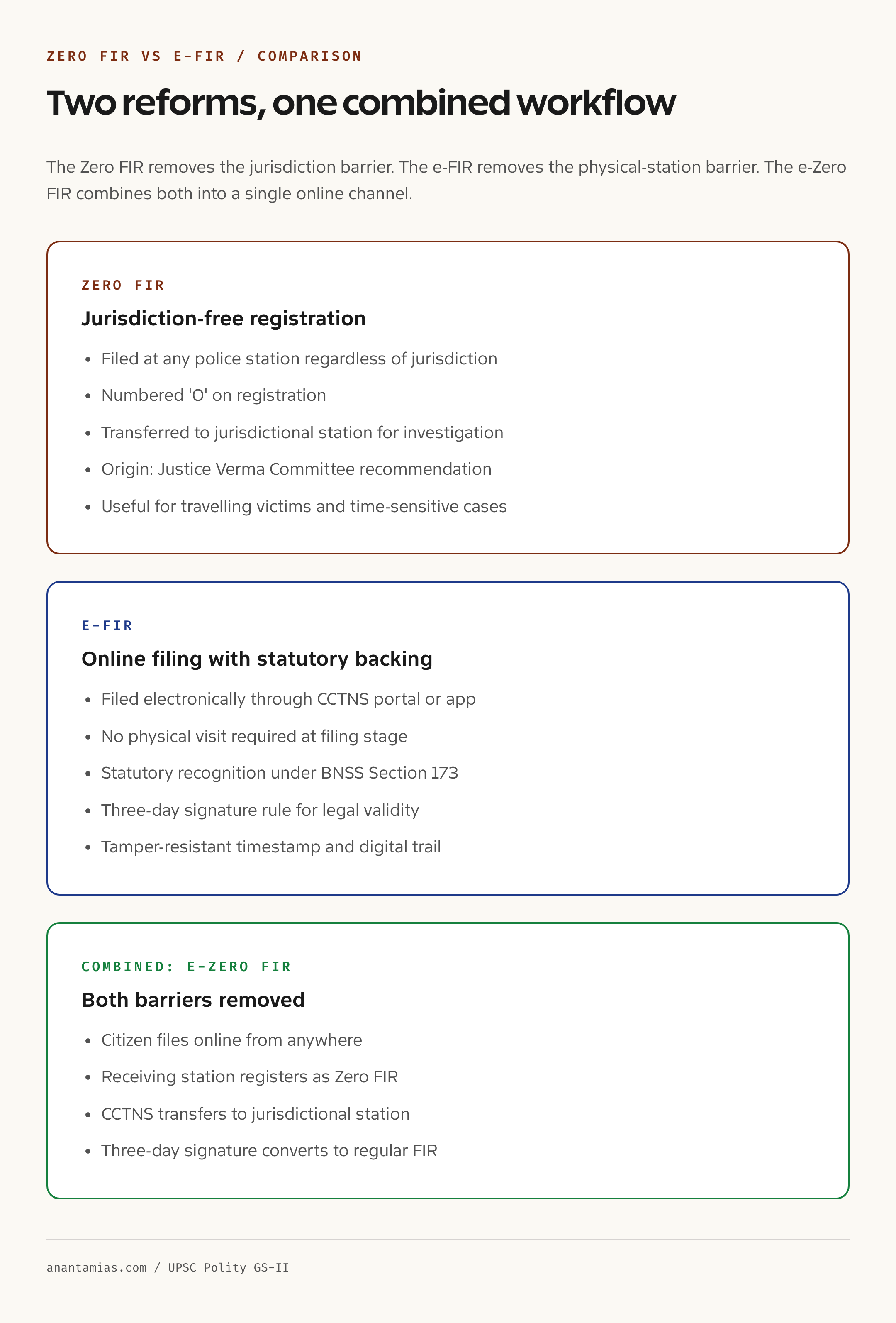
The Zero FIR is not a new concept. It dates back to the recommendations of the Justice Verma Committee, which examined the Nirbhaya case and noted that police stations frequently refused to register complaints in cases where the offence had occurred outside their jurisdiction. The Committee recommended that any police station should accept a complaint, irrespective of jurisdiction, and forward it to the relevant station.
The mechanism is straightforward. The receiving police station registers the FIR but numbers it as zero, hence the name, signalling that it does not have jurisdiction to investigate. The Zero FIR is then transferred to the police station that has territorial jurisdiction. That station converts the Zero FIR into a regular numbered FIR and begins the investigation. The intervening period gives the victim the legal protection of an FIR without the practical hurdle of having to find the right police station first.
Zero FIRs have been particularly important in cases involving travel, in cases where victims have moved across States, and in time-sensitive offences where every hour matters for evidence collection. Sexual assault cases, road accidents, kidnapping, and cybercrime have been the most frequent users of the Zero FIR mechanism.
The “e” in e-Zero FIR
Until recently, even a Zero FIR required a physical visit to a police station. The complainant had to walk in, narrate the complaint, and have it reduced to writing. The “e” in e-Zero FIR removes that physical step. Through the CCTNS portal or its associated mobile applications, a citizen can file a Zero FIR online, from anywhere, at any hour. The system routes the complaint to a designated receiving police station in the State, which generates the Zero FIR electronically.
The CCTNS infrastructure had been in development for over a decade. It was envisaged as a national database that connects all police stations and allows seamless data sharing across jurisdictions. The e-Zero FIR is one of its first citizen-facing applications. It uses the same database that police use internally, but exposes a controlled interface to citizens.
The digital layer is more than convenience. It generates a tamper-resistant timestamp, a digital trail of the complaint, and a clear chain of custody from complaint to investigation. It also reduces the discretion of the desk officer who used to be the gatekeeper of FIR registration. A digitally filed complaint cannot be refused as easily as a verbal complaint at a counter.
Section 173 of the BNSS
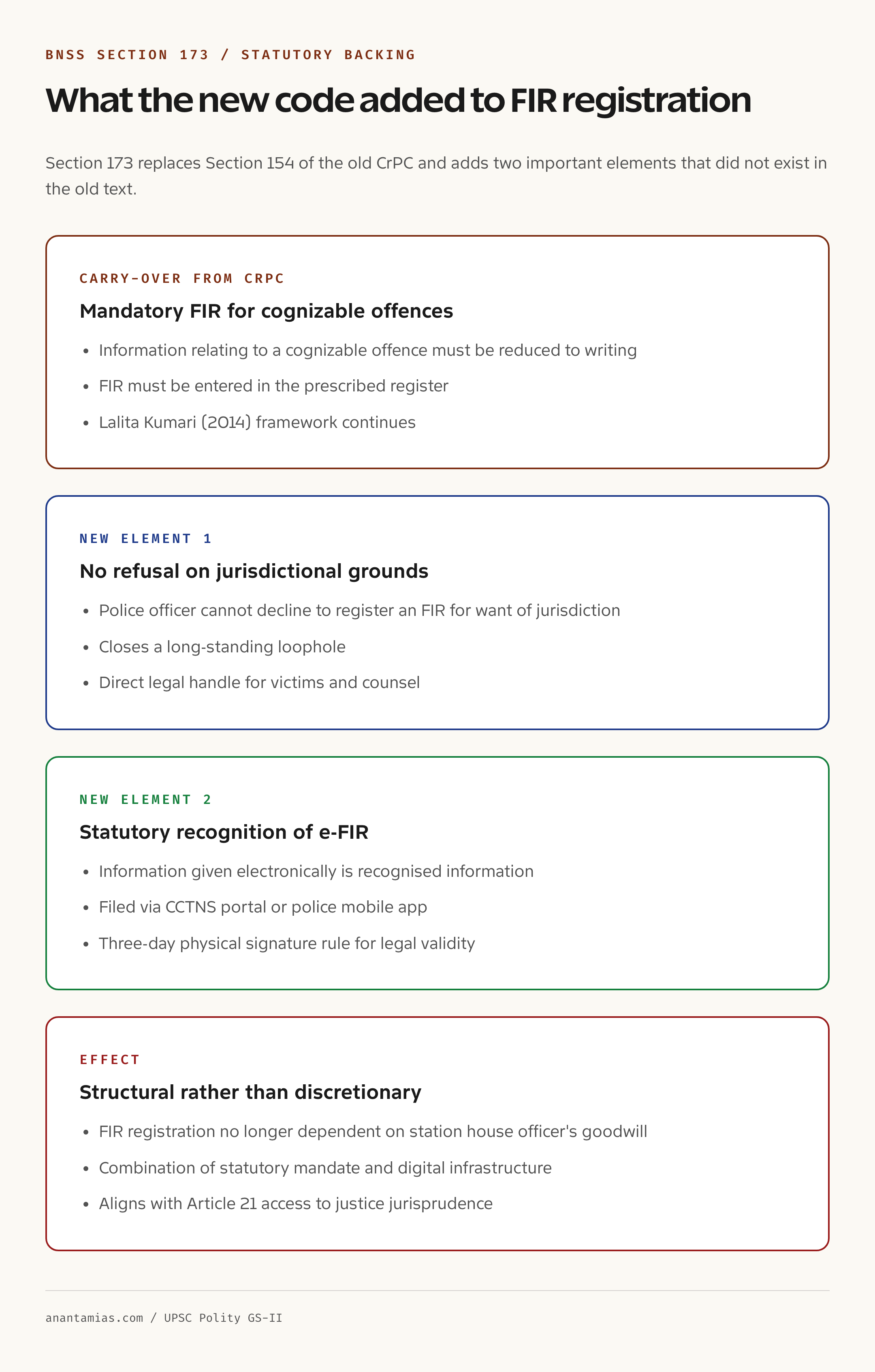
Section 173 of the Bharatiya Nagarik Suraksha Sanhita, 2023 is the legal heart of the reform. The section is the BNSS counterpart to Section 154 of the old Code of Criminal Procedure. It carries forward the basic rule that information relating to a cognizable offence must be reduced to writing and registered, but it adds two important new elements.
First, it explicitly mandates that a police officer cannot refuse to register an FIR on the ground of jurisdiction. The phrasing closes a long-standing loophole. Even before the BNSS, judicial decisions held that jurisdictional refusal was illegal, but the practice continued. Putting the rule into the statutory text gives victims and their lawyers a direct legal handle against any officer who refuses to register a Zero FIR.
Second, Section 173 gives statutory recognition to e-FIRs. For the first time, electronic filing of an FIR is not merely an administrative or procedural innovation but a recognised statutory pathway. Information given electronically is treated as information for the purposes of the section, with one important rider that links back to the physical world.
The Three-Day Signature Rule
Section 173 provides that for an electronically filed FIR to be treated as a regular legal FIR, the complainant must sign the physical copy within three days. This is the so-called three-day rule and it is the hinge between the digital filing and the eventual prosecution.
The rationale is partly evidentiary and partly anti-fraud. An electronically filed complaint can be made by anyone with access to a phone, an email address, or a basic identity. Without a physical signature, there is no easy way to confirm that the named complainant actually filed the complaint. The three-day rule asks the complainant to walk into the relevant police station, verify identity, and sign the printed FIR. Once that step is complete, the FIR has the same legal status as one filed physically from the start.
The rule has practical implications for victims who are travelling, who live abroad, or who are physically incapacitated. Police authorities are increasingly building in flexibility for such cases through video verification and authorised representatives, but the statutory baseline remains the three-day physical signature requirement.
The Step-by-Step Workflow
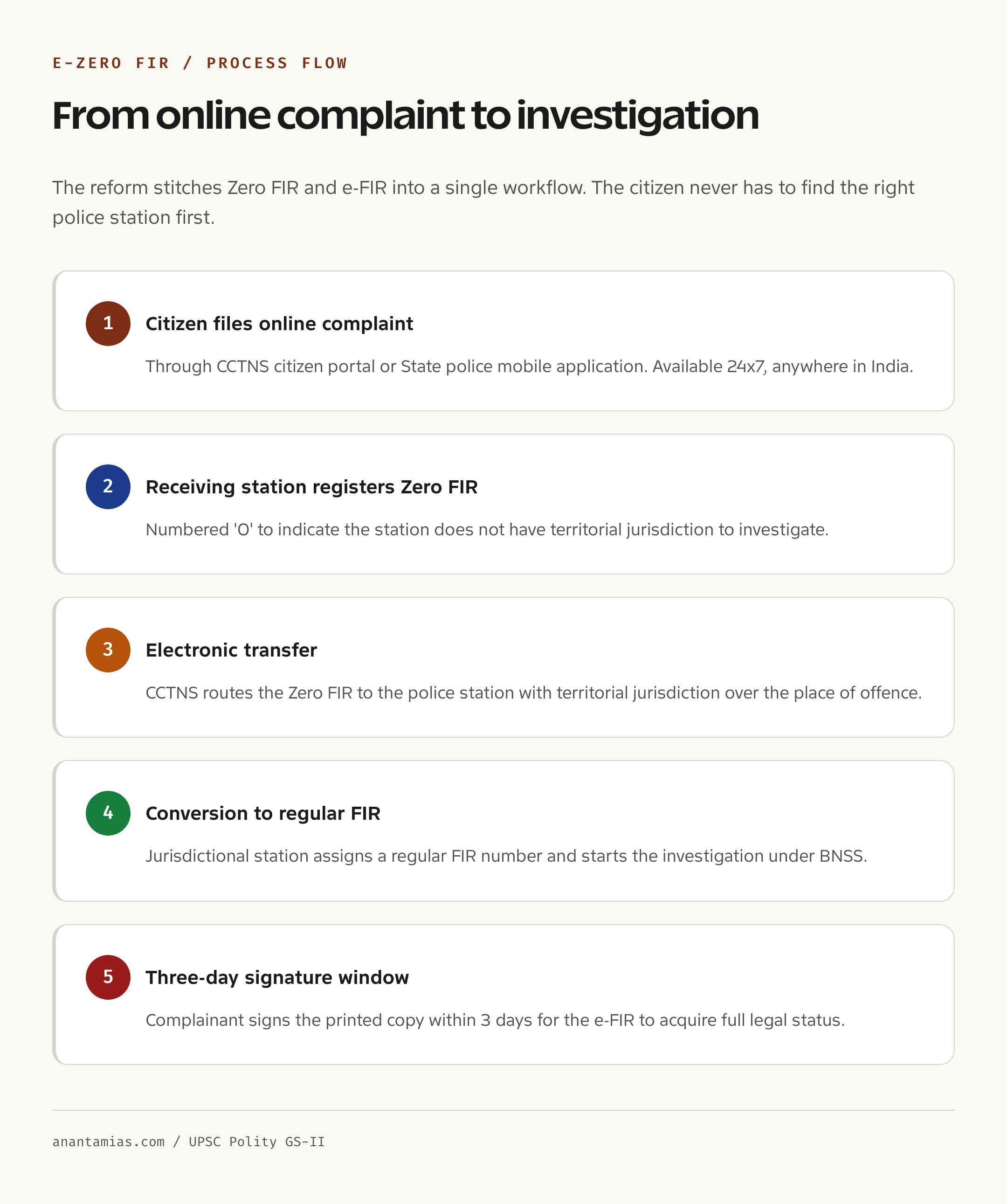
The citizen’s journey from complaint to investigation under the e-Zero FIR initiative typically runs in five steps. The citizen logs into the CCTNS citizen portal or the State police mobile application and files an electronic complaint, narrating the offence and providing supporting details. The receiving police station, which is designated to accept State-wide e-Zero FIRs, registers the complaint as a Zero FIR with number zero in its register.
The system then transfers the Zero FIR electronically to the police station that has territorial jurisdiction over the place of the offence. The transfer happens in real time within the CCTNS database. The jurisdictional station receives the Zero FIR, converts it into a regular numbered FIR, and begins the investigation. The complainant signs the physical copy within the three-day window to complete the legal formalities. From the complainant’s point of view, the entire journey can be completed without ever visiting the receiving station.
How the Initiative Interacts With Existing Mechanisms
The e-Zero FIR sits alongside several related citizen-facing mechanisms. The cybercrime reporting portal at the National Cybercrime Reporting Portal is a separate channel for cyber offences. The 112 emergency response system handles real-time emergencies. The State women helplines and child helplines route specific categories of complaints to specialised cells. The e-Zero FIR is the general-purpose complement to all of these. It works for the broad universe of cognizable offences and connects to the regular police investigation pipeline.
Coordination across these channels is improving but remains uneven. A cybercrime complaint filed on the National Cybercrime Reporting Portal can be converted into an FIR through the CCTNS link. A 112 call that turns out to involve a cognizable offence can trigger an FIR at the responding station. The e-Zero FIR is increasingly the back-end through which these multiple front-ends route their complaints.
State-Level Implementation Patterns
The pace of e-Zero FIR rollout has varied by State. States with mature CCTNS infrastructure and strong digital governance, such as Delhi, Andhra Pradesh, Telangana, and Maharashtra, have moved fastest. They offer fully online filing, generate Zero FIR copies via email, and have integrated SMS-based status tracking. Other States are still finalising their citizen portals or running them only in pilot mode.
The Ministry of Home Affairs has issued advisories pushing all States to fully implement the e-Zero FIR within their CCTNS rollouts. The advisories also require States to publish standard operating procedures for the three-day signature window, including arrangements for victims who cannot physically appear within the window. The Bureau of Police Research and Development tracks compliance and publishes periodic reports.
Constitutional and Article 21 Dimension
The e-Zero FIR initiative ties into the broader constitutional understanding of access to justice. The right to life under Article 21 has been read to include the right to a fair and effective investigation. Refusal to register an FIR has been held by the Supreme Court to violate that right. The Lalita Kumari v. State of Uttar Pradesh judgment, decided by a Constitution Bench in 2014, made FIR registration mandatory in cognizable offences and laid down a narrow set of exceptions in which a preliminary inquiry may precede the FIR.
The e-Zero FIR operationalises Lalita Kumari’s principles by removing the physical and jurisdictional barriers that historically frustrated FIR registration. It also complements the fundamental rights framework by giving victims a workable channel that does not depend on the goodwill of a station house officer. The combination of statutory mandate under Section 173 and digital infrastructure under CCTNS creates a structural rather than discretionary protection.
Practical Limitations and Gaps
The initiative is not without limits. Internet penetration and digital literacy remain uneven, particularly in rural areas where the most vulnerable victims often live. The three-day signature rule, while reasonable on paper, can be a barrier for victims who are unable to travel. Language remains an issue, with citizen portals not yet uniformly available in all regional languages and dialects.
There are also concerns about quality of complaint drafting. An electronic complaint drafted by a layperson without legal advice can omit material details, leaving the FIR weak from the start. State police forces have begun to publish templated forms and guides to address this, but the reform is still maturing. Privacy is another concern. CCTNS contains sensitive personal data, and any citizen-facing layer must be matched by robust data protection.
UPSC Relevance and Question Patterns
The e-Zero FIR is a high-yield topic for UPSC GS Paper II. Likely prelims questions test knowledge of CCTNS, the meaning of Zero FIR, and the BNSS section number. Mains questions can ask candidates to evaluate the reform within the broader project of police reform, to discuss Article 21 implications, or to compare the BNSS provision with the older CrPC framework.
A good answer should distinguish Zero FIR from e-FIR, identify Section 173 BNSS as the statutory anchor, mention the three-day rule, and connect the reform to the Lalita Kumari precedent. Mentioning CCTNS as the technical backbone and the State-level variation in rollout adds depth. The reform’s link to victim-centric justice, particularly for women and migrant workers, is a useful framing for ethics and society overlap.
Frequently Asked Questions
What is the e-Zero FIR initiative?
The e-Zero FIR initiative is a digital mechanism that allows citizens to file a Zero FIR online through the CCTNS portal or police mobile applications, without visiting a police station. The receiving station registers it as a Zero FIR and electronically transfers it to the station with territorial jurisdiction.
What is the difference between Zero FIR and e-FIR?
A Zero FIR is registered at any police station regardless of jurisdiction and later transferred to the relevant station. An e-FIR is filed electronically from anywhere and given statutory recognition under BNSS Section 173. The e-Zero FIR combines both ideas into a single online workflow.
What does BNSS Section 173 provide?
BNSS Section 173 mandates registration of cognizable offences, prohibits refusal of FIR registration on jurisdictional grounds, and gives statutory recognition to electronically filed FIRs. It also requires the complainant to sign the physical copy within three days for the e-FIR to be treated as a regular legal FIR.
What is the three-day rule for e-FIR?
The three-day rule under BNSS Section 173 requires the complainant to physically sign the printed copy of the e-FIR within three days of electronic filing. Without this signature, the e-FIR does not acquire the legal status of a regular FIR.
How does CCTNS support the e-Zero FIR?
CCTNS is the national database that links police stations across India. It hosts the citizen portal and mobile applications used to file e-Zero FIRs and handles the back-end transfer of a Zero FIR from the receiving station to the jurisdictional station in real time.
Can an e-Zero FIR be refused on jurisdictional grounds?
No. Section 173 of the BNSS expressly prohibits any police officer from refusing to register an FIR on the ground of jurisdiction. Such refusal is a statutory breach and the complainant has remedies before the Superintendent of Police and the courts.