Indian Judiciary: Structure, Independence & Reforms
The Indian judiciary is an integrated, independent system with the Supreme Court at its apex, followed by High Courts and subordinate courts. Unlike the American dual court system, India has a single hierarchy where all courts — from district level to the Supreme Court — apply both Union and State laws. Judicial independence, guaranteed through constitutional provisions, makes the judiciary the guardian of Fundamental Rights and the Constitution. This is a core UPSC Polity topic spanning Prelims, Mains, and the Interview.
Structure of the Indian Judiciary
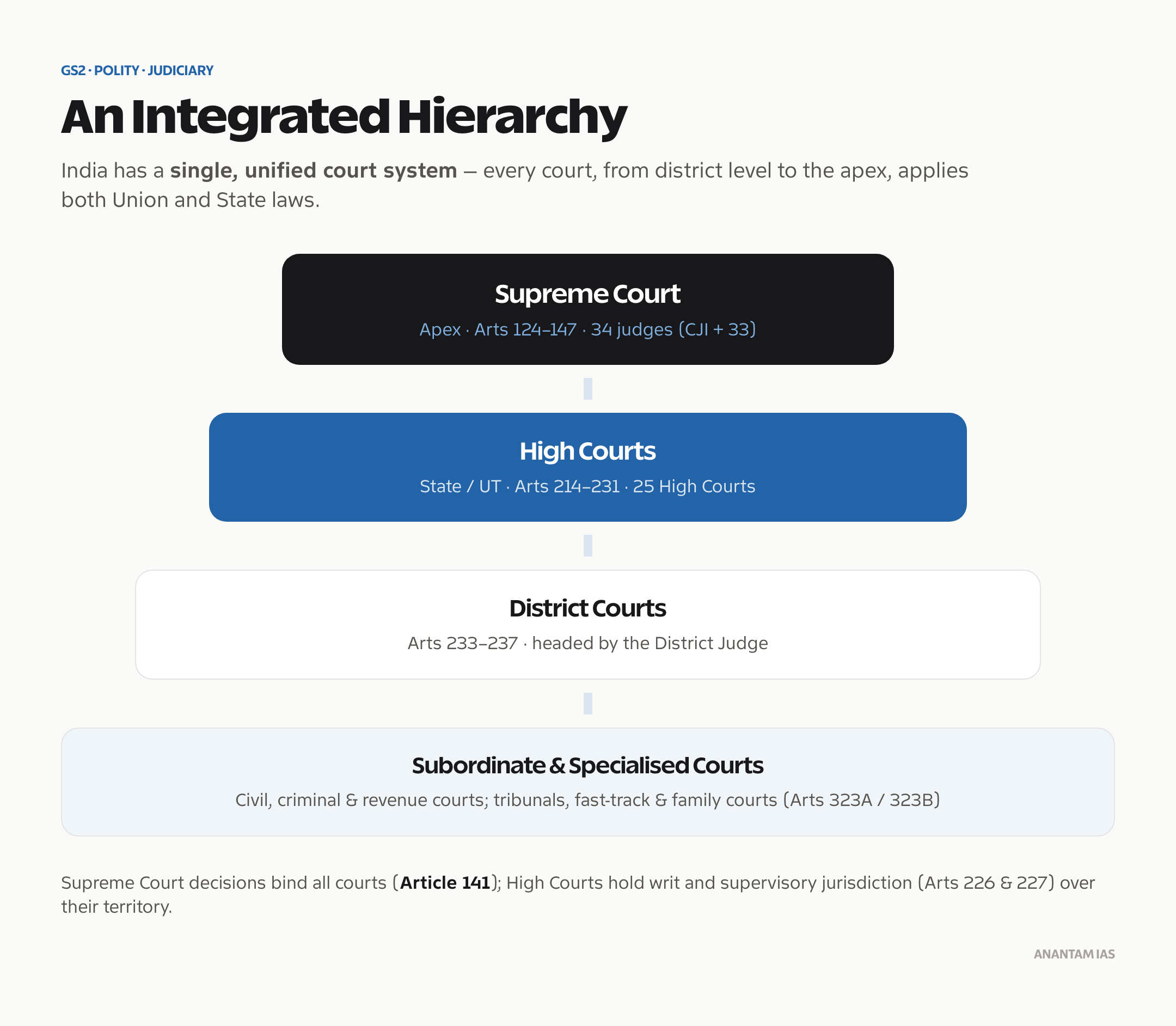
Hierarchical Organisation
The Indian court system operates in a strict hierarchy:
| Level | Court | Constitutional Basis |
|---|---|---|
| Apex | Supreme Court of India | Articles 124–147 (Part V) |
| State/UT | High Courts (25) | Articles 214–231 (Part VI) |
| District | District Courts | Articles 233–237 (Part VI) |
| Subordinate | Civil Courts, Criminal Courts, Revenue Courts | State legislation |
| Specialised | Tribunals, Fast Track Courts, Family Courts | Articles 323A, 323B; Parliamentary/State legislation |
Supreme Court
The Supreme Court sits in New Delhi with a sanctioned strength of 34 judges (CJI + 33). It exercises original, appellate, and advisory jurisdiction. Decisions of the Supreme Court are binding on all courts in India (Article 141). It has the power of judicial review and can strike down laws that violate the Constitution.
High Courts
Each state has a High Court, though some High Courts serve multiple states and UTs. Currently, there are 25 High Courts across India. The newest are the High Courts for Andhra Pradesh (separated from Telangana, 2019) and Telangana.
Jurisdiction of High Courts:
- Original jurisdiction in revenue matters, enforcement of Fundamental Rights (Article 226), and company law
- Appellate jurisdiction over subordinate courts in civil and criminal matters
- Supervisory jurisdiction over all courts and tribunals within their territory (Article 227)
- Writ jurisdiction wider than the Supreme Court — for Fundamental Rights and “any other purpose”
- Power of judicial review over state legislation
- Court of Record with contempt powers
District and Subordinate Courts
District Courts are headed by the District Judge, the highest judicial authority at the district level. Below them are:
- Civil Courts: Munsif Courts, Civil Judge (Junior Division), Civil Judge (Senior Division)
- Criminal Courts: Judicial Magistrate (First/Second Class), Chief Judicial Magistrate, Sessions Court
- Revenue Courts: At tehsil/taluka level (in some states)
The District Judge is appointed by the Governor in consultation with the High Court of the state (Article 233). Subordinate judges are appointed by the Governor after consultation with the State Public Service Commission and the High Court.
Judicial Independence
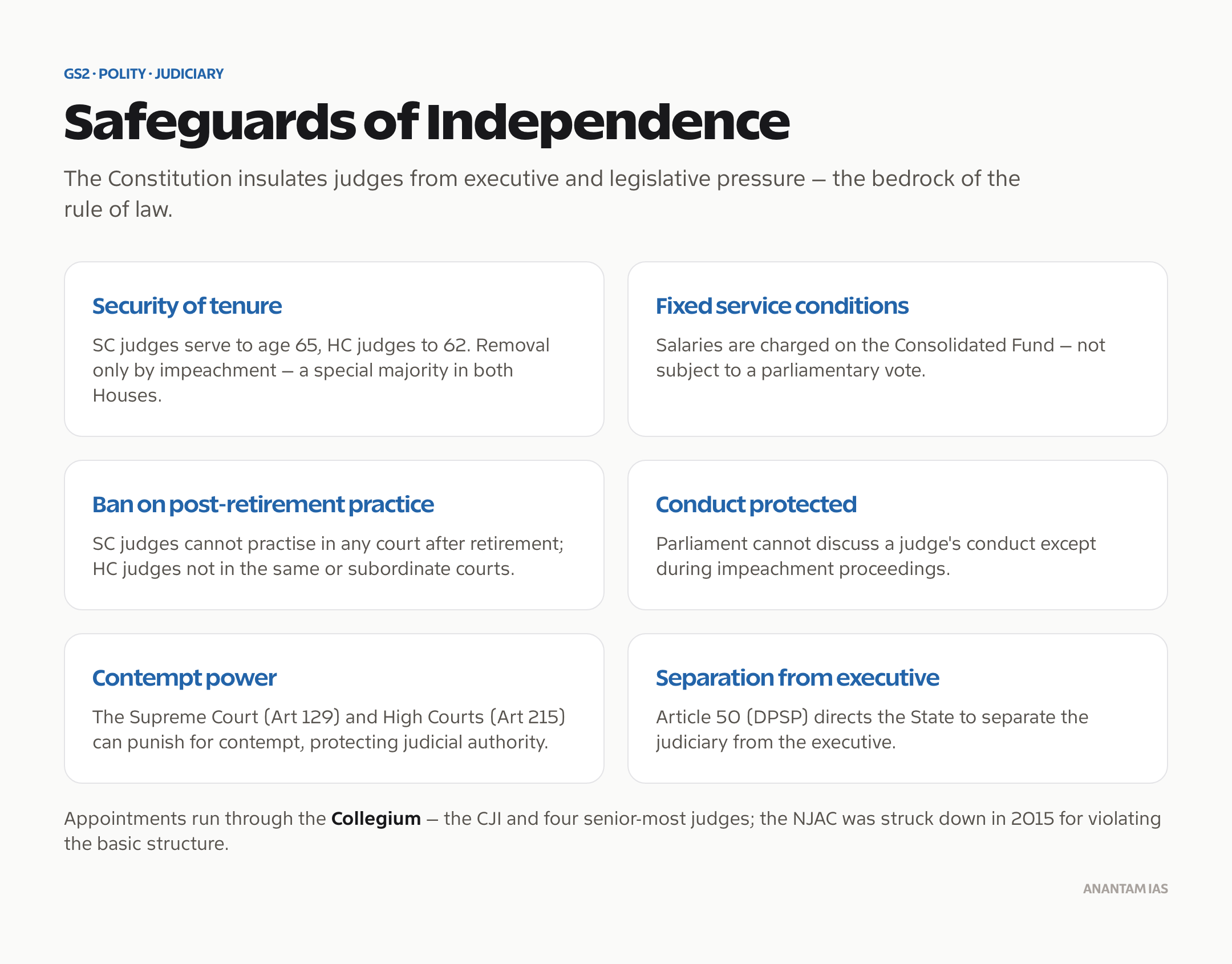
Judicial independence is the bedrock of the rule of law. The Constitution provides multiple safeguards:
Constitutional Safeguards
Security of Tenure: Supreme Court judges serve until 65 years, High Court judges until 62 years. Removal only through impeachment — a rigorous process requiring special majority in both Houses of Parliament.
Fixed Service Conditions: Salaries, allowances, and privileges of judges are charged on the Consolidated Fund of India (Supreme Court) or the Consolidated Fund of the State (High Court). They aren’t subject to parliamentary vote.
Ban on Post-Retirement Practice: Supreme Court judges can’t practise in any court after retirement. High Court judges can’t practise in the same High Court or subordinate courts after retirement.
Protection of Conduct Discussion: Parliament can’t discuss the conduct of Supreme Court or High Court judges except during impeachment proceedings.
Contempt Power: Both the Supreme Court (Article 129) and High Courts (Article 215) can punish for contempt, protecting judicial authority.
Separation from Executive: Article 50 (DPSP) directs the state to separate the judiciary from the executive — largely achieved through the Criminal Procedure Code amendments.
Comparison: Judicial Independence Safeguards
| Safeguard | India | USA | UK |
|---|---|---|---|
| Appointment | Collegium (judges appoint judges) | President nominates, Senate confirms | Independent Judicial Appointments Commission |
| Tenure | Until retirement age (65/62) | Life tenure (“good behaviour”) | Until retirement (70/75) |
| Removal | Parliamentary impeachment | Congressional impeachment | Address by both Houses |
| Salary Protection | Charged on Consolidated Fund | Congress can’t reduce | Charged on Consolidated Fund |
| Judicial Review | Yes (explicit + basic structure) | Yes (implied from Marbury v. Madison) | Limited (Parliamentary sovereignty) |
The Collegium System
The Collegium System governs the appointment and transfer of judges to the Supreme Court and High Courts. It emerged through judicial interpretation, not from constitutional text.
How It Works
For Supreme Court: The Collegium comprises the CJI and four senior-most Supreme Court judges. They recommend names to the government for appointment. The government can return recommendations for reconsideration, but if the Collegium reiterates its recommendation, the government is bound to accept.
For High Courts: The Collegium recommends names in consultation with the Chief Justice of the concerned High Court and the Governor of the state.
Criticisms of the Collegium
- Lack of transparency: No published criteria for selection; deliberations are opaque
- Nepotism concerns: “Uncle judges” — allegations of favouring relatives and associates
- No accountability: Judges appoint judges without external checks
- Diversity deficit: Underrepresentation of women, SC/STs, and other communities
- Executive exclusion: Government reduced to a clerical role
NJAC: The Failed Alternative
The 99th Constitutional Amendment (2014) established the National Judicial Appointments Commission comprising the CJI, two senior Supreme Court judges, the Law Minister, and two eminent persons. The Supreme Court struck it down in 2015, ruling that it violated the basic structure by compromising judicial independence. The debate over a better appointment mechanism continues.
Judicial Reforms
Pendency Crisis
The most pressing challenge. As of 2024:
- Supreme Court: ~80,000 pending cases
- High Courts: ~60 lakh pending cases
- District/Subordinate Courts: ~4.5 crore pending cases
The total pendency exceeds 5 crore cases — a staggering backlog that undermines access to justice.
Key Reform Measures
National Judicial Infrastructure Corporation: Proposed to create a dedicated body for planning, funding, and managing court infrastructure. Currently, courts often operate in inadequate facilities.
E-Courts Project: Launched in 2007, it aims to computerise all district and subordinate courts. Phase III focuses on digital courts, paperless filing, video conferencing, and interoperability of judicial data.
Fast Track Courts: Established for time-bound disposal of specific categories — heinous crimes, cases against MPs/MLAs, sexual offences (POCSO cases), and senior citizen cases.
Gram Nyayalayas Act, 2008: Provides for village-level courts for speedy justice. Implementation has been slow — only about 400 operational out of a target of thousands.
Lok Adalats and Mediation: Alternative dispute resolution mechanisms under the Legal Services Authorities Act, 1987. Lok Adalats provide free and speedy justice for pre-litigation and pending cases. The National Lok Adalat system disposes of lakhs of cases annually.
Increasing Judge Strength: The Law Commission (245th Report) recommended increasing judges to 50 per million population (current ratio is approximately 21 per million). Filling existing vacancies is a perennial issue — hundreds of positions remain unfilled across High Courts and district courts.
All India Judicial Service (AIJS)
Article 312 empowers Rajya Sabha to create an All India Judicial Service by special majority resolution. The idea — recruiting district judges through a centralised exam similar to UPSC — has been debated for decades. Proponents argue it would improve quality and fill vacancies faster. Opponents worry about undermining High Court control and ignoring regional language requirements.
Tribunals in India
Articles 323A and 323B (inserted by the 42nd Amendment) authorise Parliament and state legislatures to establish tribunals.
Key Tribunals:
- Central Administrative Tribunal (CAT): Service matters of Union government employees
- National Green Tribunal (NGT): Environmental disputes
- National Company Law Tribunal (NCLT): Company law matters
- Income Tax Appellate Tribunal (ITAT): Tax disputes
- Armed Forces Tribunal (AFT): Service matters of armed forces personnel
The Supreme Court in L. Chandra Kumar v. Union of India (1997) held that tribunal decisions are subject to High Court judicial review under Articles 226/227 — tribunals can’t be a substitute for High Courts.
The Tribunals Reforms Act, 2021 fixed tenure, qualifications, and appointment procedures for tribunal members. However, the Supreme Court struck down provisions that reduced member tenure to four years, insisting on minimum five-year terms for independence.
Judicial Accountability
In-House Procedure
The Supreme Court adopted an In-House Procedure in 1999 for dealing with complaints against judges. The CJI can form a three-member committee to examine complaints. If the complaint is substantiated, the judge may be advised to resign or the CJI may not allocate judicial work.
Judicial Standards and Accountability Bill
Introduced in Parliament in 2010 but lapsed, this bill sought to establish a mechanism for investigating complaints against High Court and Supreme Court judges. It proposed a National Judicial Oversight Committee and required judges to declare assets. The bill hasn’t been reintroduced.
Contempt of Court
The Contempt of Courts Act, 1971 defines civil contempt (disobedience of court orders) and criminal contempt (scandalising the court, interfering with judicial proceedings). The Supreme Court’s power to punish for contempt has been controversially applied — notably in the case of Prashant Bhushan (2020), where a Re. 1 fine was imposed for contemptuous tweets.
Supreme Court of India Judicial Activism Separation of Powers
Frequently Asked Questions
How many courts are there in India?
India has a three-tier integrated court system: the Supreme Court (1), High Courts (25 — serving all states and UTs), and subordinate courts (district courts, sessions courts, magistrate courts) numbering over 20,000 across the country. Additionally, specialised tribunals like CAT, NGT, and NCLT handle specific categories of disputes outside the regular court hierarchy.
What is the collegium system of judicial appointments?
The Collegium System is a judge-led mechanism for appointing and transferring judges to the Supreme Court and High Courts. For the Supreme Court, the CJI and four senior-most judges form the Collegium. It emerged from the Second (1993) and Third (1998) Judges Cases through judicial interpretation. The system has no statutory basis and has been criticised for opacity and lack of accountability.
What are the main challenges facing Indian judiciary?
The biggest challenge is the pendency of over 5 crore cases across all courts, caused by inadequate judge strength, slow proceedings, and frequent adjournments. Other challenges include judicial vacancies (hundreds unfilled in High Courts), poor court infrastructure, lack of diversity on the bench, opacity in appointments through the Collegium, and the need for better use of technology and alternative dispute resolution.
What is the difference between civil and criminal courts?
Civil courts handle disputes between private parties involving property, contracts, family matters, and monetary claims. Criminal courts try cases involving offences against the state — crimes punishable under the Bharatiya Nyaya Sanhita (formerly IPC) and other penal statutes. Civil courts award remedies like damages and injunctions. Criminal courts impose punishment including imprisonment and fines. The burden of proof differs: preponderance of probability in civil cases, beyond reasonable doubt in criminal cases.
Tell Google you want more of this.
Add Anantam IAS as a preferred sourceOne tap, and this site shows up more often in your own Top Stories, AI Overviews and AI Mode. Remove it any time.