Earth Day (22 April): Theme, History, Mission LiFE & UPSC Notes
Earth Day 2026 is observed on 22 April under the theme 'Our Power, Our Planet'. Know its 1970 origin, Rio/Paris links, India's Panchamrit climate commitments and UPSC angles.
Earth Day is observed every year on 22 April to demonstrate support for environmental protection. First held in 1970, it now mobilises more than 1 billion people in 193 countries — the largest secular civic observance in the world. The 2026 theme is “Our Power, Our Planet”, calling for tripling renewable electricity generation by 2030.
The UN General Assembly formally designated 22 April as International Mother Earth Day in 2009 (Resolution A/RES/63/278). For UPSC aspirants, the day links Prelims facts, GS-III environment, and GS-II international governance.
When and Why Is Earth Day Observed?
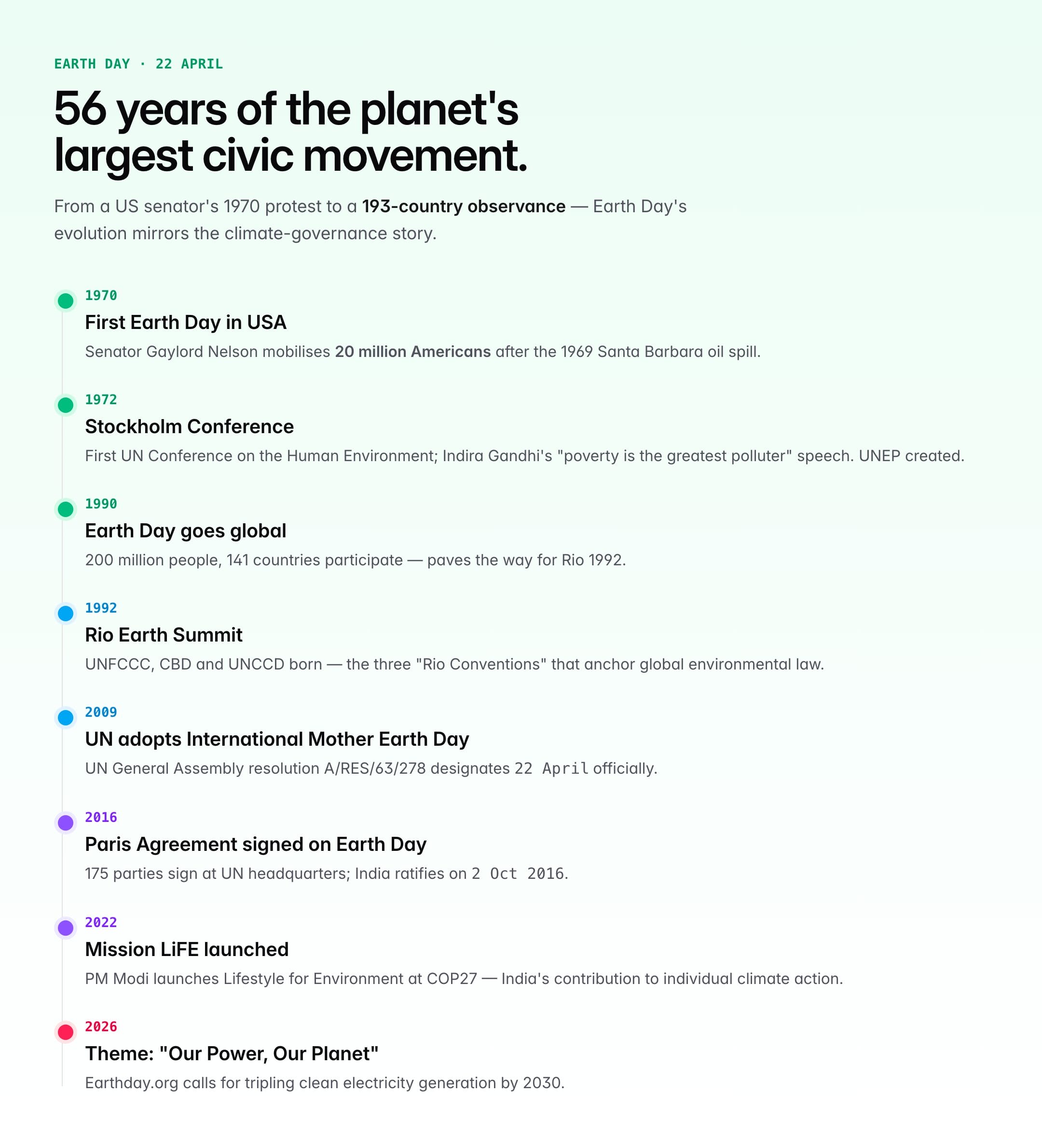
Earth Day was conceived by US Senator Gaylord Nelson of Wisconsin in response to the massive 1969 Santa Barbara oil spill — then the worst in US history. On 22 April 1970, 20 million Americans took part in rallies, teach-ins and demonstrations across university campuses and cities — one of the largest single-day protests in American history.
The first Earth Day directly led to:
- Creation of the US Environmental Protection Agency (EPA) in December 1970
- Passage of the Clean Air Act (1970), Clean Water Act (1972), and Endangered Species Act (1973)
- Birth of the modern environmental movement globally
Earth Day 2026 Theme: “Our Power, Our Planet”
Earthday.org, the global organiser, has fixed the 2026 theme as “Our Power, Our Planet” — a multi-year focus on tripling global clean electricity generation by 2030. The campaign builds on COP28’s (Dubai, 2023) pledge by 130+ countries to triple renewable capacity.
Past Earth Day Themes
| Year | Theme |
|---|---|
| 2026 | Our Power, Our Planet |
| 2025 | Our Power, Our Planet |
| 2024 | Planet vs Plastics |
| 2023 | Invest in Our Planet |
| 2022 | Invest in Our Planet |
| 2021 | Restore Our Earth |
| 2020 | Climate Action (50th anniversary) |
| 2019 | Protect Our Species |
| 2018 | End Plastic Pollution |
History of Earth Day — From 1970 to 2026
The Organisations Behind Earth Day
- EARTHDAY.ORG (formerly Earth Day Network) — the global coordinator of Earth Day campaigns, founded 1970.
- UNEP (United Nations Environment Programme) — created in 1972 after Stockholm; headquartered in Nairobi, Kenya.
- UNFCCC — UN Framework Convention on Climate Change, born at Rio 1992, anchors the Paris Agreement.
Earth Day and International Environmental Governance
Earth Day is not a standalone observance — it sits inside a dense web of multilateral environmental treaties. The key conferences and conventions every UPSC aspirant must memorise:
| Year | Event | Outcome |
|---|---|---|
| 1972 | UN Conference on Human Environment, Stockholm | Stockholm Declaration; UNEP created |
| 1987 | Brundtland Report Our Common Future | Defined “sustainable development” |
| 1987 | Montreal Protocol | Phase-out of ozone-depleting substances |
| 1992 | Rio Earth Summit (UNCED) | UNFCCC, CBD, UNCCD (Rio Conventions); Agenda 21 |
| 1997 | Kyoto Protocol | First binding emission cuts for developed countries |
| 2002 | Johannesburg Summit (Rio+10) | Plan of Implementation |
| 2012 | Rio+20 | “The Future We Want” — SDGs process initiated |
| 2015 | Paris Agreement (COP21) | 1.5°C goal, NDCs, global stocktake |
| 2023 | COP28 Dubai | Global Stocktake; “transition away from fossil fuels” |
| 2025 | COP30 Belém, Brazil | Updated NDCs; Just Transition Work Programme |
India’s Climate Commitments — The Panchamrit
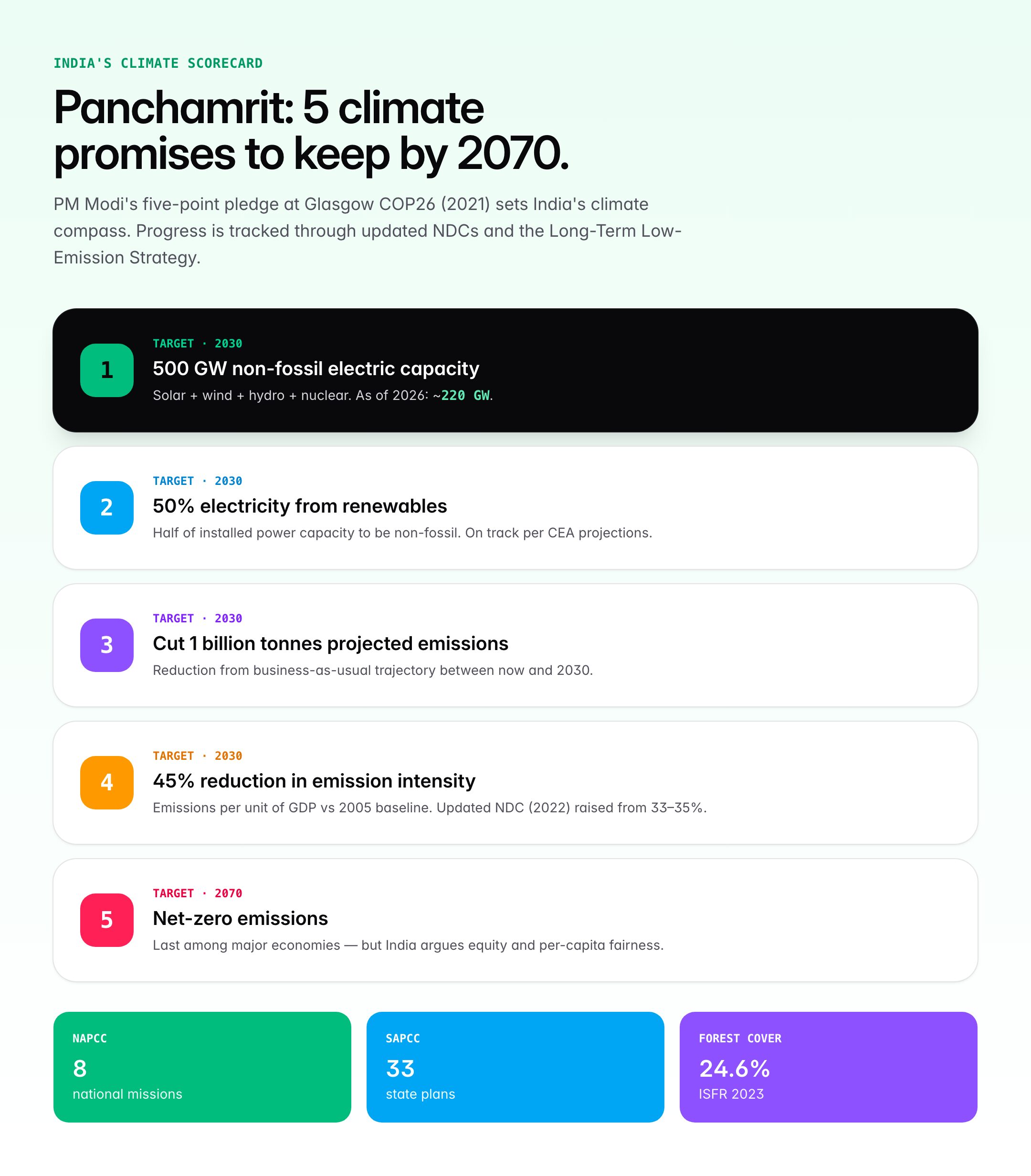
At COP26 (Glasgow, November 2021), Prime Minister Narendra Modi announced India’s Panchamrit — five “nectar elements” of climate action. These were formalised in the Updated NDC (August 2022):
- 500 GW non-fossil fuel electric installed capacity by 2030
- 50% of electricity from renewables by 2030
- Cumulative reduction of 1 billion tonnes of projected emissions from now to 2030
- Reduce emission intensity of GDP by 45% from 2005 levels by 2030 (updated from 33–35%)
- Achieve net-zero emissions by 2070
Mission LiFE — India’s Contribution to Earth Day
Mission LiFE (Lifestyle for Environment) was launched by PM Modi at COP27 (Sharm El-Sheikh, November 2022). It is India’s answer to the question: what can individuals do for the planet?
LiFE shifts climate discourse from nation-state targets to individual behaviour. Seven thematic areas:
- Save energy
- Save water
- Say no to single-use plastic
- Adopt sustainable food systems
- Reduce waste (e-waste, food waste)
- Adopt healthy lifestyles
- Reduce e-waste
Key Environment Legislation & Schemes in India
- Environment Protection Act, 1986 — umbrella law (post-Bhopal)
- Air (Prevention and Control of Pollution) Act, 1981
- Water (Prevention and Control of Pollution) Act, 1974
- Forest Conservation Act, 1980 (amended 2023)
- Wildlife Protection Act, 1972
- Biological Diversity Act, 2002
- NAPCC (2008) — 8 national missions including Solar, Enhanced Energy Efficiency, Water, Himalayan Ecosystem, Green India, Sustainable Agriculture, Strategic Knowledge for Climate Change, Sustainable Habitat
- PM Surya Ghar Muft Bijli Yojana (2024) — 1 crore rooftop solar homes
- Green Credit Programme (2023)
- National Green Hydrogen Mission (2023)
- Namami Gange Mission
India’s Position in Global Climate Negotiations
India’s negotiating stance is anchored in Common But Differentiated Responsibilities (CBDR) — a principle enshrined at Rio 1992. Core positions:
- Historical responsibility: developed countries caused the climate crisis; they must lead mitigation.
- Per-capita equity: India’s per-capita emissions (~1.9 tCO2e) are a third of the global average; about one-seventh of the US.
- Climate finance: the $100 billion/year pledge by developed countries remains unfulfilled; India demands $1 trillion/year post-2025.
- Technology transfer: IPR flexibility for green tech.
- Loss and Damage Fund (operationalised at COP28) — India a key advocate for developing countries.
Major Environmental Threats — The UPSC List
- Climate change — 1.5°C breach likely within a decade per IPCC AR6
- Biodiversity loss — 1 million species face extinction (IPBES 2019)
- Air pollution — India has 39 of the world’s 50 most-polluted cities (IQAir 2024)
- Plastic pollution — 11M tonnes enter oceans annually; India banned 19 SUP items in 2022
- Water stress — NITI Aayog Composite Water Management Index
- Deforestation — net forest cover rising in India but dense forest declining
- Soil degradation — 30% of India’s land degraded (UNCCD)
UPSC Relevance
Prelims Pointers
- Earth Day — 22 April; first observed 1970
- Founder: Senator Gaylord Nelson
- UN designation as International Mother Earth Day: 2009
- Stockholm 1972 → UNEP (Nairobi, Kenya)
- Rio 1992 → UNFCCC, CBD, UNCCD (3 Rio Conventions)
- Kyoto 1997 → Paris 2015 → COP28 Dubai → COP30 Belém
- India’s net-zero target year: 2070
- Mission LiFE — COP27, 2022
- India’s NAPCC (2008) — 8 missions
Mains GS-III Themes
- Equity in climate negotiations — CBDR and India’s position
- Renewable energy transition — challenges of land, grid, storage, finance
- Climate finance architecture — GCF, Loss & Damage Fund
- Assess Mission LiFE as a behaviour-change intervention
- Green Hydrogen — opportunities for India
- Carbon markets — Article 6 of Paris Agreement; India’s Carbon Credit Trading Scheme 2023
Frequently Asked Questions
Why is Earth Day celebrated on 22 April?
The first Earth Day was held on 22 April 1970, organised by US Senator Gaylord Nelson after the 1969 Santa Barbara oil spill. The UN designated the same date as International Mother Earth Day in 2009.
What is the theme of Earth Day 2026?
Earth Day 2026 theme is u0022Our Power, Our Planetu0022, focusing on tripling global renewable electricity generation by 2030.
What is India’s net-zero target year?
2070. Announced by PM Modi at COP26 Glasgow (November 2021) as part of the five-point Panchamrit pledge.
Who is the father of Earth Day?
Senator Gaylord Nelson of Wisconsin, USA. He conceived the first Earth Day in 1970 and later received the Presidential Medal of Freedom (1995) for his contribution to environmental protection.
What is the difference between Earth Day and World Environment Day?
Earth Day (22 April) is a civic movement started by Senator Nelson in 1970, coordinated by Earthday.org. World Environment Day (5 June) is a UN observance established at Stockholm 1972, led by UNEP with a different host country each year.
What is Mission LiFE?
Mission LiFE (Lifestyle for Environment) is India’s behavioural climate initiative launched at COP27 (2022). It promotes individual-level sustainable choices across seven themes including saving energy, water, and reducing plastic use.