Energy Sector in India: Architecture, Goals and 2024-26 Outlook (UPSC Economy)
India's energy sector — from 24x7 power to 500 GW renewables by 2030 and net zero by 2070. Master the structure, mix, policies, and 2024-26 updates for UPSC GS-III.
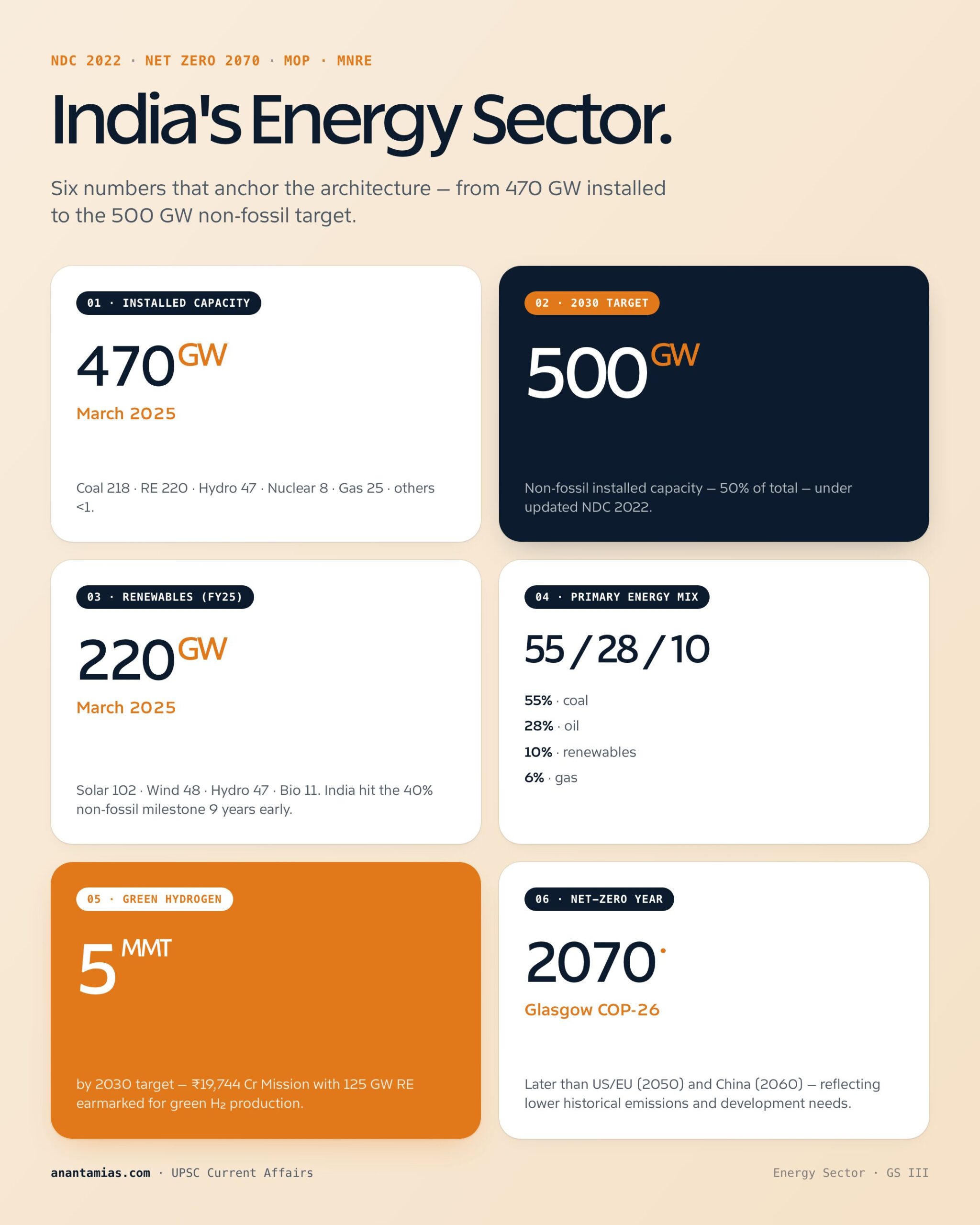
The energy sector is the fundamental input to every economic activity. From households cooking meals to factories smelting steel, from farms running pumps to data centres running AI workloads — affordable, reliable, sustainable, and modern energy is the precondition for growth and human development. India is the world's third-largest energy consumer after China and the USA, with per-capita consumption still only one-third of the global average. Energy demand is projected to grow 3-4 percent annually through 2030 even as the country pursues net zero emissions by 2070. The challenge: deliver 24×7 affordable power to every household, scale 500 GW of non-fossil capacity by 2030, reduce import dependence in oil and gas, and meet NDC commitments under the Paris Agreement. This article unpacks the architecture, mix, policy framework, and 2024-26 status for UPSC GS-III on infrastructure, environment, and economy.
What the Energy Sector Covers
The energy sector spans:
- Electricity generation — coal, gas, nuclear, hydro, solar, wind, biomass.
- Petroleum — crude oil, diesel, petrol, LPG, ATF, naphtha.
- Natural gas — LNG, piped gas, CNG, fertiliser feedstock.
- Coal — thermal, coking, lignite.
- Renewables and emerging fuels — solar PV, wind, hydro, biofuels, hydrogen, EVs, biomass.
Each sub-sector has separate ministries, regulators, public sector enterprises, and private players — but they are interconnected through fuel substitution, sectoral demand, and climate policy.
Why the Energy Sector Is Central to UPSC
The syllabus places energy at the intersection of:
- GS-III Infrastructure (energy, ports, roads, airports, railways).
- GS-III Environment — climate change, NDC, conservation.
- GS-III External sector — oil-import dependence and current account.
- GS-III Indian economy — fiscal subsidies, DBT.
A single energy question can pull from all four. Mastery of the mix, policy goals, and key schemes is essential.
Government's Stated Objectives
The government's energy-sector policy aims to provide access to affordable, reliable, sustainable, and modern energy — closely aligned with SDG 7.
The Original Set of Targets (declared 2017-18)
- 24×7 power for all by 2019.
- 175 GW renewable capacity by 2022.
- Reduce oil and gas imports by 10 percent by 2022-23.
- Reduce emission intensity of GDP consistent with NDC 2030.
The Updated 2030 Targets (NDC enhanced 2022)
| Target | Original | Updated 2022 NDC |
|---|---|---|
| Non-fossil installed capacity | 40% of total | 50% by 2030 |
| Renewable capacity | 175 GW (2022) | 500 GW non-fossil by 2030 |
| Emission intensity reduction (vs 2005) | 33-35% | 45% by 2030 |
| Net zero | Not declared | 2070 (announced at COP-26 Glasgow, November 2021) |
India's Energy Mix Today (2024-25)
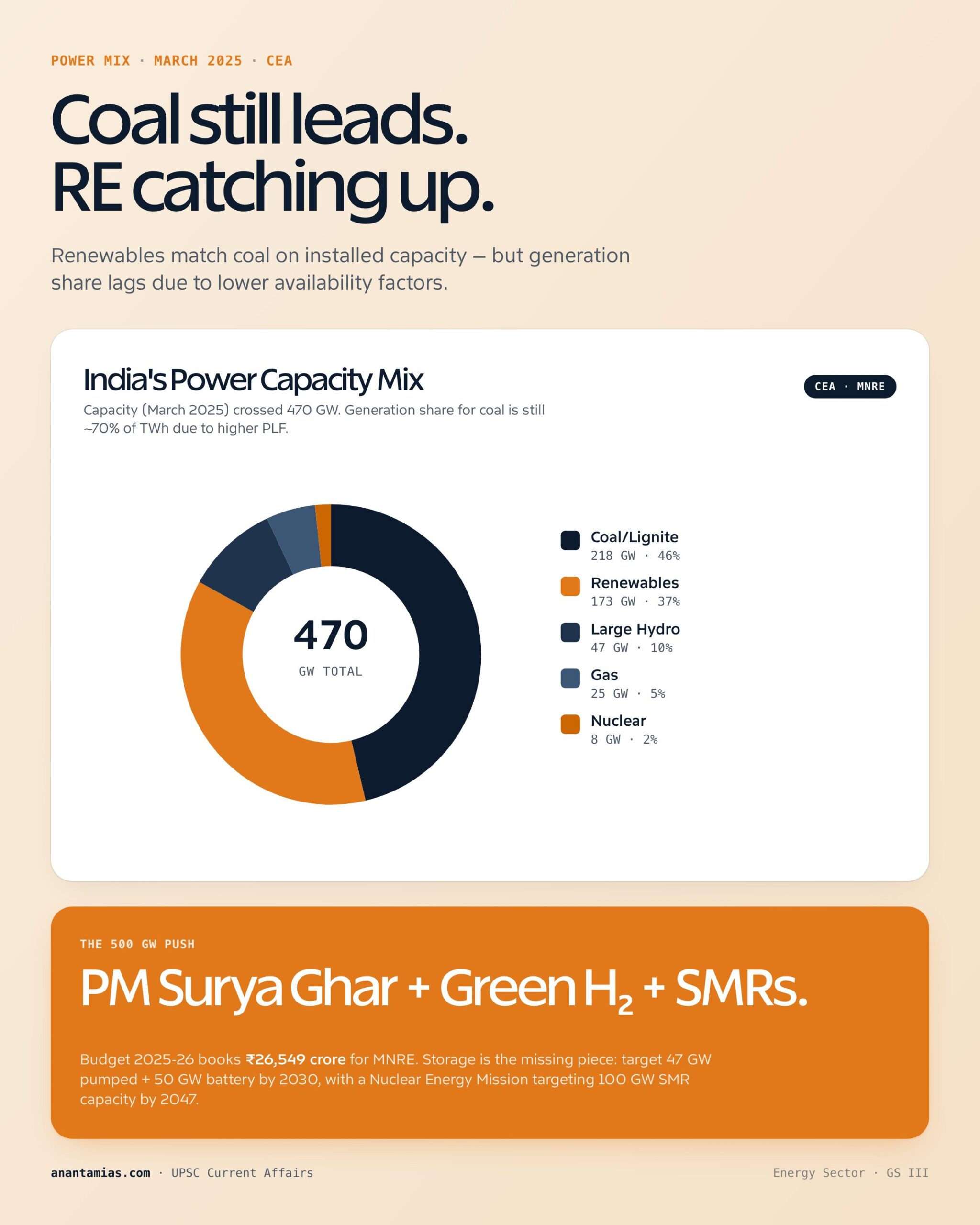
| Source | Installed Capacity (GW, March 2025) | Share |
|---|---|---|
| Coal/Lignite | 218 | ~46% |
| Renewable Energy (Solar, Wind, Bio, Small Hydro) | 220 | ~46% |
| Large Hydro | 47 | ~10% |
| Nuclear | 8.2 | ~2% |
| Gas | 25 | ~5% |
| Diesel/Other | <1 | <1% |
| Total | ~470 GW | 100% |
Source: Ministry of New and Renewable Energy (MNRE), Central Electricity Authority (CEA).
In electricity generation (actual TWh), coal still dominates with around 70 percent share because thermal plants run with high Plant Load Factors while RE has lower availability factors.
The Bigger Picture: Primary Energy
In primary energy consumption:
- Coal: ~55 percent (still the backbone for power and industry).
- Oil: ~28 percent (transport, petrochemicals).
- Gas: ~6 percent.
- Renewables: ~9-10 percent.
- Nuclear: ~1 percent.
- Hydro: ~1 percent.
Major Policy Pillars
Electricity
- Electricity Act, 2003 — comprehensive law; opens generation, transmission, distribution.
- Saubhagya Scheme (2017) — universal household electrification; over 2.86 crore connections.
- DDUGJY — Deen Dayal Upadhyaya Gram Jyoti Yojana — rural electrification feeder separation.
- IPDS — Integrated Power Development Scheme — urban distribution upgrade.
- RDSS — Revamped Distribution Sector Scheme (2021) — Rs 3.03 lakh crore for DISCOM reform; smart metering; loss reduction.
- Smart Cities Mission — energy efficiency in urban infrastructure.
Renewables
- National Solar Mission (2010, JNNSM) — original 20 GW solar target, now folded into 500 GW non-fossil.
- PM Surya Ghar Muft Bijli Yojana (February 2024) — rooftop solar for 1 crore households, with subsidies up to Rs 78,000.
- PM-KUSUM (2019) — solar pumps and decentralised RE for farmers.
- National Green Hydrogen Mission (January 2023) — Rs 19,744 crore; 5 MMT green hydrogen capacity by 2030.
- National Bioenergy Mission, Wind-Solar Hybrid Policy 2018.
Oil and Gas
- Hydrocarbon Vision 2025 — diversify import sources, build strategic petroleum reserves, deepen domestic exploration.
- OALP — Open Acreage Licensing Policy (2017).
- HELP — Hydrocarbon Exploration and Licensing Policy (2016).
- Gas Pipeline Network under PNGRB; target 34,500 km of pipelines by 2030.
- Strategic Petroleum Reserves at Visakhapatnam, Mangalore, Padur (5.33 MMT capacity); expansion underway.
Coal
- Commercial coal mining auctions (2020) — broke Coal India's monopoly.
- Coal Mines (Special Provisions) Act, 2015 for reallocation post-Supreme Court 2014 judgment.
- Mission Coking Coal — ramp up domestic supply for steel sector.
Nuclear
- Atomic Energy Act, 1962; PSU NPCIL.
- 2024 Budget announcement of Bharat Small Modular Reactors (SMRs) — partnerships with private sector for innovation in reactor design.
- Kudankulam, Kakrapar capacity additions; target 22 GW by 2031.
Major Schemes Snapshot
| Scheme | Year | Focus |
|---|---|---|
| Saubhagya | 2017 | Household electrification |
| PM-KUSUM | 2019 | Solar pumps for farmers |
| Ujjwala 2.0 | 2021 | LPG access for poor households |
| FAME II | 2019 | EV adoption |
| RDSS | 2021 | DISCOM reform |
| Green Hydrogen Mission | 2023 | 5 MMT green hydrogen |
| PM Surya Ghar Muft Bijli | 2024 | Rooftop solar 1 crore homes |
| National Critical Minerals Mission | 2024 | Lithium, cobalt, REEs |
| PLI for Solar PV | 2021/2022 | Domestic solar manufacturing |
| PLI for ACC Battery | 2021 | EV battery manufacturing |
Recent Developments (2024-26)
Renewables Surge
- Renewable capacity crossed 220 GW by March 2025 — solar 102 GW, wind 48 GW, hydro 47 GW, biomass 11 GW.
- PM Surya Ghar Muft Bijli Yojana — 20 lakh+ households had registered by early 2025; subsidy outlay Rs 75,000 crore over five years.
- Repowering of older wind farms accelerated.
Green Hydrogen
- National Green Hydrogen Mission — first auctions for electrolyser manufacturing concluded 2024.
- Target capacity: 5 MMT/year by 2030 with 125 GW renewable capacity earmarked for green H2 production.
Critical Minerals
- National Critical Minerals Mission (Budget 2024-25) — domestic exploration, recycling, foreign acquisition.
- KABIL (Khanij Bidesh India Ltd) — JV among NALCO, HCL, MECL — for overseas mineral acquisition.
Electric Mobility
- EMPS 2024 (Electric Mobility Promotion Scheme) — 4-month bridge after FAME-II ended.
- PM E-DRIVE Scheme (October 2024) — Rs 10,900 crore for EV uptake, charging infra, e-buses.
Strategic Petroleum Reserves
- Phase II expansion at Padur and Chandikhol approved with 6.5 MMT additional capacity.
Energy Conservation
- Energy Conservation (Amendment) Act, 2022 — enables Carbon Credit Trading Scheme.
- CCTS Notification 2024 — domestic compliance carbon market with PAT scheme as foundation.
Budget 2025-26
- Rs 26,549 crore for MNRE (renewables push).
- PM-Surya Ghar scaled up.
- Nuclear Energy Mission — public-private collaboration for SMRs, target 100 GW nuclear by 2047.
- Critical Minerals Mission — full operationalisation.
NDC Performance
- India achieved 40 percent non-fossil installed capacity target by 2021 — nine years ahead of NDC schedule.
- Emission intensity reduction has tracked the 2030 target trajectory.
Major Constraints (Brief Overview)
While addressed in detail in a sister article (Major Constraints in the Energy Sector), the binding constraints today are:
- DISCOM financial health — accumulated losses; AT&C losses ~16-17 percent.
- Coal supply mismatch — import dependence ~25 percent, occasional shortages.
- Renewable integration — grid storage, transmission, balancing.
- Land acquisition for solar parks and transmission corridors.
- Imports of solar PV cells still substantial (mostly from China) — addressed via PLI ALMM.
- Subsidies and tariffs — distortion of efficient pricing.
Way Forward
- Storage at scale: Pumped storage projects, battery storage; achieve 47 GW pumped storage and 50 GW battery by 2030.
- Grid modernisation: Smart grids, transmission corridors, One Nation One Grid.
- DISCOM reform: Smart metering (250 million consumers under RDSS), tariff rationalisation, ToD pricing.
- Energy efficiency: PAT scheme, ECBC for buildings, BEE star labels.
- Nuclear scale-up: SMRs, fuel cycle, expanded uranium supply.
- Just transition: Coal-region rehabilitation; new jobs in green sectors.
- Hydrogen ecosystem: Steel and refinery captive hydrogen, transport fuel pilots.
- Behavioural change: ToD pricing, ECBC, EV promotion.
International Comparisons
| Country | Per Capita Energy Use (toe) | Net Zero Year | RE Share in Mix |
|---|---|---|---|
| USA | 6.7 | 2050 | 22% |
| EU | 3.0 | 2050 | 23% |
| China | 2.7 | 2060 | 30% |
| India | 0.7 | 2070 | 22% |
India is committed to net zero by 2070 — later than peers but reflecting lower historical emissions, lower per-capita energy, and higher development needs.
UPSC Relevance
GS-III Mapping
- Infrastructure: Energy, Ports, Roads, Airports, Railways.
- Conservation, environmental pollution, and degradation; environmental impact assessment.
- Indian economy and issues relating to planning, mobilization of resources.
Prelims Pointers
- NDC 2022 (updated): 50% non-fossil installed capacity, 45% emission intensity reduction by 2030.
- Net zero: 2070, announced at COP-26 Glasgow (November 2021).
- PM Surya Ghar Muft Bijli Yojana: February 2024.
- National Green Hydrogen Mission: January 2023, Rs 19,744 crore.
- PM E-DRIVE Scheme: October 2024, Rs 10,900 crore.
- Renewable installed capacity: ~220 GW (March 2025).
Mains Hooks
- "Discuss the architecture and goals of India's energy sector and the trade-off between affordability, reliability, and sustainability." (GS-III)
- "Evaluate India's progress on the 500 GW non-fossil target by 2030 and the constraints to scaling further." (GS-III)
- "Examine India's pathway to net zero by 2070 and the role of green hydrogen in it."
- "How does India's energy import dependence affect its external sector and macroeconomic stability?"
India's energy sector is at the single most consequential transition in its post-Independence history. The goals are ambitious — 500 GW non-fossil capacity, 50 percent of installed capacity, net zero by 2070 — and the early progress under the 2022 NDC is real. The 2024-26 push (PM Surya Ghar, Green Hydrogen Mission, Nuclear Energy Mission, Critical Minerals Mission) shows policy intent. Execution depends on DISCOM finances, storage, transmission, and just transition. For UPSC, hold the mix, the policy stack, the targets, and the 2024-26 schemes as anchors and write authoritative answers across infrastructure, environment, and economy.