Ethical Dilemma: Meaning, Sources, Forms and Resolution Frameworks (UPSC GS IV)
Ethical dilemma for UPSC GS IV — meaning, why dilemmas arise, common forms, resolution frameworks, Indian case studies and Mains answer template.
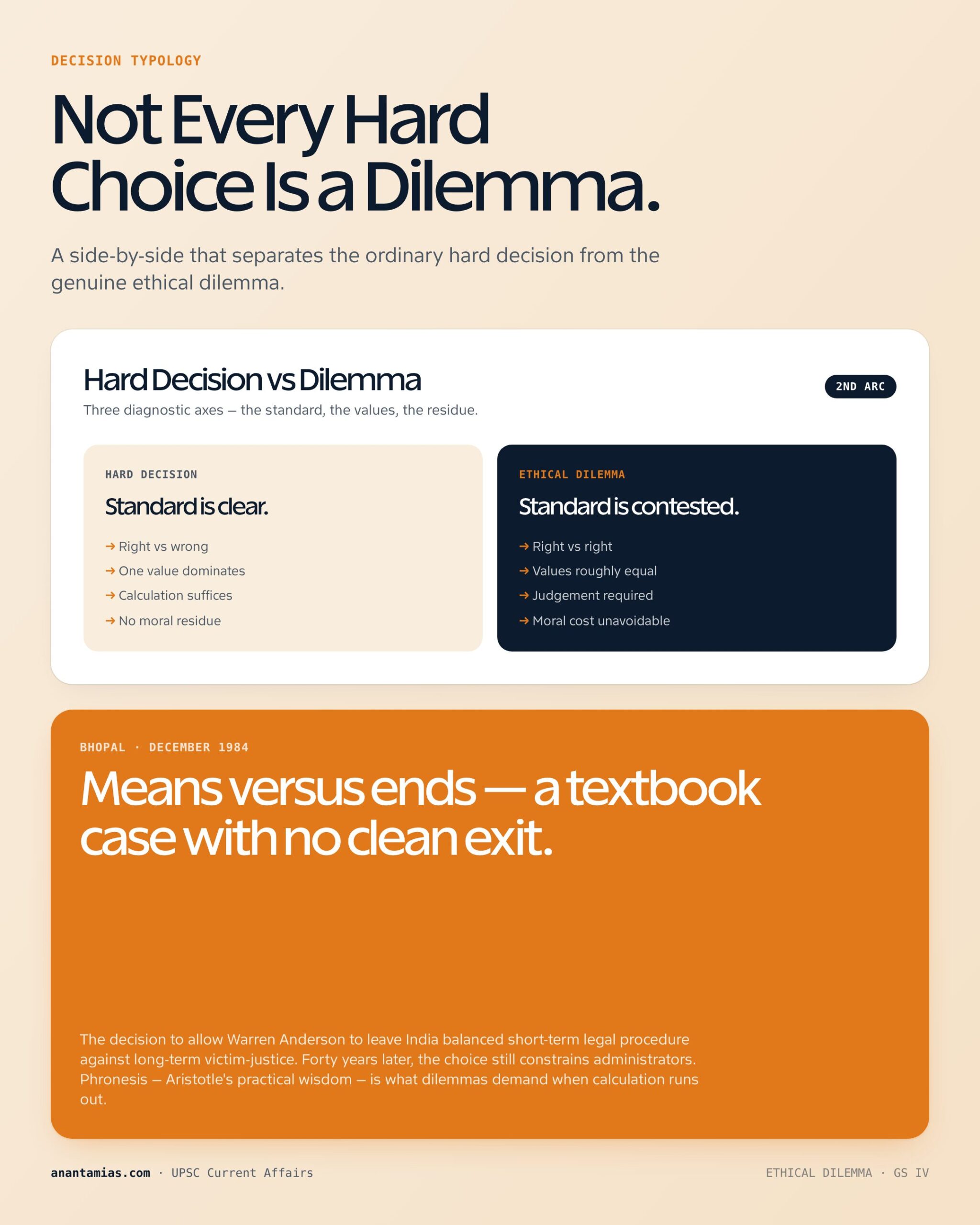
A dilemma is not the same as a difficult decision. Many decisions are difficult — they require weighing facts, predicting consequences, allocating scarce resources. But the standard for rightness in difficult decisions is at least clear, even if the data is messy. Ethical dilemmas are different. In a true ethical dilemma, the standard itself is contested — two or more equally legitimate values pull in opposite directions, and choosing one requires letting down another.
For the UPSC GS IV aspirant, the ethical dilemma is not an abstract puzzle. It is the structure of most case-study questions in the paper, and it is the daily condition of administrative life. This article works through the meaning of an ethical dilemma, the conditions under which dilemmas arise, the common forms they take in Indian administration, and the frameworks for resolving them.
What an ethical dilemma is
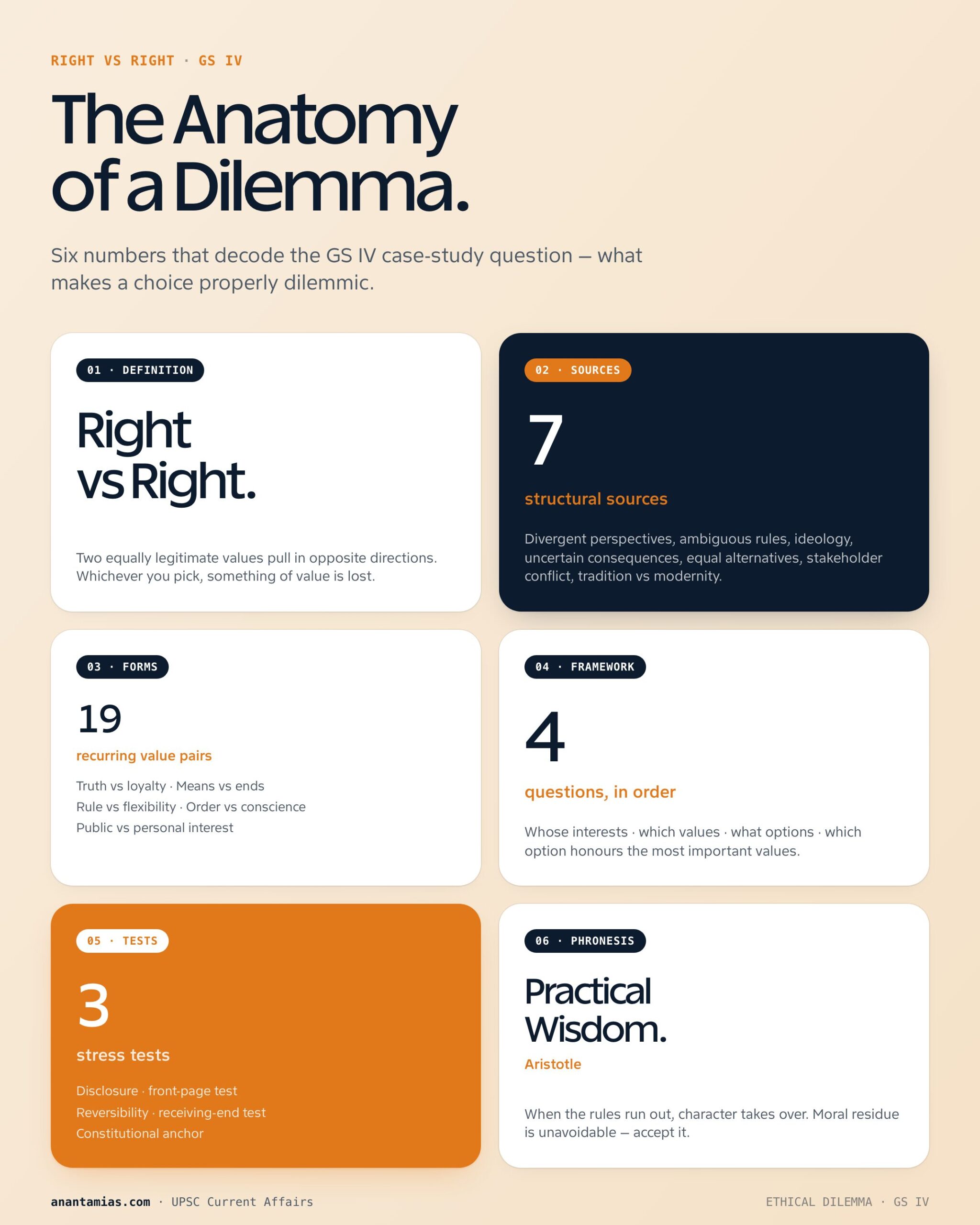
An ethical dilemma is a situation in which one must choose between two or more equally competent values — both positive, both legitimate — where honouring one means failing to honour the other.
Three features distinguish a dilemma from an ordinary decision.
- The values in conflict are both positive — it is not a choice between right and wrong but between right and right. (Choosing between honesty and corruption is not a dilemma; choosing between honesty and loyalty often is.)
- The values are roughly comparable in weight — when one clearly outweighs the other, the choice is hard but not properly dilemmic.
- Some moral cost is unavoidable — whichever option is chosen, something of value is lost.
A dilemma is therefore the situation where ordinary moral reasoning cannot fully discharge its work; what is needed is judgement, not calculation.
When do we face an ethical dilemma?
The structure becomes clearer when we contrast ethical questions with two other kinds.
| Type of question | Example | Standard for answer |
|---|---|---|
| Aesthetic | Do you like the colour blue? | Subjective preference |
| Scientific | Is the earth flat? | Objective fact |
| Ethical | Should universal basic income be implemented? | Multiple criteria — individual morality, conscience, social ethics, religious ethics, constitutional ethics, international ethics — that may conflict |
Aesthetic questions admit of variation; scientific questions admit of objective answer. Ethical questions admit of neither pure subjectivity nor pure objectivity. They have multiple legitimate criteria, and where the criteria diverge, dilemma results.
Why dilemmas arise in administration
The 2nd ARC and the broader literature identify seven structural sources of administrative dilemmas.
- Different perspectives about right and wrong. A diverse society contains contested moral views; the administrator must act amid the disagreement.
- Ambiguity in laws, rules and procedures. Where rules are vague or silent, discretion enters and dilemma follows.
- Traditional values versus modern values. Honour killings versus individual choice; caste-bound social organisation versus constitutional equality.
- Different ideologies. Left-versus-right policy frames generate different verdicts on the same situation.
- Uncertainty of consequences. When the outcome of action is unpredictable, choices that seem right ex ante may produce unwanted ex post results.
- Alternatives are equally justifiable. When two paths can each be defended on legitimate grounds, judgement decides.
- Conflict in consequences for different stakeholders. Helping one group harms another; the question is which harm to accept.
These seven sources rarely act alone. Most real dilemmas combine several.
Common forms of ethical dilemma
The Indian administrative experience produces a recognisable list of recurring value conflicts. The list below — drawn from case-study debates across decades — is the working vocabulary of GS IV.
- Merit versus social justice. Reservation in public employment and education trades the value of competitive merit against the value of historical redress.
- Justice versus equal treatment. Treating everyone identically (formal equality) sometimes produces unequal substantive outcomes.
- Centralisation versus decentralisation. Strong central authority brings consistency but can override local judgement; decentralisation respects local knowledge but can produce uneven outcomes.
- Public servant versus political servant. The civil servant serves the elected government but is also bound to the constitutional order — when they conflict, dilemma follows.
- Truth versus loyalty. Disclosing the senior's misconduct serves truth and honesty; loyalty argues for silence or internal channels first.
- Information sharing versus confidentiality. Open governance favours sharing; legitimate confidentiality (security, privacy) limits it.
- Means versus ends. A good outcome reached by improper means often costs more than it gains.
- Law versus ethics. Legal action that produces unjust outcomes; ethical action that requires legal disobedience.
- Personal interest versus public interest. The recurring core of corruption — and many less dramatic conflicts.
- Secrecy versus transparency. Necessary secrecy (defence, ongoing investigation) conflicts with the public's right to know.
- Honesty versus efficiency. Frank assessment may slow a decision; efficient action may sometimes shade the truth.
- Rule versus flexibility. Rigid application produces injustice in unanticipated cases; flexibility opens room for partiality.
- Mitigating economic hardship of the vulnerable versus financial prudence. Welfare expansion versus fiscal sustainability.
- Order versus conscience. Following the lawful order versus refusing what one believes to be wrong.
- Short-term gain versus long-term gain. Politically attractive immediate measures versus painful long-term reforms.
- Reason versus emotions. Cool calculation versus warranted moral feeling.
- Liberty versus conservatism. Individual choice versus social cohesion.
- Modernity versus traditionalism. Cultural-economic change versus continuity.
- Tolerance versus resistance. Accommodating difference versus pushing against intolerance.
Each pair captures a recurring shape of administrative life. The skilled aspirant memorises this list and uses it to identify the dilemma at the heart of any case study.
Frameworks for resolving ethical dilemmas
No framework eliminates the cost of dilemma — by definition, something of value is lost whichever path is chosen. Frameworks help us decide better, not painlessly.
The four-question framework
A practical sequence used widely in administrative ethics training.
| Step | Question |
|---|---|
| 1 | Whose interests are at stake, and what are they? |
| 2 | Which values, principles or rules apply? |
| 3 | What options exist, and what are the consequences of each? |
| 4 | Which option best honours the most important values, with the least violation of others? |
The disclosure / public test
Would I be comfortable if my decision and its reasons were on the front page of tomorrow's newspaper? If the answer is no, the decision needs reconsideration.
The reversibility test
If I were on the receiving end of this decision, would I judge it fair? If not, the decision needs reconsideration.
The constitutional anchor
When values conflict, the Indian constitutional values (justice, liberty, equality, fraternity) provide the deepest anchor. A dilemma resolved against constitutional values is rarely well-resolved.
The phronesis test
Aristotle's practical wisdom — what would the wise officer with experience and good character do here? When the rules run out, character takes over.
Two Indian case studies
Case study 1 — Bhopal gas tragedy and the means-versus-ends dilemma
The decision to allow Warren Anderson to leave India in December 1984 was framed by some as a means-versus-ends decision — facilitating short-term legal procedure (extradition arrangements) at the cost of long-term ends (justice for victims). Each subsequent administration has had to decide how to balance constitutional process, diplomatic relations, and victim compensation. The case is a textbook study in dilemma analysis with no easy resolution; choices made then continued to constrain choices made decades later.
Case study 2 — riot control and the order-versus-conscience dilemma
A police officer ordered to use force on a crowd that includes innocent bystanders faces an order-versus-conscience dilemma. Following the order may be lawful but may also produce avoidable casualties; refusing it may save lives but may also produce wider disorder. The 2nd ARC and the Justice Verma Committee have commented on this recurring dilemma, recommending training in proportional force, clear written orders, and protection for officers who exercise judgement in extremis.
Civil services application
Practical disciplines for handling dilemmas in office.
- Name the dilemma. Most administrative confusion is just unnamed dilemma. Identifying the values in conflict clarifies the choice.
- Slow down where possible. Time for reflection improves judgement; rushed dilemmas usually go badly.
- Consult. Senior advice, peer perspective and (where appropriate) institutional ethics resources distribute judgement and reduce blind spots.
- Document. Recording the reasoning protects both the decision and the decider.
- Accept moral residue. Even the right choice in a dilemma leaves a moral cost. The mature officer accepts this rather than denying it.
UPSC past-year question references
- Most GS IV case studies are dilemma-structured. Recurring patterns include:
- 2018 GS IV: case study on conflict between truth-telling and loyalty.
- 2017 GS IV: case study on order versus conscience in policing.
- 2014 GS IV: discussion of conflict-of-interest dilemmas.
- 2020 GS IV: case study on means-versus-ends in welfare delivery.
Mains answer hook
An ethical dilemma is a situation in which one must choose between two or more equally competent values where honouring one requires failing to honour the other. Dilemmas arise from divergent moral perspectives, ambiguous rules, ideological difference, uncertain consequences, equally justifiable alternatives, and conflicting stakeholder interests. The recurring administrative forms — merit versus social justice, truth versus loyalty, means versus ends, law versus ethics, personal interest versus public interest, order versus conscience — constitute the working vocabulary of public-administration ethics. Resolution does not eliminate moral cost; it minimises it. The four-question framework, the disclosure test, the reversibility test, the constitutional anchor, and Aristotle's practical wisdom each contribute to better resolution. What makes a civil servant ethical is not the absence of dilemmas but the quality of judgement she brings to them.
Prelims pointers
- An ethical dilemma — choice between two or more equally competent positive values.
- 2nd ARC's Ethics in Governance — sources of dilemma.
- Frameworks — four-question, disclosure, reversibility, constitutional anchor, phronesis.
- Aristotle — practical wisdom (phronesis) for case-by-case judgement.
FAQ
What is the difference between an ethical dilemma and an ethical problem?
An ethical problem has a clear right answer that may be hard to enact. An ethical dilemma has multiple legitimate answers in tension; whichever is chosen, something of value is lost.
Can all dilemmas be resolved?
All can be decided; not all can be resolved without moral residue. The mature view accepts that some dilemmas leave a permanent ethical cost even when handled as well as possible.
Why are constitutional values useful in resolving dilemmas?
Because they represent the considered moral consensus on which the polity is built. They provide an anchor when first-order values conflict.
Should dilemmas be resolved by individual conscience or institutional rules?
Both. Rules constrain individual error; conscience corrects rule failure in unanticipated cases. The skilled officer integrates both rather than relying on either alone.
How should a UPSC candidate write a case study answer involving dilemma?
Identify the dilemma explicitly. List the values in conflict. Apply a framework to weigh them. State the chosen option clearly. Acknowledge the moral cost of the unavoidable trade-off. Write tightly — examiners reward structure as much as content.
The ethical dilemma is the heart of public-service ethics. The administrator who pretends dilemmas do not exist, or who treats them as ordinary problems, will be exposed by experience. The administrator who recognises them, names them, and faces them with practical wisdom is the one who deserves the office.