Ethical Leadership and Institutional Integrity: Why Tone at the Top Decides Everything Below (UPSC Ethics — GS IV)
Whether a rule binds is a prediction subordinates make about what the head of office will do when the phone rings. A leader can change the climate in months and cannot change the culture in eighteen, which makes posting policy an ethics question.
Two offices of the same department operate under an identical rule book, identical conduct rules and the same disciplinary machinery. Their observed conduct differs enormously. Whatever explains that difference is not in the rules, because the rules are the constant.
The explanation that survives examination is unfashionably simple. Rules do not enforce themselves. Every rule carries a discretionary margin, an exception clause and a delay at which non-compliance stops being visible, so what determines whether a rule binds is the expectation held by everyone in the office about what happens when it is broken. That expectation is set overwhelmingly by the conduct of the person at the top — by conduct, not by circulars, and least of all by speeches about values.
Whether a Rule Binds Is a Prediction, Not a Value
An officer deciding whether to refuse an improper request is running a forecast. The question they are actually answering is what the head of office will do when the phone rings from above: back them, abandon them, or quietly arrange for the file to move to someone more accommodating. Every subordinate in the building has formed an estimate of that answer, and the estimates are remarkably consistent across an office because they are built from the same observed evidence.
This is why exhortation has such a poor record. A training module on values does not change the forecast. A single instance of the head of office absorbing pressure on a subordinate’s behalf changes it permanently. And integrity at the level of an institution is not the sum of its members’ virtues; it is the reliability of that forecast, which is a property of the organisation rather than of any person in it.
The corollary is uncomfortable for the leader. Once the forecast is negative, individual honesty at the top makes almost no difference to conduct below, because nobody below is basing their behaviour on the leader’s private virtue. They are basing it on what they have seen happen.
What Tone at the Top Concretely Consists Of
The phrase comes from auditing and corporate governance, where it appears in fraud-risk assessment. It sounds soft and its content is not. It reduces to a small number of observable facts, all of which the office reads accurately.
Which behaviour gets rewarded. Who receives the good posting, the sensitive charge, the deputation, the confidence. If the officer who delivers by cutting corners is promoted while the officer who insists on procedure is described as slow, the code of conduct is a decoration and everyone has understood this.
Whose calls get returned. The set of people to whom the head of office is directly available, and the set who need an intermediary, is read by the whole building as a map of who matters. Contractors and intermediaries who have that access are understood to have it for a reason.
What happens to the first person who raises a problem. The single most informative event in an organisation’s ethical life. If the first bearer of bad news is thanked and the problem is acted on, a second and a third come forward. If they are asked why they could not have handled it themselves, or their appraisal cools that year, nobody comes again — and the leader then enjoys an office with no complaints, which is either exceptional cleanliness or a well-trained silence.
How exceptions are made. Every exception is simultaneously a rule about who may be excepted. The first one is the policy, whatever the file says.
What the leader tolerates without comment. A junior who watches a superior accept a small favour has learned more in ten seconds than a training programme can undo.
Compliance-Based and Values-Based Ethics Management
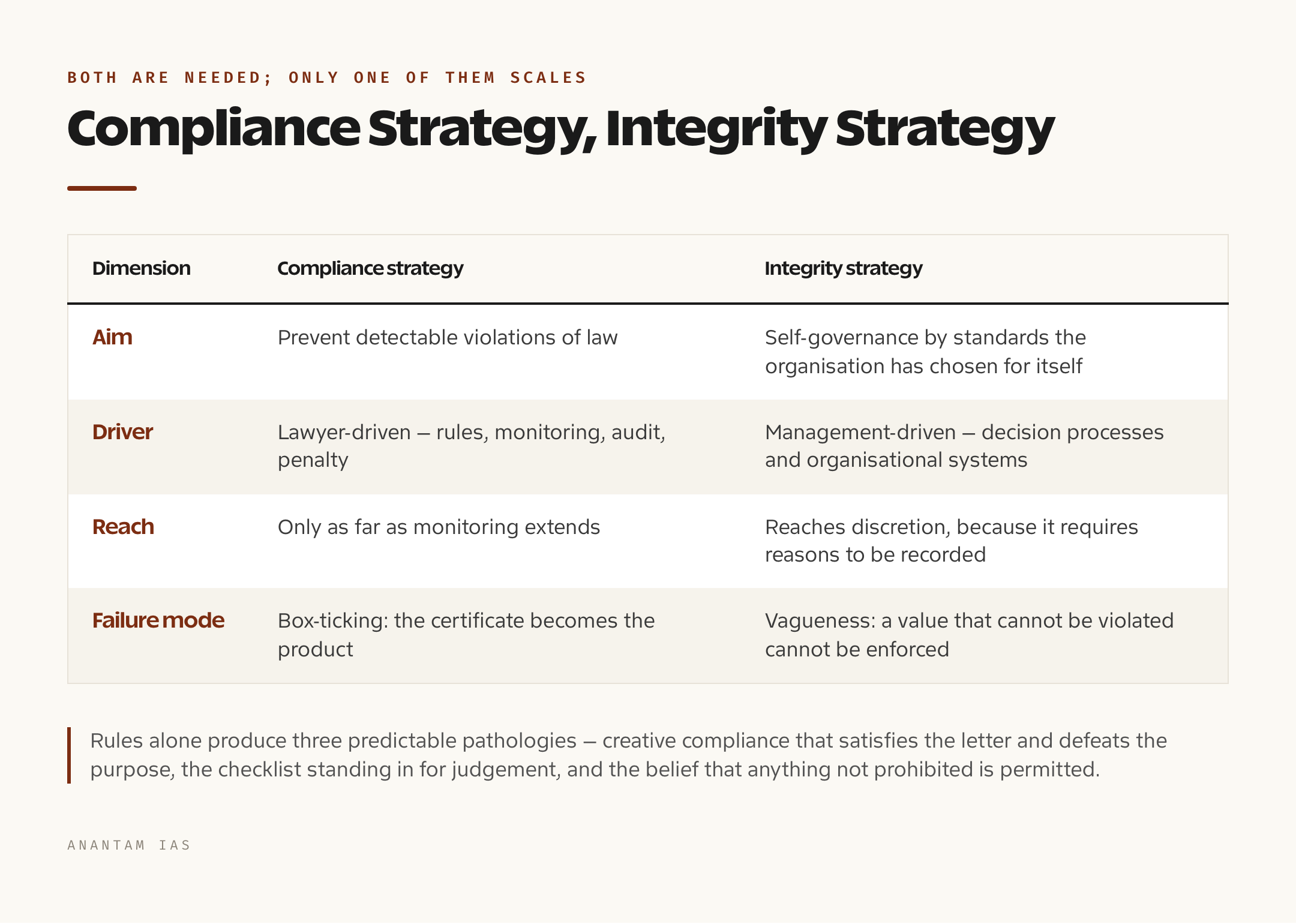
Lynn Sharp Paine’s 1994 distinction, drawn from corporate practice, remains the clearest available. A compliance strategy is lawyer-driven, aims at preventing detectable violations of law, and works through rules, monitoring, audit and penalty. An integrity strategy is management-driven, aims at self-governance according to standards the organisation has chosen, and works through shared values, decision processes and organisational systems. Both are necessary. Only the second scales, because no monitoring system can cover every occasion of discretion.
Compliance alone produces box-ticking for a structural reason, not because of laziness. It defines success as the absence of a detectable violation, so effort migrates from conduct toward documentation, and the certificate becomes the product. Three pathologies follow predictably. Creative compliance — satisfying the letter of a rule in a way that defeats its purpose, which the letter permits by construction. The checklist substituting for judgement, so that a decision nobody would defend on its merits becomes defensible because every box was filled. And the belief that anything not prohibited is permitted, which converts a code into the outer boundary of acceptable conduct rather than its floor.
Corporate governance has run this experiment at scale, with audit committees, independent directors, disclosure regimes and whistleblower policies, and the result is instructive: the form is easy to acquire and the substance is not, so the presence of the apparatus predicts far less than one would hope. The record is set out in the account of corporate governance and business ethics.
Values-based management has its own failure mode, which is vagueness. A values statement with no consequence attached is in one respect worse than a rule, because it cannot be violated and therefore cannot be enforced, while still generating the impression that something has been done. The workable combination is a small number of genuinely enforced rules plus a decision process that requires reasons to be recorded — reasons being the only mechanism that reaches discretion.
Transactional, Transformational, Servant: Used Carefully
James MacGregor Burns distinguished, in 1978, transactional leadership — an exchange of performance for reward, operating within existing goals — from transformational leadership, which changes followers’ goals and self-conception. Bernard Bass developed the measurement apparatus. Two cautions turn this from jargon into something usable.
Transactional leadership is not the inferior kind. Most administration is transactional, and an office in which work is clearly defined, honestly monitored and predictably rewarded is a substantial ethical achievement. The enemy of administrative ethics is arbitrariness, not transactionality. A great deal of harm has been done by leaders who found routine management beneath them.
And transformational leadership is morally neutral about ends. Bass had to introduce the qualifier “authentic” precisely because the charismatic reshaping of followers’ commitments works at least as well for bad ends as for good ones; the pseudo-transformational leader is a category within the literature rather than an objection from outside it. Any answer that treats transformational leadership as a synonym for ethical leadership has missed the only interesting thing about the distinction.
Robert Greenleaf’s servant leadership, from 1970, inverts the question: the test is whether those served grow as persons, become more autonomous, and are themselves more likely to serve. Its administrative value is that it supplies a criterion — has capacity been left behind, or only output. Its weakness is that it says nothing about how to exercise coercive power, which a district administration must do daily, and in practice the service framing can be used to evade the responsibility of deciding against someone.
Ethical Climate and Ethical Culture
These are routinely conflated and the distinction carries the most practically important point in the subject.
Ethical climate is the shared perception among members of an organisation of what is expected, rewarded and supported in ethical matters. It is measurable by survey, comparatively shallow, and responds to a change of leadership within months. Ethical culture is the deeper layer — assumptions, stories, remembered heroes and villains, taken-for-granted practices — which takes years to form and outlives individuals.
The consequence is that a good leader can visibly clean up an office within a few months, and the improvement can revert equally fast when they are transferred, because climate tracks the current occupant. Converting a climate change into a culture change requires three specific things: the new practice must be written down, made routine to the point of being unremarkable, and made somebody else’s formal responsibility. Reform that lives in the personal attention of the head of office has a half-life equal to their tenure.
How a Leader’s Conduct Propagates
Five mechanisms do the transmission, and none of them involves anybody being told anything.
Modelling. Behaviour is acquired by observing a high-status model whose conduct appears to be rewarded. Subordinates copy what the head of office does rather than what the circular says, and they copy the small things most reliably, because the small things are what they can actually see — punctuality, whether files are read, whether a supplicant is treated with the same courtesy as an influential visitor.
Selective enforcement. A rule enforced against some and not others does not teach the rule; it teaches the hierarchy of protection. It also does more damage than no rule at all, because it converts the rule into an instrument, and everyone can see what it is being used for.
The signal in exceptions. An exception granted once becomes precedent, and the argument for the second is stronger than the argument for the first. The officers who processed the first exception are now invested in its defensibility, which makes them advocates rather than obstacles.
The informal norm around what the leader tolerates. A boundary forms exactly at the edge of the leader’s demonstrated inattention. Nothing needs to be said. Silence in the face of a practice is a communication about that practice, and it is received as one.
Postings and charges. Who is placed in the revenue-sensitive post, the transfer desk, the procurement cell, is the clearest single statement of intent any head of office makes, and it is the statement the office believes.
This is precisely why a leader answers for outcomes they never ordered. The distinction between responsibility that attaches to an act and answerability that attaches to a post is worked out in the account of accountability and responsibility, and propagation is the reason the second exists at all.
Why Integrity Is Systemic: The Second ARC’s Distinction
The Second Administrative Reforms Commission’s fourth report, Ethics in Governance (2007), is worth reading for one structural argument. It treats ethical failure in government as arising from monopoly, wide discretion and weak accountability rather than as an aggregate of individual moral failures, and its remedies accordingly are changes to systems and processes: reducing discretion, simplifying transactions, integrity pacts in procurement, a framework for serious economic offences, institutional ombudsman arrangements, partial state funding of elections, and amendment of the anti-corruption statute.
The values-versus-systems point is the transferable one. Exhortation, training and codes address values. Reducing the number of points at which a decision can be sold addresses systems. Only the second is durable, because it does not require anyone to keep choosing well, and Indian practice has over-invested heavily in the first. The full argument and its recommendations are set out in the account of the Second ARC on ethics in governance.
It does not follow that values are irrelevant, and the report does not claim it. A system has to be operated by people who apply it as intended, and every system leaves a residue of discretion that only judgement can fill — which is why the reduction of discretion is a strategy of narrowing the residue rather than eliminating it. The honest version of the claim is that systems work should absorb most of the effort and cannot absorb all of it.
Mechanisms That Institutionalise Integrity
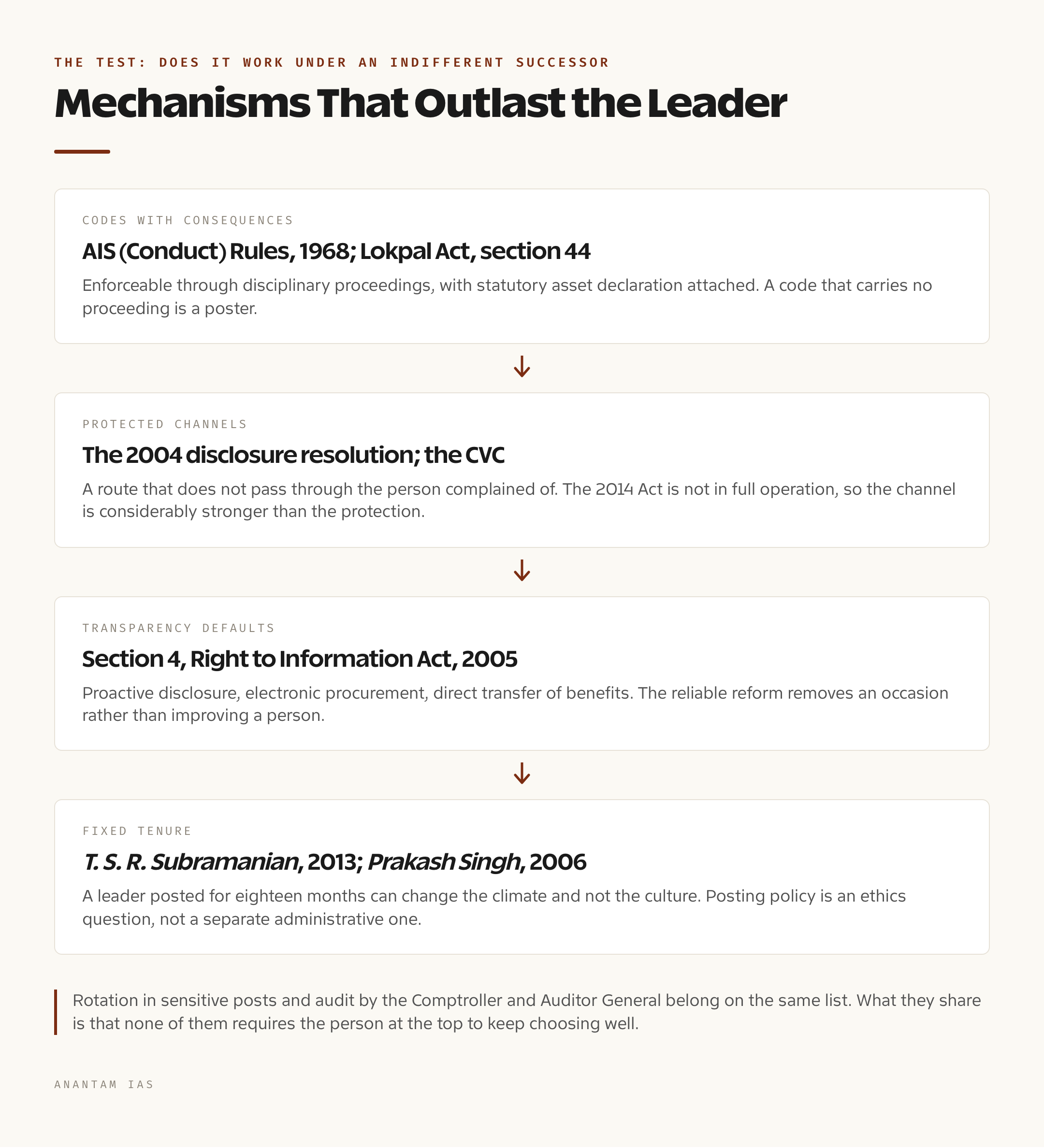
The test of any of these is whether it keeps working when the good leader is transferred and replaced by someone indifferent.
Codes with consequences attached. The All India Services (Conduct) Rules, 1968 and the Central Civil Services (Conduct) Rules, 1964 are enforceable through disciplinary proceedings; asset declaration under section 44 of the Lokpal and Lokayuktas Act, 2013 is a statutory obligation. A code that carries no proceeding is a poster.
Protected channels. A route by which a subordinate can report a problem without it passing through the person complained of. The Public Interest Disclosure and Protection of Informers resolution of 2004 designates the Central Vigilance Commission for central government matters, and the Whistle Blowers Protection Act, 2014 was enacted to make the protection statutory. It has not been brought into full operation, so the channel is considerably stronger than the protection attached to it — examined in the account of whistleblowing in India.
Rotation in sensitive posts. Vigilance practice identifies posts where discretion has market value and requires periodic rotation, on the reasoning that durable extraction needs a stable relationship with whoever is paying. It is one of the few integrity measures that costs almost nothing.
Audit. The Comptroller and Auditor General under Articles 148 to 151, with reports laid before the legislature and examined by the Public Accounts Committee. The value lies less in detection than in the standing knowledge that a record will eventually be read by someone outside the chain of command.
Transparency defaults. Section 4 of the Right to Information Act, 2005 requires proactive disclosure of specified categories of information without anyone asking. Electronic procurement and direct transfer of benefits remove human touchpoints altogether. The most reliable integrity reform is usually the removal of an occasion rather than the improvement of a person.
Appointment processes. Multi-member selection is the standard device for oversight posts: the Central Vigilance Commissioner is appointed on the recommendation of a committee of the Prime Minister, the Home Minister and the Leader of the Opposition under the Central Vigilance Commission Act, 2003, and comparable arrangements exist for the Lokpal and the Chief Information Commissioner. The composition of the committee is where the real argument happens. After the Supreme Court in 2023 prescribed a selection committee including the Chief Justice of India for Election Commission appointments until Parliament legislated, Parliament’s 2023 Act substituted a Union Cabinet Minister for the Chief Justice. Whether that composition satisfies the constitutional requirement of an independent Commission is contested, and the position is unsettled; the competing arguments are worth stating rather than resolving.
The Short Tenure Problem
Culture-building requires repetition over time. A practice becomes routine only when it has survived several cycles of the work and several arrivals of new staff, which takes years. A leader posted for eighteen months can change the climate and cannot change the culture, and knowing this changes what they should attempt: write the practice down, embed it in a standing order, and give it an owner, rather than sustaining it by personal attention.
Short tenure also generates its own ethics, and they are bad. An officer who knows they will have moved before the consequences arrive discounts long-run outcomes, which is the exact incentive structure that produces unfinished projects, deferred maintenance and decisions optimised for the closing date of their own posting. It further destroys the value of the leader’s reputation as an enforcement device: “I will not tolerate this” is credible only if the speaker will still be present when the test comes.
The remedy is a posting-policy argument rather than a character argument, which is the point worth making. In T. S. R. Subramanian v. Union of India (2013) the Supreme Court directed fixed minimum tenure, Civil Services Boards to advise on transfers, and that oral instructions be recorded in writing; the Indian Administrative Service cadre rules were amended to provide a minimum tenure. Prakash Singh v. Union of India (2006) had already directed a minimum two-year tenure for the Director General of Police and specified senior police posts. Compliance in both cases has been uneven, and the incentive that produces frequent transfers is unchanged. Anyone who discusses ethical leadership while treating tenure as a separate administrative matter has missed the mechanism entirely.
The Limits of Leadership as an Explanation
It is systematically over-attributed. Leadership research suffers badly from inferring the cause from the outcome: organisations that succeed are described as well led, and identical behaviour in an organisation that failed is called autocratic or naive. Much of the case-study literature is survivorship presented as analysis, and the same problem afflicts admiring accounts of individual administrators.
It is used to excuse subordinates. “The tone at the top was bad” is not a defence. The Nuremberg principles settled the converse proposition — that acting under superior orders does not relieve a person of responsibility — and the inverted version is no better. Everyone in a chain retains the ability to seek the instruction in writing, record dissent, refer the decision upward and decline to sign. A bad leader raises the price of those acts substantially; the acts remain available, and a system of ethics that locates all responsibility at the top has excused the great majority of the people who actually did the thing.
It ignores the collective-action problem. An honest head of office in an institution where extraction is the settled practice is not merely facing wickedness; they are facing a coordination failure. Subordinates’ incomes, contractors’ business models and political superiors’ arrangements are all built on the existing equilibrium. Unilateral rectitude at the top reliably produces information withholding, slow sabotage and formal compliance with substantive evasion. This is why exhortation fails at the level of theory and not only in practice: the individuals are not choosing between right and wrong so much as between a costly unilateral deviation and a stable arrangement everyone else is in. Breaking such an equilibrium requires changing payoffs — the probability of detection, the number of extraction points, the cost of refusing — which is systems work, and it is why the Second ARC’s framing has more purchase than a leadership seminar.
Leadership is unevenly distributed by design. A district magistrate has considerable latitude; a section officer has almost none. Framing institutional integrity primarily as a leadership question hands the problem to the small number of people at the top and gives everyone else a legitimate-sounding reason to wait for a better posting.
FAQ
What does “tone at the top” actually consist of? Observable facts rather than statements: which behaviour gets rewarded with good postings, whose calls the head of office returns, what happens to the first person who reports a problem, how exceptions are granted, and what conduct the leader tolerates without comment.
What is the difference between compliance-based and values-based ethics management? A compliance strategy is lawyer-driven, aims at avoiding detectable legal violations and works through rules and penalty. A values or integrity strategy is management-driven, aims at self-governance according to chosen standards and works through decision processes and systems. Compliance alone rewards documentation over conduct.
Is transformational leadership the same as ethical leadership? No. Transformational leadership changes followers’ goals and self-conception, and does so equally well for bad ends, which is why the literature had to add the qualifier “authentic” and to name the pseudo-transformational leader as a category.
What is the difference between ethical climate and ethical culture? Climate is the shared perception of what is expected and rewarded; it is measurable and shifts within months of a change of leader. Culture is the deeper layer of assumptions and routine practice; it takes years and outlives individuals. Climate reverts when the leader leaves unless the change was written down and given an owner.
Why does the Second ARC treat integrity as a systems problem? Because it locates ethical failure in monopoly, wide discretion and weak accountability rather than in individual character, so its remedies reduce discretion and cut the number of points at which a decision can be extracted. Systems changes do not require anyone to keep choosing well.
Why does short tenure matter for institutional integrity? Culture forms through repetition over years. A leader posted for eighteen months can shift the climate but not the culture, and knowing they will be gone before consequences arrive weakens both their long-run judgement and the credibility of their own warnings.
Practice Questions
Prelims MCQs
- The expression “tone at the top” originates in: (a) constitutional law (b) auditing and corporate governance (c) military doctrine (d) public choice theory — Answer: (b) it entered use in fraud-risk assessment, where the conduct of senior management is treated as a risk factor in its own right.
- Under the Central Vigilance Commission Act, 2003, the Central Vigilance Commissioner is appointed on the recommendation of a committee consisting of: (a) the President, Vice-President and Chief Justice (b) the Prime Minister, the Home Minister and the Leader of the Opposition (c) the Cabinet Secretary, the Comptroller and Auditor General and the Chief Information Commissioner (d) a collegium of Supreme Court judges — Answer: (b) multi-member selection with an opposition presence is the standard device for insulating oversight appointments.
- The Second Administrative Reforms Commission’s report dealing specifically with ethics in governance was its: (a) first report, of 2005 (b) fourth report, of 2007 (c) tenth report, of 2008 (d) fifteenth report, of 2009 — Answer: (b) the fourth report, Ethics in Governance, frames corruption as a systemic outcome of monopoly, discretion and weak accountability.
- Section 4 of the Right to Information Act, 2005 requires public authorities to: (a) appoint a Chief Information Commissioner (b) proactively publish specified categories of information without a request (c) respond to applications within thirty days (d) maintain a register of denied applications — Answer: (b) proactive disclosure is a transparency default, which removes the occasion for a request rather than improving the response to one.
- In Prakash Singh v. Union of India (2006) the Supreme Court directed, among other measures: (a) abolition of the Indian Police Service (b) a minimum two-year tenure for the Director General of Police and specified senior posts (c) transfer of policing to the Union List (d) creation of a national police force — Answer: (b) security of tenure was treated as a precondition for insulating police leadership from routine political direction.
Mains Practice Questions
- “Whether a rule binds in an organisation is a prediction its members make, not a value they hold.” Examine this claim with reference to ethical leadership in public administration. (150 words)
- Distinguish between compliance-based and values-based approaches to managing ethics in an organisation. Why does compliance alone produce box-ticking? (250 words)
- Explain the mechanisms by which a leader’s personal conduct propagates through an organisation, and why a leader is answerable for outcomes they did not order. (250 words)
- “Institutional integrity must be designed to survive the transfer of the individual at the top.” Discuss the mechanisms that make this possible. (250 words)
- An honest officer heading an office where extraction is the settled practice faces a collective-action problem rather than a moral failure of colleagues. Critically examine, and state what follows for reform strategy. (250 words)