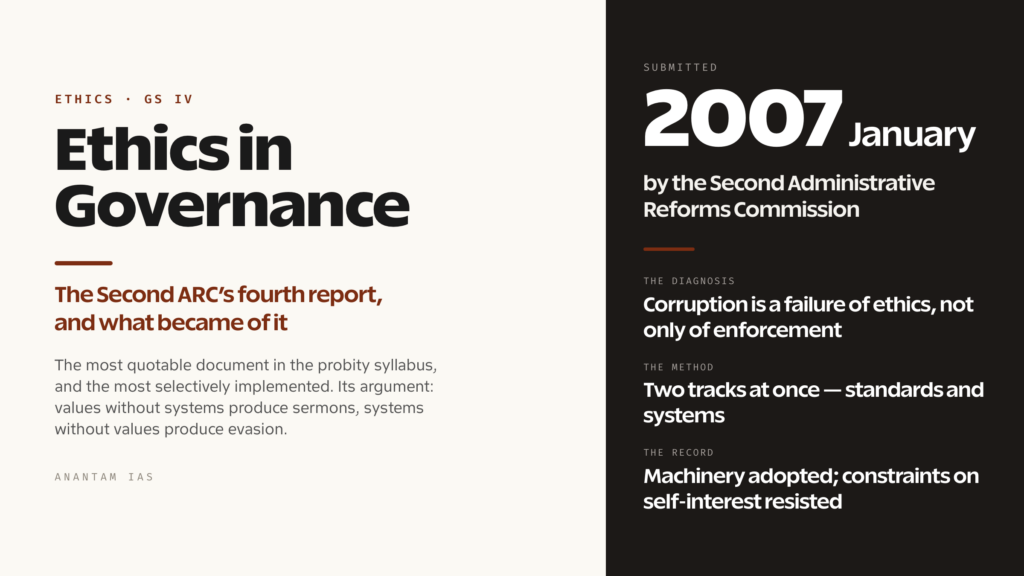
The Second Administrative Reforms Commission submitted its fourth report, Ethics in Governance, in January 2007. It remains the most quotable single document in the probity half of the syllabus, and the most selectively implemented — which is itself the reason to know it. Nearly every reform proposal in Indian anti-corruption debate since has either come from this report or been measured against it.
Its opening move is worth quoting because it sets the tone for everything after. Ethics, the Commission wrote, is a set of standards that society places on itself and which helps guide behaviour, choices and actions — and it added, painfully aware, that standards do not by themselves ensure ethical behaviour. The crux does not lie in bold words enshrined as standards but in their adoption in action, in sanctions against violations, and in competent disciplinary bodies that investigate and impose sanctions quickly.
The Diagnosis
The report treats corruption as an important manifestation of the failure of ethics rather than as a separate problem of law enforcement. It notes the etymology deliberately: corruptus means to break or destroy, while ethikos means arising from habit — and observes that corruption has, for many, itself become a matter of habit, running from grand corruption involving persons in high places to retail corruption touching everyday life.
Its assessment of existing anti-corruption effort is unusually blunt for a government document. Interventions so far, it says, are seen as ineffectual, as mere posturing without real intention to bring the corrupt to book, and as handy weapons for partisan political use to harass opponents. The consequence it identifies is public cynicism: most people regard corruption as inevitable and any effort to fight it as futile, and that cynicism spreads in a way that bodes ill for the democratic system itself.
That framing matters for answer-writing. The Commission’s premise is that the credibility of anti-corruption machinery is itself a governance asset, and that selective or theatrical enforcement destroys more than it achieves.
The Argument That Organises Everything
The report’s most examinable idea is a distinction between two contrary approaches to corruption.
The first overemphasises values and character. Many lament a decline in values and the consequent rise in corruption, and the implicit assumption is that until values are restored, nothing much can be done to improve human conduct.
The second proceeds from the belief that most human beings are fundamentally decent, and that what determines conduct is the incentive structure they face — whether dishonesty is easy, profitable and low-risk.
The Commission does not choose one. Its position is that values without systems produce sermons, and systems without values produce evasion, so the report runs on both tracks at once: an ethical framework of codes and standards, and a machinery of law, institutions and process design that makes dishonesty difficult and detection likely. If you take one thing from this report into an answer, take this: the Commission’s answer to “are we short of good people or good systems” is that the question is badly posed.
The Ethical Framework
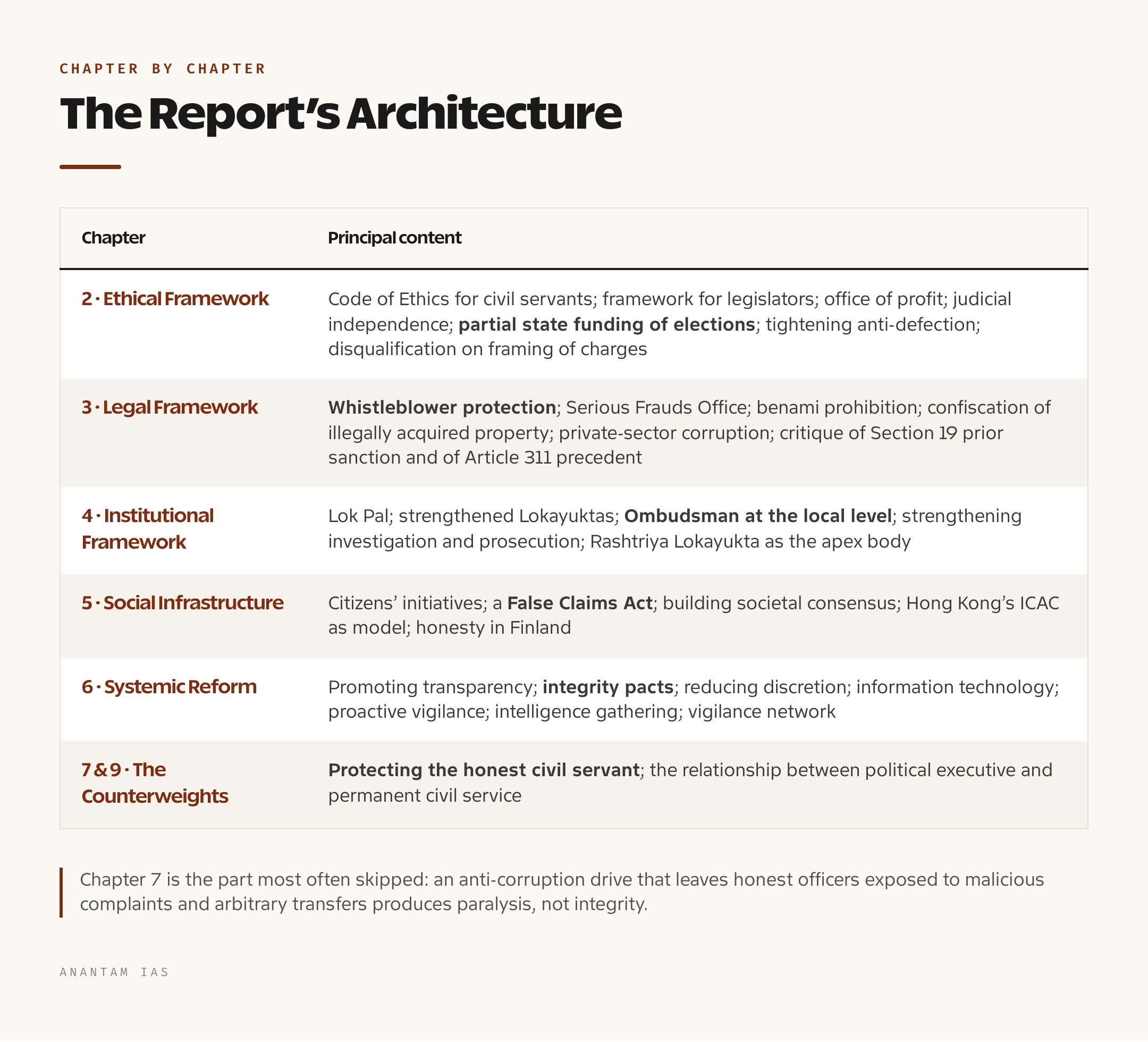
Chapter 2 builds the standards track. It proposes a Code of Ethics for civil servants distinct from the existing conduct rules — the difference being that conduct rules prohibit specified acts while a code of ethics states positive values to be pursued, a distinction developed in codes of ethics versus codes of conduct. It also takes up an ethical framework for legislators, the office of profit question, and the independence of the judiciary, and it draws comparative material from the United Kingdom, Spain and Belize.
Its electoral-reform proposals sit here and are among the most cited. The report recommends that a system of partial state funding of elections be introduced in order to reduce illegitimate and unnecessary funding of election expenses, referring to the Indrajit Gupta Committee’s earlier work on the subject. It recommends tightening the anti-defection law, and disqualification of candidates against whom charges have been framed for specified serious offences — the proposal that reappears in every subsequent debate on criminality in politics.
Gandhi’s Seven Social Sins appear in this chapter, which is where the report’s moral vocabulary is most explicit.
The Legal Framework
Chapter 3 turns to law, and its recommendations are the ones with the clearest legislative afterlife.
Protection to whistleblowers is recommended as statutory protection for those who expose corruption — a direct ancestor of the Whistle Blowers Protection Act, 2014, whose fate is the subject of whistleblowing in India.
A Serious Frauds Office is proposed to handle serious economic offences, with the notable design detail that where a public functionary is involved in a serious fraud, the office would report to the Rashtriya Lokayukta and follow its directions. Related proposals cover prohibition of benami transactions, confiscation of illegally acquired property, and statutory reporting obligations.
The report also addresses corruption involving the private sector, which is worth flagging because candidates routinely treat the report as being only about public servants.
Two provisions come in for direct criticism. Section 19 of the Prevention of Corruption Act, requiring prior sanction before prosecuting a public servant, is examined as an obstacle. And on Article 311, the report’s language is striking: the huge body of jurisprudential precedents, it says, has crowded out the real intent of Article 311 and created a heap of roadblocks in reducing corruption. That is a constitutional-protection provision being described as an impediment to accountability — a genuine tension between security of tenure for honest officers and the ability to remove dishonest ones.
The Institutional Framework
Chapter 4 evaluates existing machinery and finds it wanting, using conviction-rate comparisons between the CBI and state anti-corruption organisations, and data on pendency in courts. Its institutional proposals are a Lok Pal at the Union level, strengthened Lokayuktas in states, an Ombudsman at the local level for panchayats and municipalities, and measures for strengthening investigation and prosecution. The Rashtriya Lokayukta runs through this chapter as the apex accountability institution.
Chapter 7, Protecting the Honest Civil Servant, is the counterweight and the part most often skipped. The Commission understood that an anti-corruption drive which leaves honest officers exposed to malicious complaints, arbitrary transfers and career damage will produce paralysis rather than integrity. Chapter 9 examines the relationship between the political executive and the permanent civil service, which is where most real pressure on an officer originates.
Social Infrastructure and Systemic Reform
Chapter 5 argues that legal and institutional machinery cannot work without societal support. It proposes citizens’ initiatives, discusses a False Claims Act modelled on the American statute that lets private citizens sue on the government’s behalf for fraud and share in recoveries, and addresses building societal consensus. Hong Kong’s Independent Commission Against Corruption appears as a comparative model, and an annexure on honesty in Finland makes the point that low-corruption societies are made rather than born.
Chapter 6 is the systems chapter, and it is where the report is most practical: promoting transparency, integrity pacts in procurement, reducing discretion, using information technology, ensuring accessibility and responsiveness, proactive vigilance, intelligence gathering and a vigilance network. Its logic is that most corruption is enabled by unnecessary discretion and opacity, and that removing the occasion is more effective than punishing the act. Citizens’ charters and social audit both feature as accountability instruments — the material covered in quality of service delivery and probity in governance.
What Actually Happened
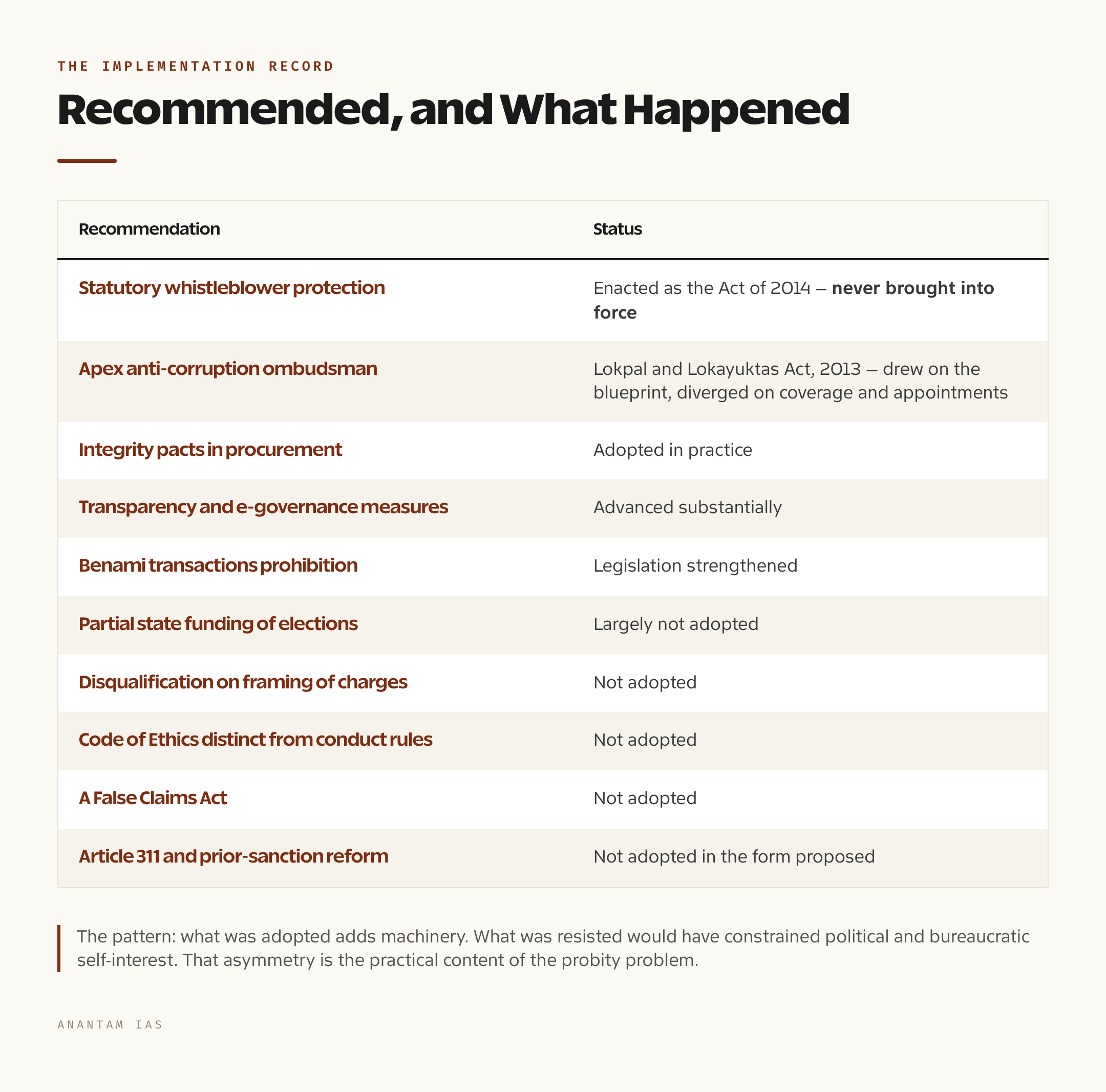
The honest assessment is partial implementation, and the gap is the most useful thing about the report for a Mains answer.
Enacted, with divergence. The Lokpal and Lokayuktas Act, 2013 followed the India Against Corruption movement rather than the report itself, and conceptually drew on the Commission’s blueprint while diverging on the scope of coverage and the appointment mechanism. The report’s Rashtriya Lokayukta design was not adopted as proposed.
Enacted but not in force. The Whistle Blowers Protection Act, 2014 echoed the Commission’s call for statutory protection — and has never been brought into effect, because the commencement notification under Section 1(3) has never been issued.
Partially adopted. Integrity pacts are used in public procurement. Transparency and technology recommendations have advanced substantially through e-governance. Benami transactions legislation was strengthened.
Largely not adopted. Partial state funding of elections. Disqualification on framing of charges. A statutory Code of Ethics distinct from conduct rules. A False Claims Act. Reform of Article 311 and of the prior-sanction requirement in the form the report proposed.
The pattern is instructive and worth stating in an answer: the recommendations adopted are those that add machinery, and the ones resisted are those that would constrain political and bureaucratic self-interest. That asymmetry is the practical content of what difficulties in practising probity describes, and it explains why India’s position on measures like the Corruption Perceptions Index has moved slowly despite two decades of reform proposals.
FAQ
What is the Second ARC’s fourth report about? Ethics in Governance, submitted in January 2007. It treats corruption as a manifestation of the failure of ethics and proposes reform on two tracks at once — an ethical framework of codes and standards, and legal, institutional and process reforms that make dishonesty difficult.
What are the two approaches to corruption the report distinguishes? One overemphasises values and character, assuming little can improve until values are restored. The other holds that most people are fundamentally decent and that conduct follows the incentive structure. The Commission rejects the choice and pursues both.
Did the report recommend state funding of elections? Yes — partial state funding, to reduce illegitimate and unnecessary election funding, referring to the earlier Indrajit Gupta Committee. It has largely not been implemented.
What did it say about Article 311? That the accumulated body of judicial precedent has crowded out the provision’s real intent and created roadblocks to reducing corruption. It framed this as a tension between protecting honest officers and being able to remove dishonest ones.
What is the Rashtriya Lokayukta in this report? The apex accountability institution the Commission proposed. Its design included a Serious Frauds Office reporting to the Rashtriya Lokayukta where a public functionary was implicated in serious fraud. The Lokpal and Lokayuktas Act, 2013 did not adopt this design as proposed.
Which of its recommendations became law? The Lokpal and Lokayuktas Act, 2013 drew on it conceptually while differing on coverage and appointments, and the Whistle Blowers Protection Act, 2014 echoed its whistleblower recommendation — though that Act has never been brought into force. Integrity pacts, transparency and technology measures advanced; electoral-funding, disqualification and Article 311 proposals largely did not.
Why does the report include a chapter on protecting the honest civil servant? Because an anti-corruption drive that leaves honest officers exposed to malicious complaints and arbitrary transfers produces paralysis rather than integrity. It is the counterweight to the enforcement chapters and the part most often overlooked.
Practice Questions
Prelims MCQs
- The Second ARC’s fourth report, Ethics in Governance, was submitted in: (a) January 2005 (b) January 2007 (c) August 2008 (d) March 2009 — Answer: (b) It was submitted in January 2007.
- The report proposed that a Serious Frauds Office, where a public functionary is implicated, should report to the: (a) Central Vigilance Commission (b) Comptroller and Auditor General (c) Rashtriya Lokayukta (d) Central Bureau of Investigation — Answer: (c) The design routed such reports to the Rashtriya Lokayukta.
- On Article 311 the Commission observed that: (a) it should be expanded (b) accumulated judicial precedent has crowded out its real intent and created roadblocks to reducing corruption (c) it applies only to All India Services (d) it should be moved to the Ninth Schedule — Answer: (b) It described the precedent as an impediment to accountability.
- The report’s electoral-reform recommendations included: (a) full state funding of elections (b) partial state funding of elections (c) abolition of the anti-defection law (d) proportional representation — Answer: (b) Partial state funding, referring to the Indrajit Gupta Committee.
- Which recommendation was enacted but has never been brought into force? (a) Integrity pacts (b) The Lokpal Act (c) Whistleblower protection (d) Benami transactions prohibition — Answer: (c) The Whistle Blowers Protection Act, 2014 awaits a commencement notification.
Mains Practice Questions
- “Standards do not by themselves ensure ethical behaviour.” Examine the Second ARC’s argument that values and systems must be pursued together in fighting corruption. (15 marks, 250 words)
- “The recommendations adopted were those that add machinery; those resisted would have constrained political and bureaucratic self-interest.” Critically evaluate the implementation record of the Second ARC’s fourth report. (15 marks, 250 words)
- Discuss the tension the Commission identified in Article 311 between protecting honest officers and removing dishonest ones. How should it be resolved? (15 marks, 250 words)
- The report devotes a chapter to protecting the honest civil servant. Explain why an anti-corruption drive without such protection may produce paralysis. (10 marks, 150 words)
- “Most corruption is enabled by unnecessary discretion and opacity.” Discuss the Commission’s systemic-reform approach in the light of this claim. (10 marks, 150 words)
Tell Google you want more of this.
Add Anantam IAS as a preferred sourceOne tap, and this site shows up more often in your own Top Stories, AI Overviews and AI Mode. Remove it any time.