Eurasian Otter (Lutra lutra): Habitat, Range in India, Conservation Status
The Eurasian otter is a semi-aquatic mammal and an indicator of healthy freshwater ecosystems. UPSC notes on Lutra lutra biology, Indian range across Western Ghats, Himalayas, and the North-East, IUCN status, and protection under the Wildlife Protection Act.
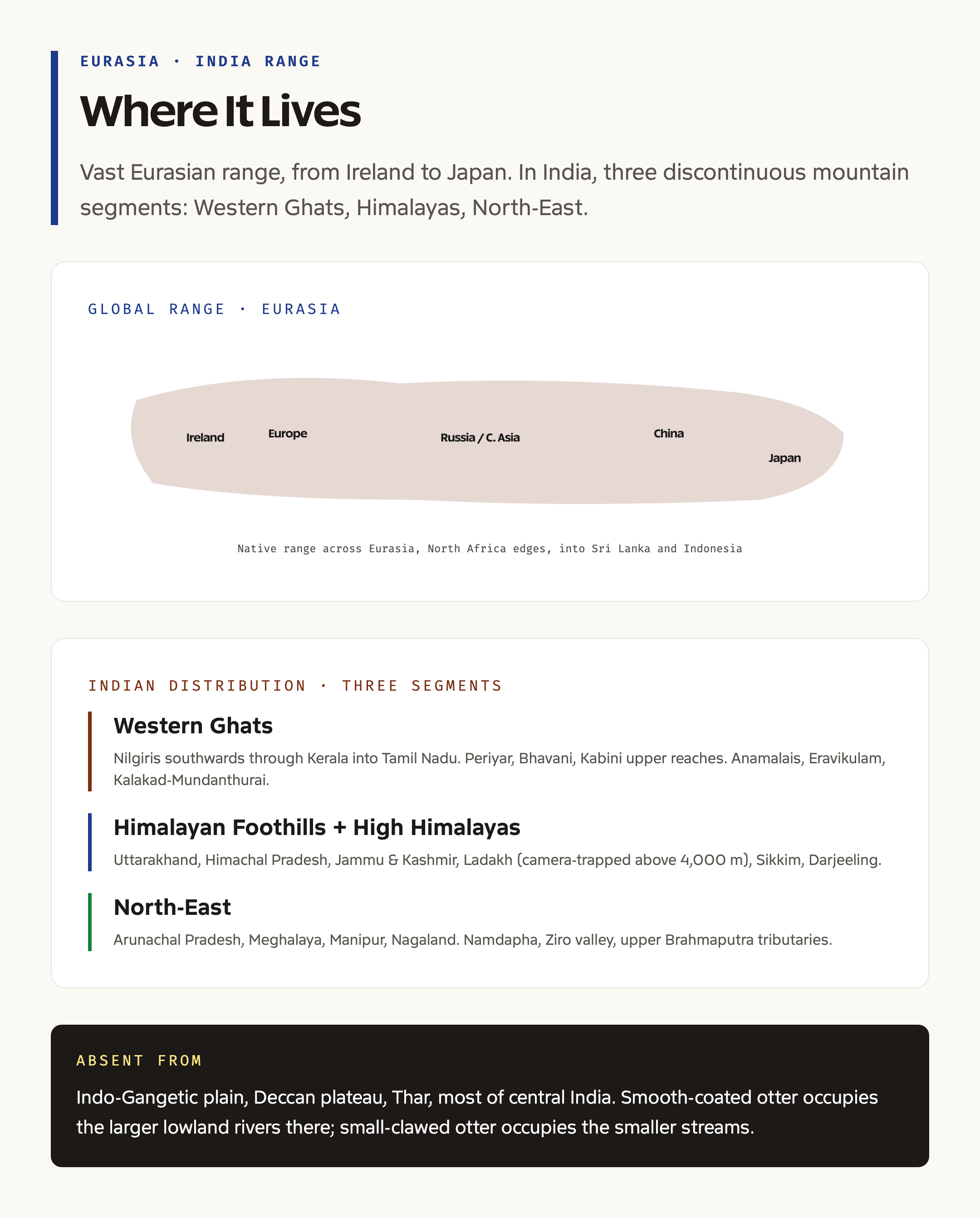
The Eurasian otter is one of the most widely distributed carnivores in the world, with a range that stretches from Ireland and Portugal in the west, through the entire breadth of temperate Eurasia, into Japan and Korea in the east, and southwards into Sri Lanka, the Indonesian archipelago, and parts of North Africa. Yet within this vast range, the species is patchy, often locally extinct, and almost everywhere a sensitive marker of how clean a river really is. Where Eurasian otters thrive, the freshwater system is in good health. Where they have disappeared, something has gone wrong upstream.
For UPSC GS-III, the Eurasian otter is a useful species to know for three reasons. It is one of three otter species found in India and is the only one whose range extends from the Himalayas to the Western Ghats with the North-East as a connector, which makes it a litmus test for biodiversity across Indian biogeographic zones. Its conservation status crosses three regulatory frameworks at once: IUCN Red List, Wildlife Protection Act 1972, and CITES, which makes it a clean test case for how these instruments interact. And it is a recurring prelims candidate whenever questions are framed around indicator species or semi-aquatic mammals.
This guide covers the biology of the Eurasian otter, its global and Indian range, its ecological role, the conservation status under each major framework, the major threats, and the policy hooks for mains answers.
Quick Facts
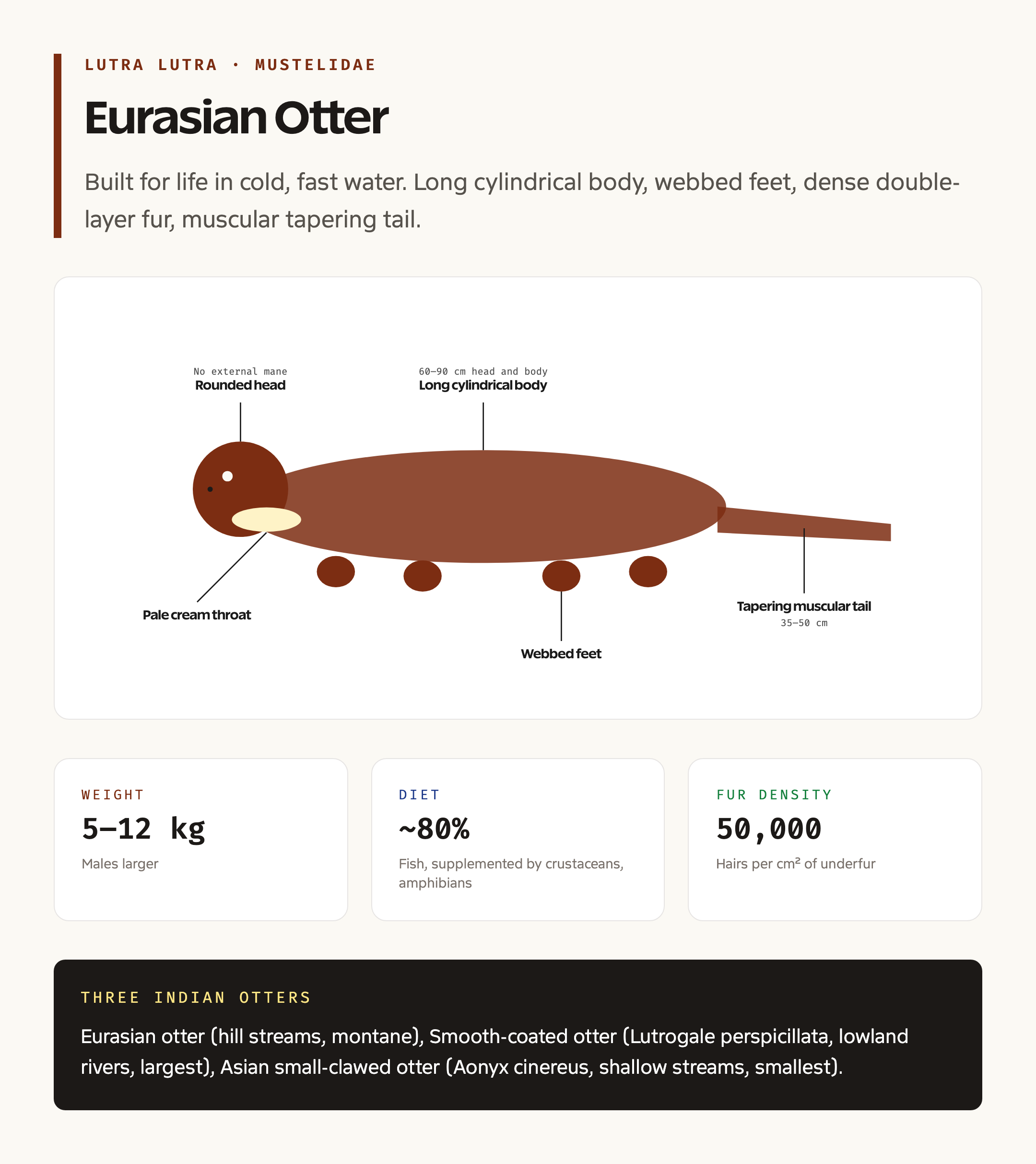
- Scientific name: Lutra lutra
- Family: Mustelidae (the weasel family, which also includes badgers, martens, and wolverines)
- Common names: Eurasian otter, European otter, common otter
- Body length: 60-90 cm (head and body), tail 35-50 cm
- Weight: 5-12 kg (males larger than females)
- Lifespan: 8-15 years in the wild, up to 22 in captivity
- Diet: Primarily fish (around 80% of diet), supplemented with crustaceans, amphibians, small mammals, birds
- Habitat: Rivers, lakes, wetlands, coastal mangroves, hill streams up to 4,500 m elevation
- Indian range: Western Ghats, Himalayan foothills, North-East India
- Other otters in India: Smooth-coated otter (Lutrogale perspicillata), Asian small-clawed otter (Aonyx cinereus)
- IUCN Red List: Near Threatened (last assessed 2014)
- Wildlife Protection Act 1972: Schedule II
- CITES: Appendix I (international commercial trade prohibited)
- CMS (Bonn Convention): Not listed
- Global population trend: Decreasing in much of Asia, recovering in parts of Europe
Biology and Identification
The Eurasian otter is built for a semi-aquatic life. The body is long and cylindrical, with short legs, fully webbed feet, and a thick muscular tail that tapers to a point. The fur is dense and double-layered, with around 50,000 hairs per square centimetre in the underfur, which traps a layer of air against the skin and keeps the animal dry and warm in cold water. The dorsal coat is uniform brown, the throat and chin are pale cream to white, and the belly is paler than the back. There is no mane, no rosette, and no stripe pattern, which separates it visually from other Indian otters.
Compared to the other two Indian otter species, the Eurasian otter is intermediate in size and habitat preference. It is smaller than the smooth-coated otter, which is the largest Indian otter and prefers slower lowland rivers and reservoirs. It is larger than the Asian small-clawed otter, which is the smallest Indian otter and prefers shallow streams and paddies. The Eurasian otter occupies a middle ground, often found in fast-flowing hill streams, montane lakes, and the upper reaches of rivers where the other two species are absent.
The species is largely solitary outside the breeding season. Each adult holds a linear riverine territory, often 5 to 15 km of river length for males and somewhat less for females. Territories are marked by spraints (otter scat), which are deposited prominently on rocks, logs, and tussocks at the water’s edge. Spraint sites are key to field surveys, since direct sightings are rare and otters are largely crepuscular and nocturnal.
Background and Why It Matters
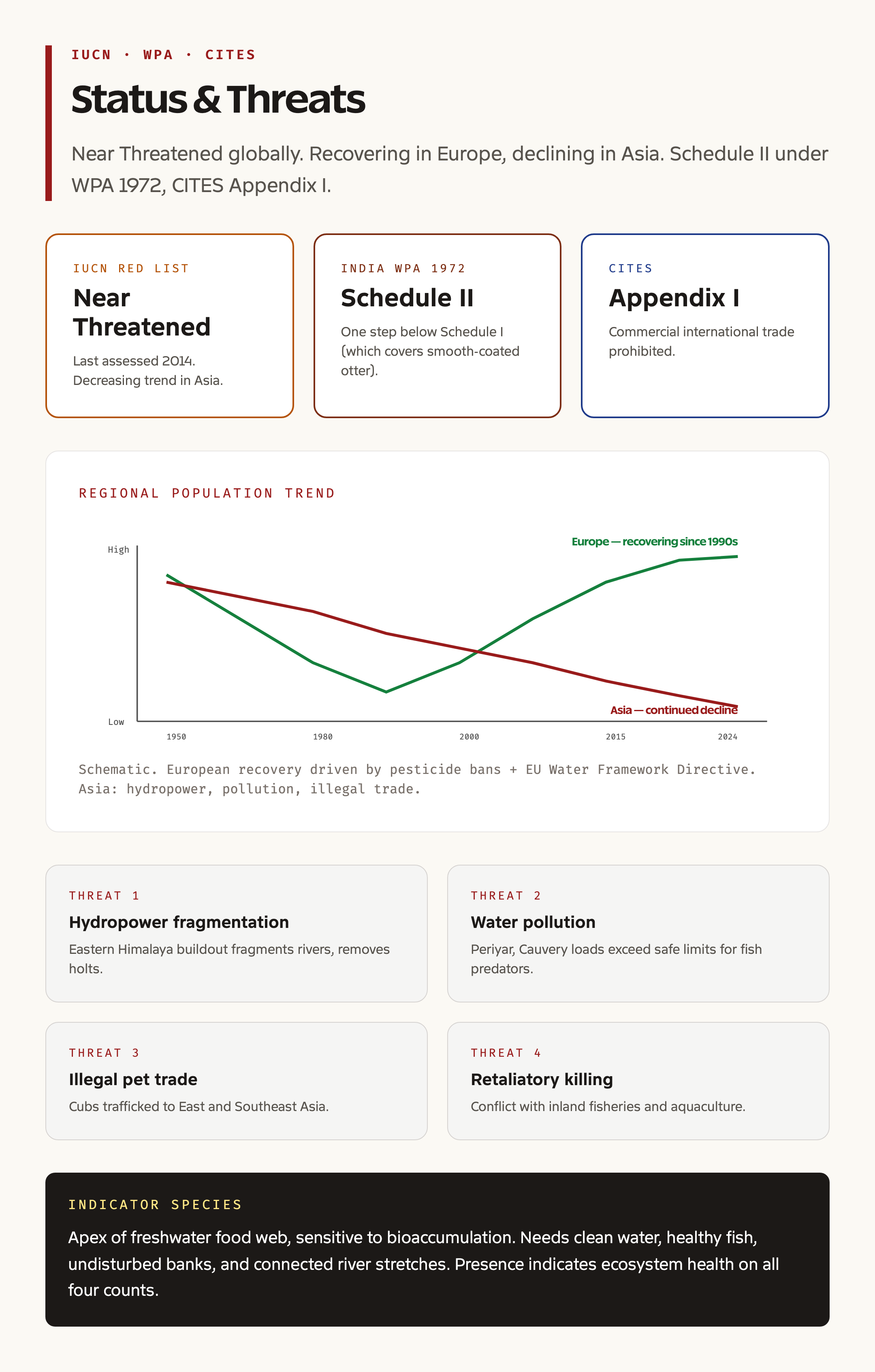
The Eurasian otter was once common across the entire continent of Europe and into the temperate zones of Asia. Industrialisation and the widespread use of organochlorine pesticides (DDT, dieldrin) from the 1940s through the 1970s caused dramatic population crashes across western Europe. By the 1980s, the otter was effectively extinct in lowland England, the Netherlands, and parts of Germany and France. Recovery began only after pesticide bans, water quality improvements under the EU Water Framework Directive, and active reintroduction programmes. By 2010, otters had returned to every county in England.
The Asian story is the opposite. Through much of South and Southeast Asia, populations have continued to decline through the late 20th century and into the present, driven by habitat destruction, river pollution, hydropower dam construction, sand mining, illegal pet trade, and the persistence of fur trade markets. The IUCN currently lists the species as Near Threatened globally, with the qualifier that the trend is still downward in Asia.
Range in India
The Eurasian otter has a discontinuous Indian distribution that lines up with the country’s three main mountain biodiversity zones.
In the Western Ghats, the species occurs from the Nilgiris southwards through Kerala into Tamil Nadu, particularly in the high-altitude shola-grassland streams and the upper reaches of major rivers like the Periyar, Bhavani, and Kabini. Records from the Anamalais, the Eravikulam landscape, the Periyar Tiger Reserve, and the Kalakad-Mundanthurai complex are well documented. The species is rarer in the Northern Western Ghats above the Goa gap.
In the Himalayan foothills and the Himalayas proper, the Eurasian otter has been recorded from Uttarakhand (Garhwal and Kumaon), Himachal Pradesh, Jammu and Kashmir, and into Ladakh, where it has been camera-trapped along the Indus tributaries up to elevations above 4,000 metres. The Sikkim and Darjeeling Himalaya hold a separate eastern population segment.
In the North-East, the species occurs through Arunachal Pradesh, Meghalaya, and parts of Manipur and Nagaland, with records from the Namdapha landscape, the Ziro valley, and the upper Brahmaputra tributaries. The North-Eastern population links the Himalayan and Western Ghats segments via Bhutan and Myanmar, although connectivity has been disrupted by hydropower development across the eastern Himalayas.
The species is absent from the Indo-Gangetic plain, the Deccan plateau, the Thar, and most of central India, where the smooth-coated otter takes its place in larger river systems and the Asian small-clawed otter occupies smaller streams in the Eastern Ghats and Odisha hill country.
Ecological Role and Indicator Status
The Eurasian otter is widely regarded as an indicator species for freshwater ecosystem health. The reasoning has three parts. First, otters are apex carnivores in their habitat, and apex predators are sensitive to bioaccumulation of pollutants through the food web. The pesticide-driven crashes of European otter populations in the 1960s and 1970s were the textbook case of biomagnification of organochlorines through fish to top predators. Second, otters need clean, well-oxygenated water with healthy fish populations, riparian vegetation, and undisturbed riverbanks for holts (dens). The presence of a breeding otter population is a quick proxy for all of these. Third, otters have large territorial requirements, so a viable population indicates that connectivity exists across multiple kilometres of river without major dam, channelisation, or pollution barriers.
Field-based otter monitoring is therefore used as a low-cost biodiversity audit. Spraint surveys can be conducted by trained volunteers, do not require expensive equipment, and produce results that can be statistically analysed for distribution change over time.
Conservation Status Across Frameworks
The Eurasian otter is one of the relatively rare cases where a species sits at different points across the major conservation instruments, and the inconsistency itself is part of why UPSC tests this species.
IUCN Red List: Near Threatened (last assessed 2014). The classification reflects a global picture in which the European population is recovering but the Asian population continues to decline. The next reassessment is due, and the Asian trend is likely to push the species closer to Vulnerable in the medium term.
Wildlife Protection Act, 1972 (India): Schedule II. Schedule II species receive substantial legal protection, with hunting punishable by imprisonment and fines, but the protection is one notch lower than Schedule I (which covers tigers, lions, and the smooth-coated otter). The classification is a recurring prelims framing because students often assume that an indicator species would automatically be Schedule I.
CITES: Appendix I. International commercial trade in the species or its parts is prohibited. The Appendix I listing reflects the historical pressure from the fur trade and the ongoing pressure from the illegal pet trade.
Convention on Migratory Species (Bonn Convention): Not listed. Otters are territorial rather than migratory, so the CMS framework does not apply.
Major Threats
Habitat destruction is the leading driver of decline across the Asian range. Hydropower dam construction fragments rivers, eliminates the holts in the riparian zone, and changes the seasonal flow regime that otters depend on for spawning fish. The eastern Himalayan hydropower buildout in Arunachal Pradesh, Sikkim, and Bhutan has been particularly disruptive. Sand mining and riverbed quarrying destroy the natural bankside cover that otters use for resting and breeding.
Water pollution is a persistent threat in the Indian context, with industrial effluents, urban sewage, and agrochemical runoff degrading water quality in many otter rivers. The Periyar in Kerala, the Cauvery in Tamil Nadu, and several Western Ghats rivers have documented pollution loads that exceed safe limits for fish-eating predators.
Illegal trade has emerged as a serious threat over the last two decades. Otter cubs are taken from the wild for the exotic pet trade, particularly to East and Southeast Asian markets, and adult skins continue to surface in seizures. The TRAFFIC India network has documented increasing seizure volumes through the 2010s and 2020s.
Direct conflict with fishing communities is local but locally significant. Otters take fish from aquaculture ponds and from gill nets in inland fisheries, and retaliatory killing has been recorded across the range.
Policy Hooks and Mains Framings
For UPSC mains, the Eurasian otter sits at the intersection of biodiversity policy, freshwater ecosystem management, and the implementation of CITES in India. A useful framing is that the species exposes a gap in Indian conservation: while flagship species like the tiger and the Asian elephant get dedicated landscape-level programmes, indicator species like the Eurasian otter rely on general habitat protection that is often inadequate. The species also features in arguments for cumulative impact assessment of hydropower in the Himalayas, since the per-project environmental clearance does not capture the basin-scale impact on otter populations.
Frequently Asked Questions
Where in India is the Eurasian otter found?
The Eurasian otter occurs in three discontinuous ranges in India: the Western Ghats from the Nilgiris southwards, the Himalayan foothills and high Himalayas including Ladakh, and the North-East through Arunachal Pradesh, Meghalaya, and parts of Manipur and Nagaland.
What is the conservation status of the Eurasian otter?
The Eurasian otter is listed as Near Threatened on the IUCN Red List. In India, it is protected under Schedule II of the Wildlife Protection Act, 1972. Internationally, it is on Appendix I of CITES, which prohibits commercial trade in the species or its parts.
Why is the Eurasian otter called an indicator species?
The species sits at the top of the freshwater food web, requires clean water with healthy fish populations and undisturbed riverbanks, and needs long stretches of connected river. The presence of a breeding population indicates that the river is clean, the fish base is healthy, and the bank is undisturbed.
What are the three otter species found in India?
The three Indian otters are the Eurasian otter (Lutra lutra), the smooth-coated otter (Lutrogale perspicillata), and the Asian small-clawed otter (Aonyx cinereus). The smooth-coated otter is the largest, the small-clawed is the smallest, and the Eurasian otter occupies hill streams and montane habitats.
What are the main threats to the Eurasian otter in India?
Habitat destruction from hydropower dams and sand mining, water pollution from industrial and urban effluents, illegal trade for the pet and fur markets, and retaliatory killing by fishing communities are the major threats. The Himalayan and Western Ghats hydropower buildout is the most rapidly emerging pressure.