Exit Poll in India: Meaning, Methodology, Accuracy and ECI Rules
Exit poll meaning, methodology, accuracy record and Election Commission rules in India explained for UPSC — Section 126A, opinion polls, and past track record.
An exit poll is a survey of voters taken immediately after they cast their ballots, used to project the election result before official counting begins. Pollsters interview a designed sample of voters as they leave polling stations and convert the responses into vote-share and seat forecasts. It differs from an opinion poll (conducted before voting) and a post-poll survey (conducted after voting ends). In India, exit-poll results cannot be published until the final phase of polling closes, under Section 126A of the Representation of the People Act, 1951.
Introduction
An exit poll is a survey of voters conducted immediately after they have cast their ballots. It tries to predict the outcome of an election before official counting begins. In India, exit polls have become a defining feature of the election news cycle, dominating prime-time television the moment polling ends and often shaping market moves, political narratives and coalition arithmetic in the days before results are declared.
For UPSC aspirants, exit polls sit at the intersection of GS2 polity (Election Commission of India, Representation of the People Act), GS1 society (public opinion, media ethics), and GS3 economy (market impact). Questions range from factual Prelims items on Section 126A and restricted time windows to Mains questions on the accuracy, methodology and regulatory framework of polling in a democracy of 969 million voters. This note covers the meaning, methods, track record, legal framework and reforms around exit polls in India.
Quick Facts at a Glance
| Parameter | Detail |
|---|---|
| Definition | Survey of voters immediately after voting, used to project results |
| India’s first exit poll | Conducted by Eric Da Costa for CSDS, 1957 Lok Sabha election |
| Mainstream use in India | Began with Doordarshan-CSDS 1996 Lok Sabha election |
| Legal framework | Section 126A, Representation of the People Act, 1951 (inserted 2009) |
| Regulator | Election Commission of India |
| Ban window | From start of first phase polling till half-hour after last phase closes |
| Typical sample size | 20,000 to 600,000 voters across constituencies |
| Typical margin of error | Plus or minus 3 to 5 percentage points on vote share |
| Key agencies | C-Voter, Axis My India, CSDS-Lokniti, CNX, Chanakya, Today’s Chanakya |
Background and Historical Context
The first true Indian exit poll was conducted in 1957 by Eric Da Costa of the Indian Institute of Public Opinion, an early pioneer of polling in the country. Through the 1960s and 1970s polling remained a niche academic exercise, largely driven by the Centre for the Study of Developing Societies (CSDS) under Rajni Kothari and later Yogendra Yadav.
The breakthrough came in 1996, when Doordarshan commissioned a CSDS-led national election study and exit poll for the Lok Sabha election. That project introduced modern sampling techniques to a mass television audience. By the late 1990s private networks were commissioning exit polls from agencies such as India Today-ORG MARG, Outlook-AC Nielsen and StarNews-Indian Express-AC Nielsen.
The regulatory framework evolved in response. In 1998 the Election Commission, using its Article 324 powers, issued guidelines restricting the release of exit polls. The Supreme Court in 1999 disallowed the ECI from imposing a blanket ban without a statutory basis. Parliament responded in 2009 by inserting Section 126A into the Representation of the People Act, 1951, creating the statutory ban window. Today’s regime combines Section 126A for exit polls with Section 126(1)(b) for campaign silence in the 48 hours before polling.
Key Features of Indian Exit Polls
What They Are and Are Not
An exit poll differs from three related instruments:
- Opinion poll — surveys voters well before election day on how they plan to vote. Not an exit poll.
- Post-poll survey — conducted after voting is over, not at the booth.
- Tracking poll — continuous smaller surveys across the campaign.
Exit polls specifically interview voters as they leave polling stations, on the basis of a designed sample of booths.
Sampling Methodology
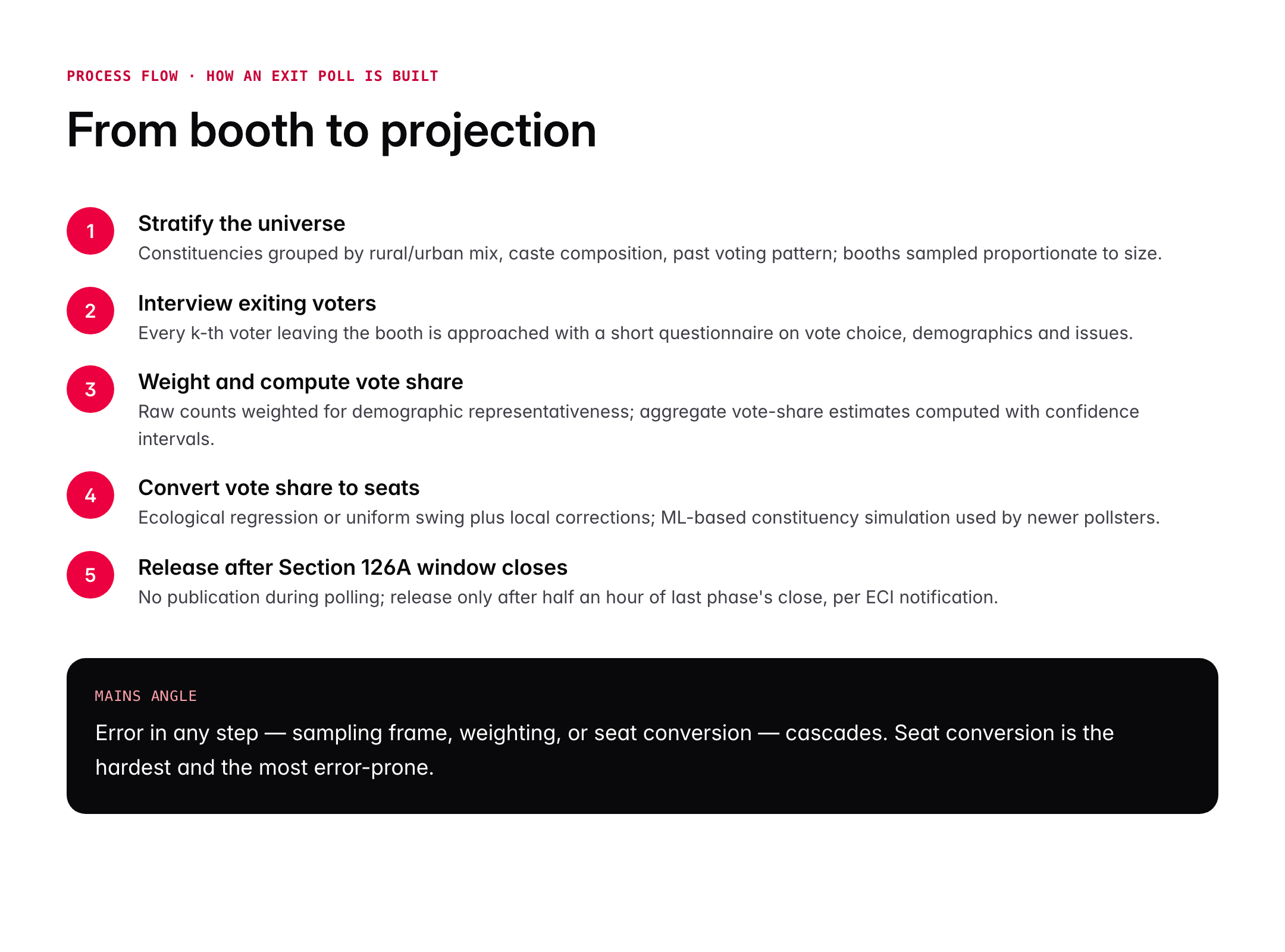
A credible exit poll typically uses multi-stage stratified random sampling. The universe is the set of polling booths. Booths are sampled proportionate to constituency size and demographic strata — rural/urban, caste composition, past voting pattern. At each sampled booth, every kth voter leaving the booth is approached.
Sample sizes in Indian national exit polls range from around 20,000 voters for quick surveys to 600,000 for major media-sponsored operations. Post-fielding, raw vote share is weighted and mapped to seats using models that include past constituency performance, swing analysis and constituency-level simulation.
Converting vote share to seats is the hardest step. In India’s first-past-the-post multi-party system, a one-point swing can produce radically different seat counts in marginals. Agencies model this through ecological regression, uniform swing with local corrections, or neural-network-based seat projections.
Major Agencies and Pollsters
Leading Indian exit-poll agencies include C-Voter (with Yashwant Deshmukh), Axis My India (with Pradeep Gupta), CSDS-Lokniti, CNX, Chanakya, Today’s Chanakya, VMR, JanKi Baat, Matrize and P-Marq. Television channels often commission polls from more than one agency and aggregate them.
Accuracy Record
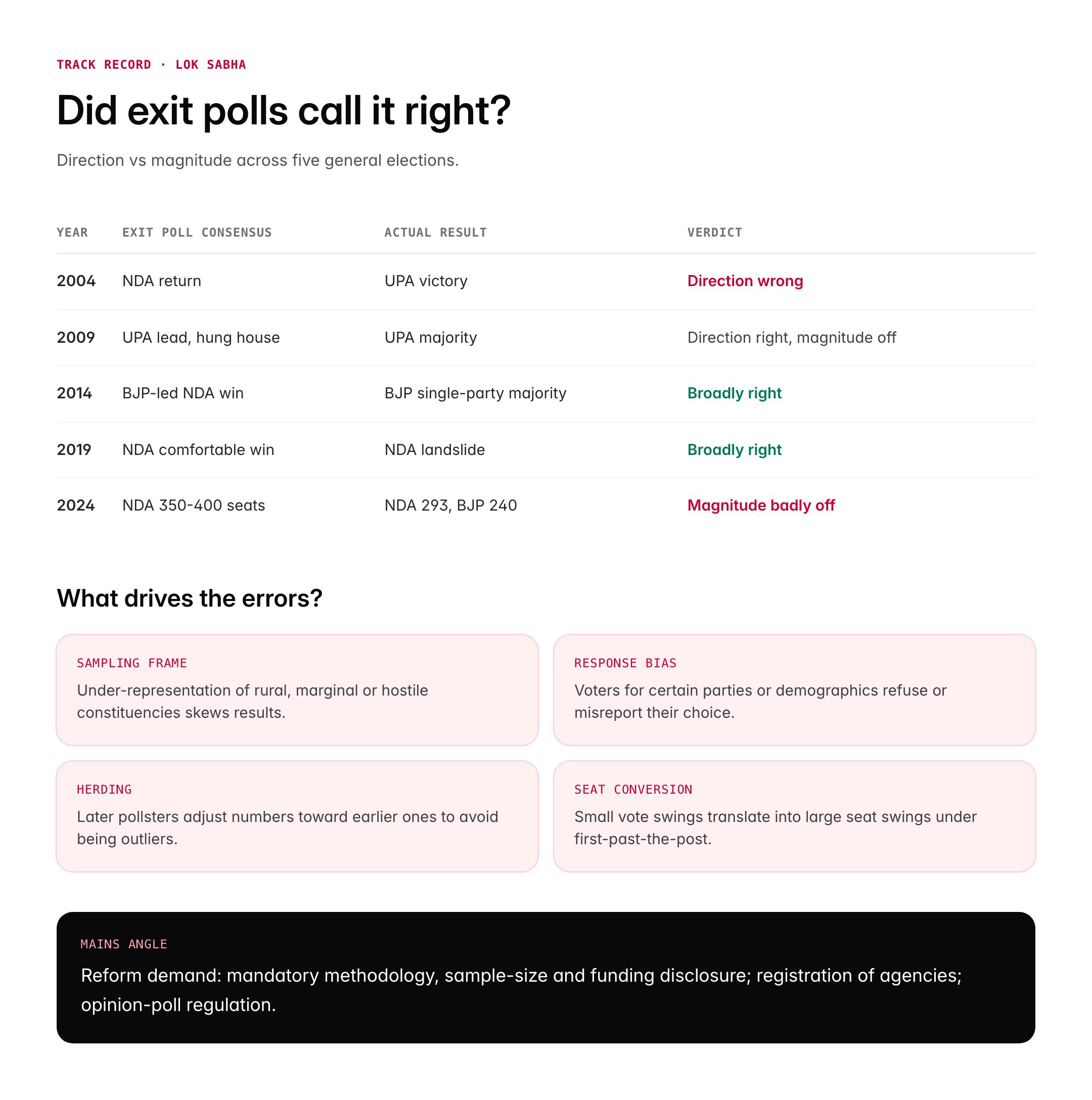
Indian exit polls have a mixed record. They got 2003 Rajasthan and 2004 Lok Sabha famously wrong, predicting a BJP return when Congress-led UPA won. They broadly called 2009, 2014 and 2019 Lok Sabha trends correctly in direction but varied on magnitude. They called 2024 Lok Sabha for a strong NDA majority when the final tally delivered a far thinner NDA win with the BJP losing its single-party majority.
Significance for UPSC and General Knowledge
- Prelims: Section 126A of the RP Act 1951, inserted 2009; ECI’s Article 324 powers.
- GS2: free and fair elections, media ethics, ECI regulation.
- GS3: impact on financial markets, sometimes triggering stock-market swings of 3-5 per cent.
- GS4: ethics of polling in a democracy, voter manipulation.
- Essay: role of media and data in democracy.
- Interview: current-affairs relevance at every general election.
Detailed Analysis: Legal Regime, Reforms and Controversies
India’s statutory framework for exit polls runs principally through Section 126A of the Representation of the People Act, 1951, inserted by the Representation of the People (Amendment) Act, 2009. It prohibits the conduct and publication of any exit poll and the dissemination of its results through print, electronic or any other media during a period to be notified by the Election Commission. That period, by the ECI’s standing order, runs from the hour fixed for commencement of polling on the first polling day to half an hour after the close of polling on the last polling day.
Violation attracts imprisonment up to two years, or fine, or both. The ECI’s 2019, 2022 and 2024 notifications reaffirmed the window and extended it across all phases of multi-phase polls. The Commission has repeatedly warned television channels and aggregator apps against pre-publishing exit-poll data during polling.
Two parallel provisions matter. Section 126(1)(b) of the RP Act prohibits displaying election matter through cinematograph, television or similar apparatus during the 48-hour “silence period” before polling ends in each phase. Opinion polls, unlike exit polls, do not have an independent statutory ban; the ECI has recommended a legislative ban from the notification of elections till polling ends, but Parliament has not enacted it.
The Election Commission of India, headed by Chief Election Commissioner Rajiv Kumar during the 2024 Lok Sabha, has proposed reforms: mandatory registration of polling agencies, disclosure of sampling methodology, funding sources, identity of clients, and disclosure of earlier errors. The Commission has cited Law Commission of India Report 255 (2015) on electoral reforms, which endorsed stricter regulation of both opinion and exit polls.
Major past controversies include the 2004 Lok Sabha prediction of an NDA return (results delivered UPA), allegations against select pollsters of paid polling and orchestrated bias, and the 2024 Lok Sabha exit polls that substantially overestimated the NDA seat tally, prompting SEBI to examine market manipulation around the 3-4 June 2024 stock swing.
Exit Polls vs Actual Results: 2019 and 2024
The most direct test of an exit poll is the gap between its prediction and the actual ECI count. The two most recent Lok Sabha elections sit at opposite ends of that gap.
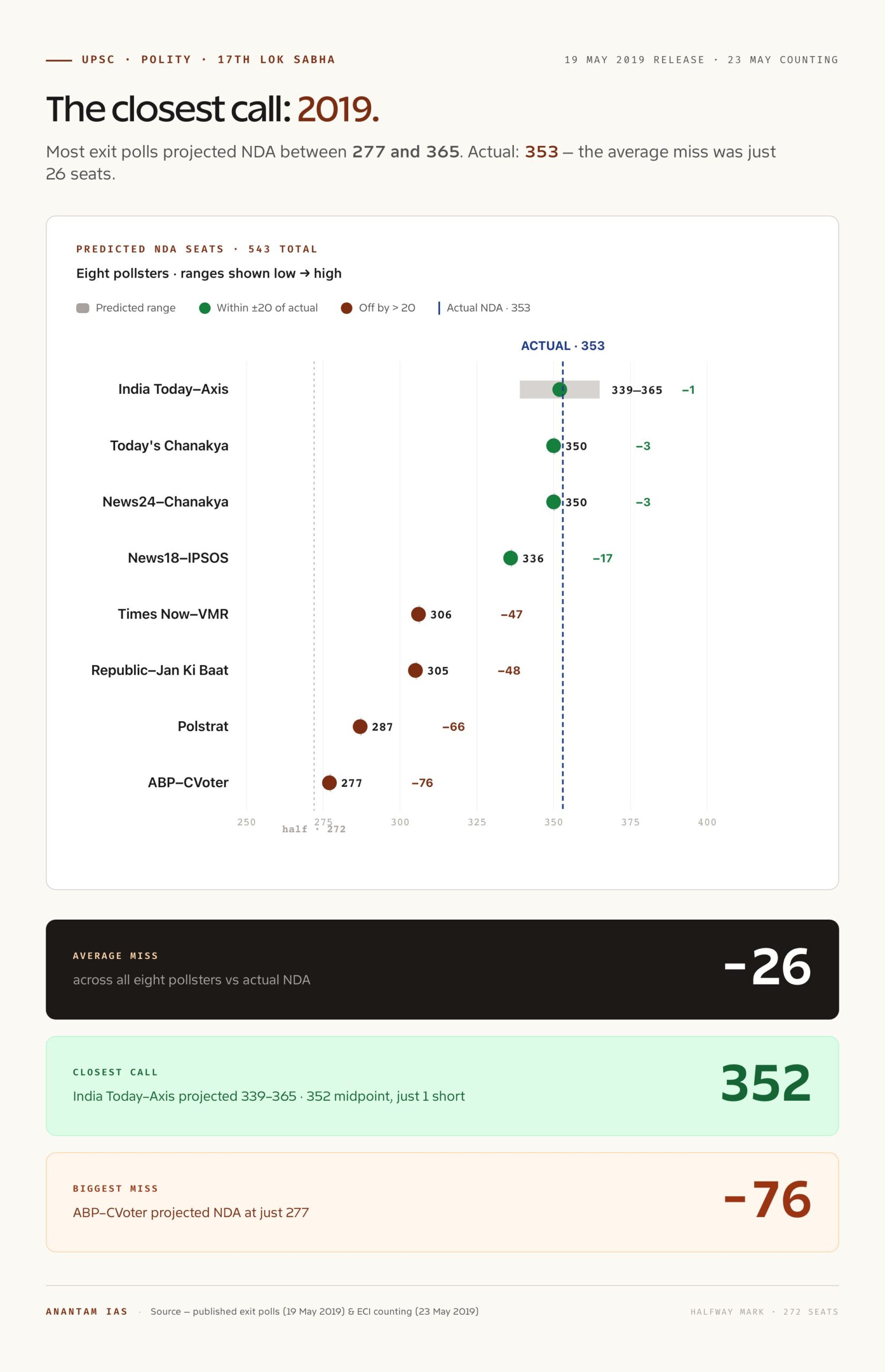
In 2019, six of the eight major pollsters projected the NDA inside a tight band of 305 to 365 seats. The actual tally of 353 fell well within India Today-Axis’s range, and the average miss across all eight polls was just 26 seats — the closest collective hit on record.
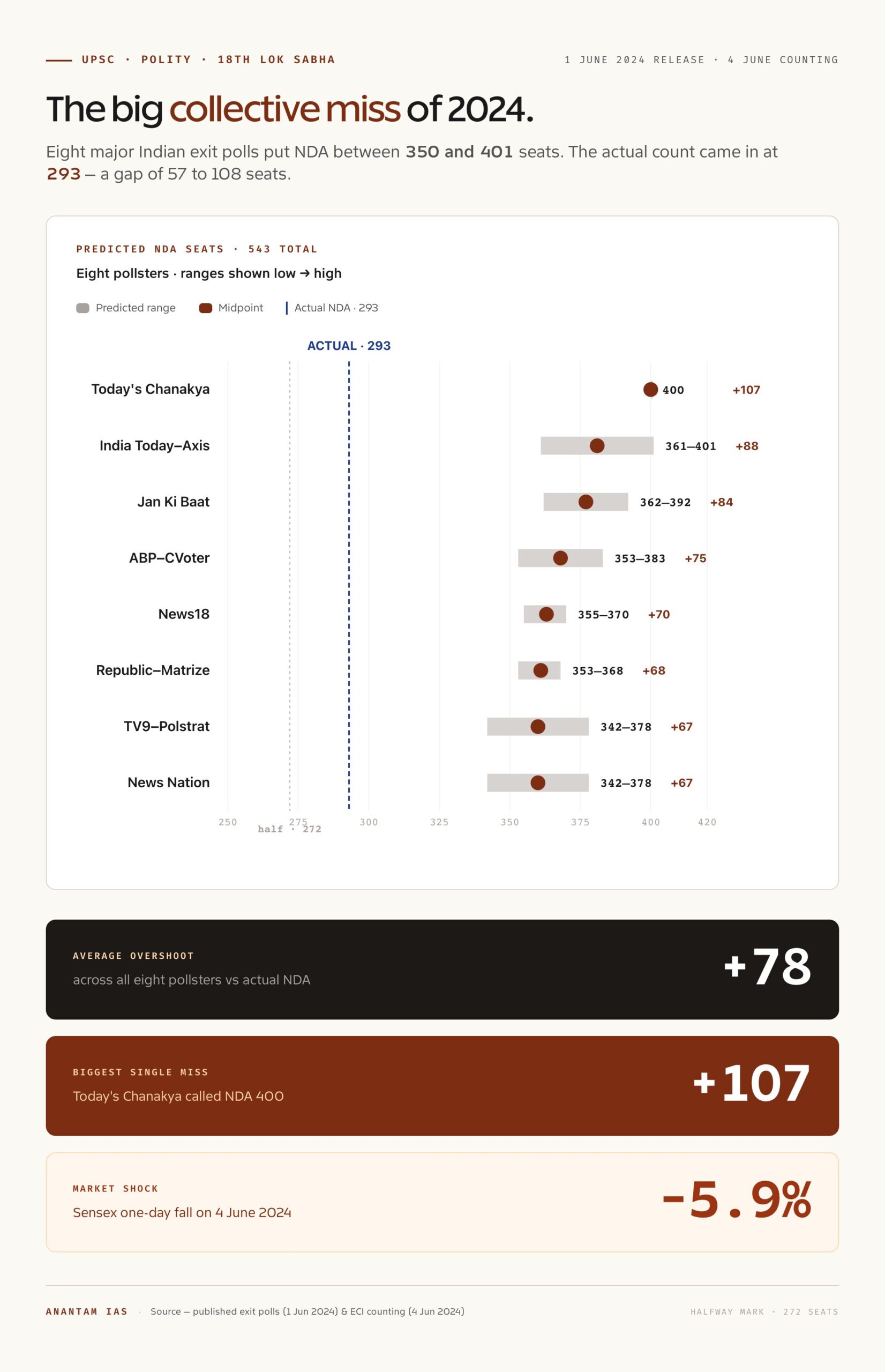
2024 was the inverse. Every published exit poll placed the NDA between 350 and 401 seats, with Today’s Chanakya calling 400. The actual NDA count was 293 — short of 350 by every poll, with the average overshoot at 78 seats and the biggest single miss at 107. The cluster of identical-direction errors revived debates around herding, sampling frames, and vote-to-seat conversion models.
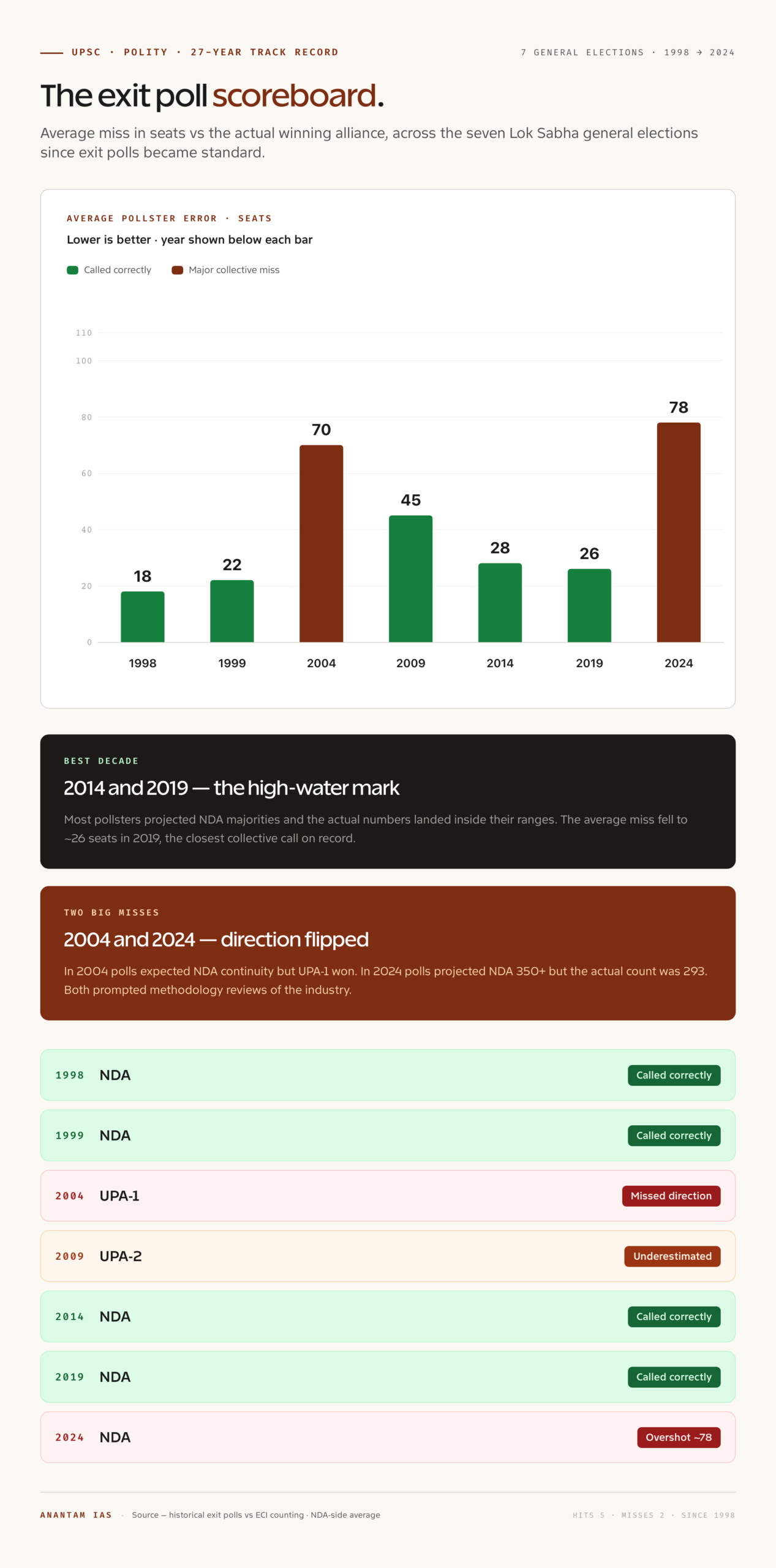
Across seven Lok Sabha elections since 1998, Indian exit polls have called the winning alliance correctly five times. The two misses — 2004 (UPA-1’s upset) and 2024 (BJP’s shrunk majority) — stand out for their scale and prompted the most serious methodology reviews of the industry.
Comparative Perspective
| Country | Exit poll norm | Release time | Enforcement |
|---|---|---|---|
| India | Section 126A, RP Act 1951 | After last polling phase ends | Statutory, up to 2 years jail |
| United Kingdom | Representation of the People Act 2000, Section 66A | After polls close | Criminal offence |
| United States | No federal ban; networks self-regulate | After state polls close | Voluntary industry pact |
| France | Law of 19 July 1977 | After last bureau closes | Criminal, fine up to 75,000 euros |
| Germany | Federal Electoral Act | After polls close | Criminal offence |
India’s regime is in the middle of the spectrum — stricter than the United States, broadly similar to the UK, France and Germany. The uniqueness is the scale: seven-phase polls across a month mean an exit-poll silence running across the entire country for weeks, longer than in any other democracy.
Controversies and Debates
Debates around exit polls fall into three buckets.
Accuracy and credibility. Indian exit polls have had several high-profile misses — 2004 Lok Sabha, 2015 Bihar, 2024 Lok Sabha — raising questions on sampling frames, weighting models, and vote-to-seat conversion. Critics point to possible herding, where later pollsters adjust their numbers to match earlier published ones, and response bias, where voters for certain parties under-report.
Regulation and free speech. Section 126A was challenged on Article 19(1)(a) free-speech grounds, but upheld on the ground that it imposes a narrowly tailored time-bound restriction to protect the integrity of the electoral process. Opinion-poll regulation remains contested; draft bills to extend restrictions have faced criticism from media organisations.
Market and political manipulation. The 2024 stock-market swing of 3-6 per cent after exit polls on 1 June, followed by a sharp fall on 4 June when results proved different, raised concerns about market manipulation through orchestrated polls. SEBI opened a preliminary examination. The Supreme Court has been moved for clearer disclosure norms.
Prelims Pointers
- Section 126A of the Representation of the People Act, 1951, governs exit polls in India.
- Section 126A was inserted by the Representation of the People (Amendment) Act, 2009.
- Violation carries up to two years imprisonment, fine, or both.
- The Election Commission derives its regulatory power from Article 324.
- Section 126(1)(b) creates the 48-hour campaign silence period before polling.
- Opinion polls are not banned by statute; only by ECI guidelines and self-regulation.
- First Indian exit poll was conducted by Eric Da Costa for the 1957 Lok Sabha election.
- CSDS-Lokniti conducted the first TV-scale exit poll for Doordarshan in 1996.
- 2024 Lok Sabha exit polls overestimated the NDA tally, triggering SEBI scrutiny.
- Law Commission Report 255 (2015) recommended stricter polling regulation.
- Major agencies: C-Voter, Axis My India, CSDS-Lokniti, CNX, Chanakya, Matrize.
- Chief Election Commissioner during 2024 Lok Sabha was Rajiv Kumar.
Mains Practice Questions
- “Exit polls strengthen democratic transparency but can also distort markets and public opinion.” Examine in the light of Section 126A of the Representation of the People Act, 1951, and recent Indian experience. (15 marks)
- Define exit polls; outline Section 126A framework and ECI powers.
- Discuss accuracy record, 2024 Lok Sabha episode, market impact.
- Suggest reforms on methodology disclosure, funding transparency, and opinion-poll regulation.
- Critically evaluate the methodology, accuracy and ethical concerns associated with exit polls in India. (10 marks)
- Explain sampling, vote-to-seat conversion and agency landscape.
- Cite accuracy cases — 2004, 2015 Bihar, 2024 Lok Sabha.
- Discuss herding, response bias, paid-polling allegations, and regulatory proposals.
Conclusion
Exit polls have become a structural feature of Indian elections, not merely a media curiosity. They shape evening news, market sentiment, and coalition arithmetic within hours of polling. Yet their methodological foundations and regulatory oversight have not kept pace with their influence. Section 126A solved one problem — release timing — but it left sampling quality, disclosure and commercial interests largely to self-regulation.
For UPSC, the expected answer blends three threads: the legal provision and its history, the technical and ethical challenges of polling a 969-million-strong electorate, and reform proposals from the ECI and Law Commission. Handled this way, “exit poll” becomes a compact case study in how democracy adapts to data.
Frequently Asked Questions
What is an exit poll?
An exit poll is a survey of voters conducted immediately after they cast their ballots, used to predict the election outcome before official counting. Pollsters interview a sample of voters leaving polling stations and project vote share and seat counts. It differs from opinion polls, which are conducted before election day, and from post-poll surveys, which happen after voting is over.
Why is exit poll regulation important for UPSC?
Exit poll regulation touches GS2 — Election Commission powers, Representation of the People Act 1951, free and fair elections. It also links to GS3 via market impact after the 2024 Lok Sabha polls, and to GS4 on media ethics. Aspirants must know Section 126A, the statutory ban window, and the ECI’s role under Article 324.
How is exit poll related to opinion poll in India?
Both are surveys to predict electoral outcomes, but an opinion poll is conducted before polling day, while an exit poll is conducted as voters leave the booth. Section 126A of the RP Act 1951 bans exit polls during the notified polling period. Opinion polls are not banned by statute; the ECI has recommended restrictions from notification till polling ends, but Parliament has not enacted them.
What is Section 126A of the Representation of the People Act 1951?
Section 126A, inserted in 2009, prohibits conduct, publication or dissemination of any exit poll during the period notified by the Election Commission — from the start of first-phase polling to half an hour after the close of the last phase. Violation attracts imprisonment up to two years, fine, or both. The provision was challenged but upheld as a reasonable restriction.
When was the first exit poll conducted in India?
The first Indian exit poll was conducted by Eric Da Costa of the Indian Institute of Public Opinion for the 1957 Lok Sabha election. Exit polls became a mass-media staple after Doordarshan commissioned CSDS to conduct a national election study and exit poll for the 1996 Lok Sabha election, with subsequent rapid growth in private media and agencies.
How accurate are Indian exit polls?
The record is mixed. Indian exit polls broadly called 2009, 2014 and 2019 Lok Sabha trends correctly in direction, but they missed 2004 Lok Sabha, 2015 Bihar and substantially overestimated the NDA tally in 2024. Margins of error typically run 3-5 percentage points on vote share, with much larger errors in seat conversion due to first-past-the-post dynamics in multi-party contests.
Which agencies conduct exit polls in India?
Major agencies include C-Voter (Yashwant Deshmukh), Axis My India (Pradeep Gupta), CSDS-Lokniti, CNX, Chanakya, Today’s Chanakya, VMR, JanKi Baat, Matrize and P-Marq. Television networks typically commission one or more agencies and air aggregated results. ECI proposals have sought mandatory registration, methodology disclosure and funding transparency.
What reforms have been proposed for exit polls?
The Election Commission and Law Commission Report 255 of 2015 have recommended mandatory registration of agencies, disclosure of methodology, sample size and funding, legislative ban on opinion polls from election notification, and stricter action against herding and paid polling. After the 2024 market swing, SEBI has also examined market-manipulation angles connected to exit-poll releases.