Factors Affecting Ethics — Religion, Culture, Law, Leadership and More (UPSC GS IV)
Comprehensive guide to the 13 factors that shape ethics — religion, culture, law, leadership, philosophy, geography, economy, time, education, power and more — for UPSC GS Paper IV.
Ethics is rarely invented from scratch. It is inherited, absorbed, debated, and reformed under the pressure of a dozen external and internal factors. A candidate who can name those factors and cite Indian examples for each is one Mains-quality answer ahead of one who can only define ethics. This guide consolidates the thirteen factors listed in the compass extract and adds the philosophical depth and case material expected in a GS-IV answer.
Why "Factors" Matter for Ethics
Ethics is not a free-standing logical system that descends, untouched, from a thinker's pen. The values an officer brings to her desk on her first day were forged by her religion (or its rejection), her family, the schools she attended, the films she watched, the constitution she swore to, the leaders she admired, the friends who argued with her. To treat ethics as if it were unaffected by these forces is to misread it.
The compass extract lists thirteen factors. Below they are organised in three layers — structural, relational, and personal — to help an aspirant remember and apply them.
A. Structural Factors
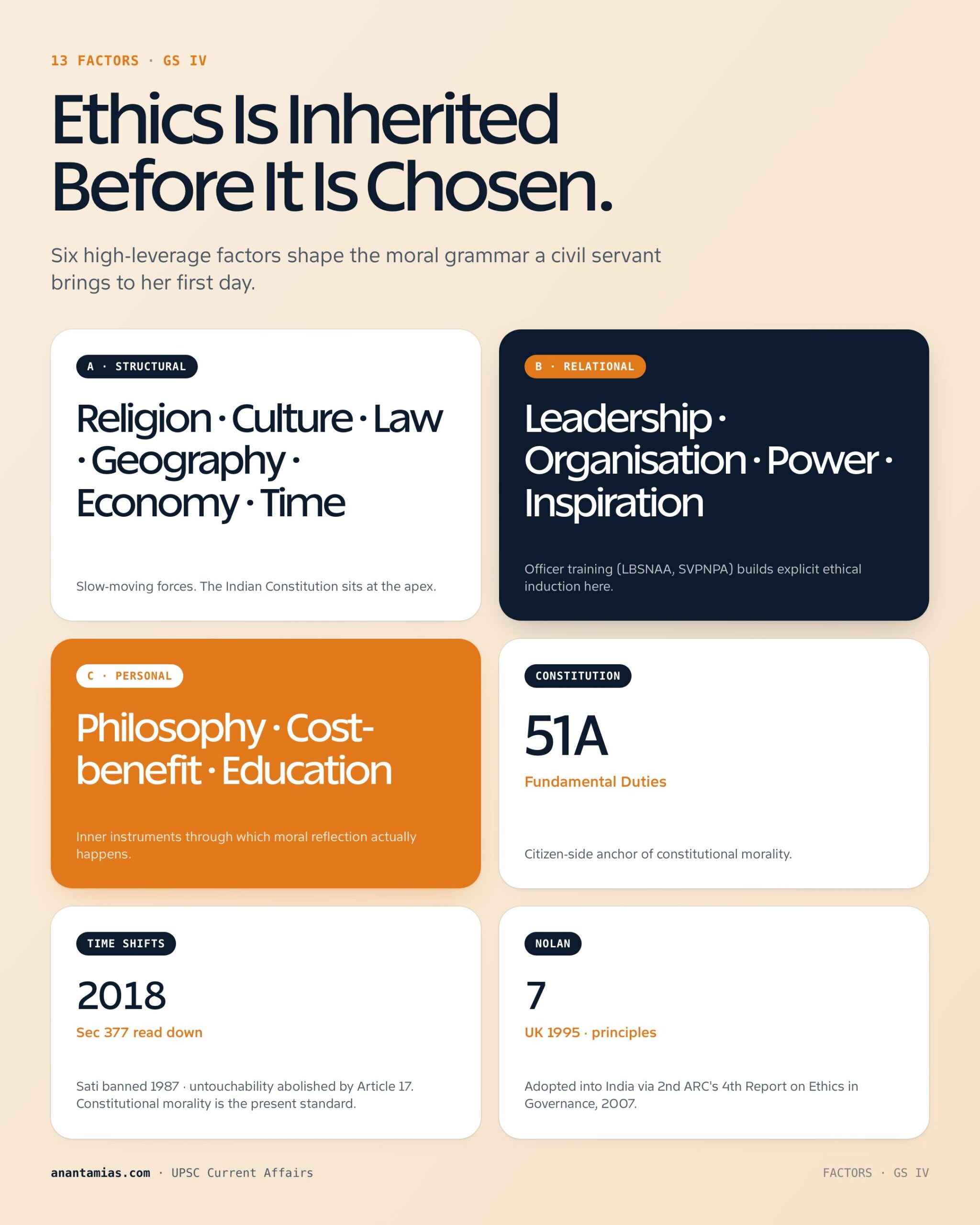
These are the deep, slow-moving forces that shape what a society considers ethical at all.
1. Religion
Religious texts and traditions deal directly with how one ought to behave and what a society should be. They supply the earliest source of moral grammar for most human beings.
- In Jainism, non-vegetarianism is unethical because of ahimsa.
- In Islam, dietary restrictions are different — pork is impermissible (haram), but most other meat is acceptable if slaughtered correctly (halal).
- In Christianity, the Sermon on the Mount frames an ethic of mercy, love and forgiveness.
- In Sikhism, seva (selfless service) and kirat karo (honest labour) are operational virtues.
- In Hinduism, dharma — context-sensitive duty — guides action.
"Religion is the manifestation of the Divinity already in man." — Swami Vivekananda
For the civil servant, the lesson is dual: religion has been a wellspring of ethical insight for millions of citizens, and at the same time the Constitution insists on secular neutrality in the discharge of office. Both must hold.
2. Tradition and Culture
Values vary across cultures.
- Western cultures lean individualistic — autonomy, rights, self-reliance.
- Indian culture has a strong altruistic / collectivist strand — vasudhaiva kutumbakam (the world is one family), joint family duty, community gift.
Cultural inheritance is not destiny. A liberal civil servant in a conservative district must respect culture without surrendering constitutional rights of the marginalised within it.
3. Law and the Constitution
Law often codifies the ethical consensus of a society. The Indian Constitution does more: it sets ethical aspirations (the Preamble's justice, liberty, equality, fraternity), enforces rules (Fundamental Rights), and lays down duties (Article 51A).
Where law and ethics diverge, the law-abiding citizen still has the duty of conscience — a point Gandhi made by accepting jail willingly when laws were unjust.
4. Geography
Geography shapes ethics through diet, livelihood, social organisation, and contact with strangers.
- The Brahmins of Bengal eat fish — proximity to fish-producing seas and rivers normalised non-vegetarianism in a community otherwise associated with vegetarianism.
- Coastal trading cultures (Gujarat, Kerala, Tamil Nadu) have historically developed open, mercantile ethics.
- Mountain societies (Ladakh, Sikkim, Northeast) carry kinship-thick ethics suited to harsh, scarce environments.
5. Economic Factors
The ethics of profit shifts with the economic system.
- In communist societies, profiteering is unethical.
- In capitalist societies, profit is broadly ethical, with constraints against fraud and externalities.
- In a mixed economy (India), public sector ethics, private sector ethics and cooperative ethics coexist and sometimes clash.
The 2008 global financial crisis revealed the ethical limits of a purely return-maximising market — a lesson built into India's later corporate-governance and CSR mandate (Section 135, Companies Act 2013).
6. Time
Ethics evolves with time. 18th-century values and 21st-century ethics differ on caste, gender, sexuality, environment, and many other domains.
- Sati was practised; it is now a crime under the Sati Prevention Act, 1987.
- Untouchability had moral defenders; it is now constitutionally abolished (Article 17).
- Section 377 of the IPC was read down in 2018 (Navtej Singh Johar v. Union of India) — an ethical stance that would have been unthinkable a generation earlier.
A serving officer in 2026 cannot pretend to be morally located in 1926. Constitutional morality is the present standard.
B. Relational Factors
These shape ethics through people and institutions in proximity.
7. Leadership
Leadership of a society, organisation, or nation determines the conduct of its followers and admirers. The democratic, liberal, secular and tolerant tradition of modern India was a gift of its founders — Gandhi, Nehru, Patel, Ambedkar, Rajaji, Maulana Azad.
"The best way to find yourself is to lose yourself in the service of others." — Mahatma Gandhi
Within the bureaucracy, the same principle holds. Officers like T.N. Seshan (electoral integrity), E. Sreedharan (delivery on time and budget), and Armstrong Pame ("Miracle Man" road) reset organisational ethics by personal example.
8. Organisation
The value system of an organisation shapes the ethics of those inside it. Compare the cultures of:
- ISRO — modest pay, mission-thick, collaborative, low-publicity.
- DRDO — secrecy-thick, defence-procurement-pressurised.
- CAG — independence, professional scepticism, written-evidence ethic.
- Police in many states — hierarchy-heavy, political-interference-prone.
A new entrant absorbs the operating ethics of her organisation in months, often unconsciously. This is why officer training (LBSNAA, SVPNPA) and mid-career exposure programmes invest in explicit ethical induction.
9. Power
What is right or wrong is, in practice, often defined by the socio-economic and political elite. The Marxist insight that the ruling ideas are the ideas of the ruling class operates partially in every society.
The civil servant must be aware of this distortion. Constitutional offices like the CAG, ECI, UPSC, CIC, the higher judiciary, and the conscientious press exist to counter the easy capture of ethics by power.
10. Inspiration
Lessons drawn from the lives and teachings of great leaders, reformers and saints become operative ethics for those who admire them.
- Gandhi — non-violence, satyagraha, trusteeship.
- Ambedkar — constitutional morality, social justice, annihilation of caste.
- Vivekananda — strength, fearlessness, daridra-narayana (service to the poor as service to God).
- Mother Teresa — care for the dying.
- Kautilya — prajasukhe sukham rajnah.
A candidate who quotes inspirations sparingly but accurately signals ethical seriousness in a Mains answer.
C. Personal Factors
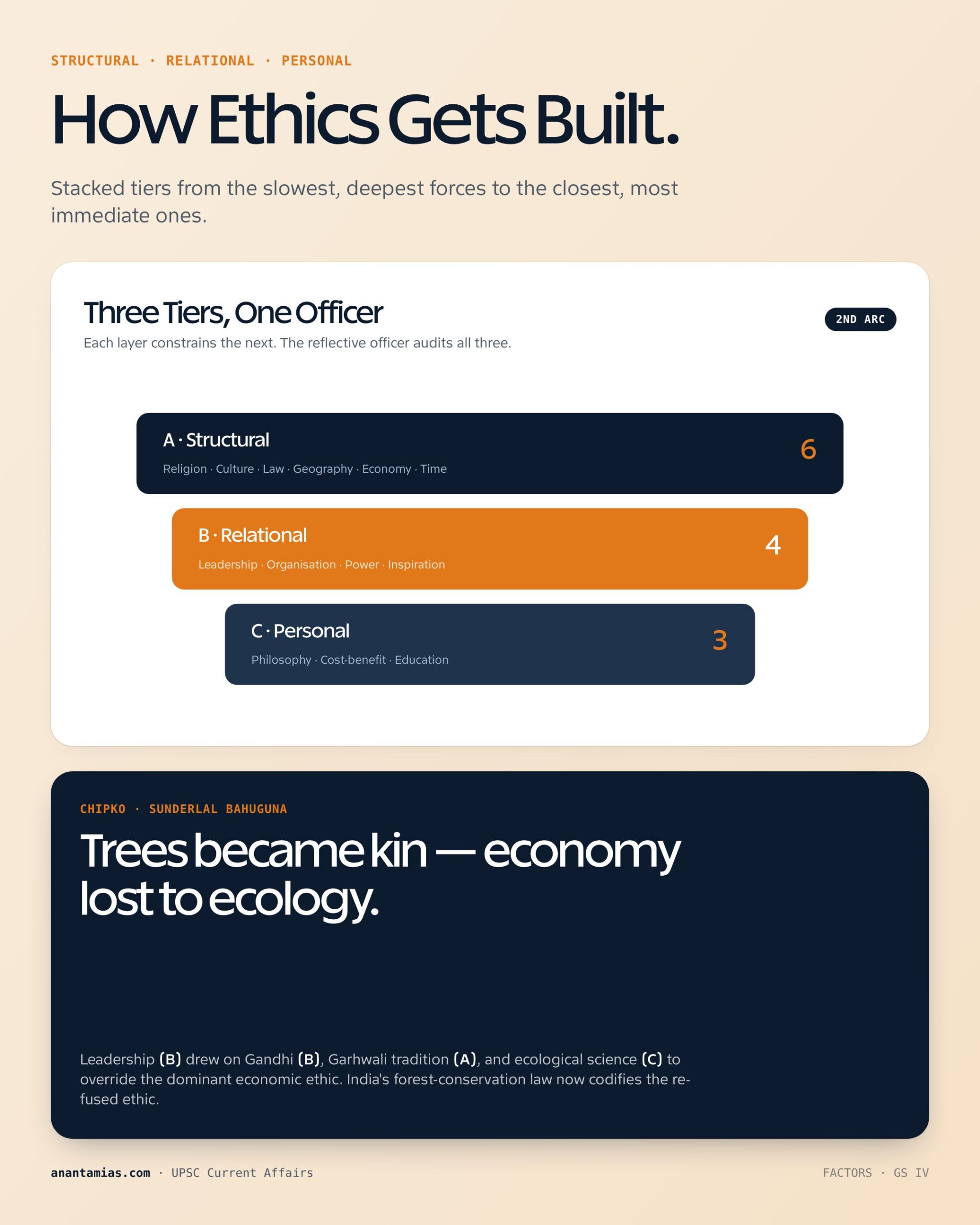
These are the inner instruments through which ethical reflection actually happens.
11. Philosophies
Ethics is also shaped by formal philosophical reflection. Aspirants should have at least one quotable line from each of:
- Aristotle — virtue ethics, the mean between extremes.
- Kant — the categorical imperative; act so that the maxim of your action could be a universal law.
- Mill / Bentham — utilitarianism; greatest happiness of the greatest number.
- Rawls — justice as fairness; the veil of ignorance.
- Gandhi — satyagraha; ends and means continuous.
"Means and ends are convertible terms in my philosophy of life." — M.K. Gandhi
12. Cost-Benefit Analysis
Utilitarianism is the formal version of cost-benefit reasoning — the greatest happiness of the greatest number. It is everywhere in policy: the National Health Mission prioritising maternal-and-child health; Aadhaar weighing convenience and welfare against privacy; environmental clearances weighing development against ecology.
Cost-benefit cannot be the only principle — it can justify the suffering of a small minority for a large majority — and this is why rights-based thinking is the constitutional counterweight.
13. Education
Thoughts depend on knowledge; knowledge is shaped by education. A civil servant educated in liberal arts, science, and the constitutional canon brings a different ethical grammar to office than one trained narrowly. The NCERT framework, the NEP 2020, and the NCRTC's value-education modules are all attempts to engineer the ethical seedbed for the next generation.
Bonus — Experience
The compass extract specifically cites Kalinga and Ashoka. After the Kalinga War's bloodshed, Ashoka renounced Bherighosa (the war drum) for Dhammaghosa (the drum of moral instruction). Personal experience can rebuild a ruler's entire ethical compass.
All Thirteen at a Glance
| # | Factor | Question It Answers |
|---|---|---|
| 1 | Religion | What does the divine demand of me? |
| 2 | Tradition / Culture | What has my community done? |
| 3 | Law / Constitution | What does the state require? |
| 4 | Leadership | Whom should I emulate? |
| 5 | Philosophies | What do reasoned thinkers conclude? |
| 6 | Geography | What does my place permit? |
| 7 | Economic factors | What does my system reward? |
| 8 | Organisation | What does my workplace expect? |
| 9 | Time | What does my era demand? |
| 10 | Experience | What has life taught me? |
| 11 | Cost-benefit | What maximises good consequences? |
| 12 | Inspiration | Whose example moves me? |
| 13 | Power | Who decides what counts as right? |
| 14 | Education | What does knowledge enable me to see? |
Two Indian Case Studies
Case 1 — The Honest Tahsildar in a Mining Belt
A young tahsildar in a mining-rich district of Odisha is socialised into a culture (Factor 8 — Organisation) where small "facilitation payments" are normalised. Her family (Factor 4 — Leadership at home) and her training at LBSNAA (Factor 13 — Education) push the opposite way. She refuses, faces transfers (Factor 9 — Power) and finally finds backing from a clean Collector (Factor 4 again) and a public-spirited journalist (Factor 12 — Inspiration). The case shows multiple factors operating at once — and the ethical agent's job is to keep the constitutional and conscience-based factors in command.
Case 2 — Sunderlal Bahuguna and the Chipko Reframing
The Chipko movement reframed forest ethics for India: trees were no longer mere economic resources but living kin. Bahuguna's leadership (Factor 7) drew on Gandhi (Factor 12), Garhwali tradition (Factor 2), and ecological science (Factor 13) to override the dominant economic ethic (Factor 5). Today, India's forest-conservation jurisprudence (Factor 3 — law) reflects this re-fused ethic.
UPSC Syllabus Relevance
GS-IV explicitly names human values — lessons from the lives and teachings of great leaders, reformers and administrators; role of family, society and educational institutions in inculcating values. Factors-affecting-ethics is the umbrella for almost all of this.
Past-Year Tested Prompts
- "What factors affect the formation of a person's attitude towards social problems?" — 2014.
- "How do you think we can build an ethical environment in the country?" — 2015.
- "Identify five ethical traits on which the resilience of an officer depends. Substantiate." — 2017.
- "Sometimes the public officials face the conflict of interest. What does the term 'conflict of interest' mean? How does it manifest in the decision-making process?" — 2022.
- "Discuss the role of formal and informal institutions in shaping public ethics in India." — 2023.
Mains Tips
- Group factors into structural / relational / personal for a clean answer-architecture.
- Cite two Indian thinkers (Kautilya + Gandhi or Ambedkar + Vivekananda) and one Western thinker.
- For every two factors, include one real-world Indian example — Chipko, Swachh Bharat, RTI, Aadhaar, NEP 2020.
- Close with a constitutional anchor — constitutional morality (Ambedkar, Kesavananda, Naz Foundation, Navtej Johar).
Prelims Pointers
- 2nd ARC, 4th Report — Ethics in Governance, 2007 — touches on factors and recommends a Code of Ethics.
- Nolan Committee (UK, 1995) — Seven Principles of Public Life.
- OECD 1998 Recommendation on Improving Ethical Conduct in the Public Service — frames ethics as an ecosystem of factors.
- Article 51A — Fundamental Duties of citizens, an institutional factor.
FAQ
Are factors affecting ethics universal?
The categories (religion, culture, law, leadership, etc.) are universal, but their content varies. Every society has some religion-shaped ethics, but which religion and what practices differ.
Can a civil servant override cultural factors?
Where culture violates the Constitution (caste exclusion, dowry, manual scavenging), the officer's duty is to enforce the constitutional standard. Where culture is benign, the officer must respect it.
Is the personal religion of an officer a factor?
It can be a private source of strength but cannot be a public criterion of decision. All India Services Conduct Rules require strict religious neutrality on duty.
Which factor is most important?
None alone. The reflective civil servant audits all the factors operating on her at any moment and asks which best aligns with constitutional ethics and the public interest.
How can one strengthen the right factors?
Read widely, choose mentors carefully, refresh exposure to original ethical texts (Gita, Arthashastra, Republic, Nicomachean Ethics, Ambedkar), and join peer groups that practise ethics openly. The civil-service academy is itself an attempt at engineered virtue formation.
The factors that shape ethics are also the levers through which ethics is reformed. Knowing them is the first move; shaping them — through education, leadership, law and personal example — is the lifelong work of every public servant.
The factors that shape ethics are also the levers through which ethics is reformed. Knowing them is the first move; shaping them — through education, leadership, law and personal example — is the lifelong work of every public servant.