Features of Public Relationship — Ethics in Public Life (UPSC GS IV)
Public relationships in administrative ethics — predictability, formality, legal-social obligation, normative pull, and wide social reach. Compares with private ethics and applies to civil-service practice.
Every officer holds two kinds of relationships at once. The private relationships with family, friends, and chosen associates — and the public relationships with citizens, colleagues, subordinates, supervisors, the political executive, the press, and constitutional offices. The ethics of each is different. UPSC GS-IV asks the candidate to articulate this difference cleanly and to identify the distinguishing features of public relationships — because civil-service ethics is largely the ethics of public, not private, life.
This guide consolidates the compass extract on the Features of Public Relationship and adds the philosophical, constitutional, and administrative depth a Mains answer needs.
What Is a Public Relationship?
A public relationship is a relationship the agent enters by virtue of a role, office or formal status rather than by virtue of personal choice. A district magistrate's relationship with citizens of her district, a police officer's relationship with an accused, a teacher's relationship with students, a doctor's relationship with patients — all are public relationships. The agent did not choose the specific other party; the role chose them.
A private relationship, by contrast, is one the agent enters by mutual personal choice — friend, spouse, confidant. Personal preference is constitutive.
The distinction matters because the ethical code that governs each is different.
Five Features from the Compass Extract
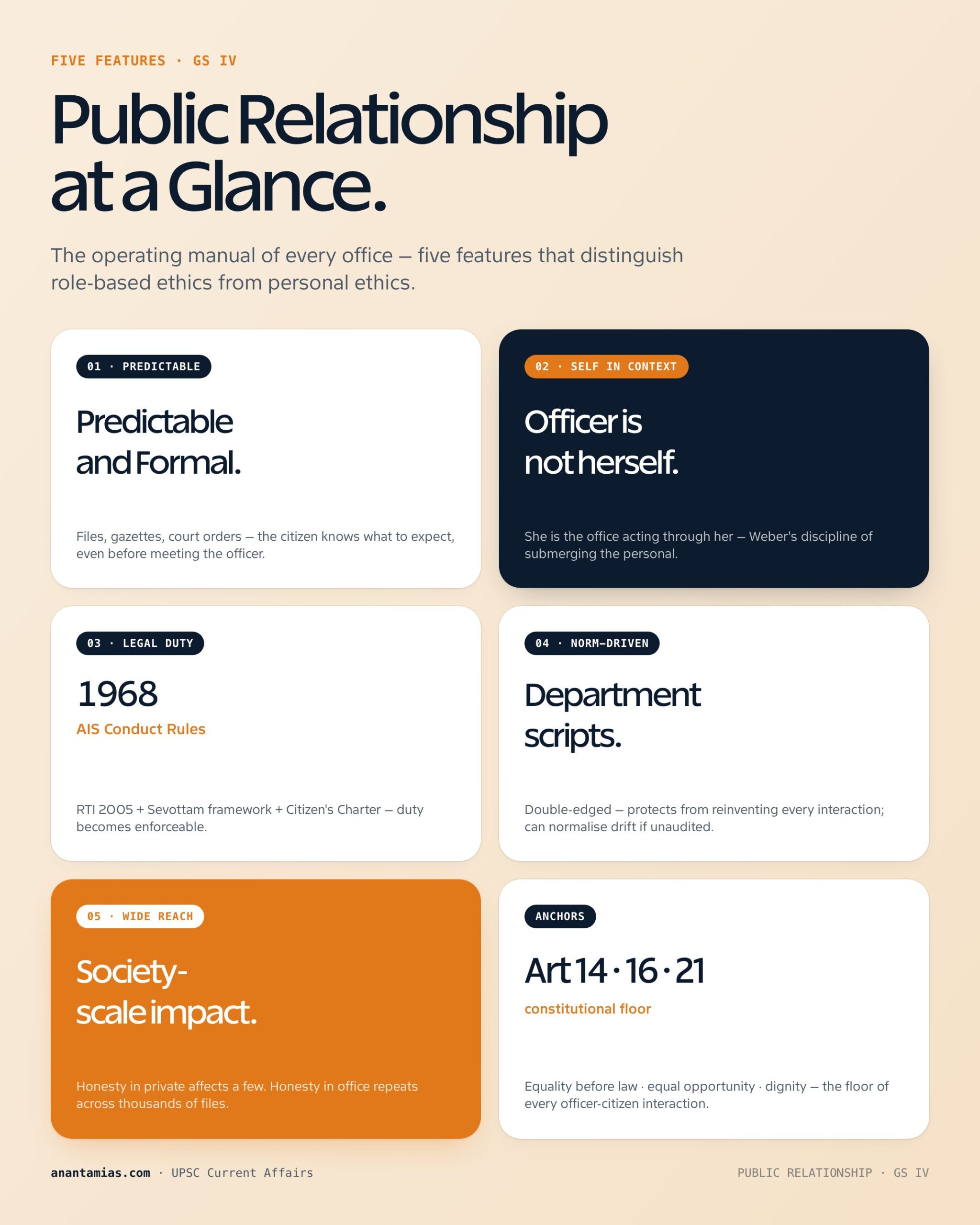
The compass identifies five features of public relationships. Each deserves elaboration.
1. Predictable and Formal
Public relationships are predictable because they are governed by rules, procedures and precedent that the citizen can know in advance. They are formal because they operate through written instruments — application forms, file noting, gazette notifications, court orders — rather than through trust and personal communication.
This formality is a feature, not a bug. It allows a citizen who has never met the officer to know what to expect from her. It allows the same officer to deliver the same standard of service to a thousand citizens she will not personally meet.
2. Self as Part of the Context
The compass puts it precisely: the individual perceives themselves as part of the context and not as separate entities. In a public relationship, the officer is not herself — she is the office acting through her. Her likes and dislikes are bracketed. Her religious or caste identity is bracketed. Her opinions about the citizen's appearance, dress, language, accent, are bracketed.
This is the demand that Max Weber described in Politics as a Vocation:
"The honour of the civil servant is vested in his ability to execute conscientiously the order of the superior authorities, exactly as if the order agreed with his own conviction." — Max Weber
The civil servant submerges the personal into the role. She acts as the impersonal instrument of the constitutional order.
3. Legal and Social Obligations
The duty in a public relationship is obligatory, externally imposed, formal and sanctioned. The officer does not perform service as a favour; she performs it because the law and the social contract require it.
- The All India Services Conduct Rules, 1968 specify a hundred forms this obligation takes.
- The Right to Information Act, 2005 turns the duty of transparency into an enforceable right.
- The Citizen's Charter of every department codifies service standards as legal commitments.
- The Sevottam framework (Department of Administrative Reforms and Public Grievances) institutionalises service-quality standards.
When duty becomes legal, failure becomes legally actionable — through departmental enquiry, vigilance proceedings, public-interest litigation, or judicial review.
4. Norm-Driven Ethics
Ethics shown in public relationships is heavily influenced by norms, values and behaviour prevailing in a particular society. The officer cannot operate in a normative vacuum. She inherits the operating ethics of her department, her cadre, her region.
This double-edged feature is important.
- On the positive side, it gives the officer ready-made ethical scripts — "this is how a Collector behaves at a public hearing" — that protect her from reinventing every interaction.
- On the negative side, it can normalise ethical drift — "this is how facilitation payments are handled in this department" — and can make the officer complicit in collective misconduct.
The corrective is to align departmental norms with constitutional morality through training, mentorship, code-of-conduct enforcement, and conscientious leadership.
5. Wide Reach — Society-Scale Impact
Public relationships have wide social reach. Personal honesty in private life affects a few. Honesty in public office affects many. The same act repeats across thousands of citizens; the same lapse multiplies across thousands of files.
The values that travel through public relationships are themselves society-scale: honesty, openness, integrity, fairness. When a Collector models these in a public hearing, the cumulative effect on civic culture is far larger than any private virtue.
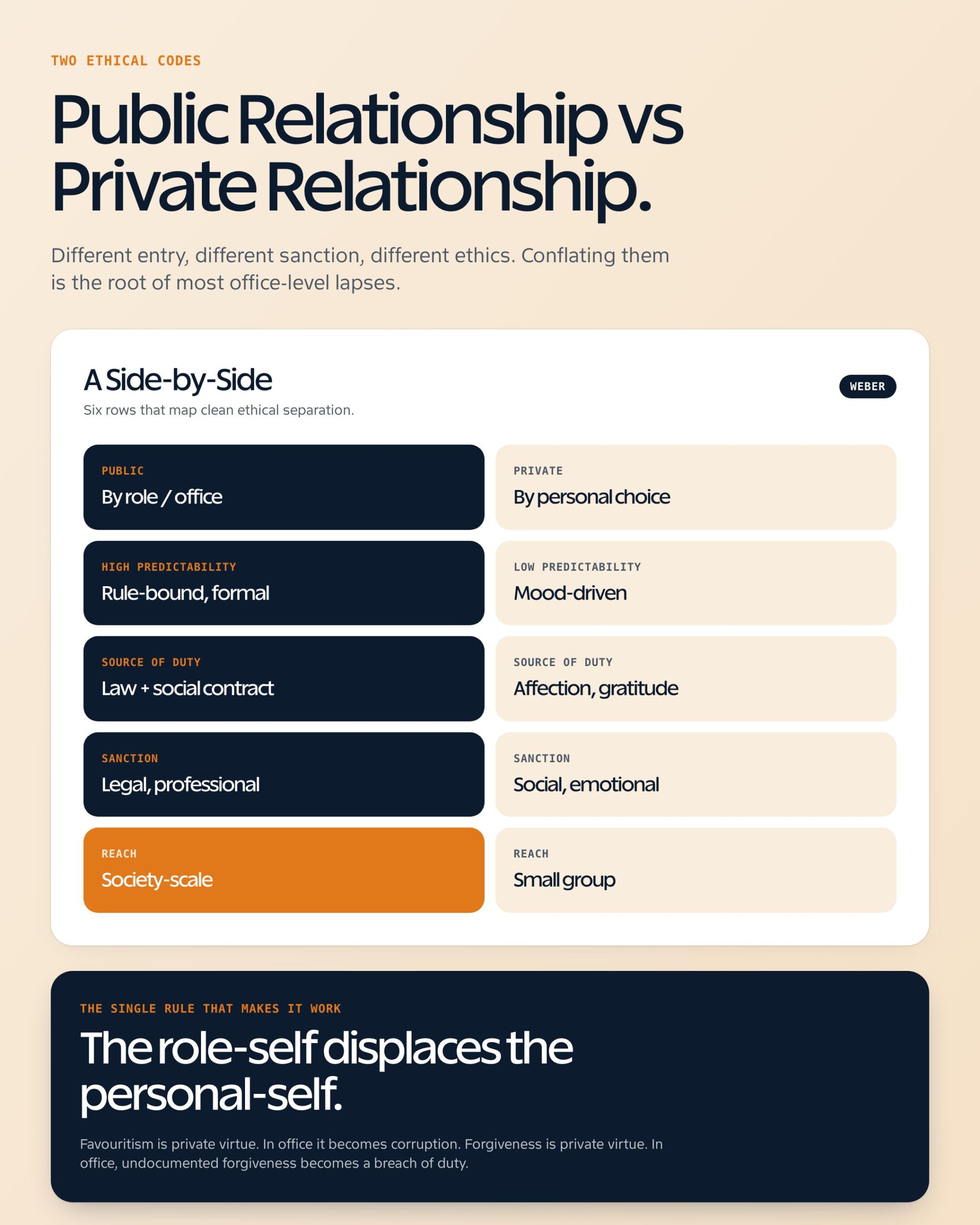
Public vs Private Ethics — A Cleaner Comparison
| Dimension | Public Relationship | Private Relationship |
|---|---|---|
| Entry | By role / office | By personal choice |
| Predictability | High — rule-bound | Low — mood-driven |
| Formality | Formal — written | Informal — spoken / felt |
| Source of obligation | Law and social contract | Affection, gratitude |
| Tone | Impersonal, neutral | Warm, personal |
| Sanction for breach | Legal, professional | Social, emotional |
| Reach | Society-scale | Small group |
| Permitted favouritism | None | Substantial |
| Confidentiality | Statutory | Personal trust |
A clean candidate answer can reproduce three or four of these rows in a Mains paper to demonstrate analytical clarity.
Where Public Ethics Diverges from Private Ethics
Three places in administration where private-ethics intuitions actively mislead.
Favouritism
In private life, preferring a friend over a stranger is virtuous — loyalty is a private excellence. In public life, preferring a friend over a stranger is corruption — the office demands impartiality.
Forgiveness
In private life, forgiving a child's lapse is virtuous. In public life, forgiving a subordinate's procedural lapse without record can be a breach of duty.
Honesty
In private life, white lies to spare feelings are sometimes virtuous ("you look fine"). In public life, all administrative communication must be truthful — even when truth is painful — because the file is a permanent record on which others will rely.
"Public service is a public trust, requiring employees to place loyalty to the Constitution, the laws, and ethical principles above private gain." — U.S. Office of Government Ethics, paraphrased in the 2nd ARC, 4th Report
Constitutional Anchors
Public-relationship ethics is anchored in the Indian Constitution at multiple points.
- Article 14 — equality before law — the foundation of impersonal treatment.
- Article 15 — non-discrimination — bars caste, religion, sex, race as criteria.
- Article 16 — equality in public employment — anchors fair recruitment and promotion.
- Article 21 — protection of life and liberty — the floor of dignity in every officer-citizen interaction.
- Article 51A — Fundamental Duties — citizens too have ethical obligations in public life.
- Preamble — justice, liberty, equality, fraternity — the four-pillar moral test for any public action.
Two Indian Case Studies
Case 1 — The IAS Officer at the Public Hearing
A young IAS officer holds a public hearing under the Forest Rights Act, 2006. A tribal elder approaches her, then her own caste-elder approaches her with a contradictory claim. Private ethics would lean toward the caste-elder (loyalty, kinship). Public ethics demands she apply the statutory criteria uniformly — the tribal elder's claim, if it meets the FRA's tests, prevails. The officer's role-self displaces her personal-self. The case shows feature 2 (self-as-context) in operation under stress.
Case 2 — Citizen's Charter Failure in a Tehsil Office
Citizens in a tehsil report that caste certificates promised within 21 days under the Citizen's Charter take 90+ days. An RTI shows the lapse is across the cadre. The District Collector convenes the tehsildars, redesigns the workflow, and publishes weekly performance data on the district website. The case illustrates features 1 (predictability), 3 (legal obligation), 4 (norms — here, of delay), and 5 (wide reach — caste certificates affect education, jobs, and welfare).
UPSC Syllabus Relevance
GS IV explicitly names ethics in public and private relationships, and probity in public life. The features of public relationships sit at the heart of this section.
Past-Year Prompts
- "In the context of defending the integrity of the civil services, Sardar Patel's address… Reflect briefly on the ethics that public servants are required to follow." — 2014.
- "Distinguish between 'Code of ethics' and 'Code of conduct' with suitable examples." — 2018.
- "Examine the relevance of the following in the context of civil service: (a) Empathy (b) Tolerance towards opposing views (c) Objectivity in one's task." — 2017.
- "What does ethics seek to promote in human life? Why is it important to learn ethics from a public service perspective?" — 2014.
- "Public servants are likely to confront with the issues of 'Conflict of Interest'. What do you understand by the term 'Conflict of Interest'?" — 2015.
Mains Answer-Writing Tips
- Open by defining public relationship — distinguish from private at the outset.
- List the five features — but elaborate at least three.
- Use Article 14 + Weber as twin anchors.
- Include one Indian case and one Western reference (Nolan Principles, OECD).
- Close with the constitutional morality frame — Ambedkar.
Prelims Pointers
- 2nd ARC, 4th Report — Ethics in Governance, 2007 — recommends the codification of public-service ethics.
- Nolan Committee Principles, UK 1995 — Selflessness, Integrity, Objectivity, Accountability, Openness, Honesty, Leadership.
- Citizen's Charter (1997) — Indian counterpart of the UK Citizen's Charter (1991).
- Sevottam Model — service-delivery framework of DARPG.
- All India Services (Conduct) Rules, 1968 — the operative rule book on public-relationship conduct.
FAQ
Are private virtues irrelevant to public office?
No. Private virtues are the seedbed of public virtue. An officer cannot be honest in office without being honest at home in some general sense. But private virtues must be adapted to public ethics — loyalty becomes impartiality, forgiveness becomes due process, affection becomes empathetic neutrality.
What about an officer’s right to private life?
Strong, and constitutionally protected. The All India Services Conduct Rules regulate public conduct, not private belief. An officer's religion, dietary practice, family choices remain her own. The rule is that public conduct must not be coloured by private preference.
Can a friend approach an officer for a legitimate request?
Yes, through the same channel as any citizen. The officer must process the request on the same standard as for a stranger. To do otherwise is to convert public office into private favour.
Are politicians in public relationships with citizens?
Yes — and held to similar features. The Code of Conduct for Ministers under the Ministry of Home Affairs codifies many of these. Political ethics, however, layer in the dimension of partisan loyalty, which the permanent civil service does not have.
How does the press fit in?
The press is a public-facing institution and is held to public-relationship ethics in its professional capacity — accuracy, fairness, public interest. The Press Council Norms of Journalistic Conduct codify this.
The features of public relationship are the operating manual of the office. An officer who internalises predictability, formality, legal obligation, normative awareness and wide reach has internalised most of administrative ethics. Everything else — codes, conduct rules, performance frameworks — is the engineering of these five features at scale.
The features of public relationship are the operating manual of the office. An officer who internalises predictability, formality, legal obligation, normative awareness and wide reach has internalised most of administrative ethics. Everything else — codes, conduct rules, performance frameworks — is the engineering of these five features at scale.