First Census in India: History, Evolution, and UPSC Notes
First census in India (1872) under Lord Mayo and the first synchronous census of 1881 by Lord Ripon. Explore evolution, methods, and Census 2021 delay.
The first census in India is a foundational landmark in the country's demographic history. A non-synchronous, partial count was conducted in 1872 under Viceroy Lord Mayo, while the first synchronous and nationwide census took place in 1881 under Viceroy Lord Ripon. Since then, the Census of India has been conducted every ten years without interruption until the decennial cycle was disrupted by the COVID-19 pandemic in 2021. Today the census is the single largest administrative exercise in the world and is governed by the Census Act, 1948. For UPSC aspirants, a clear grasp of its origin, legal basis, evolution and current status is essential for both Prelims and Mains.
What Is a Census?
A census is the complete enumeration of the population of a defined territory at a given point of time, including demographic, social and economic information. In India, it is conducted by the Office of the Registrar General and Census Commissioner of India (ORGI) under the Ministry of Home Affairs. The constitutional basis comes from Entry 69 of the Union List (Schedule Seventh), which covers "Census". The legal framework is the Census Act, 1948, supplemented by the Census Rules, 1990.
Information collected is confidential for individuals but published as aggregate statistics for policy and research.
The Census of 1872 – "First" but Non-Synchronous
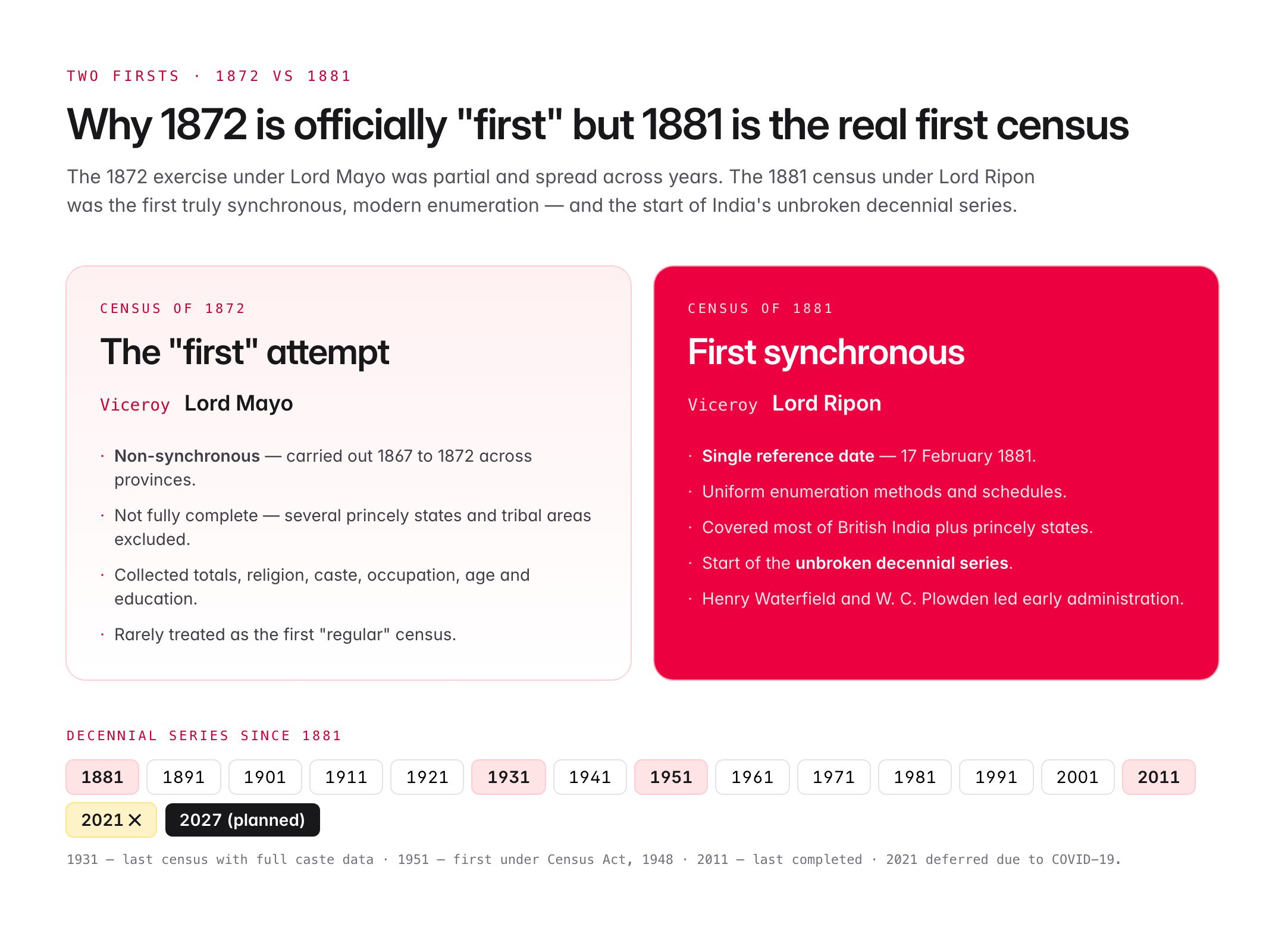
The idea of a systematic population count gained ground in the 1860s as the British Raj sought reliable data for revenue, administration and public health after the Revolt of 1857. The first all-India census was undertaken in 1872 under Viceroy Lord Mayo. Features:
- Non-synchronous – enumeration happened at different times in different provinces between 1867 and 1872, depending on local arrangements.
- Not fully complete – several princely states and tribal areas were not uniformly covered.
- Focused on population totals, religion, caste, occupation, age and education.
Because it was carried out piecemeal, it is rarely treated as the first "regular" census. It is, however, officially recognised as the first attempt.
The Census of 1881 – First Synchronous Census
The 1881 census, under Viceroy Lord Ripon, was conducted on a single reference date (17 February 1881) across most of British India and princely states. It is considered the first synchronous, continuous and modern census of India and marks the start of the unbroken decennial series. Its significance:
- Introduced uniform enumeration methods and schedules.
- Covered larger territory and more princely states than 1872.
- Provided the first comprehensive baseline for population, sex, age, literacy, religion, caste, language and occupation.
- Henry Waterfield and W. C. Plowden were prominent figures associated with early census administration.
From 1881 onwards, censuses were conducted every ten years: 1891, 1901, 1911, 1921, 1931, 1941, and after independence, 1951, 1961, 1971, 1981, 1991, 2001, 2011.
Evolution of Indian Census
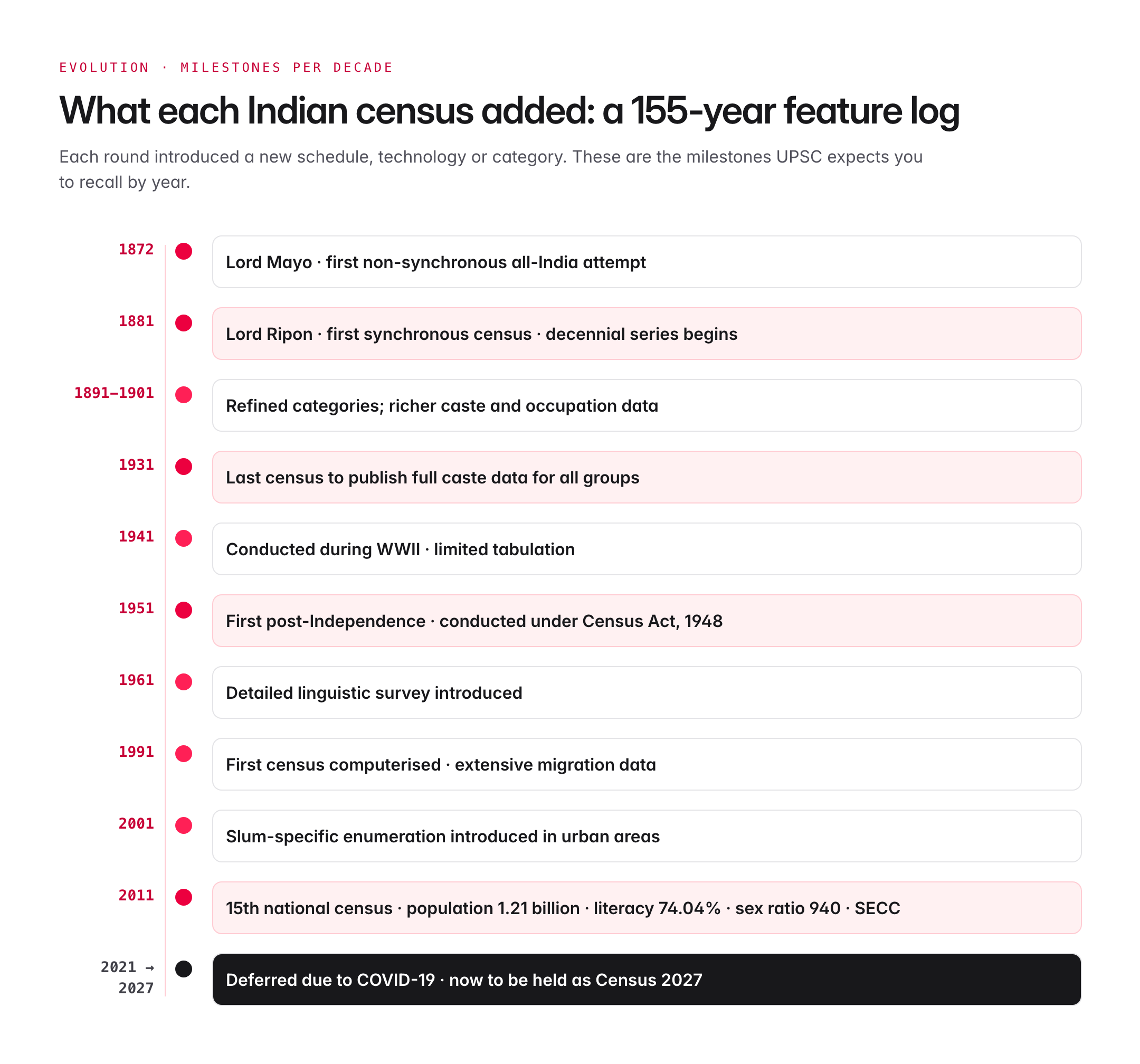
| Census | Key Features |
|---|---|
| 1872 (Lord Mayo) | First, non-synchronous all-India attempt |
| 1881 (Lord Ripon) | First synchronous census; start of decennial series |
| 1891, 1901 | Refined categories; caste & occupation data |
| 1931 | Last census to publish full caste data for all groups |
| 1941 | Conducted during WW II; limited tabulation |
| 1951 | First post-Independence; under Census Act, 1948 |
| 1961 | Introduced detailed linguistic survey |
| 1991 | First census on computers; extensive migration data |
| 2001 | Introduced slum-specific enumeration in urban areas |
| 2011 | 15th national census; population 1.21 billion; literacy 74.04%; added data on disabilities, SECC |
| 2021 | Postponed due to COVID-19; to be held as Census 2027 per government announcements |
The 1931 census is often cited as the last census that recorded caste data for all communities (beyond Scheduled Castes and Scheduled Tribes). Since then, only SC and ST have been separately enumerated.
Legal and Administrative Framework
The Census Act, 1948 is the cornerstone statute. Key features:
- Obligation to answer – citizens are legally required to respond truthfully.
- Confidentiality – individual-level data cannot be used as evidence in court.
- Offences – for refusing information or providing false data.
- Powers of Census Officers – appointed under the Act.
The Registrar General and Census Commissioner is the nodal authority. Enumeration is carried out in two phases:
- Houselisting and Housing Census – collects data on housing conditions, amenities and assets.
- Population Enumeration – detailed demographic, social and economic attributes.
Millions of enumerators, mostly school teachers, are trained and deployed across the country.
Census, NPR, SECC: Distinctions
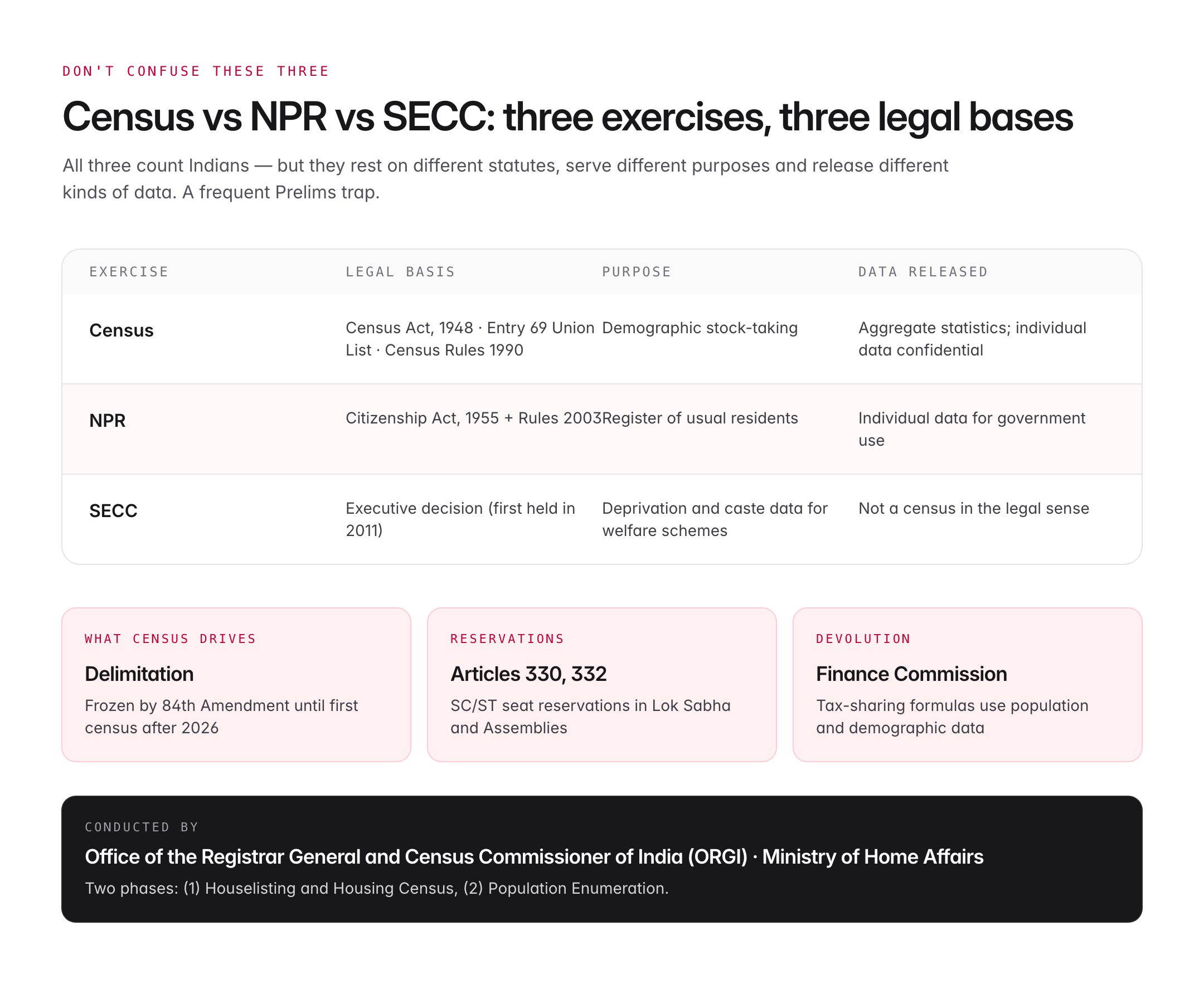
UPSC questions often test students on the differences between overlapping exercises.
| Exercise | Basis | Purpose | Data Released |
|---|---|---|---|
| Census | Census Act, 1948 | Demographic stock-taking | Aggregate statistics |
| National Population Register (NPR) | Citizenship Act, 1955 + Rules 2003 | Register of usual residents | Individual data for government use |
| Socio-Economic and Caste Census (SECC) | Executive decision; first in 2011 | Deprivation & caste data for schemes | Not a census in the legal sense |
Significance and Uses
Census data underpins almost every dimension of Indian governance:
- Delimitation of Lok Sabha and Assembly constituencies (frozen until first census after 2026 by 84th Amendment).
- Reservations for SCs and STs (Article 330, 332).
- Finance Commission formulas for tax devolution.
- Planning and schemes – PDS, MGNREGA coverage, health and education programs.
- Urbanisation and migration analysis.
- Linguistic data – foundation of the Official Languages Act and the 8th Schedule.
- Research – social scientists rely on census microdata.
Delimitation and women's reservation implementation (under the 106th Amendment) are directly tied to the next census, making the 2027 exercise politically consequential.
Challenges Ahead
Key issues for the upcoming census:
- Timeliness – delayed by nearly seven years, affecting all policy planning.
- Digital enumeration – rollout of mobile-app-based collection.
- Caste enumeration debate – demands for a comprehensive caste census beyond SC/ST.
- Privacy and data protection – intersection with the Digital Personal Data Protection Act, 2023.
- Migration – capturing seasonal and circular migrants accurately.
UPSC Relevance
Prelims focus
- First census (non-synchronous) – 1872, Lord Mayo.
- First synchronous census – 1881, Lord Ripon.
- Census Act, 1948; constitutional Entry 69, Union List.
- 1931 – last census with complete caste data.
- 2011 census headline figures: population, literacy rate, sex ratio (940).
- Difference between Census, NPR and SECC.
Mains GS-I / GS-II angle
Questions span: role of census data in policymaking, caste census debate and its implications for social justice, delimitation and representation, and data privacy. An effective frame: "The census is not just a count, it is the statistical foundation of Indian democracy." Back this with examples from reservation, delimitation and welfare delivery.
Sample PYQ angle – "Discuss the need for a caste-based census in India" or "Examine the challenges in conducting the next census." Use historical anchor (1931) + current context (delay, NPR overlap, privacy concerns) for a balanced answer.
The journey from 1872 to 2027 shows how a colonial administrative tool evolved into a democratic instrument – a theme UPSC finds endlessly useful.