Foundational Values of Civil Services: Nolan Principles, Indian Additions and Real-World Application (UPSC GS IV)
Foundational values of civil services for UPSC GS IV — Nolan committee seven principles, Indian additions, why values matter, and Indian case studies of value conflict.
A modern state runs on rules, but the rules are interpreted, applied and occasionally bent by human beings. What anchors that interpretation? Foundational values — the durable moral commitments that shape how a civil servant uses the discretion the law inevitably leaves her. Without them, every rule becomes loophole; with them, even an ambiguous rule produces fair outcomes.
The UPSC has made foundational values the spine of GS IV. This article walks through the meaning, the Nolan committee's seven values, Indian additions, the philosophical justification for each value, the situations where values collide, and case studies that show what each value looks like in administrative practice.
What "foundational" means here
A foundational value is one that stands beneath all other professional commitments and would have to be honoured even if no rule mentioned it. Three things distinguish a foundational value from an ordinary preference.
- It is broadly endorsed across the constitutional, philosophical and democratic traditions of the country.
- Its absence makes the rest of public service hollow — efficiency without integrity is corruption optimised.
- It applies regardless of post, cadre or political dispensation.
A foundational value functions like a tuning fork. When a decision feels off, you strike it against the foundational values; if it rings false against any one, the decision needs rework.
Why civil services need foundational values
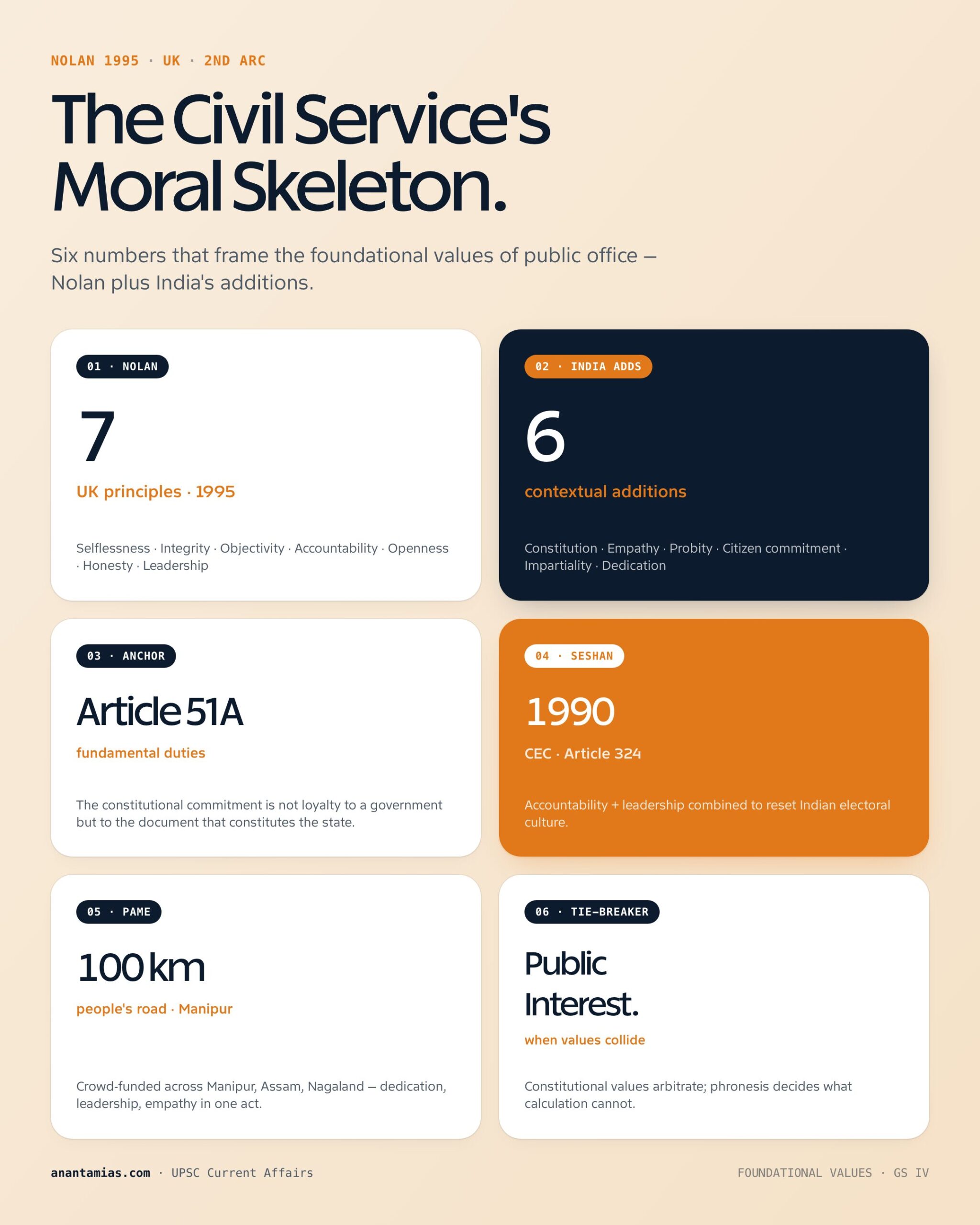
Three structural facts about administration make foundational values non-negotiable.
- Discretion is unavoidable. Statutes leave gaps; rules cannot anticipate every case. The officer's discretion is the place where values do real work.
- Accountability runs to citizens, not just superiors. A civil servant is the visible face of the state for the citizen. The foundational values are the citizen's protection against arbitrary use of state power.
- Legitimacy comes from values, not just legality. A government that follows law without values produces grievance; a government that honours values even where law is silent earns trust.
The 2nd Administrative Reforms Commission's Ethics in Governance report makes this point directly: rules without values are insufficient, and values without rules are weak. Both must be present.
The Nolan Committee's seven principles
The Committee on Standards in Public Life, chaired by Lord Nolan, was set up in the United Kingdom in 1994 in response to a series of public-life scandals. Its 1995 report listed seven principles that have become the international template for public-service ethics — adapted by India in the Code of Ethics for civil servants and discussed throughout 2nd ARC.
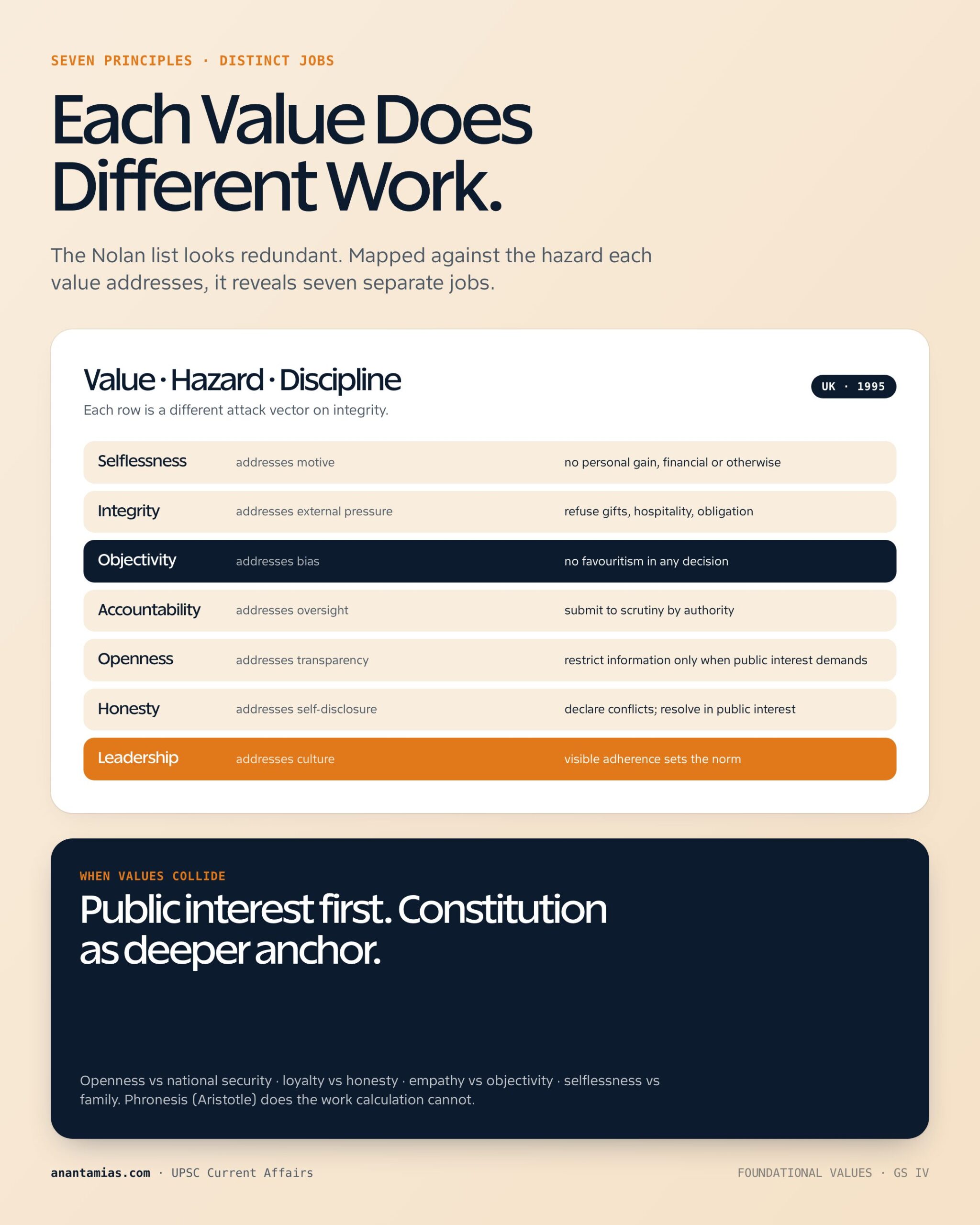
| Principle | Core requirement | Operational meaning |
|---|---|---|
| Selflessness | Decisions taken solely in public interest | No personal gain — financial or otherwise |
| Integrity | No financial or other obligation that could influence decisions | Refuse gifts, hospitalities, relationships that compromise judgement |
| Objectivity | Choices on merit | No favouritism in appointments, contracts, transfers |
| Accountability | Answerable for decisions and actions | Submit to scrutiny by appropriate authorities |
| Openness | Decisions and reasons publicly available | Restrict information only when public interest clearly demands |
| Honesty | Disclose private interests that conflict with public role | Resolve conflicts in favour of public interest |
| Leadership | Promote and support these principles by example | Visible adherence sets the cultural norm |
Each value is doing distinct work. Selflessness addresses motive; integrity addresses external pressure; objectivity addresses bias; accountability addresses the relation to oversight; openness addresses transparency to citizens; honesty addresses self-disclosure; leadership addresses cultural transmission.
Indian additions to the Nolan list
The 2nd ARC and the proposed Public Service Bill expanded the Nolan principles to fit the Indian constitutional and social context. The additions are not arbitrary — each is tied to a feature of Indian democracy.
- Commitment to the Constitution. Article 51A makes constitutional commitment a citizen duty; for the civil servant it is the deepest oath. This is not loyalty to a government but to the document that constitutes the state.
- Empathy and compassion for the vulnerable. A largely poor country with deep social inequalities cannot run on cold procedural fairness alone. The 2nd ARC explicitly invokes empathy as a foundational value.
- Adherence to the highest standards of probity, integrity and conduct. A maximalist version of the integrity principle, recognising that lower standards in a developing country compound rapidly.
- Commitment to citizens and the public good. A reformulation of selflessness in democratic terms — the citizen, not the file, is the point.
- Impartiality and non-partisanship. Critical in a competitive democracy where political dispensations change every five years.
- Dedication to public service. Beyond the contractual; a vocation rather than a job.
Two Indian case studies
Case study 1 — T.N. Seshan and electoral integrity
When T.N. Seshan was Chief Election Commissioner (1990–96), the foundational values of independence, objectivity and leadership were under threat. He enforced the model code of conduct against ruling parties, used Article 324 powers, and made the Election Commission a feared, respected institution. His success rested on combining accountability (he answered to the Constitution, not the government) with leadership (he visibly modelled what neutral electoral administration looks like). The institution's strengthened independence is his foundational-value legacy.
Case study 2 — Armstrong Pame and the People's Road
Armstrong Pame, an IAS officer in Manipur, used crowd-funding and community labour to build a 100-km road connecting Manipur, Assam and Nagaland — a road his department was unable to fund. The values at work: dedication to public service (he chose problem-solving over bureaucratic resignation), leadership (he set the example for officers and citizens), and empathy (the road served a remote tribal population). When values combine, civil service stops looking like a job and starts looking like a vocation.
Where foundational values collide
Values rarely conflict in textbook situations; in real life they collide constantly.
- Openness vs national security. A defence procurement detail may serve openness but compromise security.
- Loyalty vs honesty. A junior officer who knows of senior misconduct must choose.
- Empathy vs objectivity. A starving family without papers cannot legally receive ration; empathy says feed them, objectivity says follow rules.
- Selflessness vs family obligation. The relative who wants a posting near home tests the officer's selflessness.
The 2nd ARC's handling of these collisions points to public interest as the tie-breaker, with constitutional values as the deeper anchor when public interest itself is contested. Practical wisdom — Aristotle's phronesis — does the rest.
Civil services application
The foundational values are not abstractions for the answer paper. They translate into routine office practice.
- Selflessness — refusing the personal call to influence a transfer; recusing from a decision involving a relative.
- Integrity — declining the gift, even the small one; refusing private hospitality from a contractor.
- Objectivity — disregarding identity in selection of beneficiaries; basing decisions on documented criteria.
- Accountability — keeping a clean file, ready for audit; signing decisions with reasons recorded.
- Openness — proactively disclosing under RTI before being asked; publishing scheme data on dashboards.
- Honesty — declaring assets annually and accurately; disclosing conflicts before they bite.
- Leadership — modelling the conduct one expects of subordinates; standing visibly behind unpopular but right decisions.
- Empathy — treating the petitioner as a person, not a file number.
UPSC past-year question references
- 2019 GS IV: "Which eminent personality has inspired you the most in the context of ethical conduct in life? Briefly describe his/her contribution to society." — invites foundational-value discussion through example.
- 2018 GS IV: "Effectiveness of public service requires foundational values." Discuss.
- 2017 GS IV: case study on a young officer balancing political pressure with foundational values.
- 2014 GS IV: "Public servants are likely to confront with the issues of 'Conflict of Interest', 'Code of Conduct vs Code of Ethics', 'Discretion vs Accountability'." — direct invocation of foundational tensions.
Mains answer hook
Foundational values are the moral skeleton of public administration. The Nolan committee's seven principles — selflessness, integrity, objectivity, accountability, openness, honesty, leadership — provide the international template; India's constitutional context adds commitment to the Constitution, empathy for the vulnerable, impartiality and dedication to public service. These values matter most when they conflict with each other or with political pressure; their function is not to give the easy answer but to keep the right questions in view. A civil service without foundational values is a contract without conscience.
Prelims pointers
- Nolan Committee — UK, 1994 setup, 1995 first report.
- Seven Nolan principles — selflessness, integrity, objectivity, accountability, openness, honesty, leadership.
- 2nd ARC's Ethics in Governance report — primary Indian source.
- Article 51A — fundamental duties; constitutional anchor for civil-service values.
- Public Service Bill — proposed statutory backing for foundational values.
FAQ
What is the difference between values and principles?
Values are durable evaluative commitments; principles are the rules that operationalise those values. Integrity is a value; "do not accept gifts above ₹500" is a principle implementing it.
Are foundational values legally enforceable?
Some are — through service rules, the Prevention of Corruption Act, RTI, and constitutional articles. Others operate through institutional culture, training and example.
Why are Indian additions necessary?
The Nolan list emerged from a particular British political context. India's constitutional commitments, social inequalities and developmental challenges require additional values — especially empathy and constitutional commitment.
How do you handle conflict between two foundational values?
Identify the public interest at stake, weigh against constitutional values, apply practical wisdom. Where rules speak, follow them; where rules are silent, the values arbitrate.
Are these values the same for politicians and civil servants?
Largely yes, but emphasis differs. Politicians carry mandate-based values (representativeness, responsiveness); civil servants carry mandate-independent values (neutrality, continuity).
The foundational values of the civil services are not a checklist to be memorised once. They are a daily disposition to be lived out, against pressure, against fatigue, against the small temptations that wear most administrators down before the big ones arrive. The civil service that holds these values holds the country.