Fuels and Combustion: Calorific Value, Types and Clean Fuels (UPSC Science & Tech)
A good fuel is judged by its calorific value, ignition temperature, cost, and how cleanly it burns. Here is the full chemistry of fuels and combustion — classification, calorific values, rapid, spontaneous and explosive combustion, flame structure, complete vs incomplete burning and carbon monoxide, and the real difference between PNG and LPG — explained for UPSC Science & Technology.
Strike a match, and you set off one of the oldest pieces of chemistry humans ever tamed — combustion, the reaction that has cooked our food, smelted our metals, and powered our engines for thousands of years. Yet most of us never stop to ask the obvious question hiding inside the flame: why is one fuel better than another? Why does a gas stove light instantly while a lump of coal needs coaxing, why does wood smoke and choke while cooking gas burns clean and blue, and why do we keep hearing that hydrogen is the “fuel of the future” when petrol still rules the road?
The answers all sit in a single, tightly connected topic — fuels and combustion — and it is one of the most reliably tested corners of the Science & Technology syllabus. It rewards clear thinking over rote learning, because almost every question is really asking you to compare fuels on a handful of measurable properties: how much energy they release, how easily they catch fire, how cleanly they burn, and how safely they can be stored. Get those properties straight, and you can reason out an answer even for a fuel you have never studied. This explainer builds that reasoning from the ground up.
What Makes a Fuel a Good Fuel
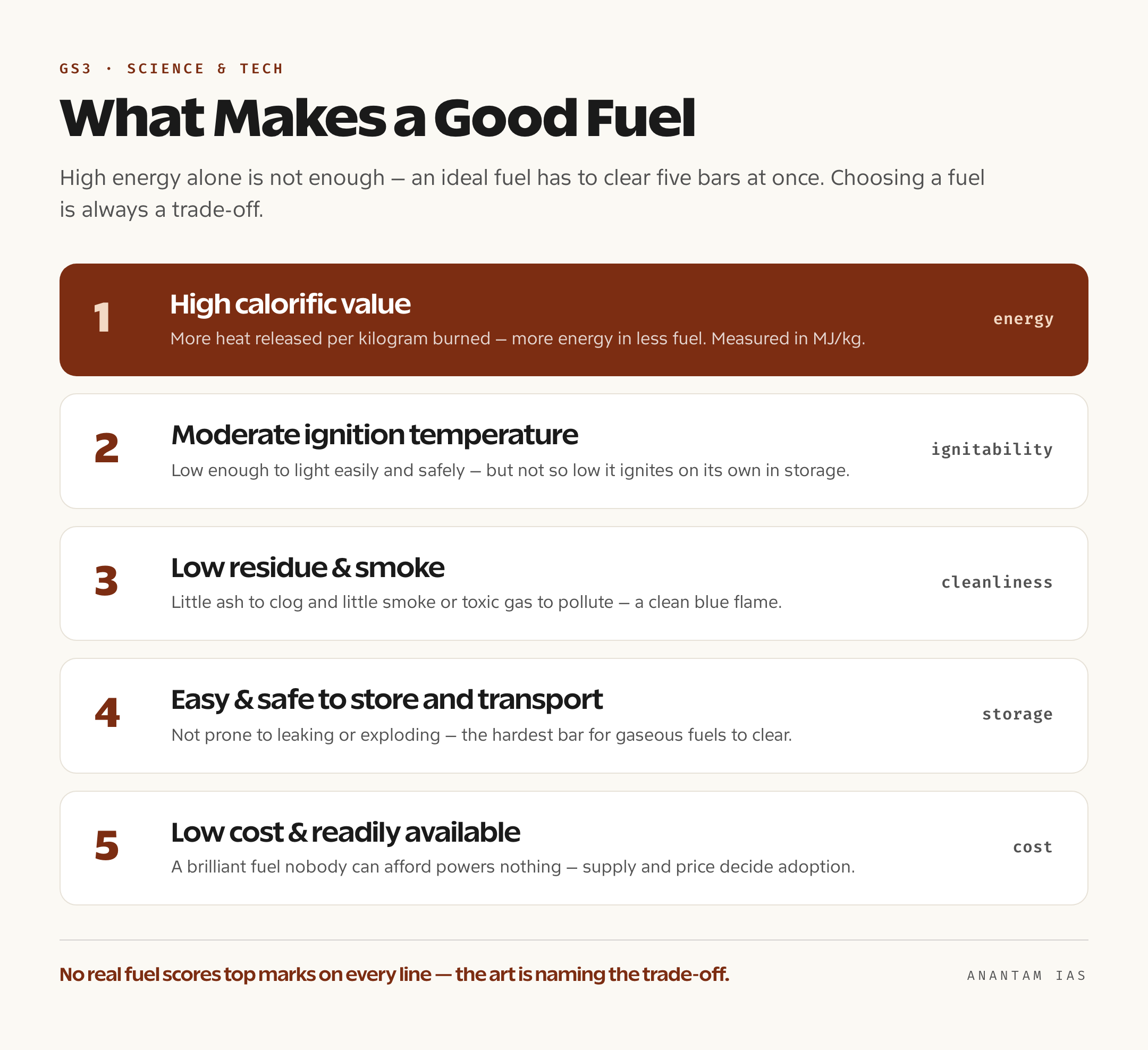
A fuel is any substance that releases usable energy — mostly as heat — when it burns. But “burns” is only the start. An ideal fuel has to clear several bars at once, and the examiner’s favourite trick is to take one of these properties and exaggerate or invert it. So learn them as a checklist.
The headline property is calorific value — the amount of heat released when one kilogram of a fuel is completely burned, measured in joules per kilogram (or, for gases, in joules per cubic metre). The unit you will most often see is the megajoule per kilogram, MJ/kg. A higher calorific value means more energy packed into less fuel, which is why aircraft and rockets crave it. But high energy alone does not make a fuel ideal — it is necessary, not sufficient.
The second property is ignition temperature — the lowest temperature to which a fuel must be heated before it catches fire on its own. A good fuel needs a moderate ignition temperature: low enough to light easily and safely, but not so low that it bursts into flame at room temperature and becomes dangerous to store. Petrol’s low ignition temperature is exactly why a stray spark near a fuel pump is treated so seriously, while coal, with a high ignition temperature, needs deliberate heating to get going.
The rest of the checklist is about behaviour and economics. A good fuel should burn cleanly — leaving little ash or residue and producing little smoke or poisonous gas — because residue clogs and smoke pollutes. It should be easy and safe to store and transport, not prone to leaking or exploding. It should be cheap and readily available, since a brilliant fuel nobody can afford powers nothing. And ideally it should burn at a controllable rate, releasing energy steadily rather than all at once. No real fuel is perfect on every count — choosing a fuel is always a trade-off, and the art of the answer is naming which property you are trading away.
How Fuels Are Classified
With the checklist in hand, the next thing examiners test is your mental map of the fuel family — and there are two clean ways to divide it.
The first is by physical state: solid, liquid and gaseous fuels. Solid fuels include wood, charcoal, coal, coke and dried dung. They are easy to store and transport but burn slowly, leave a lot of ash, and usually produce smoke. Liquid fuels — petrol, diesel, kerosene, fuel oil — are mostly products of refining crude petroleum; they have higher calorific values than most solids, burn without ash, and are easy to pour and pump, which is why they dominate transport. Gaseous fuels — natural gas, CNG, LPG, biogas, hydrogen — are the cleanest burning of all, light instantly, leave no residue, and let you control the flame with a knob, but they are the hardest to store and transport because gases must be compressed or liquefied and can leak.
The second cut is by origin: fossil fuels versus biofuels. Fossil fuels — coal, petroleum and natural gas — formed over millions of years from the buried remains of ancient plants and plankton, cooked under heat and pressure. They are energy-dense and convenient but finite, non-renewable, and the biggest single source of the carbon dioxide driving climate change. Biofuels — ethanol, biodiesel, biogas, and the wood and dung that still cook many rural meals — come from recently living biomass and can be replenished within a human timescale, so they are renewable. India’s ethanol-blending programme, which mixes sugarcane- and grain-based ethanol into petrol, and its push for compressed biogas under the SATAT scheme are both bets on this renewable column. The classification matters for policy as much as chemistry: the whole energy-transition debate is, at bottom, an argument about shifting from the fossil column to the renewable one. You can read more about how these gaseous fuels are sourced and supplied in our explainer on major fuel types in India and on bio-CNG and the SATAT scheme.
Calorific Values: Which Fuels Pack the Most Energy
Now put numbers on the energy, because a single well-placed figure can anchor an entire answer. Calorific value is the cleanest way to rank fuels, and the ranking holds a few surprises.
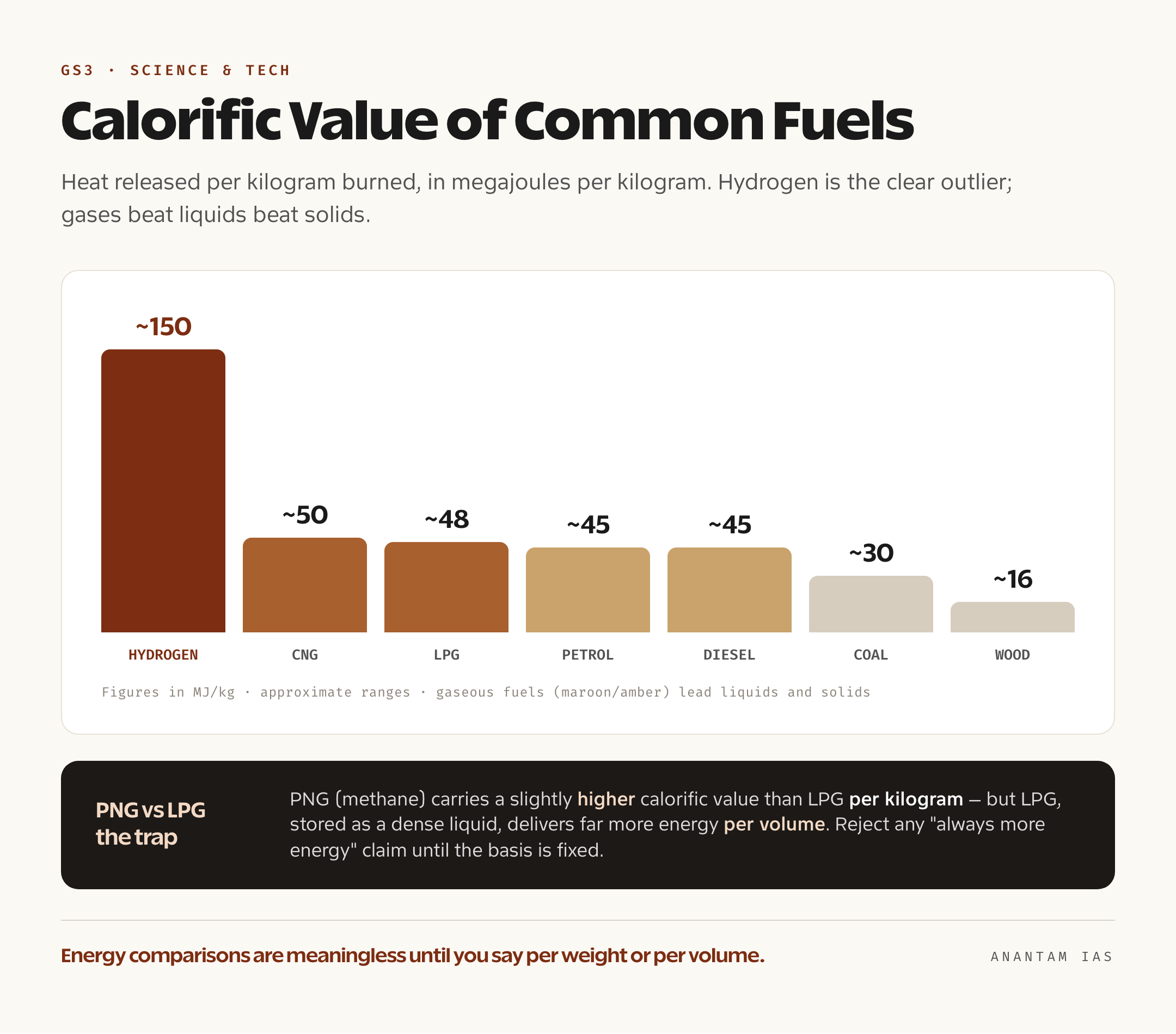
Hydrogen tops the list by a wide margin — roughly 150 megajoules per kilogram, almost three times the energy of any fossil fuel per unit of weight. That extraordinary energy-to-weight ratio is precisely why hydrogen powers rockets and why it is courted as a clean transport fuel, since its only combustion product is water vapour. Below it come the gaseous hydrocarbons. Natural gas and CNG, which are mostly methane, sit around 50 MJ/kg. LPG — liquefied petroleum gas, a blend of propane and butane — is close behind at roughly 46-50 MJ/kg. Then the liquid fuels: petrol at about 45 MJ/kg, diesel and kerosene in the 43-46 MJ/kg band. The solid fuels trail well behind — coal at roughly 25-33 MJ/kg depending on grade, and wood lowest of the common fuels at around 15-17 MJ/kg, which is why an open wood fire feels so inefficient compared with a gas flame.
Here is where you must be careful, because this is the exact trap built into many comparison questions. The claim that one gaseous fuel “always” gives more energy per unit weight than another is usually false. Take piped natural gas, PNG, versus LPG. PNG is essentially methane; LPG is propane and butane. Per kilogram, methane actually carries a slightly higher calorific value than LPG. But the everyday experience is the opposite, because the two are not used or sold by the same measure. LPG is stored as a dense liquid under modest pressure, so a small cylinder holds a large mass of fuel and delivers a hot, energy-rich flame; PNG arrives as a low-pressure gas through a pipe, so the same volume contains far less mass. Compare them by volume at supply conditions and LPG is the more energy-rich domestic fuel; compare them by mass and methane edges ahead. The lesson for an answer is simple: never accept a blanket “always more energy” statement without asking per unit of what — weight or volume — and at what pressure or state. Energy comparisons are meaningless until the basis is fixed.
The Types of Combustion and the Anatomy of a Flame
Combustion itself is not one process but several, distinguished by how fast the reaction runs — and naming the type correctly is a common one-mark win.
Rapid combustion is the ordinary burning you control on a stove: the fuel reacts with oxygen quickly, giving out heat and light steadily, but only once you supply heat to start it. Spontaneous combustion needs no external spark at all — the material ignites on its own when heat builds up internally, as can happen in a heap of damp coal, oily rags, or stored hay, or in the self-ignition of white phosphorus in air. Explosive combustion releases a huge amount of heat, light and gas almost instantly, producing a sudden expansion and a loud bang, as when a firecracker or dynamite goes off. A fourth term worth knowing is combustion proper simply meaning the chemical reaction of a substance with oxygen accompanied by heat — and the requirement that all combustion needs three things together: a fuel, a supply of oxygen (or air), and heat to reach the ignition temperature. Remove any one of these three sides of the “fire triangle” and the fire dies, which is exactly how every fire extinguisher works — water cools below the ignition temperature, while carbon dioxide and foam cut off the oxygen.
The flame itself has a hidden structure that questions love to probe. A candle or gas flame has three zones. The innermost zone, dark and around the wick, is unburnt vaporised fuel and is the coolest part because there is too little oxygen for it to burn. The middle zone glows yellow and bright: here the fuel burns only partially for want of oxygen, and it is the glowing unburnt carbon particles that give this zone its luminous yellow colour. The outermost zone, a faint blue, is where combustion is complete because oxygen is freely available — and this outer zone is the hottest part of the flame, which is why a goldsmith heats jewellery in the outer flame, not the bright middle. A blue flame, then, is a sign of plentiful oxygen and complete burning; a yellow, smoky flame is a sign of starved, incomplete burning. That single visual cue carries straight into the most consequential distinction in the whole topic.
For Your Mains Answer
This topic sits mostly in GS Paper 3 under science and technology and the energy-and-environment overlap, and it feeds GS Paper 3 environment answers on air pollution and clean-fuel policy too. Prelims leans hard on the precise definitions — calorific value, ignition temperature, the three flame zones, the types of combustion — while Mains rewards candidates who can connect the chemistry to India’s clean-fuel transition: why the country is pushing CNG, PNG, LPG (under PMUY), ethanol blending, compressed biogas and a National Green Hydrogen Mission. The examiner is testing whether you can move from a property to a policy in one clean step.
How to Build the Answer
Open by defining a good fuel through its measurable properties — calorific value, ignition temperature, clean burning, safe storage, cost — rather than by listing fuels. Then classify (state and origin), rank by calorific value with two or three exact figures, distinguish complete from incomplete combustion, and close on the clean-fuel angle relevant to the question. That arc — properties, classification, energy, combustion quality, policy — flexes to almost any fuel question.
Common Mistakes to Avoid
Don’t equate “high calorific value” with “best fuel” — a fuel also has to be safe, clean and affordable. Don’t claim one gaseous fuel “always” beats another in energy without specifying per weight or per volume; the methane-versus-LPG comparison flips depending on the basis. Don’t confuse the flame zones — the dark inner zone is coolest, the outer blue zone hottest. And don’t say incomplete combustion produces carbon dioxide; the dangerous product is carbon monoxide.
A Compact Answer Spine
Good fuel = high calorific value + moderate ignition temperature + low residue/smoke + safe storage + low cost → classified by state (solid/liquid/gas) and origin (fossil/biofuel) → calorific value ranking: hydrogen (~150) ≫ CNG/methane (~50) ≈ LPG (~46-50) > petrol (~45) > coal (~25-33) > wood (~15-17) MJ/kg → combustion types: rapid, spontaneous, explosive; fire triangle = fuel + oxygen + heat → flame zones: dark (coolest) · yellow (partial) · blue outer (hottest, complete) → complete burning gives CO₂ + a blue flame; incomplete burning gives toxic CO + soot + a yellow flame → policy: India shifting to CNG/PNG/LPG, ethanol blending, compressed biogas and green hydrogen.
Diagram or Flowchart Idea
Sketch a labelled flame with its three zones marked for temperature and colour, beside a small two-row table contrasting complete combustion (enough oxygen → CO₂ + blue flame + more heat) with incomplete combustion (limited oxygen → CO + soot + yellow flame + less heat). It communicates the heart of the topic at a glance and is fast to draw.
A Balanced-Conclusion Line
A line that lands the marks: “The search for a better fuel is the search for one that gives more energy, burns more cleanly and stores more safely at once — which is why India’s energy transition is moving steadily from smoky solid fuels toward gaseous and green-hydrogen options that complete their combustion instead of poisoning the air.”
How to Use Data Without Cramming
You need only a handful of anchors: hydrogen ~150 MJ/kg, CNG/LPG ~46-50 MJ/kg, wood ~15-17 MJ/kg, and the fact that incomplete combustion produces carbon monoxide. Drop those into the right sentences and the answer reads as informed. Attribute figures plainly — “by calorific value” — rather than scattering numbers loose.
FAQ
What is the difference between calorific value and ignition temperature? Calorific value is how much heat a fuel releases when one kilogram of it is completely burned, measured in megajoules per kilogram — it tells you how energy-rich a fuel is. Ignition temperature is the lowest temperature to which the fuel must be heated before it starts to burn on its own — it tells you how easily a fuel catches fire. A good fuel needs a high calorific value but only a moderate ignition temperature, low enough to light conveniently yet high enough to store safely.
Which fuel has the highest calorific value? Hydrogen, at roughly 150 megajoules per kilogram — nearly three times that of any fossil fuel by weight, with water vapour as its only combustion product. Among everyday fuels, natural gas and CNG (about 50 MJ/kg) and LPG (about 46-50 MJ/kg) lead, followed by petrol (~45), diesel and kerosene (~43-46), then coal (~25-33) and wood (~15-17) at the bottom.
Why is a blue flame better than a yellow flame? A blue flame means combustion is complete — there is enough oxygen for the fuel to burn fully, producing carbon dioxide, the maximum heat, and no soot. A yellow, luminous flame means incomplete combustion from a shortage of oxygen: it burns cooler, deposits black soot, and releases poisonous carbon monoxide. That is why a gas stove with a yellow flame needs its air vents cleaned — the flame is wasting fuel and producing a dangerous gas.
Is PNG more energy-rich than LPG? It depends on how you measure. PNG is mostly methane, which per kilogram carries a slightly higher calorific value than LPG (propane and butane). But LPG is stored as a dense liquid, so by volume at the point of use it delivers far more energy than low-pressure piped gas — which is why LPG is treated as the more energy-rich domestic fuel. The blanket claim that PNG “always” gives more energy per unit weight is the kind of statement that is true on one basis and false on another, so it should be rejected.
Practice Questions
Prelims MCQs
- With reference to the calorific value of a fuel, which statement is correct?
(a) It is the lowest temperature at which a fuel catches fire
(b) It is the amount of heat released when one kilogram of the fuel is completely burned
(c) It is the time a fuel takes to burn completely
(d) It is the mass of ash a fuel leaves behind
Answer: (b) Calorific value is the heat energy released per kilogram (or per cubic metre for gases) on complete combustion, usually given in MJ/kg. - Which of the following fuels has the highest calorific value per unit mass?
(a) LPG
(b) Petrol
(c) Hydrogen
(d) Coal
Answer: (c) Hydrogen, at roughly 150 MJ/kg, has by far the highest calorific value of common fuels, with only water vapour as its combustion product. - In a candle flame, which zone is the hottest and why?
(a) The innermost dark zone, because the wax vapour is concentrated there
(b) The middle yellow zone, because glowing carbon particles release heat
(c) The outermost blue zone, because combustion is complete with abundant oxygen
(d) All three zones are at the same temperature
Answer: (c) The outer blue zone has free access to oxygen, so combustion is complete and it is the hottest part; the dark inner zone is the coolest. - Consider the following requirements for combustion:
1. A combustible fuel 2. A supply of oxygen or air 3. Heat to reach the ignition temperature. Which are essential for combustion to occur?
(a) Only 1 and 2
(b) Only 2 and 3
(c) Only 1 and 3
(d) 1, 2 and 3
Answer: (d) All three sides of the fire triangle — fuel, oxygen and heat to reach ignition temperature — must be present together; removing any one stops combustion. - Incomplete combustion of a carbon-based fuel is dangerous mainly because it produces which gas?
(a) Carbon dioxide
(b) Carbon monoxide
(c) Nitrogen
(d) Water vapour
Answer: (b) When oxygen is limited, carbon burns only partially to carbon monoxide, a toxic gas, along with soot and a yellow, smoky flame, rather than to carbon dioxide.
Mains Practice Questions
- “Calorific value alone does not make a fuel ideal.” Discuss the properties that determine the suitability of a fuel, with examples from the fuels used in India. (15 marks, 250 words)
- Distinguish between complete and incomplete combustion, and explain why incomplete combustion is both an efficiency problem and a public-health hazard. (10 marks, 150 words)
- Examine how the classification of fuels into fossil and renewable categories shapes India’s energy-transition strategy, with reference to CNG, ethanol blending, compressed biogas and green hydrogen. (15 marks, 250 words)
- “Comparisons of fuels by energy content are meaningless until the basis is fixed.” Critically analyse this statement using the example of PNG and LPG. (10 marks, 150 words)
- Hydrogen is often called the fuel of the future. Evaluate its advantages as a fuel and the practical challenges of storing and using it, in the context of India’s National Green Hydrogen Mission. (15 marks, 250 words)