
A fuel is anything we burn or react to release usable energy. The list is short in everyday life. Wood and dung at one end. Coal, petrol, and diesel in the middle. Liquefied gases, compressed gases, and hydrogen at the other end. Each fuel has a chemistry, a storage condition, and a typical end use. Each also has a safety profile that follows from physics, not from policy.
For an Indian household, the practical fuels are the gaseous ones. The LPG cylinder under the kitchen counter. The piped natural gas line that delivers methane to the burner. The CNG dispenser at the petrol pump that fills an autorickshaw. The Bio-CNG that runs the same vehicle on methane refined from cattle dung and crop residue. The four fuels look similar on a tariff sheet. They are very different molecules with very different transport, storage, and emission profiles.
For UPSC, the topic spans GS-III energy security, environment, and the science portion of paper-III. The questions ask which gas is heavier than air, which initiative supplies which fuel, and how the fuel relates to India’s net-zero pathway. This article walks through all four fuels and the policy scaffolding that surrounds them, with side trips into renewable energy and nuclear energy where the comparison helps.
What Counts as a Fuel
A fuel is any substance that releases energy when it undergoes a chemical or nuclear reaction with a usable energy density. For day-to-day economic life, the term means hydrocarbon fuels and a few alternatives such as hydrogen and biomass. The relevant property of a fuel is its calorific value, measured in megajoules per kilogram or per cubic metre, and the conditions under which the fuel can be stored and transported.
Hydrocarbon fuels can be solid, liquid, or gas at room temperature. Solid fuels include coal, lignite, and biomass. Liquid fuels include petrol, diesel, kerosene, and crude oil itself. Gaseous fuels include methane, ethane, propane, butane, and hydrogen. The lighter the molecule, the cleaner the combustion. Methane burns to carbon dioxide and water with very little particulate matter or sulphur oxide. Coal burns to ash, carbon dioxide, sulphur oxides, and nitrogen oxides. The trade-off is that lighter fuels are gases at room temperature and need either pressurisation or cooling to store at usable density.
LPG: Propane, Butane, and the Cylinder Under the Counter
Liquefied petroleum gas is the household cooking fuel that most Indians know by name. Chemically, LPG is a mixture of propane (C3H8) and butane (C4H10). The exact ratio varies with the season and the supplier, with more propane in the winter mix because propane has a lower boiling point and vaporises better at low ambient temperature. LPG comes from two sources. It is a by-product of the refining of crude oil, and it is also separated from natural gas during processing.
The defining trick of LPG is that propane and butane can be liquefied at moderate pressure at room temperature. A standard domestic cylinder holds the fuel as a liquid at roughly five to ten bar of pressure. When the valve opens, the liquid evaporates and the gas flows to the burner. The energy density per cylinder is high enough to run an Indian kitchen for several weeks. Indian cylinders are filled by oil marketing companies under PAHAL direct benefit transfer for subsidy and under the Pradhan Mantri Ujjwala Yojana for new connections to households below the poverty line.
The safety property that matters is that LPG is heavier than air. A leak does not rise and disperse. It pools at floor level near the leak. This is why an LPG cylinder valve is checked downward and why a leak detector is mounted low. A spark at floor level can ignite a pool. Householders are taught to not switch on lights or fans in the kitchen if they smell gas, but to open windows and remove the cylinder.
LNG: Methane Cooled to Minus 162 Celsius
Liquefied natural gas is methane that has been cooled to its boiling point of approximately minus 162 degrees Celsius and stored as a cryogenic liquid. The cooling reduces the volume of the gas by a factor of about six hundred. That density is what makes intercontinental shipping economical. A specialised LNG carrier with insulated tanks can move a quantity of methane that would require hundreds of pipelines to move as gas.
LNG is not used directly. It arrives at a regasification terminal, where it is warmed back to gas, pressurised, and sent into the trunk pipeline network. India operates regasification terminals at Dahej, Hazira, Kochi, Mundra, Dhamra, and Ennore, with more in construction. Dahej alone handles a large share of the country’s gas imports. From the regasification point, methane flows through pipelines to power plants, fertiliser plants, refineries, and city gas distribution networks.
The safety property of LNG is that the liquid is extremely cold. A spill on skin causes cold burns. A spill on a metal deck can crack the metal. Once the liquid warms to gas, it is methane, which is lighter than air and disperses upward. LNG terminals are sited at coastlines because the supply is shipborne, and because a pipeline backbone can move the gas inland after regasification.
CNG: Compressed but Not Liquefied
Compressed natural gas is methane stored at high pressure, typically two hundred to two hundred and fifty bar, but at ambient temperature. CNG is not a liquid. It is a dense gas. The choice between CNG and LNG depends on the application. CNG is the right choice for vehicles and small captive users because the equipment is simpler and the volumes are smaller. LNG is the right choice for shipping, where cryogenic liquid is the only economical way to move large volumes by sea.
CNG entered Indian transport on the back of a Supreme Court order in 1998 that required Delhi’s public transport fleet to convert to a clean fuel. The conversion of buses, autorickshaws, and taxis to CNG cut visible smoke from the city’s air. Since then, the Petroleum and Natural Gas Regulatory Board has awarded city gas distribution rights in successive bidding rounds covering most major urban areas. A typical CGD entity supplies CNG at retail outlets and piped natural gas to homes and small businesses on the same network.
The safety property of CNG is that methane is lighter than air. A leak rises and disperses. A CNG vehicle is therefore safer in a closed parking garage than an equivalent LPG vehicle, because the gas does not pool at floor level. Emissions from a CNG vehicle are significantly lower than petrol or diesel for particulate matter, sulphur oxides, and most regulated pollutants, though carbon dioxide and methane slip remain concerns at the lifecycle level.
Bio-CNG: The Same Methane, a Different Source
Bio-CNG, also called compressed biogas or CBG, is methane refined from biological waste rather than from fossil natural gas. The chemistry of the final fuel is identical to that of CNG. The difference is upstream. Cattle dung, crop residue, municipal solid waste, and sewage sludge are fed into an anaerobic digester. Bacteria break down the organic matter in the absence of oxygen and produce biogas, a mixture of roughly fifty to sixty per cent methane and the rest carbon dioxide along with traces of hydrogen sulphide.
To convert biogas to bio-CNG, the gas is cleaned of hydrogen sulphide and water, the carbon dioxide is removed by membrane separation or pressure swing adsorption, and the resulting near-pure methane is compressed to vehicle-grade pressure. A bio-CNG plant is essentially a small-scale natural gas processing facility built on top of a digester. The fuel can be used in any CNG vehicle and can be injected into a piped natural gas network with appropriate quality control.
The Indian government promotes bio-CNG under the Sustainable Alternative Towards Affordable Transportation programme, known as SATAT. The scheme guarantees offtake from oil marketing companies for bio-CNG at a notified price, and aims to set up thousands of plants across the country. The economics are most favourable in agricultural districts with large quantities of crop residue that would otherwise be burned, and in dairy clusters with concentrated supplies of cattle dung. The carbon balance is the central appeal. The methane that would have escaped from decomposing biomass to the atmosphere is captured and burned to carbon dioxide, which is a less potent greenhouse gas. The waste stream becomes a digestate that can be returned to the field as fertiliser.
How the Four Fuels Compare
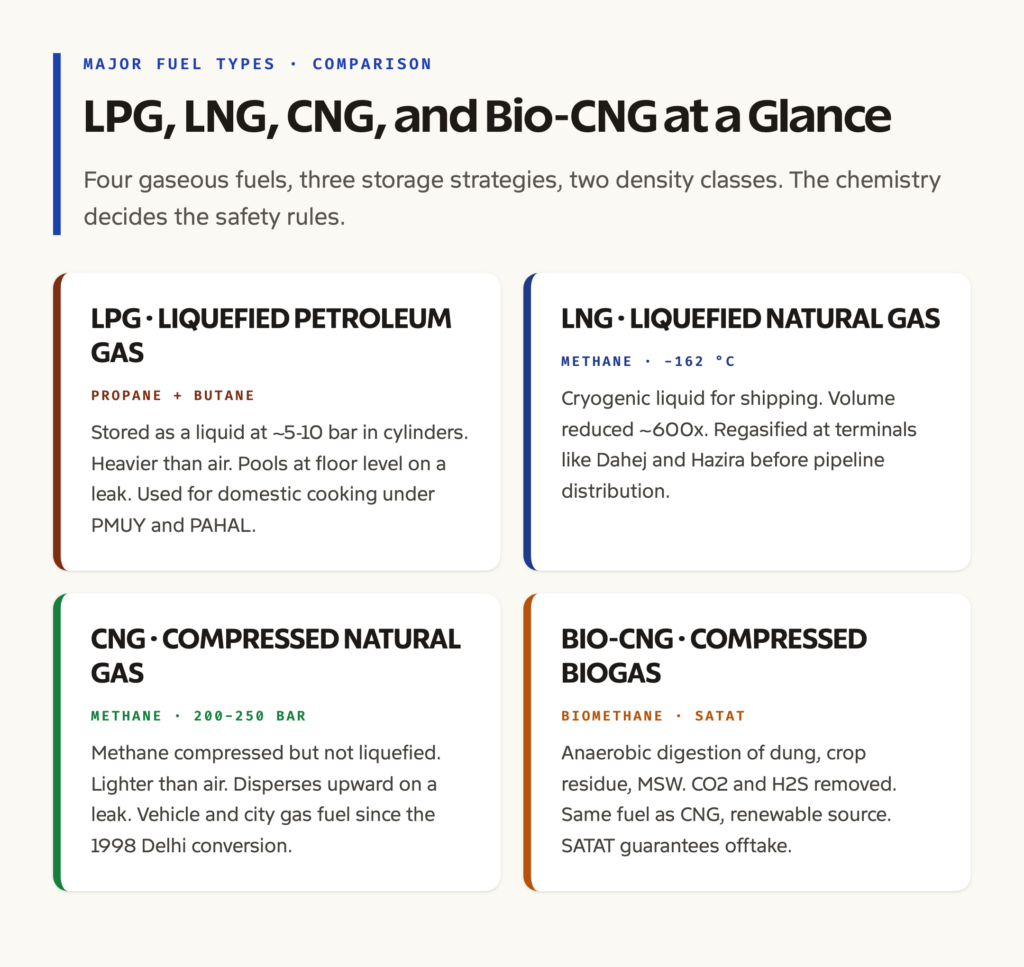
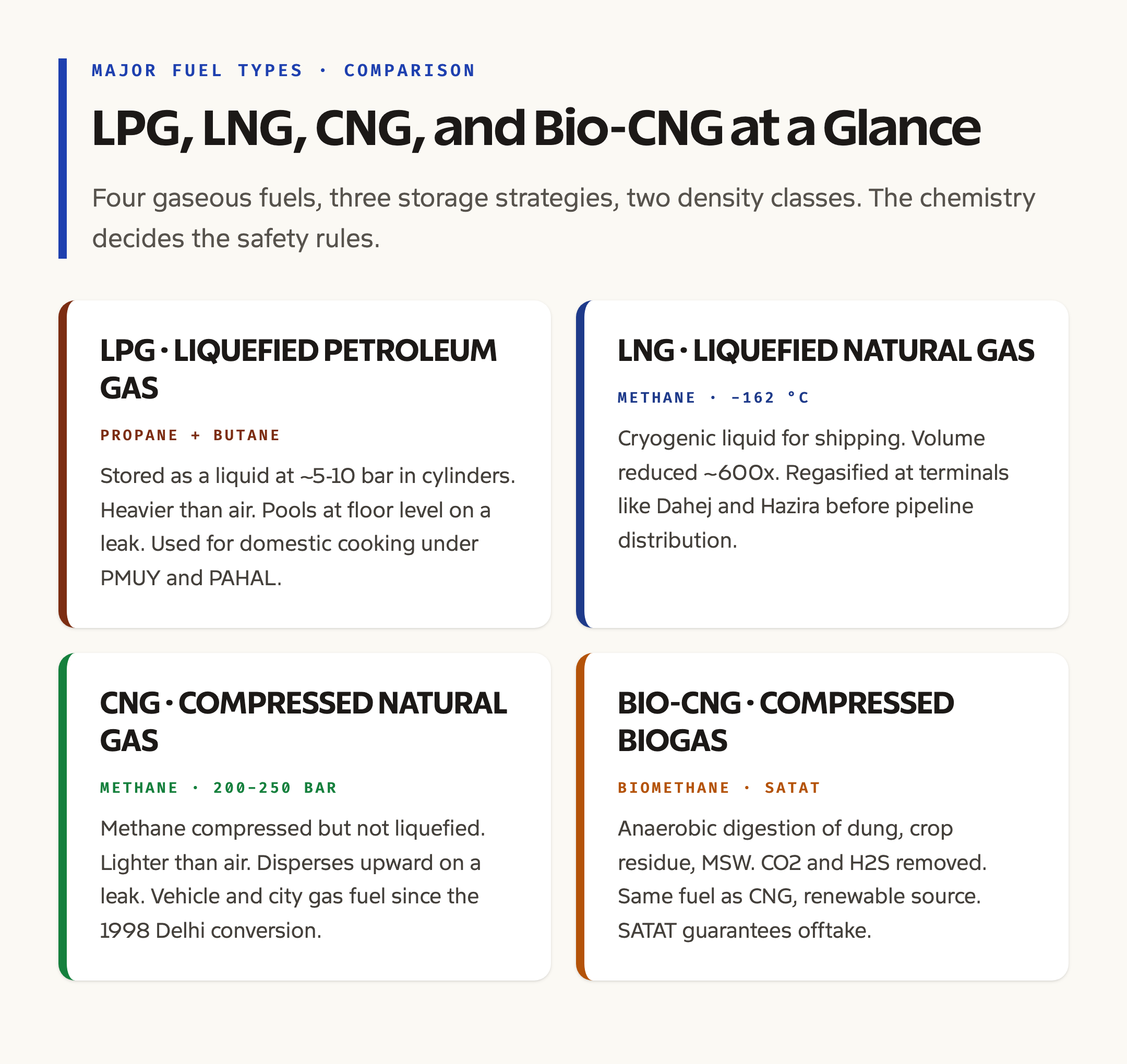
The four fuels look similar on a household bill but behave very differently. LPG is propane and butane, stored as a liquid under moderate pressure, heavier than air, and used in domestic and small commercial cooking and heating. LNG is methane cooled to a cryogenic liquid for shipping, then regasified at terminals and sent through pipelines. CNG is methane compressed at ambient temperature, lighter than air, and used in vehicles and city distribution. Bio-CNG is the same methane as CNG, sourced from organic waste under SATAT.
The energy density per kilogram is highest for LPG among the four because propane and butane have more carbon atoms per molecule. The energy density per cubic metre at storage condition is highest for LNG because cryogenic liquid is the densest gaseous form short of solidification. The cleanest combustion belongs to methane in any form, because methane is the simplest hydrocarbon and burns most completely.
The Indian Natural Gas Value Chain
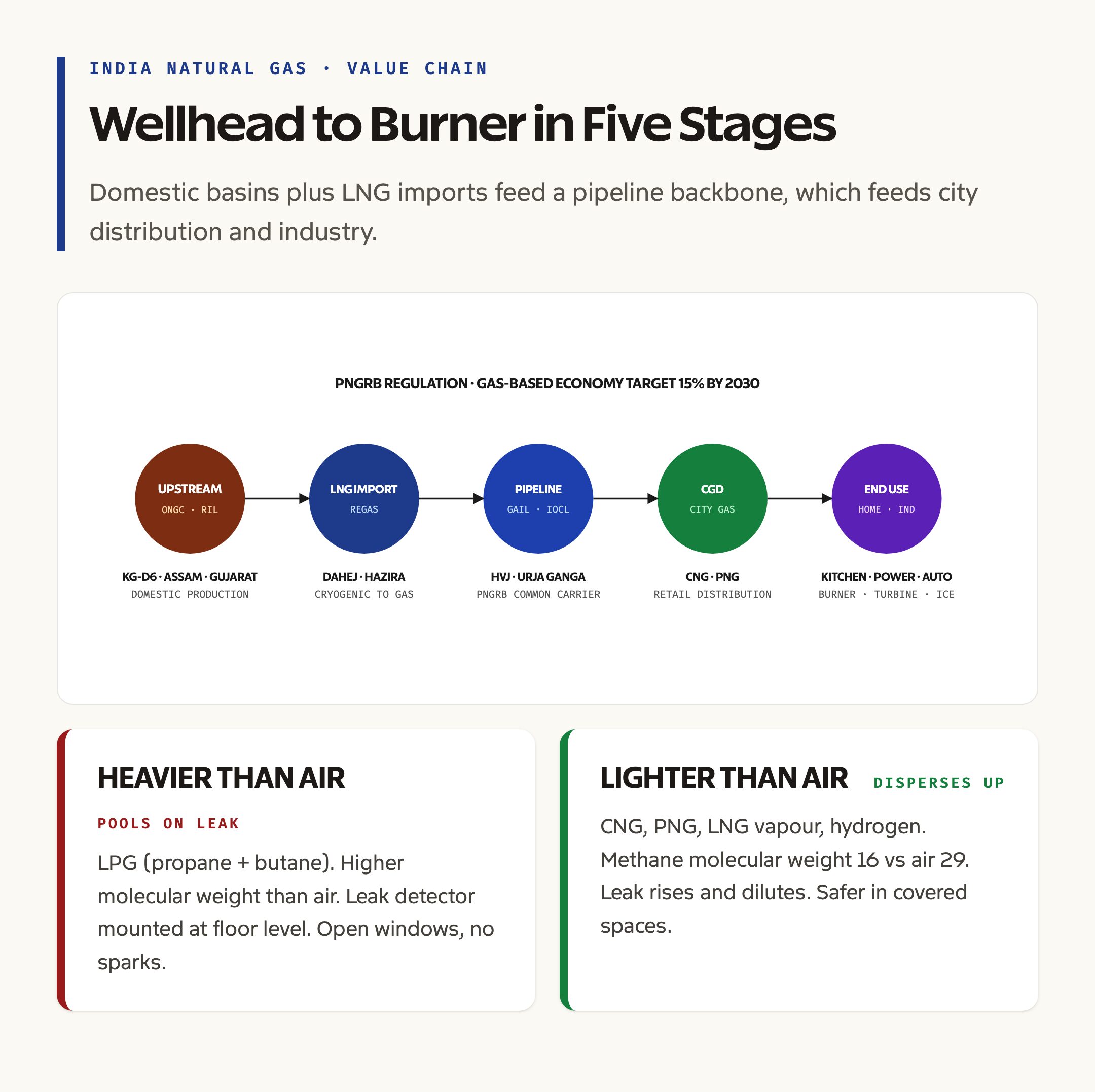
To understand where each fuel comes from, it helps to walk through the Indian gas value chain end to end. Upstream, ONGC and Reliance produce gas from offshore basins such as KG-D6 in the Krishna Godavari basin, and from onshore fields in Assam, Gujarat, and Rajasthan. Domestic production has historically been below domestic demand, so the gap is filled by imported LNG arriving at the regasification terminals.
Once the gas is in the trunk network, it moves through cross-country pipelines operated by GAIL, the Indian Oil Corporation, and others. The Hazira-Bijaipur-Jagdishpur (HVJ) pipeline and the Dahej-Vijaipur trunk are the spine of the system. Recent additions include the Pradhan Mantri Urja Ganga in the east and the North-East Gas Grid that brings methane to states such as Assam, Mizoram, and Tripura. The Petroleum and Natural Gas Regulatory Board regulates pipeline tariffs and access on a common-carrier principle.
At the city level, the city gas distribution entity laces the urban area with steel and polyethylene pipes and runs CNG dispensers at retail outlets. Pressure reduction stations step the gas down from trunk pressure to distribution pressure, and again to household appliance pressure. The retail customer is the last few metres of the system.
Safety: Heavier than Air, Lighter than Air
The single most useful safety question to ask of any fuel gas is whether it is heavier or lighter than air. LPG is heavier than air because propane and butane have higher molecular weights than the average of nitrogen and oxygen. CNG and methane in any form are lighter than air, because the molecular weight of methane (sixteen) is less than the molecular weight of air (about twenty-nine). Hydrogen is the lightest of all.
A heavier-than-air fuel pools at floor level on a leak. A lighter-than-air fuel rises and dilutes. This explains the design rules. LPG cylinders are stored upright with valves up and pipes leading down. Leak detectors for LPG are mounted near the floor. CNG vehicles are safer in covered parking than petrol vehicles in some respects because the leak rises away from ignition sources. Hydrogen is safer still by this metric, though it has its own complications around flame visibility and embrittlement.
Emissions: Why Gaseous Fuels Win
Burning a hydrocarbon produces carbon dioxide and water, plus a residue that depends on the impurities and the completeness of combustion. The cleanest possible burn is methane plus oxygen producing carbon dioxide and water with no residue. Heavier hydrocarbons leave traces of unburned material as particulates. Coal leaves ash, sulphur oxides, and nitrogen oxides. Petrol and diesel leave nitrogen oxides and particulates.
A switch from coal to natural gas in a power station cuts carbon dioxide per unit of electricity by roughly half and cuts particulates and sulphur oxides to near zero. A switch from petrol or diesel to CNG in a vehicle cuts particulates, sulphur oxides, and nitrogen oxides significantly, and cuts carbon dioxide somewhat. The lifecycle picture must include methane leaks, because methane is a strong short-lived greenhouse gas. A small leak in the natural gas value chain can erode the climate benefit of fuel switching.
Policy Scaffolding: PMUY, PAHAL, SATAT, CGD
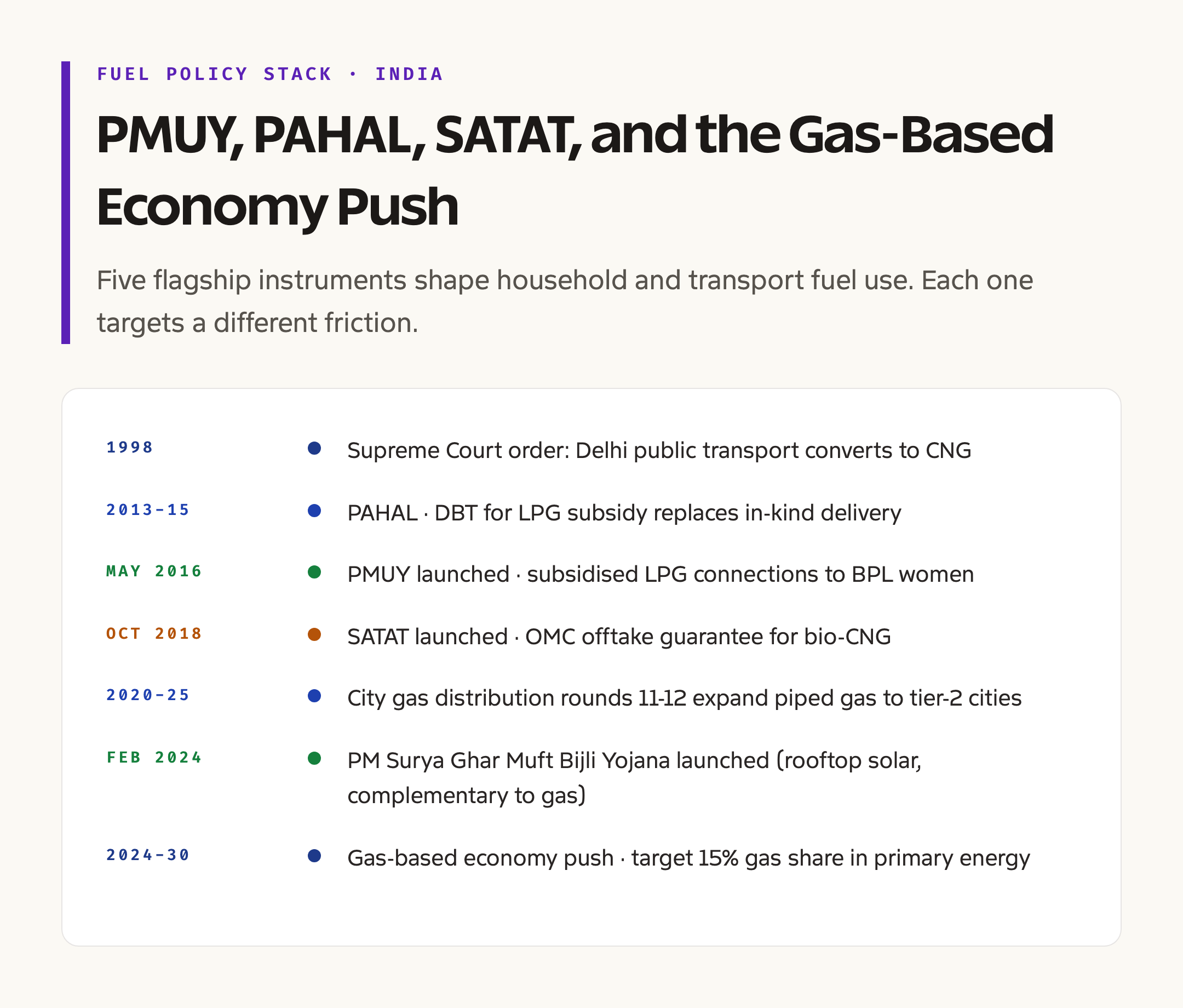
The government’s instruments for steering fuel use are domestic. PMUY, the Pradhan Mantri Ujjwala Yojana, supplies subsidised LPG connections to women in households below the poverty line. PAHAL is the direct benefit transfer for LPG subsidy, replacing in-kind delivery with a bank credit. The combined effect is a near-universal LPG penetration in rural India, with usage gradually rising as refill rates improve.
SATAT, the Sustainable Alternative Towards Affordable Transportation, is the framework for bio-CNG. The PNGRB awards city gas distribution geographic areas in successive bidding rounds and regulates tariffs. The recent push to a gas-based economy aims to raise the share of natural gas in the primary energy basket from the current single digits to fifteen per cent by 2030. This requires a step-up in domestic production, regasification capacity, pipeline build-out, and city gas distribution penetration in second-tier cities.
The role of biofuels and ethanol blending is parallel rather than substituting. Ethanol blended with petrol displaces a fraction of crude oil imports without changing vehicle technology. Bio-CNG fits the same logic for compressed natural gas. The two together, alongside renewable electricity, form the demand-side response in defence and energy security calculations.
Why It Matters for UPSC
The major fuel types map cleanly to several recurring UPSC themes. Energy security is the core. India imports a large share of its crude oil and a growing share of its natural gas, which makes the fuel mix a strategic question. Environment and climate connect through the emission profile of each fuel. The policy push to a gas-based economy is a balance between affordability, security, and emissions. SATAT and PMUY are flagship welfare-and-energy programmes that sit on this map.
Prelims questions on the topic are typically clean factual questions. Which gas is heavier than air. What is the storage temperature of LNG. Which initiative is associated with bio-CNG. The mains questions are larger. Discuss the role of natural gas in India’s energy transition. Examine the trade-offs in moving rural cooking from biomass to LPG. Evaluate the SATAT scheme as a circular-economy instrument. The four fuels are a small enough set to remember in detail, and the detail pays off in both papers.
Frequently Asked Questions
What is the difference between LPG and LNG?
LPG is propane and butane stored as a liquid under moderate pressure at room temperature. LNG is methane cooled to about minus 162 degrees Celsius and stored as a cryogenic liquid for shipping. The molecules and the storage method are different, and so is the end use.
Why is LPG considered dangerous on a leak?
LPG is heavier than air. A leak does not disperse upward but pools at floor level near the leak point, where any spark can ignite it.
Why did Delhi switch its public transport to CNG?
The Supreme Court ordered the conversion in 1998 to reduce particulate emissions from diesel buses and autorickshaws. CNG combustion produces far lower particulate matter and sulphur oxides than diesel.
What is bio-CNG and how is it different from CNG?
Bio-CNG is methane purified from biogas produced by anaerobic digestion of organic waste. It is chemically identical to CNG but has a renewable, circular-economy source.
What is the SATAT initiative?
SATAT is the Indian government’s framework for bio-CNG. Oil marketing companies guarantee offtake from bio-CNG plants at a notified price to encourage investment in plants that use crop residue, dung, and municipal waste.
Why is the natural gas share in India’s energy mix below the global average?
Domestic production is constrained, regasification and pipeline infrastructure is still being built out, and coal has been the cheaper baseload fuel for power. The gas-based economy push aims to raise the share to fifteen per cent of primary energy by 2030.
Tell Google you want more of this.
Add Anantam IAS as a preferred sourceOne tap, and this site shows up more often in your own Top Stories, AI Overviews and AI Mode. Remove it any time.