Fundamental Rights and Articles — Articles 12–35, Types, Landmark Cases (UPSC Polity)
If you've been Googling fundamental rights and articles at midnight, you're probably staring at a Prelims question that asks "Which article deals with abolition of titles?" and you remember it's somewhere between 14 and 18...
If you’ve been Googling fundamental rights and articles at midnight, you’re probably staring at a Prelims question that asks “Which article deals with abolition of titles?” and you remember it’s somewhere between 14 and 18… but not which one. I’ve watched aspirants lose 4-6 Prelims marks per year on exactly this — they know the right, they don’t know the article number. The fix isn’t memorisation. The fix is a clean article-by-article map you can scan in two minutes before the exam. This guide is that map. Article 12 to Article 35, every clause, every cluster, every landmark case attached to its article — built so you can use it as a lookup table and never confuse 17 with 18 again.
What are the fundamental rights and articles in the Indian Constitution?
The fundamental rights and articles are the 24 articles (Articles 12 to 35) in Part III of the Constitution that guarantee six categories of justiciable civil liberties to every person on Indian soil. Articles 12 and 13 are the foundation (defining “State” and laws inconsistent with rights), Articles 14–32 list the rights themselves, and Articles 33–35 cover special provisions and Parliamentary powers.
- Article 12 — defines “State” — includes Union, States, Parliament, local authorities, statutory bodies.
- Article 13 — laws violating fundamental rights are void to the extent of inconsistency.
- Article 32 — direct remedy in Supreme Court — Ambedkar’s “heart and soul” article.
- Article range — 12 to 35 — Part III of the Constitution.
- Articles repealed — 19(1)(f) and 31 — by the 44th Amendment, 1978 (Right to Property removed).
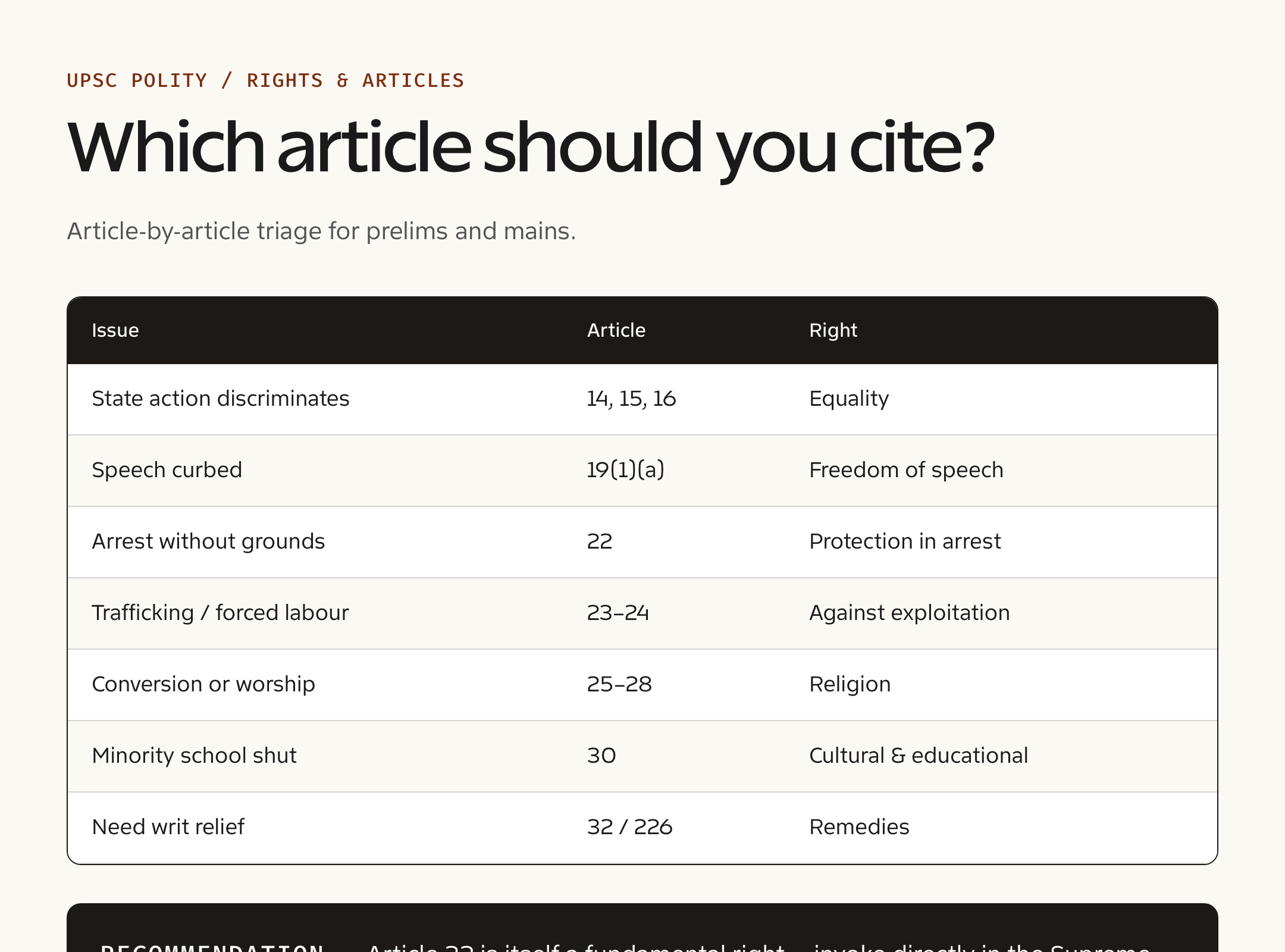
The full article-wise map of fundamental rights
Number every list. Aspirants memorise lists.
Foundation articles
- Article 12 — Definition of “State” for Part III purposes.
- Article 13 — Laws inconsistent with fundamental rights are void.
Right to Equality (Articles 14–18)
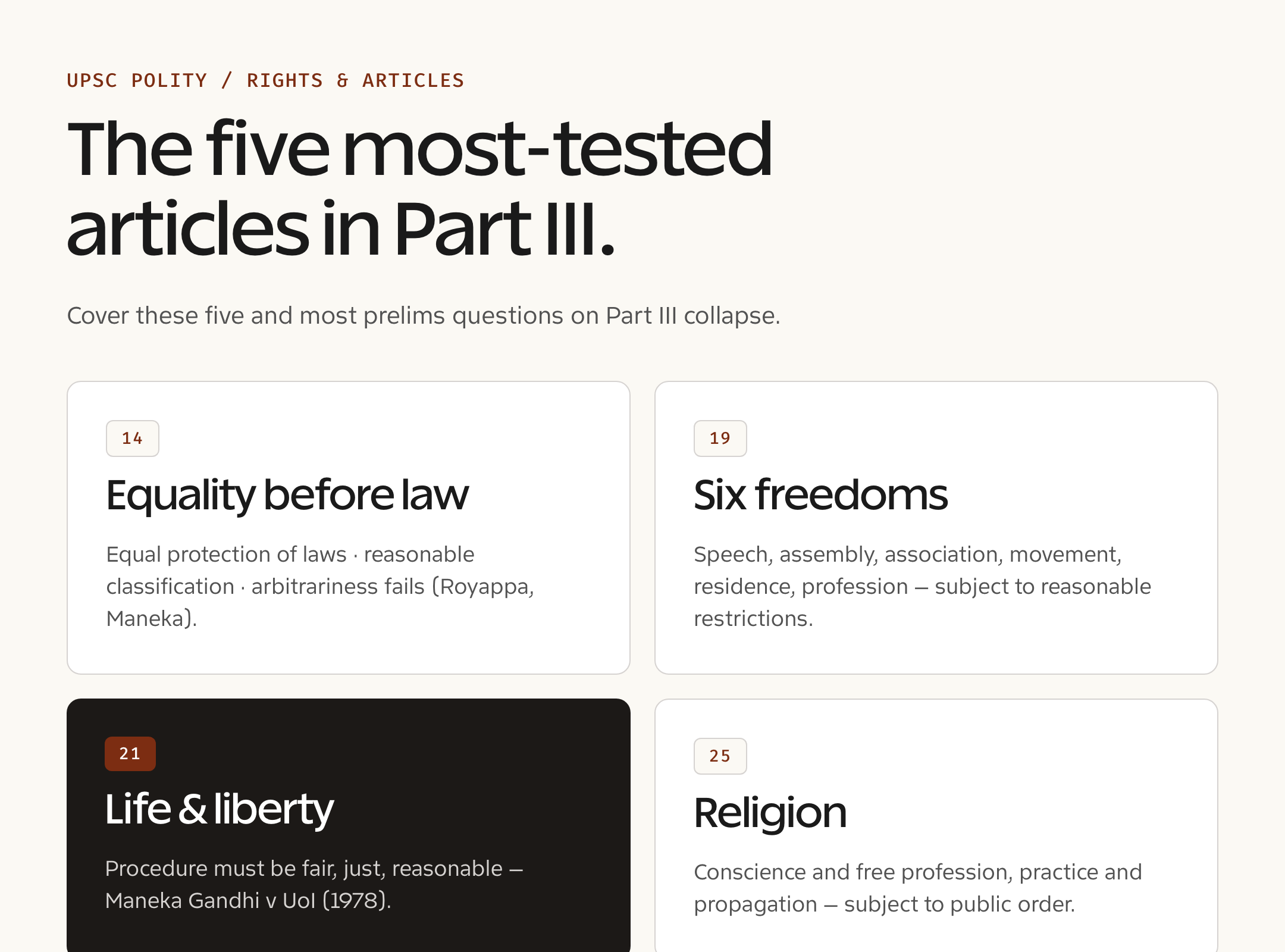
- Article 14 — Equality before law and equal protection of laws (applies to all persons).
- Article 15 — Prohibition of discrimination on grounds of religion, race, caste, sex, place of birth (citizens only).
- Article 16 — Equality of opportunity in matters of public employment.
- Article 17 — Abolition of untouchability.
- Article 18 — Abolition of titles (except military and academic).
For deeper coverage of this cluster, study Right to Equality: Articles 14-18 of Indian Constitution, Article 14 of the Indian Constitution, and Articles 15 and 16 of the Indian Constitution.
Right to Freedom (Articles 19–22)
- Article 19 — Six freedoms (speech and expression, assembly, association, movement, residence, profession). Originally seven; right to property under 19(1)(f) was removed in 1978.
- Article 20 — Protection in respect of conviction for offences (no ex post facto law, no double jeopardy, no self-incrimination).
- Article 21 — Protection of life and personal liberty.
- Article 21A — Right to free and compulsory education for children aged 6 to 14 (added by 86th Amendment, 2002).
- Article 22 — Protection against arrest and detention.
The deep dives sit at Article 19 of the Indian Constitution and Article 21 of the Indian Constitution: Right to Life and Personal Liberty.
Right against Exploitation (Articles 23–24)
- Article 23 — Prohibition of trafficking in human beings and forced labour (begar).
- Article 24 — Prohibition of employment of children below 14 in factories, mines, and hazardous work.
For the cluster overview, see Right Against Exploitation: Articles 23 and 24 of the Indian Constitution.
Right to Freedom of Religion (Articles 25–28)
- Article 25 — Freedom of conscience and free profession, practice, and propagation of religion.
- Article 26 — Freedom to manage religious affairs.
- Article 27 — Freedom from payment of taxes for promotion of any religion.
- Article 28 — Freedom from religious instruction in wholly state-funded educational institutions.
Cultural and Educational Rights (Articles 29–30)
- Article 29 — Protection of interests of minorities (language, script, culture).
- Article 30 — Right of minorities to establish and administer educational institutions.
For the case-law thread, study Cultural and Educational Rights: Articles 29 and 30 of the Indian Constitution.
Right to Constitutional Remedies (Articles 32–35)
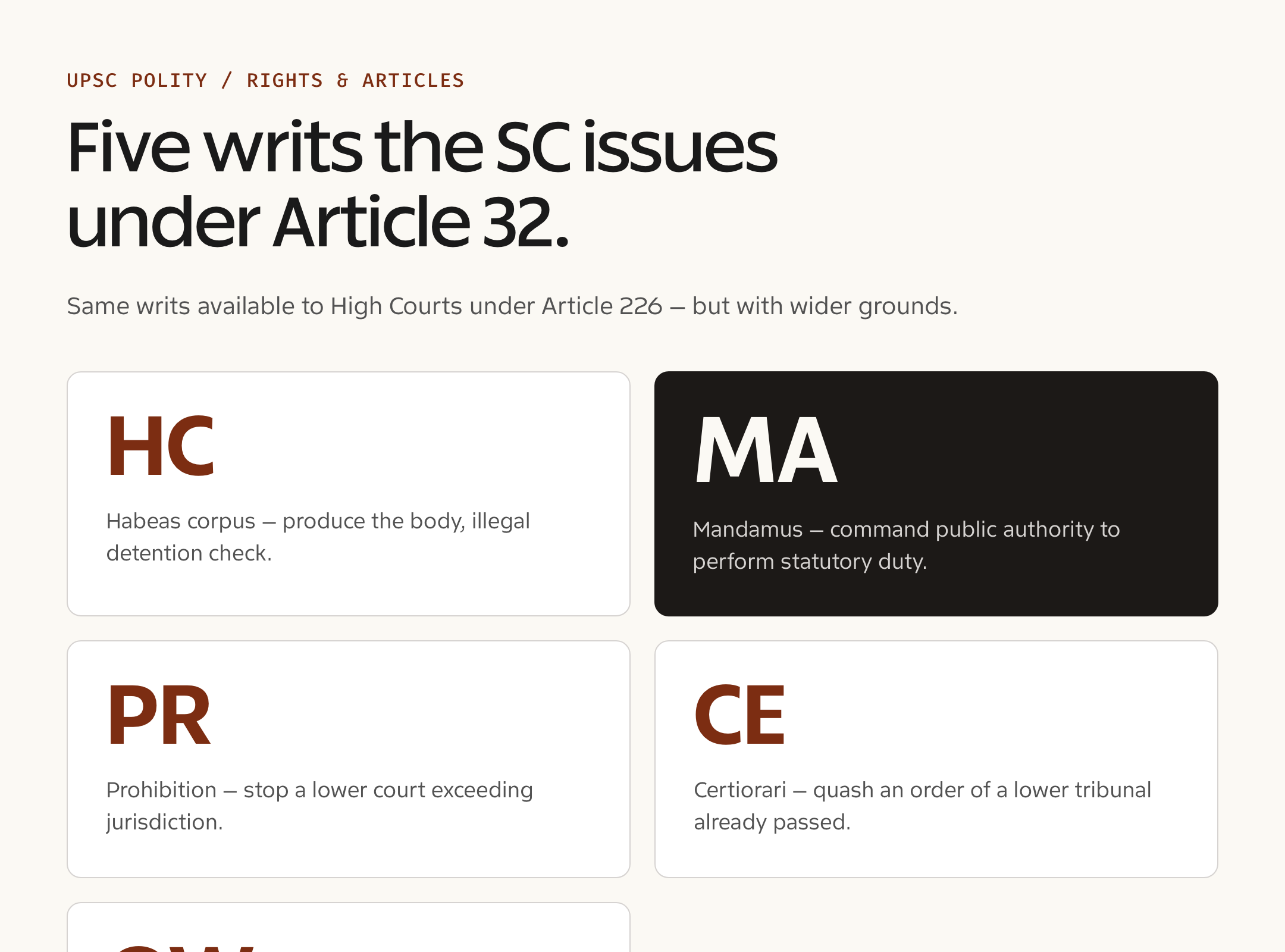
- Article 32 — Right to move the Supreme Court for enforcement of fundamental rights; five writs available.
- Article 33 — Power of Parliament to modify FRs in their application to armed forces, paramilitary, intelligence.
- Article 34 — Restriction on FRs while martial law is in force.
- Article 35 — Legislation to give effect to FR provisions vested in Parliament.
For Article 32 in depth, see Article 32: Right to Constitutional Remedies — The Heart of the Constitution, and for the writs themselves, Writ Jurisdiction: Types of Writs in Indian Constitution.
Citizens-only vs all-persons — the article-by-article split
This is a high-frequency Prelims question. Three out of every five UPSC papers since 2014 have asked some variant.
| Available to | Articles |
|---|---|
| All persons (citizens, foreigners, juristic) | 14, 20, 21, 21A, 22, 23, 24, 25, 27, 28 |
| Citizens only | 15, 16, 19, 29, 30 |
Mnemonic: “15-16-19-29-30 = citizens only.” Five articles. Everything else is for all persons.
Landmark cases — mapped article by article
If you remember one case from this chapter, make it Kesavananda Bharati. But for full Mains coverage, you need at least eight cases mapped to articles.
| Article | Case | Year | What it decided |
|---|---|---|---|
| 12 | Pradeep Kumar Biswas v. IICB | 2002 | Test for “other authorities” under Article 12. |
| 13 | Shankari Prasad v. Union of India | 1951 | Constitutional amendments are not “law” under Article 13. |
| 14 | E.P. Royappa v. State of Tamil Nadu | 1974 | Equality means non-arbitrariness. |
| 19/21 | Maneka Gandhi v. Union of India | 1978 | Article 21’s “procedure” must be just, fair, reasonable; FRs read together. |
| 21 | Justice K.S. Puttaswamy v. Union of India | 2017 | Right to privacy is a fundamental right. |
| 21 | M.K. Ranjitsinh v. Union of India | 2024 | Right against adverse climate-change effects. |
| 25 | Shirur Mutt | 1954 | Essential religious practices test. |
| 32 | Bandhua Mukti Morcha v. UoI | 1984 | PIL jurisprudence; locus standi expanded. |
For the basic structure case in full, read Kesavananda Bharati Case (1973): Basic Structure Doctrine Explained.
Why this matters for UPSC
Prelims. Expect at least 2–3 direct article-number questions per year. Most common targets: Article 14 (equality), Article 19 (freedoms), Article 21 (life and liberty), Article 32 (remedies). Less obvious targets — Article 17 (untouchability) and Article 25 (essential religious practices) — surface every fourth or fifth year. Look at the 2018, 2021, and 2024 papers — Article 25 came up in all three with different framings.
Mains GS-2. Article-number recall is necessary but not sufficient. Examiners want article + landmark case + current relevance. A 15-mark answer on Article 21 in 2025–2026 should mention Maneka Gandhi, Puttaswamy, and Ranjitsinh — all three. The 2024 question on “evolution of right to life” was answerable in 30 marks if you knew that arc; without it, candidates wrote 250 generic words and walked away with 8.
Essay. Articles 14, 19, 21 give you ready introductions on liberty, equality, dignity. Quote the article verbatim, then move to the framework. The same approach works for the philosophical paper too — fundamental rights and articles offer the constitutional spine for any liberty-vs-restriction essay.
Interview. Panels routinely ask candidates to defend their article-number recall under pressure. Don’t memorise lists; understand the cluster logic. If the panel asks “Article 23?” and you say “trafficking,” they ask “and Article 24?” — and the candidate who knows that 23–24 form the anti-exploitation cluster answers smoothly while the rote-memoriser stumbles. That cluster logic is worth ten marks across Mains and Interview combined.
Common misconceptions
- “Article 21 only protects citizens.” Wrong. Article 21 — life and personal liberty — applies to all persons, including foreigners. Confirmed by the Supreme Court multiple times.
- “All articles in Part III are non-amendable.” False. Parliament can amend FRs, but the basic structure cannot be destroyed (Kesavananda Bharati, 1973).
- “Article 18 abolishes all titles.” Misleading. Article 18 abolishes titles other than military and academic. National awards (Bharat Ratna, Padma awards) are not “titles” per Supreme Court interpretation.
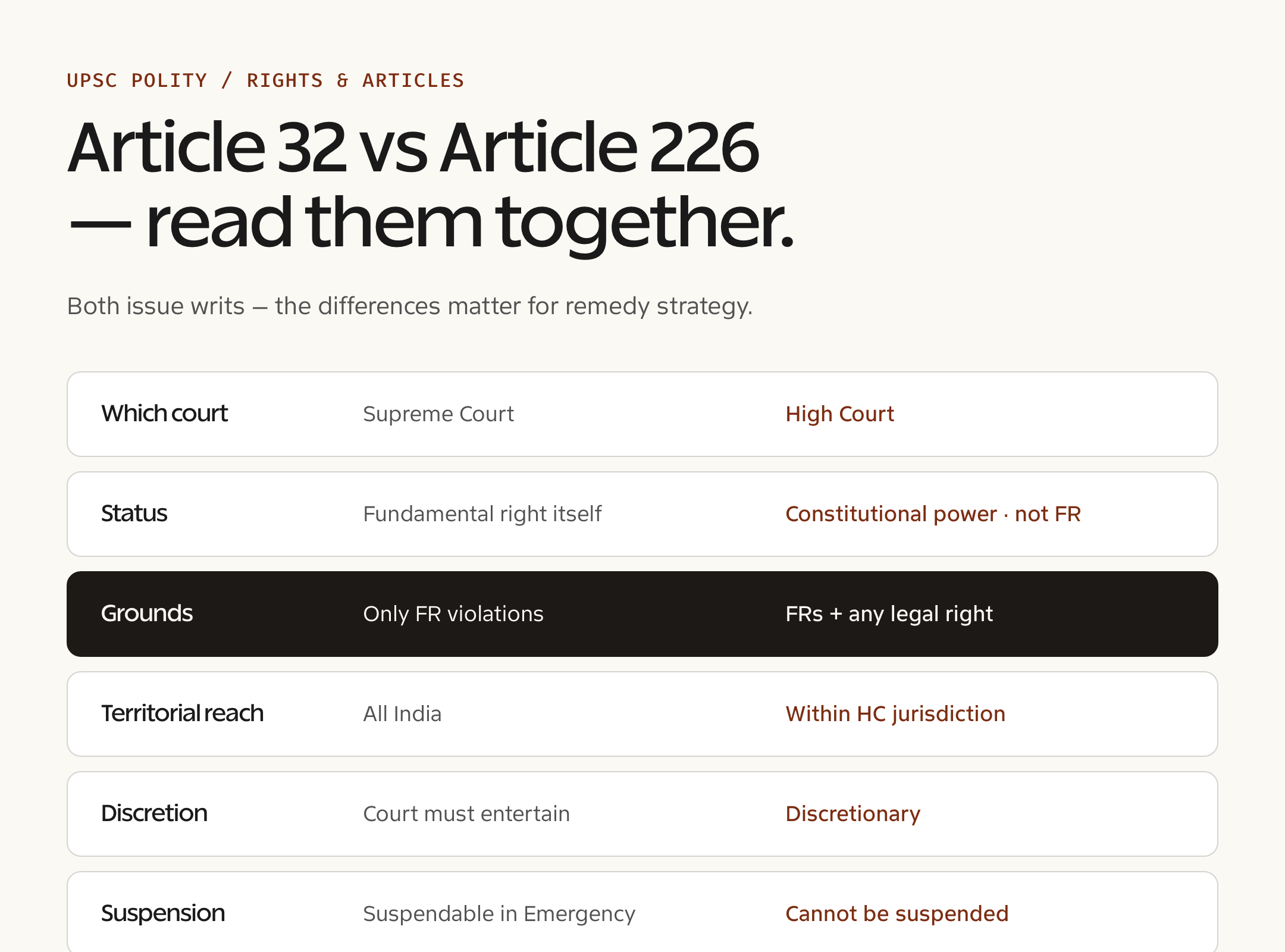
- “Article 32 and Article 226 are identical writ powers.” No. Article 32 — Supreme Court — only for FRs. Article 226 — High Courts — wider, covers FRs and legal rights.
How to revise this in 30 minutes
- Make a flash card per article — one side article number, other side right + landmark case. 12 minutes.
- Drill citizens-only vs all-persons — five articles to memorise: 15, 16, 19, 29, 30. 5 minutes.
- Revise the eight landmark cases mapped above. 8 minutes.
- Read PRS or Indian Express explainer on the latest 2024 ruling — M.K. Ranjitsinh climate rights. 5 minutes.
Source priority: Laxmikanth → NCERT Class 11 Indian Constitution at Work → PRS Legislative Brief → Indian Express explainer.
Frequently Asked Questions
How many articles cover fundamental rights in the Indian Constitution?
Twenty-four — Articles 12 to 35 — in Part III. Two of them (Articles 19(1)(f) and 31) were repealed by the 44th Amendment, 1978.
Which article is the u0022heart and soulu0022 of the Constitution?
Article 32, the Right to Constitutional Remedies. Ambedkar gave it that label in the Constituent Assembly.
Which article was added by the 86th Amendment?
Article 21A — right to free and compulsory education for children aged 6 to 14, added in 2002.
Which articles deal with Right to Equality?
Articles 14, 15, 16, 17, and 18.
Which articles deal with Right to Freedom?
Articles 19, 20, 21, 21A, and 22.
Which articles deal with Right against Exploitation?
Articles 23 and 24.
Which articles cover Cultural and Educational Rights?
Articles 29 and 30.