Gallantry Award Winners — India’s Military Honours & UPSC Defence Guide
Complete UPSC guide to India's gallantry awards — PVC, MVC, VrC, AC, KC, SC hierarchy, notable recipients, selection process, and Republic Day significance.
Gallantry awards are the highest military and civilian honours conferred by the Government of India for acts of exceptional courage, bravery, and self-sacrifice. India's system of gallantry awards, established on January 26, 1950 (with retrospective effect from August 15, 1947), recognises valour both in the face of the enemy (wartime) and otherwise (peacetime). These awards are announced on Republic Day (January 26) and Independence Day (August 15) each year.
For UPSC, gallantry awards are relevant to Governance and Defence (GS Paper II and III) and are frequently asked in Prelims, particularly the hierarchy and notable recipients.
Hierarchy of Gallantry Awards
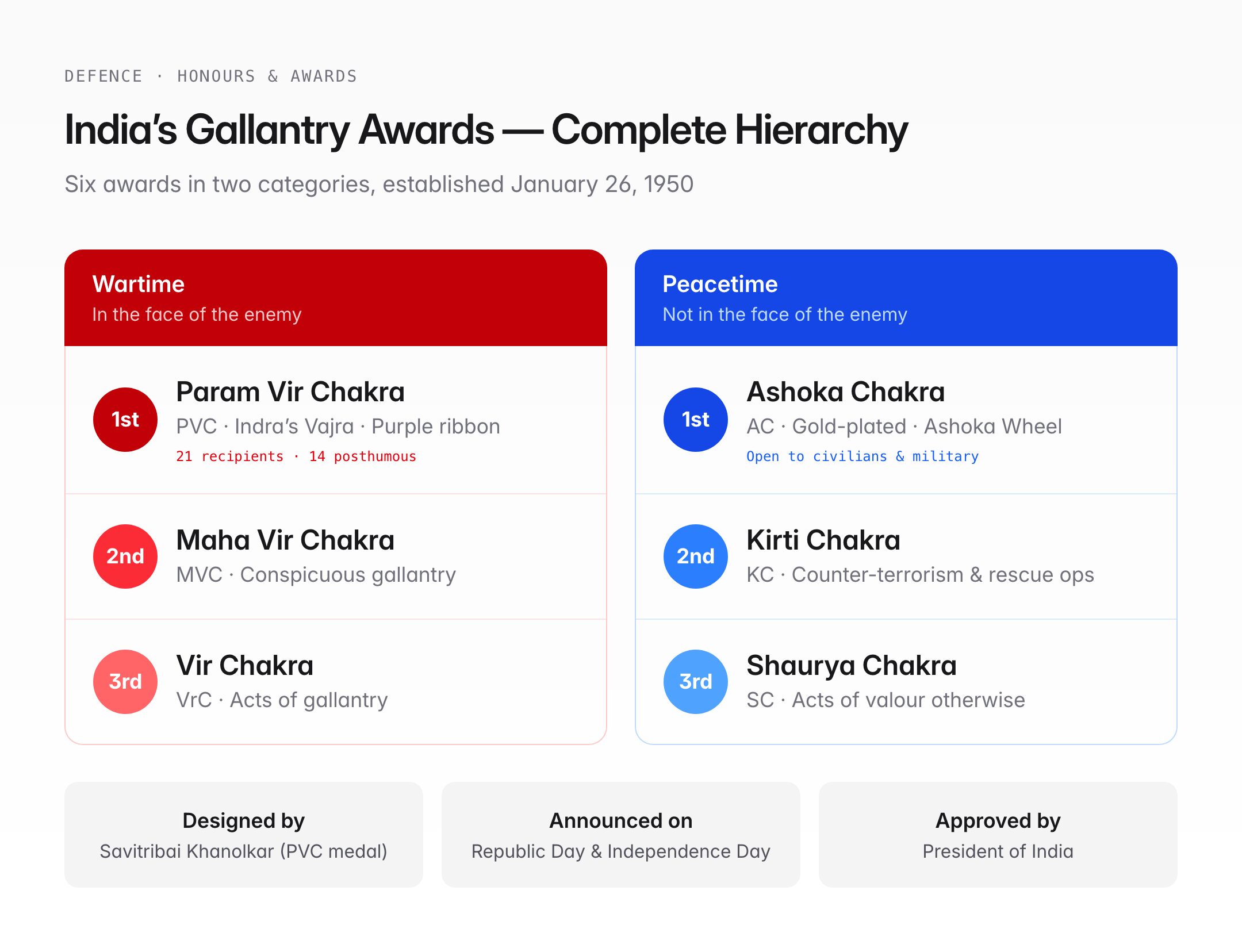
India's gallantry awards are organised into two categories — wartime (in the face of the enemy) and peacetime (not in the face of the enemy) — each with three tiers of descending order of precedence.
Complete Hierarchy Table
| Rank | Wartime (Face of Enemy) | Peacetime (Not Face of Enemy) |
|---|---|---|
| 1st (Highest) | Param Vir Chakra (PVC) | Ashoka Chakra (AC) |
| 2nd | Maha Vir Chakra (MVC) | Kirti Chakra (KC) |
| 3rd | Vir Chakra (VrC) | Shaurya Chakra (SC) |
Wartime Gallantry Awards
Param Vir Chakra (PVC)
| Feature | Detail |
|---|---|
| Full name | Param Vir Chakra (Wheel of the Ultimate Brave) |
| Equivalent | Victoria Cross (UK), Medal of Honor (USA) |
| Instituted | January 26, 1950 (retrospective from August 15, 1947) |
| Designed by | Savitribai Khanolkar (born Eva Yvonne Linda Maday de Maros, a Swiss-Hungarian national married to an Indian Army officer) |
| Medal design | Bronze, circular; Indra's Vajra (thunderbolt) on the face |
| Ribbon | Purple |
| Award criteria | Most conspicuous bravery, or some daring or pre-eminent act of valour or self-sacrifice, in the presence of the enemy |
| Total recipients | 21 (as of 2024) |
| Posthumous | 14 of the 21 recipients received the award posthumously |
Maha Vir Chakra (MVC)
The second-highest wartime gallantry award for acts of conspicuous gallantry in the presence of the enemy. Recipients include officers and soldiers across all three services.
Vir Chakra (VrC)
The third-highest wartime gallantry award for acts of gallantry in the presence of the enemy. The largest number of gallantry awards are at this level.
Peacetime Gallantry Awards
Ashoka Chakra (AC)
| Feature | Detail |
|---|---|
| Full name | Ashoka Chakra |
| Equivalent | George Cross (UK) |
| Award criteria | Most conspicuous bravery, or some daring or pre-eminent act of valour or self-sacrifice, otherwise than in the face of the enemy |
| Eligible | Military personnel and civilians |
| Medal design | Gold-plated, circular; replica of the Ashoka Chakra (the wheel from the national emblem) |
The Ashoka Chakra is particularly significant because it can be awarded to civilians as well as military personnel. It has been awarded for acts of courage during counter-terrorism operations, natural disaster rescue, and other non-war situations.
Kirti Chakra (KC) and Shaurya Chakra (SC)
The Kirti Chakra and Shaurya Chakra are the second and third-highest peacetime gallantry awards respectively, following the same pattern as the wartime hierarchy.
Notable Param Vir Chakra Recipients
| Recipient | War/Conflict | Key Act of Valour |
|---|---|---|
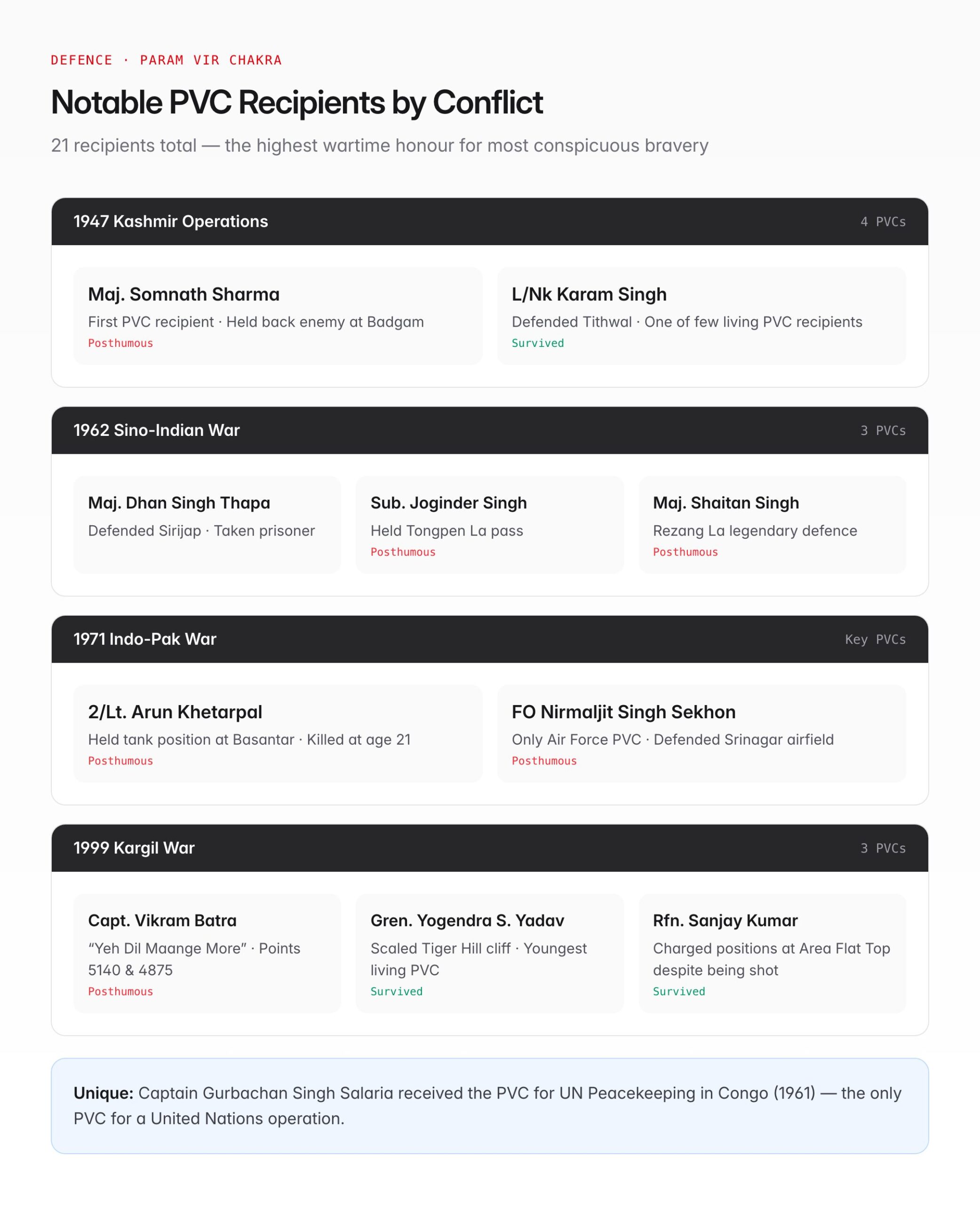
| Major Somnath Sharma | 1947 Kashmir Operations | First PVC recipient; held back enemy advance at Badgam despite being injured; killed in action |
| Lance Naik Karam Singh | 1947 Kashmir Operations | Defended Tithwal against repeated enemy attacks; one of few PVC recipients who survived |
| Second Lt. Rama Raghoba Rane | 1947 Kashmir Operations | Cleared minefields under fire to enable advance to Rajouri |
| Company Havildar Major Piru Singh | 1947 Kashmir Operations | Single-handedly charged enemy positions at Tithwal; killed in action |
| Captain Gurbachan Singh Salaria | Congo (UN Peacekeeping), 1961 | Led a charge against Katangese forces in the Congo; the only PVC for a UN operation |
| Major Dhan Singh Thapa | 1962 Sino-Indian War | Defended Sirijap against overwhelming Chinese attack; taken prisoner |
| Subedar Joginder Singh | 1962 Sino-Indian War | Held off waves of Chinese attacks at Tongpen La with a small platoon |
| Major Shaitan Singh | 1962 Sino-Indian War | Defended Rezang La pass with his company against massive Chinese assault; killed in action |
| Lt. Col. A.B. Tarapore | 1965 Indo-Pak War | Led armoured charges in the Sialkot sector; killed in action |
| 2nd Lt. Arun Khetarpal | 1971 Indo-Pak War | Held his tank position against enemy armour at Basantar; killed at age 21 |
| Flying Officer Nirmaljit Singh Sekhon | 1971 Indo-Pak War | Defended Srinagar airfield in aerial combat; the only Air Force PVC recipient |
| Captain Vikram Batra | 1999 Kargil War | Captured Point 5140 and Point 4875; famous for "Yeh Dil Maange More"; killed in action |
| Grenadier Yogendra Singh Yadav | 1999 Kargil War | Scaled Tiger Hill cliff face under fire, destroyed enemy bunkers; youngest living PVC recipient |
| Rifleman Sanjay Kumar | 1999 Kargil War | Charged enemy positions at Area Flat Top despite being shot; survived |
Selection and Approval Process
| Step | Detail |
|---|---|
| 1. Citation | The unit commanding officer prepares a detailed citation of the act of bravery |
| 2. Military review | The citation is reviewed through the chain of command (brigade, division, corps, command) |
| 3. Service HQ | The respective service headquarters (Army/Navy/Air Force) evaluates and recommends |
| 4. Central Honours and Awards Committee | An inter-service committee reviews all recommendations |
| 5. Defence Minister | Recommendation forwarded through the Defence Minister |
| 6. President of India | Final approval by the President of India, who is the supreme commander of the armed forces |
| 7. Announcement | Awards are announced on Republic Day (26 January) and Independence Day (15 August) through a gazette notification |
Key Facts About Gallantry Awards
- All six gallantry awards can be conferred posthumously
- A recipient can receive the same award multiple times — a bar is added to the ribbon for each subsequent award
- The Param Vir Chakra takes precedence over all other awards except the Bharat Ratna
- Gallantry awards carry a monthly stipend — the PVC carries the highest stipend among gallantry awards
- The awards are not restricted by rank — from sepoys to generals, all are eligible
- Civilians are eligible only for the peacetime gallantry awards (AC, KC, SC)
Distinction from Other National Awards
| Award Type | Examples | Purpose |
|---|---|---|
| Gallantry Awards | PVC, MVC, VrC, AC, KC, SC | Bravery and valour |
| Distinguished Service Awards | Param Vishisht Seva Medal, Ati Vishisht Seva Medal, Vishisht Seva Medal | Exceptional service of the most exceptional order |
| Civilian Awards | Bharat Ratna, Padma Vibhushan, Padma Bhushan, Padma Shri | Outstanding contribution to various fields |
Gallantry Awards and Republic Day
The announcement of gallantry awards on Republic Day is one of the most significant ceremonial traditions. Gallantry award winners participate in the Republic Day Parade on Rajpath (now Kartavya Path), where they are honoured before the President. The families of posthumous awardees receive the honour on behalf of the fallen soldiers.
UPSC Relevance
GS Paper Mapping
| Paper | Topic | Connection |
|---|---|---|
| GS Paper II | Governance — Awards and Honours | Hierarchy, selection process, constitutional provisions |
| GS Paper III | Internal Security / Defence | Military operations, counter-terrorism, bravery in conflict |
| GS Paper I | Post-Independence History | Wars of 1947, 1962, 1965, 1971, Kargil 1999 |
Key Points for Prelims
- India has six gallantry awards — three wartime (PVC, MVC, VrC) and three peacetime (AC, KC, SC)
- The Param Vir Chakra (PVC) is the highest wartime gallantry award; Ashoka Chakra (AC) is the highest peacetime gallantry award
- The PVC was designed by Savitribai Khanolkar and features Indra's Vajra on the medal
- 21 PVC recipients as of 2024; 14 were posthumous
- Major Somnath Sharma was the first PVC recipient (1947 Kashmir Operations)
- Captain Gurbachan Singh Salaria received the PVC for action during UN Peacekeeping in Congo (1961)
- Flying Officer Nirmaljit Singh Sekhon is the only Indian Air Force PVC recipient
- Gallantry awards are announced on Republic Day and Independence Day
- Civilians are eligible only for peacetime gallantry awards (AC, KC, SC)
- The President of India grants final approval as supreme commander of the armed forces