GC Leong Geography: Which Edition to Buy and What to Read for UPSC
GC Leong's second edition from OUP is the second geography book for UPSC, after NCERT. Which of its 25 chapters matter, a four-week plan and its limits.
GC Leong is the physical geography book that sits on nearly every UPSC booklist, and the doubt you came with is a fair one: does a slim 208-page textbook still earn a place next to the NCERTs? For one job, it does. Goh Cheng Leong’s Certificate Physical and Human Geography explains landforms, weather and the world’s climatic regions more cleanly than any other single book an aspirant is likely to open. It doesn’t cover Indian geography, and its human geography is thinner than the title suggests.
Most aspirants go wrong with it in one of two ways. The first group reads it as their very first geography book, before NCERT, and finds the climate chapters heavy going because the basics aren’t in place yet. The second group hears that NCERT is enough, never opens it and then meets world-geography questions on vegetation belts and farming regions that the NCERT chapters only touch.
The fix is order, not choice. NCERT’s Class 11 physical geography first, GC Leong second, then the atlas and the previous-year questions. I want to settle the edition before anything else, because most of the copies passed around are not the book OUP sells today.
What GC Leong is, and which edition to buy
Certificate Physical and Human Geography by Goh Cheng Leong is published in India by Oxford University Press. The current print is the second edition, released in December 2023: a 208-page paperback, 241 x 184 mm, ISBN 978-9354975660.
OUP lists what the second edition changed:
- Key terms, essential facts and headings are highlighted in colour, and the maps and illustrations were updated and redrawn in colour.
- Every chapter ends with practice questions.
- The index was fully revised.
- OUP promises regular digital updates to questions and exercises for Prelims and Mains.
That matters because the GC Leong people pass around, as a scan or a second-hand copy, is usually the older black-and-white print. The second edition is the one to buy. Amazon.in carries plenty of third-party and used listings under the same title, so pick the one sold as the Oxford University Press second edition.
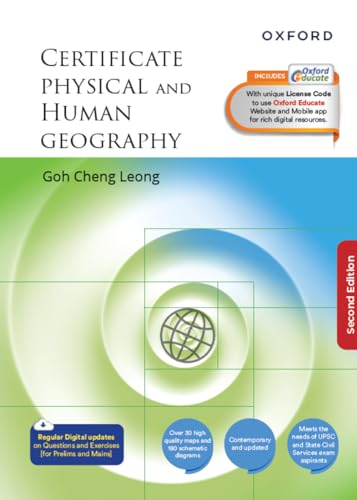
Certificate Physical and Human Geography, GC Leong, 2nd Edition (OUP)
- 208 pages, Oxford University Press India, December 2023
- 25 chapters in two parts: physical geography, and weather, climate and vegetation
- Second edition in colour, with practice questions in every chapter and a revised index
One thing the cover won’t tell you. Read OUP’s table of contents and you won’t find a human geography part at all. The book has two parts:
- Part 1, Physical Geography: 12 chapters, from The Earth and the Universe to The Oceans.
- Part 2, Weather, Climate and Vegetation: 13 chapters, from Weather and Climate through eleven climatic regions, ending with the Arctic or Polar climate.
The human geography lives inside Part 2. Each climatic-region chapter covers the farming and other economic activity of that region. Population, migration, settlements and industrial location are simply not in it.
Who GC Leong is for, and who should skip it
GC Leong is for the UPSC Prelims and GS1 aspirant who has read NCERT’s Class 11 Fundamentals of Physical Geography and needs a second, clearer pass on processes and world climates. The syllabus asks for exactly that. Prelims lists physical, social and economic geography of India and the world. GS1 lists the salient features of the world’s physical geography and important geophysical phenomena such as earthquakes, tsunamis, volcanic activity and cyclones.
Our Prelims geography question bank counts 149 geography questions from 2013 to 2026, and several of its largest topics are GC Leong’s home ground:
- Continents: 18 questions
- Atmosphere: 13 questions
- Climatic regions of the world: 8 questions
The climatic-regions questions are the clearest case. Eleven of Leong’s 25 chapters are nothing but climatic regions, each with its climate, natural vegetation and economy, which is what those questions test.
Read it as a core book if:
- UPSC Prelims and GS1 are ahead and NCERT Class 11 physical geography is done.
- A state PSC prelims with a world geography section is in your plan.
- CDS, NDA or CAPF is the target, where direct questions on landforms and climates are common.
- Geography is your optional, as a clear first pass before the heavier optional texts listed on our geography optional booklist.
Leave it for later if:
- You haven’t opened NCERT yet. Start with the Class 11 physical geography textbook, which is free.
- You need Indian geography. Leong has none; NCERT’s India Physical Environment does that job.
- You are in the Mains-heavy months with no Prelims ahead. Its main value is Prelims and short GS1 answers.
It isn’t wise to read Leong first, and it isn’t wise to skip it. It is the second book, and it does that job better than anything else on the shelf.
The chapter map: what to read for UPSC, and what for state exams
The 25 chapters sort into seven groups, and for UPSC they are not equal. This is how they sort out for the two kinds of reader.
| Chapters | What they cover | UPSC Prelims and GS1 | State PSC, CDS, SSC |
|---|---|---|---|
| 1. The Earth and the Universe | The Earth as a planet and the ground rules of position and time | Read once | Core |
| 2-3. The Earth’s Crust; Volcanism and Earthquakes | Crust, rocks, earth movements, volcanoes, earthquakes | Core; pair with plate tectonics | Core |
| 4. Weathering, Mass Movement and Groundwater | How rock breaks down and moves | Read | Read |
| 5-8. Running water, glaciation, arid, limestone and chalk landforms | Landforms by agent of erosion | Read with the diagrams; landform names recur in Prelims | Core |
| 9-11. Lakes; Coastal Landforms; Islands and Coral Reefs | Lake types, coasts, islands and reefs | Read; coral reefs come up often | Read |
| 12. The Oceans | Ocean relief, currents, salinity | Read, then go deeper on currents | Read |
| 13-14. Weather; Climate | Temperature, pressure, winds, rainfall, climate types | Core: the two most useful chapters in the book | Core |
| 15-25. The eleven climatic regions | Equatorial to Polar, each with vegetation and economy | Core for world geography; read with the atlas open | Core |
If time is short, the essential set is chapters 2-3, 13-14 and 15-25. That is roughly the part of GC Leong that NCERT can’t replace.
How to read GC Leong in four weeks
The method is draw, then recall. About 45 minutes a day for four weeks covers 208 pages at a steady seven or eight pages a day, and every chapter ends with you drawing its main diagram from memory.
- Week 1, chapters 1-4. The Earth, the crust, volcanoes and earthquakes, weathering. Draw a fold, a fault and a volcano cross-section once each without the book. Our note on plate tectonics fills the gap Leong leaves on plate boundaries.
- Week 2, chapters 5-12. One agent of erosion a day. Build a single table with three columns: the agent, its erosional landforms and its depositional landforms. The geomorphic processes explainer uses the same frame.
- Week 3, chapters 13-19. Weather and Climate slowly, over two or three days, then the first five climatic regions.
- Week 4, chapters 20-25, then practice. The remaining regions, each with the atlas open. For every region, name three countries, its natural vegetation and one crop. Then solve the practice questions at the end of each chapter and a set of geography PYQs.
If your recall of a landform table is under six out of ten, you are reading, not studying. Cut the table in half and try again. Nobody’s first attempt at the glacial landforms goes well.
What to skip, and what to cross-check
For UPSC there’s little to skip in a book this short. After the first read, the region-by-region detail on farming and trade can be skimmed. Keep the climate, the vegetation and the location of each region, because those are what the questions ask.
Cross-check three things:
- Names of climate types. Leong names regions descriptively: the China type, the British type, the Laurentian. The UPSC optional syllabus and NCERT also use Köppen’s classification with its letter codes, so learn the match. Our Köppen classification note maps it.
- Economic facts. Any statement about a country’s leading crop, mineral or trade partner can date. Check it before it goes into an answer.
- Oceans. Chapter 12 is compact. For salinity, temperature and currents at Mains depth, read our oceanography note alongside.
What GC Leong will not do
It won’t teach Indian geography, and it won’t teach human geography in the sense the syllabus means it. Population, migration, settlements and industrial location are covered in NCERT’s Class 12 Fundamentals of Human Geography, which you can download through our NCERT books guide.
It won’t keep you current. The GS1 syllabus asks about changes in critical geographical features, water bodies and ice caps included, and no textbook printed in 2023 can do that for you. It won’t carry the geography optional on its own either. And it won’t write your answers: GS1 geography rewards structure and a quick diagram, which is what our Mains geography PYQs page drills.
Leong is a teacher, not a syllabus. Read it after NCERT, not instead of it.
GC Leong vs NCERT Class 11 vs Savindra Singh
Three books get bought for world physical geography, and they do three different jobs.
| Book | Pages and edition | What it is | Verdict |
|---|---|---|---|
| Certificate Physical and Human Geography, GC Leong, 2nd edition | 208 pages, OUP, December 2023 | Clear processes plus eleven climatic regions | The second book for GS |
| NCERT Fundamentals of Physical Geography, Class 11 | About 160 pages, NCERT | The syllabus foundation, also free on the NCERT site | The first book, before Leong |
| Physical Geography, Savindra Singh | Pravalika Publications, a thick reference | Optional-level depth in geomorphology, climatology, oceanography and biogeography | For the optional, not for GS |
For a GS-only aspirant the answer is NCERT plus Leong, and nothing more. Savindra Singh is a fine book with the wrong job for you. Our wider geography books for UPSC list covers the India side.
Is there a GC Leong PDF?
No official one. Oxford University Press sells the second edition as a printed book, and its product page lists digital updates to questions and exercises, not a free copy of the text. The files that circulate as a GC Leong PDF are almost always scans of the older black-and-white print, without the second edition’s colour diagrams, revised index or end-of-chapter questions.
The free and legitimate alternative is NCERT. Both Fundamentals of Physical Geography for Class 11 and Fundamentals of Human Geography for Class 12 are on the official NCERT textbook site at https://ncert.nic.in/textbook.php.
GC Leong has lasted on booklists because it explains things plainly, and the second edition keeps that and adds colour. Read NCERT’s physical geography first, then Leong in four weeks with a pencil in hand, and pay the most attention to chapters 13 to 25, where it does what no other book on your list does. Start with the climatic regions tonight, with the atlas open beside you.
Frequently Asked Questions
Is GC Leong enough for UPSC geography?
No. It covers world physical geography and climatic regions well, but it has no Indian geography and little human geography. Pair it with NCERT’s Class 11 and 12 geography textbooks and an atlas.
Which edition of GC Leong should I buy?
The second edition from Oxford University Press, released in December 2023 at 208 pages. It is in colour, has practice questions in every chapter and a revised index. The copies passed around as scans are the older print.
Should I read NCERT or GC Leong first?
NCERT first. The Class 11 Fundamentals of Physical Geography builds the basics that make Leong’s climate chapters easy to follow. Leong is the second pass, and it is most useful on the climatic regions of the world.
Which chapters of GC Leong are most important for UPSC?
Chapters 2 and 3 on the crust, volcanoes and earthquakes, chapters 13 and 14 on weather and climate, and chapters 15 to 25 on the eleven climatic regions. Together they are the part NCERT cannot replace.
Does GC Leong cover human geography?
Only inside the climatic-region chapters, which describe the farming and economic activity of each region. Population, migration, settlements and industrial location are not in the book; NCERT’s Class 12 Fundamentals of Human Geography covers them.
How long does it take to read GC Leong?
About four weeks at 45 minutes a day, or seven to eight pages a day. Draw each chapter’s main diagram from memory before moving on, and finish with the practice questions and a set of geography PYQs.
Is GC Leong useful for the geography optional?
As a first pass, yes. It gives clear basics on landforms and climate before the heavier optional texts. It is not enough for Paper I on its own, which needs optional-level depth in geomorphology, climatology and human geography.
Is there a free GC Leong PDF?
There is no official free PDF. The scans online are usually the older black-and-white print without the second edition’s colour diagrams and questions. NCERT’s physical and human geography textbooks are free on the NCERT website.