Gold Reserves of India: RBI Holdings, Repatriation and Why They Matter (UPSC Economy)
The RBI holds 880.5 tonnes of gold, gold's share in India's forex reserves has jumped to nearly 17%, and 77% of that gold now sits in vaults inside India. Here is the full picture — what forex reserves are, why central banks hoard gold, and why the RBI is quietly bringing its bullion home — explained for UPSC GS3.
In early June 2026, a single rumour did what bullion rarely does — it made gold front-page news. Reports claimed the Reserve Bank of India had quietly sold about $12 billion of gold to prop up a shrinking war chest of foreign exchange. Within hours the government’s fact-check unit and Finance Ministry sources had knocked it down: the RBI hadn’t sold an ounce. Its physical gold stock was sitting exactly where it had been, at 880.52 tonnes, and the share of gold in India‘s reserves was not falling but climbing. The story was false. But the panic it caused tells you something real — that India’s gold has become a sensitive nerve in the body of the economy, and people no longer treat it as a sleepy line item.
And it is worth understanding why, because the numbers underneath that denial are genuinely striking. Over the past year the RBI has been doing two quiet, deliberate things at once: it has let gold swell into nearly a sixth of India’s reserves, and it has been shipping that gold physically back into vaults inside the country. Both moves are about the same thing — insurance against a world that suddenly looks less safe for anyone who keeps their savings in someone else’s currency or someone else’s basement. For a UPSC aspirant, gold reserves are no longer a footnote in the external-sector chapter. They sit at the crossroads of monetary policy, the balance of payments and the new geoeconomics of de-dollarisation, and they reward a candidate who can explain them with a few sharp figures and a clear chain of logic.
What Forex Reserves Are and Where Gold Fits
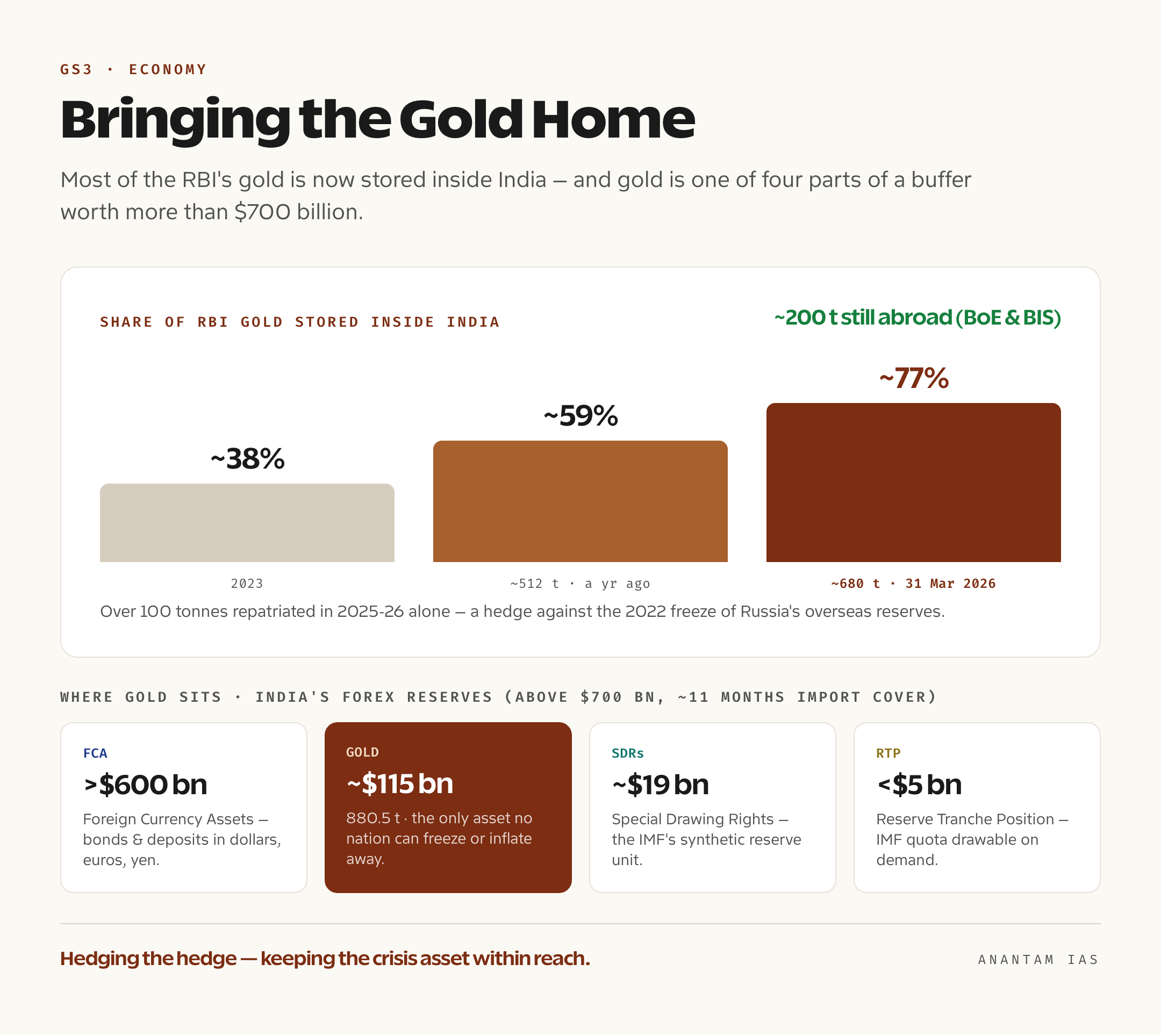
Start with the container, then look at the gold inside it. India’s foreign exchange reserves are the stock of external assets the RBI can draw on to meet the country’s foreign payments and to steady the rupee when markets turn rough — the national emergency fund, in plain terms. As of mid-2026 they sit above $700 billion, among the largest such buffers in the world, and they come in four parts that every aspirant should be able to name in order. The biggest by far is Foreign Currency Assets, or FCA — dollars, euros, yen, pounds and other currencies held mostly as foreign government bonds and deposits, worth more than $600 billion. Then comes gold. Then Special Drawing Rights, or SDRs, the synthetic reserve unit the International Monetary Fund hands its members, worth roughly $19 billion. And last, the Reserve Tranche Position, the slice of India’s IMF quota it can pull back on demand without conditions, a little under $5 billion.
The standard health check on this buffer is import cover — how many months of imports the reserves could pay for if every other dollar inflow stopped tomorrow. India’s cover is comfortable, in the region of eleven months, well above the three-month line economists treat as the danger floor. So the country is not short of reserves. What’s changed is the mix. For years gold was a modest, almost ornamental sliver of the pile. Now it is muscling its way toward the centre, and that shift is the real story.
Because here is the thing about why central banks hold gold at all. Foreign currency assets are somebody else’s promise — a US Treasury bond is only as good as Washington’s willingness to honour it, and the dollars in it are only as good as the dollar. Gold is nobody’s promise. It carries no credit risk, no counterparty who can default, no government that can freeze it or inflate it away. That’s why it behaves like financial insurance: when currencies wobble, when inflation bites, when geopolitics turns ugly, gold tends to hold or gain value precisely as paper assets fall. It is also unusually liquid and globally accepted — under the Basel banking rules, allocated physical gold has long carried a zero-risk weighting, putting it on the same footing as cash for capital purposes. A central bank that wants a buffer that no foreign power can switch off keeps a chunk of it in metal. That single idea — gold as the asset nobody else controls — explains almost everything India has done with it lately.
How Much Gold the RBI Holds and Why Its Share Jumped
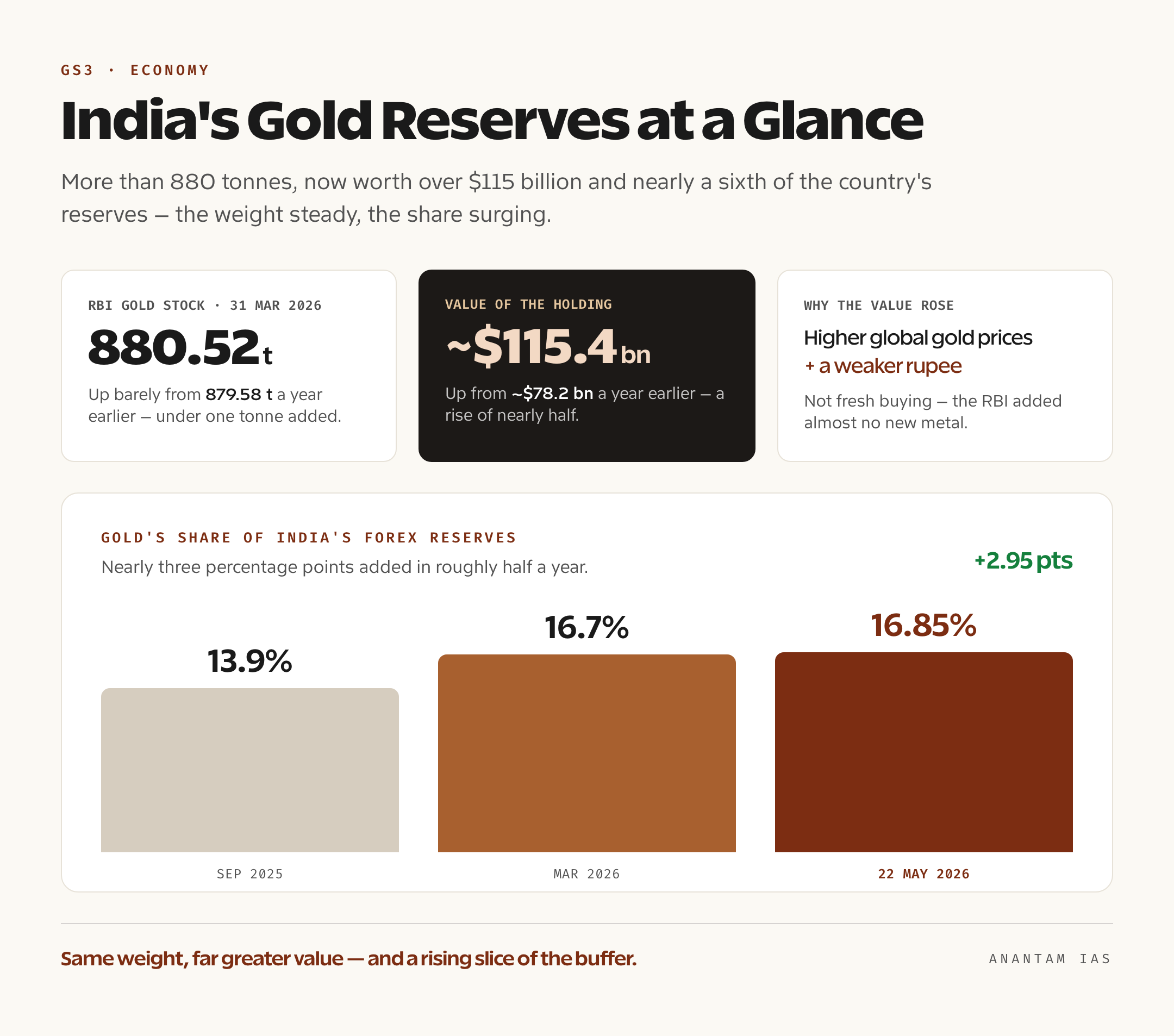
Now the hard numbers, because this is where examiners and editorials both live. As of 31 March 2026, the RBI’s physical gold stock stood at 880.52 tonnes, up marginally from 879.58 tonnes a year earlier — an addition of less than a single tonne. So in weight, almost nothing changed. The RBI barely bought any new gold over the year. Yet in value and share, the change was dramatic, and holding those two facts together is the whole trick of understanding this story.
Look at the share first. Gold made up about 13.9 per cent of India’s foreign exchange reserves at the end of September 2025. By 31 March 2026 that had jumped to 16.7 per cent, and by 22 May 2026 it had edged up further to 16.85 per cent — nearly three percentage points added in roughly half a year. In value terms, the gold the RBI holds was worth about $78.2 billion a year earlier and is now worth around $115.4 billion, a rise of close to half. As the RBI’s own annual report numbers showed, the rupee value of the gold held by its Banking Department alone rose more than 63 per cent in a single year. And because almost no new metal was bought, that swelling came from two outside forces, not from RBI shopping. First, the price of gold has surged on world markets, lifted by the same anxieties — wars, inflation, central-bank buying — that make gold attractive in the first place. Second, the rupee has depreciated against the dollar, which mechanically inflates the rupee value of any asset priced in dollars or in gold. So the same 880 tonnes are simply worth a great deal more.
This is exactly why the June 2026 sale rumour collapsed so fast. If the RBI had dumped $12 billion of gold, the physical stock would have fallen and the share would have dropped. Instead the tonnage held steady and the share rose to record levels — the data point flatly contradicted the claim. The fact-check made a subtler point too, and it is worth carrying into an answer. India’s overall reserves have in fact dipped at times over the past year, but the reason is the RBI selling dollars — its foreign currency assets — to defend the rupee in the market, not selling gold. The gold pile has been steady or rising even as the dollar pile was spent down. That distinction — dollars sold to manage the currency, gold held as the long-term anchor — is the kind of precise point that separates a strong external-sector answer from a vague one.
Why the RBI Is Bringing Its Gold Home
There’s a second, quieter move that matters as much as the first, and it has nothing to do with how much gold India owns and everything to do with where it sits. For decades, a large part of the RBI’s gold was stored abroad — in the vaults of the Bank of England in London and with the Bank for International Settlements in Basel, a convenient arrangement that made the metal easy to trade and to use as collateral in global markets. Over the past three years the RBI has been steadily reversing that, physically transporting gold back to vaults inside India. As of 31 March 2026, roughly 680 tonnes of the 880-tonne stock — about 77 per cent — was held domestically, up sharply from around 512 tonnes, or roughly 59 per cent, a year earlier, and from barely 38 per cent in 2023. The remainder, just under 200 tonnes, still sits with the Bank of England and the BIS. In 2025-26 alone the RBI is reported to have repatriated well over 100 tonnes, part of a multi-year pattern of bringing large quantities home.
So why move heavy, expensive bullion across continents at all? The trigger is geopolitical, and it is recent enough that you can date it. When Russia invaded Ukraine in 2022, the West froze hundreds of billions of dollars of Russian central-bank reserves held abroad — overnight, money Moscow thought it owned became money it could not touch. That episode rang an alarm in every reserve-managing central bank, including the RBI’s. The lesson was blunt: reserves parked in another country’s financial system can be sanctioned, frozen or weaponised in a crisis, however unlikely that feels in calm times. Gold stored in London is safe only as long as relations with London stay friendly. Gold stored in Nagpur or Mumbai answers to no one but India. Bringing it home is, in effect, buying sovereignty over your own insurance.
There are smaller reasons stacked behind the big one. Holding gold abroad means paying storage and custody fees year after year, which domestic vaulting avoids. Confidence in the RBI’s own secure storage has grown as its holdings have. And there is a plain signalling value: a country that keeps its gold at home tells markets and citizens that it trusts itself to safeguard its wealth. None of this means India is turning its back on the global financial system — keeping a portion abroad preserves the flexibility to trade or pledge gold quickly. It means India is hedging its hedge, making sure the bulk of the asset designed to survive a crisis would actually be reachable in one.
The Global Picture: Central Banks, De-Dollarisation and Why Gold Is Surging
India is not acting alone, and the answer that places it in the global trend will always read better. Around the world, central banks have been buying gold at a pace not seen in half a century. They added more than 1,000 tonnes to their reserves in each of 2022, 2023 and 2024 — roughly double the average of the previous decade — and even as buying cooled to around 860 tonnes in 2025, it stayed far above historical norms. Surveys by the World Gold Council have found a large and rising majority of central banks expecting to add gold and trim their dollar exposure over the coming years. The official sector, in other words, has become a structural buyer of gold, and that steady demand is a big part of why prices keep climbing.
The word that ties this together is de-dollarisation — the slow, deliberate effort by many countries to reduce their dependence on the US dollar as the world’s reserve currency and settlement medium. The dollar still dominates global trade and reserves, and it isn’t being dethroned anytime soon. But the same freezing of Russian reserves that pushed India to bring gold home pushed other nations to ask an uncomfortable question: how much of our national savings should sit inside a system one government can switch off? Gold is the natural answer, because it is the one reserve asset that belongs to no nation’s monetary policy and no nation’s sanctions list. Add a decade of dollar-debasement worries — large US deficits, repeated inflation scares — and you get a world where central banks quietly diversify into the oldest money there is.
For India, this trend is both a tailwind and a vindication. The surge in gold prices has handed the RBI a large, unearned gain in the value of reserves it already owned — a cushion built without spending a rupee. The repatriation move looks prudent rather than paranoid when half the world’s central banks are thinking the same way. And it dovetails with India’s broader push to internationalise the rupee and settle more trade outside the dollar, from rupee-trade arrangements with partner countries to a cautious interest in alternatives for cross-border payments. Gold is the conservative, non-controversial leg of that wider strategy: you can diversify away from the dollar without making any political enemies simply by buying more of a metal everyone already trusts.
For Your Mains Answer
This is a high-value topic for GS Paper 3, which covers the Indian economy, mobilisation of resources, the external sector and the balance of payments. Questions on forex reserves, exchange-rate management, the RBI’s monetary and reserve-management role, and the new geoeconomics of de-dollarisation can all be answered with this material. It also offers a clean, data-rich example for the Essay paper on themes of economic sovereignty, security and self-reliance. The skill examiners reward is the same one this article uses: pair a few exact figures with a clear chain of cause and effect, and always connect the domestic move to the global trend.
How to Build the Answer
Open with the buffer, not the metal — define forex reserves and their four components, then show where gold sits and why its share is rising. Move in a logical chain: what reserves are, why central banks hold gold (no counterparty risk), how much India holds (880.5 tonnes), why its share jumped (price plus rupee depreciation, not fresh buying), where it is now stored (77 per cent at home) and why (the Russia-sanctions precedent), and finally the global frame (record central-bank buying and de-dollarisation). Close by judging whether the strategy is sound. That arc — define, hold, value, locate, contextualise, evaluate — fits almost any reserves-or-gold question.
Common Mistakes to Avoid
Don’t confuse the share rising with India buying lots of gold — the tonnage barely moved; the share rose because of price and a weaker rupee. Don’t claim the RBI sold gold to defend the rupee; it sold dollars (foreign currency assets), and that fact-check is itself examinable. Don’t overstate de-dollarisation as the imminent fall of the dollar; frame it as gradual diversification. And don’t list the four reserve components without explaining why gold is the safest of them — the “no counterparty risk” point is what earns the marks.
A Compact Answer Spine
Forex reserves = FCA + gold + SDRs + reserve tranche position, above $700 bn, ~11 months import cover → gold is the only asset with no counterparty or sanctions risk → RBI holds 880.5 t (≈ unchanged in weight) → share up from 13.9% (Sep 2025) to 16.7% (Mar 2026) on higher prices + rupee depreciation, value ≈ $115 bn → repatriation: 77% now stored domestically, up from ~59%, after the 2022 freeze of Russian reserves → global context: record central-bank buying and de-dollarisation → verdict: prudent insurance, not panic.
Diagram or Flowchart Idea
Draw a simple pie of the four reserve components with gold’s slice highlighted and an upward arrow on it, beside a small bar showing the domestic-storage share rising from ~59% to 77%. A clean two-panel visual like this — composition plus the homecoming trend — communicates the whole story at a glance and is quick to sketch.
A Balanced-Conclusion Line
A line that lands the marks: “India’s gold strategy is less about hoarding wealth than about hedging risk — holding the one reserve asset no foreign power can freeze, and keeping most of it within reach at home, even as it stays committed to an open, dollar-anchored global system.”
How to Use Data Without Cramming
You need only four anchors, not a spreadsheet: 880.5 tonnes (the stock), ~16.7 per cent (gold’s share by March 2026), ~$115 billion (its value), and 77 per cent (now stored domestically). Drop those four into the right sentences and the answer reads as authoritative. Attribute them plainly — “as the RBI’s 2025-26 annual report showed” — rather than scattering numbers without a source.
FAQ
How much gold does the RBI hold, and is it rising? As of 31 March 2026, the RBI held 880.52 tonnes of gold, barely changed from 879.58 tonnes a year earlier — so the physical stock is broadly steady. What rose sharply is its value and share: gold’s slice of India’s forex reserves climbed from about 13.9 per cent in September 2025 to 16.7 per cent by March 2026 and 16.85 per cent by late May 2026, with the holding now worth around $115 billion, driven by higher global gold prices and a weaker rupee.
Why is the RBI bringing its gold back to India? For sovereignty and security. After Western nations froze Russia’s overseas central-bank reserves in 2022, the RBI accelerated moving gold out of foreign vaults like the Bank of England and into storage inside India — partly to avoid any future risk of sanctions or freezes, partly to save custody fees, and partly to signal self-reliance. About 77 per cent of its gold is now held domestically, up from roughly 59 per cent a year earlier.
Did the RBI sell $12 billion of gold in 2026? No. In June 2026 the government’s fact-check unit and Finance Ministry sources rejected that report as false. The RBI’s physical gold stock stayed at 880.52 tonnes and gold’s share of reserves actually rose to record levels — the opposite of what a large sale would show. Any dip in India’s overall reserves came from the RBI selling dollars to defend the rupee, not from selling gold.
Why do central banks hold gold at all? Because gold is the one reserve asset with no counterparty risk — it is nobody’s debt, so no government can default on it, freeze it or inflate it away. It holds value when currencies, inflation or geopolitics turn against paper assets, and it is globally liquid and accepted. That is why central banks worldwide have been buying gold at record pace and diversifying away from the dollar, a trend known as de-dollarisation.
Practice Questions
Prelims MCQs
- India’s foreign exchange reserves consist of which of the following components?
(a) Foreign Currency Assets, gold, SDRs and the Reserve Tranche Position
(b) Foreign Currency Assets, gold and crude oil stocks
(c) Gold, SDRs and commercial bank deposits abroad
(d) Foreign Currency Assets, gold and domestic government bonds
Answer: (a) The four components are FCA, gold, Special Drawing Rights, and the Reserve Tranche Position with the IMF. - The Reserve Tranche Position, a component of India’s forex reserves, is held with which institution?
(a) The Bank for International Settlements
(b) The World Bank
(c) The International Monetary Fund
(d) The Bank of England
Answer: (c) The Reserve Tranche Position is the portion of a country’s IMF quota it can draw on demand without conditions. - The share of gold in India’s foreign exchange reserves rose sharply during 2025-26 mainly because of which factors?
(a) Large fresh purchases of gold by the RBI
(b) Rising global gold prices combined with rupee depreciation
(c) A fall in the RBI’s foreign currency assets to zero
(d) The IMF allotting additional gold to India
Answer: (b) The physical stock barely changed; the share rose because gold prices surged and the rupee weakened against the dollar. - With reference to “import cover,” which statement is correct?
(a) It measures how many months of imports the forex reserves could finance
(b) It is the tax levied on imported goods
(c) It measures the share of imports paid for in rupees
(d) It is the limit on gold imports set by the RBI
Answer: (a) Import cover indicates how many months of imports the reserves can pay for; India’s is around eleven months, well above the three-month danger floor. - Why have central banks, including the RBI, increased gold holdings and storage at home in recent years?
(a) Gold offers higher interest income than bonds
(b) Gold carries no counterparty or sanctions risk after the freezing of Russia’s reserves
(c) International rules now require gold to be stored domestically
(d) Gold is exempt from all price volatility
Answer: (b) The 2022 freezing of Russia’s overseas reserves highlighted that gold, owing no one and freezable by no one, is the safest reserve asset, accelerating buying and repatriation.
Mains Practice Questions
- Examine the composition of India’s foreign exchange reserves and discuss why the share of gold in these reserves has been rising in recent years. (15 marks, 250 words)
- “Bringing its gold home is, in effect, India buying sovereignty over its own insurance.” In light of recent repatriation by the RBI, critically analyse the rationale and implications of storing reserves domestically. (15 marks, 250 words)
- Discuss the role of gold as a reserve asset for central banks. How does the global trend of de-dollarisation explain the record pace of central-bank gold buying? (15 marks, 250 words)
- Distinguish between the RBI selling foreign currency assets to defend the rupee and selling gold to support reserves. How does this distinction help in assessing the health of India’s external sector? (10 marks, 150 words)
- Forex reserves are often described as a country’s external-sector buffer. Evaluate the adequacy and management of India’s reserves, using gold as a case study, in the context of contemporary geoeconomic risks. (15 marks, 250 words)