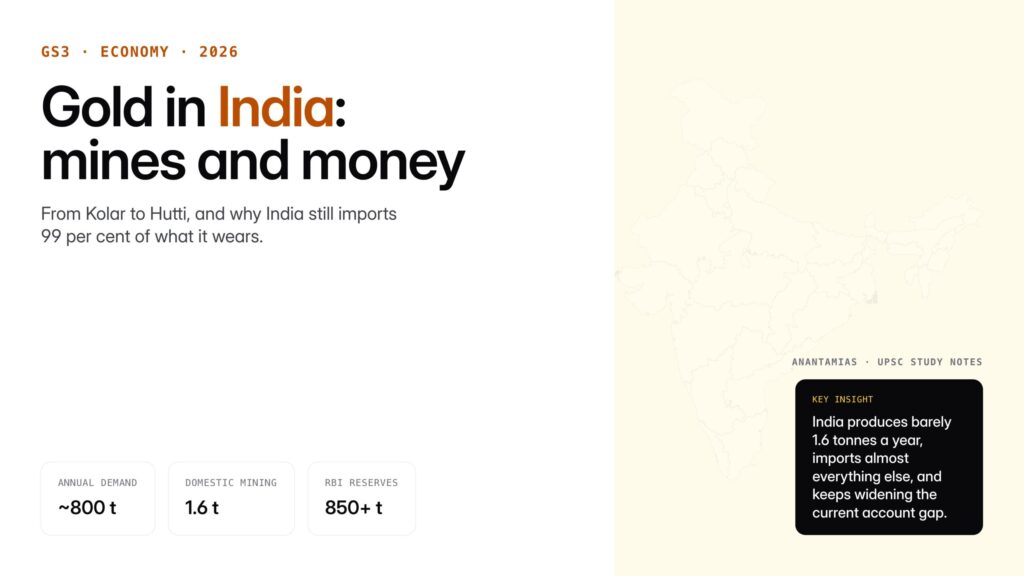
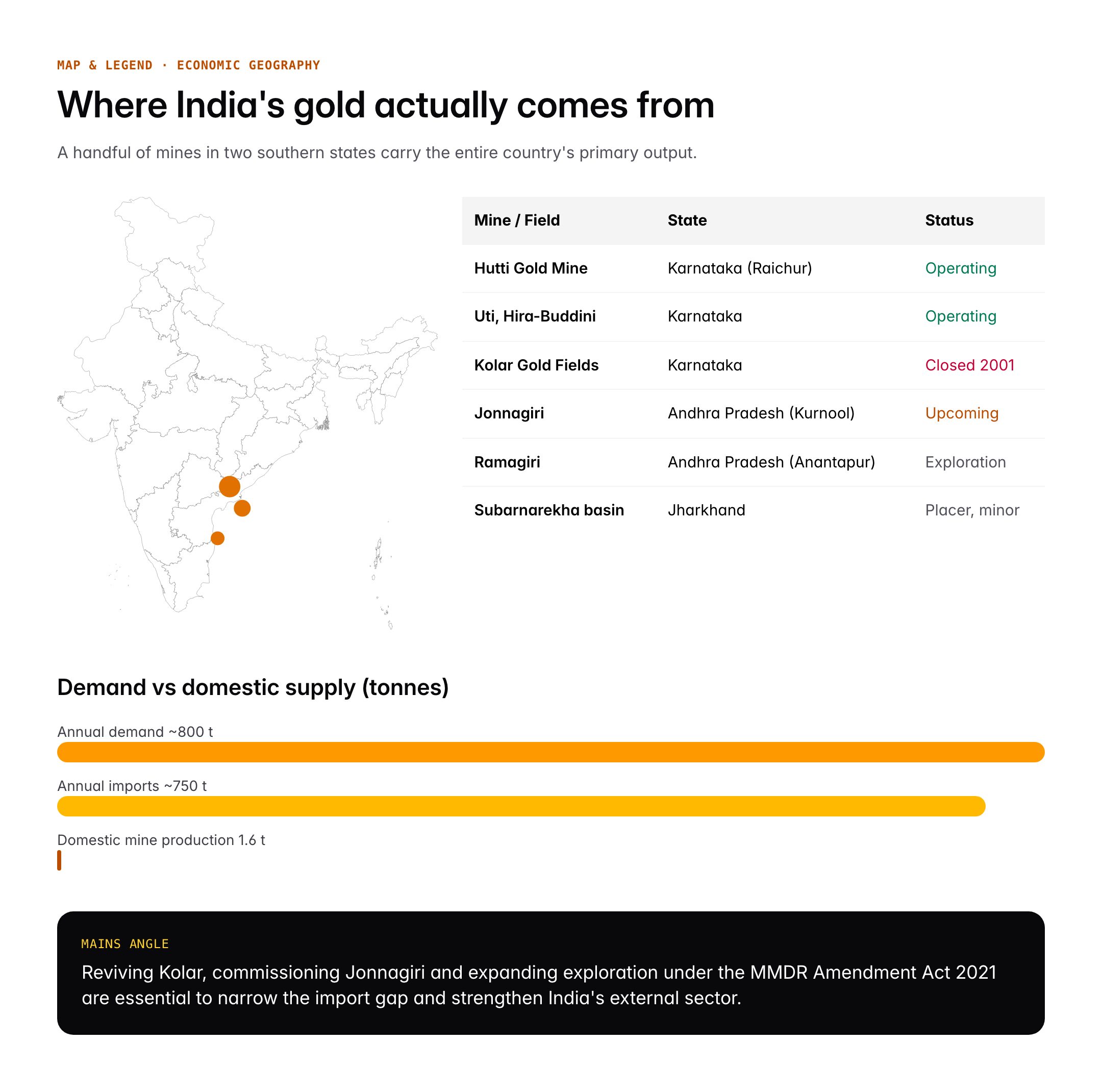
India’s only significant operating gold mine is the Hutti Gold Mine in Raichur district, Karnataka, run by the Hutti Gold Mines Company Ltd and producing around 1.6 tonnes a year. The historic Kolar Gold Fields (KGF), once among the world’s deepest mines, closed in 2001, while Jonnagiri in Andhra Pradesh is being developed as India’s next operating mine. Karnataka is the country’s leading gold-producing state, yet domestic output meets barely a fraction of India’s 700–850 tonne annual demand — forcing heavy imports.
Introduction
Gold occupies a unique place in India’s economy, culture and monetary history. Indians are the world’s second-largest consumers of gold after China, with an annual demand hovering between 700 and 850 tonnes. Yet domestic mine production is tiny, barely one to two tonnes a year, forcing the country to import almost everything it consumes. This demand-supply gulf shapes India’s current account deficit, its foreign exchange reserves and a lattice of regulations ranging from import duties to the Sovereign Gold Bond scheme.
For a UPSC aspirant, gold sits at the intersection of economic geography, international trade, monetary policy and social anthropology. Understanding where India’s gold comes from, how much lies in the Reserve Bank of India’s vaults, and why the government wants households to monetise their private hoards is essential for both Prelims factual questions and GS3 analytical answers on the Indian economy.
Quick Facts at a Glance
| Attribute | Detail |
|---|---|
| India’s rank in global gold consumption | 2nd (after China) |
| India’s rank in global gold production | Below 50th |
| Leading producer state | Karnataka |
| Major operating mine | Hutti Gold Mine, Raichur (Karnataka) |
| Historic mine (closed 2001) | Kolar Gold Fields |
| Largest public sector miner | Hutti Gold Mines Company Ltd |
| Annual domestic production (approx.) | 1.6 tonnes |
| Annual gold demand (approx.) | 700 to 850 tonnes |
| Annual imports | 650 to 800 tonnes |
| RBI gold reserves (2024) | Over 850 tonnes |
| Import duty on gold (2024) | 6 per cent basic customs duty |
| Key government scheme | Sovereign Gold Bond, Gold Monetisation Scheme |
Background and Historical Context
India’s gold story stretches back to the Harappan civilisation, which used gold ornaments as early as 3000 BCE. The Satavahanas, Guptas and Cholas minted gold coins that circulated across the Indian Ocean world. During the colonial period, gold was central to the drain of wealth narrative: British India exported raw cotton, indigo and jute and imported precious metals to settle trade balances.
The modern mining industry took shape at the Kolar Gold Fields (KGF) in Karnataka. Discovered by British geologist Michael Fitzgerald Lavelle in 1871 and exploited by the John Taylor and Sons company, KGF produced the bulk of India’s gold for over a century and once hosted the world’s second-deepest mine, descending over 3,000 metres. The mines were nationalised in 1956 and vested in Bharat Gold Mines Ltd in 1972. Declining grades and mounting losses forced closure in 2001, leaving behind a ghost town and enduring environmental damage.
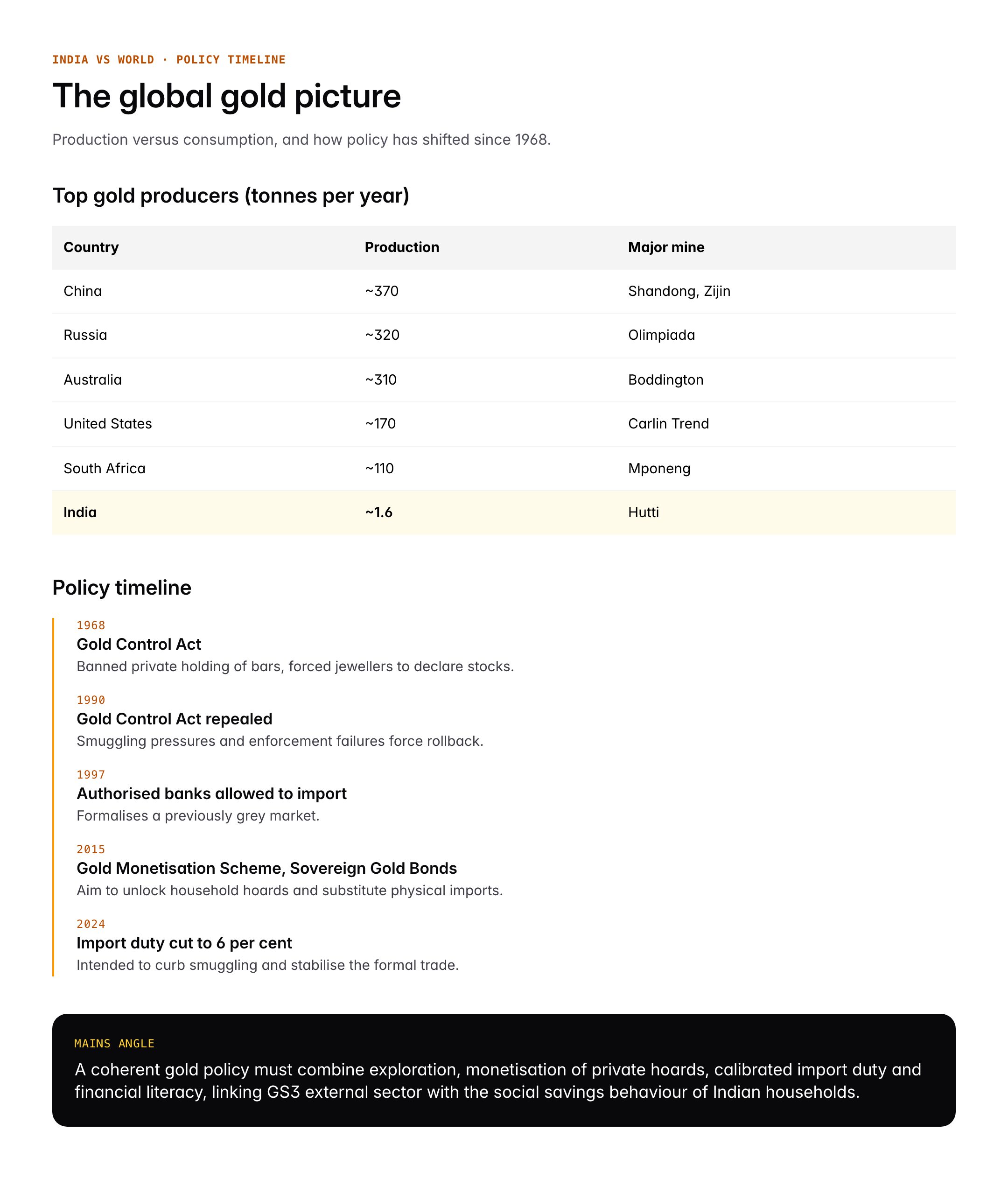
After independence, the government tried to curb private gold imports to preserve foreign exchange. The Gold Control Act of 1968 banned private holding of gold bars and forced jewellers to declare stocks. It proved unenforceable, fuelled a massive smuggling economy and was finally repealed in 1990. Liberalisation in 1997 allowed authorised banks to import gold, normalising the trade.
Since 2015 the government has tried a different approach, nudging households to deposit their estimated 25,000 tonnes of private gold into formal channels through the Gold Monetisation Scheme, Sovereign Gold Bonds and digital gold products.
Key Mines and Geography
Kolar Gold Fields, Karnataka
Located in Kolar district about 100 km east of Bengaluru, KGF produced an estimated 800 tonnes of gold over 120 years. Its Champion Reef, Nundydroog and Mysore mines are now shut. Revival proposals with private partners have been discussed but not executed.
Hutti Gold Mine, Karnataka
The Hutti mine in Raichur district is today the only significant primary gold producer in India. Operated by Hutti Gold Mines Company Ltd, a Karnataka government PSU, it yields roughly 1.6 tonnes a year. Adjacent deposits at Uti and Hira-Buddini have been developed to extend operations.
Ramagiri Field, Andhra Pradesh
The Ramagiri-Penakacherla belt in Anantapur district has small gold occurrences historically mined by the Deccan Gold Mines Ltd. Recent exploration suggests moderate reserves.
Jonnagiri and Chigargunta, Andhra Pradesh
The Geological Survey of India has identified resources at Jonnagiri in Kurnool, now being developed by a private company, expected to add India’s second significant operating mine.
Lawa, Jharkhand and Sonbhadra, Uttar Pradesh
Small-scale placer gold deposits occur along the Subarnarekha river basin. Large recent claims about Sonbhadra reserves have been discredited by the Geological Survey of India, which estimated actual resources at barely 160 kg.
Other States
Minor occurrences are reported in Kerala (Nilambur), Tamil Nadu (Dharmapuri), Rajasthan (Banswara) and Odisha. None are commercially operational at scale.
Significance for UPSC and General Knowledge
- Directly tested in Prelims Geography (mineral distribution) and Economy (current account, balance of payments).
- Core topic for GS3 questions on external sector, import substitution and mineral policy.
- Sovereign Gold Bond and Gold Monetisation Scheme appear in Mains economic reform questions.
- Links to RBI policy on foreign exchange reserves and balance-sheet diversification.
- Connects with PMLA and anti-smuggling investigations handled by DRI, ED and NIA.
- Touches social sector topics: women’s savings, dowry, informal credit markets and Jan Dhan financial inclusion.
Economic Importance and Trade Flows
Demand Structure
Jewellery accounts for about 70 per cent of Indian gold demand, investment bars and coins 25 per cent, and industrial uses about 5 per cent. Weddings alone drive nearly half of all jewellery purchases. Akshaya Tritiya, Dhanteras and Diwali are peak consumption festivals.
Imports and the Current Account
Gold consistently ranks among India’s top three imports by value, alongside crude oil and electronics. In most years the country’s gold bill exceeds USD 40 billion. A spike in gold imports widens the current account deficit (CAD) and pressures the rupee. The 2013 taper-tantrum crisis was partly driven by a ballooning gold import bill.
Tariffs and Policy Levers
The government has repeatedly adjusted import duties, ranging between 7.5 and 15 per cent, to curb volume. The 2024 Union Budget cut basic customs duty on gold to 6 per cent to discourage smuggling, which had swelled to an estimated 200 to 250 tonnes a year at peak.
RBI Gold Reserves
The Reserve Bank of India holds over 850 tonnes of gold in its foreign exchange reserves, making it among the top ten central bank holders globally. In 2024, the RBI repatriated around 100 tonnes from Bank of England vaults to domestic storage, a signal of strategic diversification.
Gold Monetisation and Sovereign Gold Bonds
Launched in 2015, the Gold Monetisation Scheme allows households to deposit physical gold in banks and earn interest, while the metal is recycled into the economy. Sovereign Gold Bonds (SGBs) are tradable securities denominated in grams of gold, paying 2.5 per cent interest, offering capital gains tax exemption on maturity. Together they have mobilised modest but growing volumes.
Employment and Regional Economy
Hutti township directly employs over 4,000 workers. A revival of Kolar and the commissioning of Jonnagiri could add several thousand more jobs, stimulating ancillary industries in refining, hallmarking and jewellery manufacture.
Comparative Perspective
| Country | Annual Production (tonnes, approx.) | Major Mines | Notes |
|---|---|---|---|
| China | 370 | Shandong Gold, Zijin | World’s largest producer |
| Australia | 310 | Boddington, Cadia | Major export revenue |
| Russia | 320 | Olimpiada, Natalka | Sanctions exposure |
| USA | 170 | Carlin Trend | Nevada hub |
| South Africa | 110 | Mponeng | Historical leader, declining |
| India | 1.6 | Hutti | Tiny production versus demand |
India is a marginal producer but a giant consumer. Closing this gap through exploration, revived Kolar operations, urban mining of electronic waste and recycling of scrap jewellery is a stated objective of the National Mineral Policy 2019.
Challenges and Criticisms
Gold mining in India faces a cluster of interlinked challenges. Declining ore grades at operating mines push up extraction costs and reduce profitability. Mining is capital intensive and long gestation, yet policy certainty in the mineral sector has been uneven. The Mines and Minerals (Development and Regulation) Amendment Act of 2021 opened auction-based allocation but few private gold blocks have seen serious bidding.
Environmental concerns are significant. Gold extraction uses cyanide and mercury, both highly toxic, with risks to groundwater and tailings dam stability. The 2019 Brazil Brumadinho tailings disaster is a cautionary precedent.
Smuggling remains a chronic headache. Despite the 2024 duty cut, unregulated gold inflows continue through Myanmar, Bangladesh and West Asian sea routes, fuelling hawala and money-laundering networks.
At the consumption end, India’s obsession with physical gold represents a form of financial exclusion: household savings are locked in a non-productive asset that does not flow into banks, bond markets or equity. Financial literacy campaigns, SGB marketing and the rise of digital gold platforms seek to redirect this flow but have made limited headway against centuries of cultural preference.
Prelims Pointers
- Karnataka is the leading gold-producing state in India.
- Hutti Gold Mine is located in Raichur district of Karnataka.
- Kolar Gold Fields closed commercial operations in 2001.
- Champion Reef at KGF was once the deepest mine in the world at over 3,000 metres.
- India is the second largest consumer of gold after China.
- Sovereign Gold Bonds offer a fixed annual interest of 2.5 per cent.
- Gold Monetisation Scheme was launched in November 2015.
- Hallmarking of gold jewellery is regulated by the Bureau of Indian Standards (BIS).
- The Gold Control Act of 1968 was repealed in 1990.
- RBI holds over 850 tonnes of gold in reserves.
- Jonnagiri in Andhra Pradesh is being developed as India’s next operational gold mine.
- Akshaya Tritiya and Dhanteras are peak gold-buying festivals.
Mains Practice Questions
- Discuss the gap between India’s gold consumption and domestic production. What policy measures has the government taken to reduce the impact of this gap on the external sector?
- Consumption versus mine output; import dependence, CAD linkages.
- Import duties, Gold Monetisation Scheme, Sovereign Gold Bonds, hallmarking reform.
- Limits of policy, cultural demand, smuggling, way forward through exploration and recycling.
- Examine the historical and contemporary significance of Kolar Gold Fields. Should India revive large-scale gold mining in Karnataka?
- KGF history, nationalisation, closure and environmental legacy.
- Current Hutti operations, proposed Jonnagiri, private participation under MMDR Act.
- Cost-benefit analysis, environmental safeguards, strategic mineral security.
Conclusion
Gold in India is far more than a precious metal. It is a savings vehicle, a wedding necessity, a diplomatic asset in RBI reserves, and a stubborn drag on the balance of payments. A country that once produced the world’s deepest gold mine today extracts barely a tonne a year while importing hundreds.
Closing this gap is not just a mining challenge but a cultural and financial one. Reviving Kolar, commissioning Jonnagiri, formalising household hoards through SGBs and strengthening hallmarking are all pieces of a broader strategy to make India’s relationship with gold more productive. For the UPSC aspirant, the topic offers a lens through which to examine geography, economics and history as a connected whole.
Frequently Asked Questions
Where are the major gold mines in India?
The Hutti Gold Mine in Raichur district of Karnataka is the only significant operating primary gold mine in India, producing around 1.6 tonnes annually. The historic Kolar Gold Fields closed in 2001. Jonnagiri in Andhra Pradesh is being developed as the next operational mine, while minor occurrences exist in Jharkhand, Kerala and Rajasthan.
Why is India a major importer of gold?
India consumes between 700 and 850 tonnes of gold annually but produces only around 1.6 tonnes domestically. Cultural demand for jewellery, festival buying, and a preference for physical gold as a savings instrument force imports of 650 to 800 tonnes every year, making gold one of the country’s top three import categories by value.
Why is gold important for UPSC?
Gold links GS1 Geography with mineral distribution, GS3 Economy with the current account deficit and monetary policy, and GS2 Governance with smuggling and anti-money-laundering rules. The Gold Monetisation Scheme, Sovereign Gold Bonds and RBI reserve policy are recurring themes in both Prelims and Mains papers.
How is Kolar Gold Fields related to India’s mining history?
Kolar Gold Fields in Karnataka produced an estimated 800 tonnes of gold between 1881 and 2001, operating some of the world’s deepest mines including the Champion Reef at over 3,000 metres. Nationalised in 1956, KGF was run by Bharat Gold Mines Ltd until closure due to depleting grades and mounting losses.
What is the Sovereign Gold Bond scheme?
Sovereign Gold Bonds are government securities denominated in grams of gold, issued by the Reserve Bank of India. Investors receive the prevailing gold price at maturity plus 2.5 per cent annual interest, with capital gains tax exempt on redemption after eight years. The scheme aims to reduce physical gold demand and imports.
How much gold does the RBI hold?
The Reserve Bank of India holds over 850 tonnes of gold as part of its foreign exchange reserves, placing it among the top ten central bank holders globally. In 2024 the RBI repatriated around 100 tonnes from Bank of England vaults to domestic storage, reflecting a strategic diversification of reserve assets.
What is the Gold Monetisation Scheme?
Launched in November 2015, the Gold Monetisation Scheme allows households and institutions to deposit physical gold with authorised banks under short, medium and long-term deposits, earning interest in cash or gold. The metal is recycled into the domestic economy through jewellers and the RBI, reducing imports.
Which state is the largest producer of gold in India?
Karnataka is the largest gold-producing state in India, accounting for virtually all of the country’s primary gold output. The Hutti Gold Mines Company Ltd, a Karnataka government public sector undertaking, operates the Hutti mine in Raichur along with adjacent deposits at Uti and Hira-Buddini.
Tell Google you want more of this.
Add Anantam IAS as a preferred sourceOne tap, and this site shows up more often in your own Top Stories, AI Overviews and AI Mode. Remove it any time.